Archive for the ‘Collage’ Category

Give Him Wine!

Monday, February 8th, 2016

“Art is making something out of nothing and selling it.”
– Frank Zappa

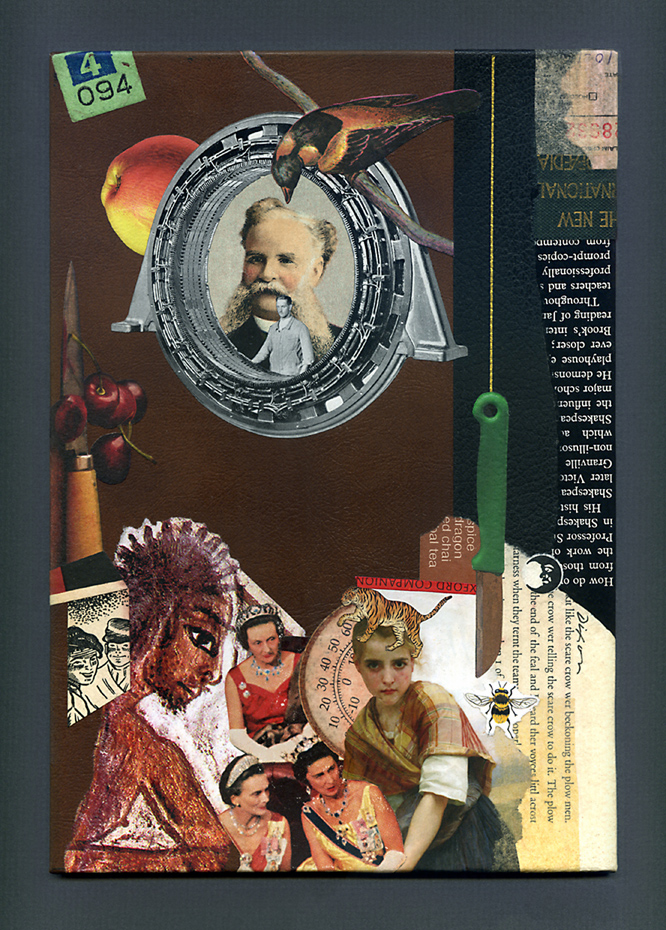
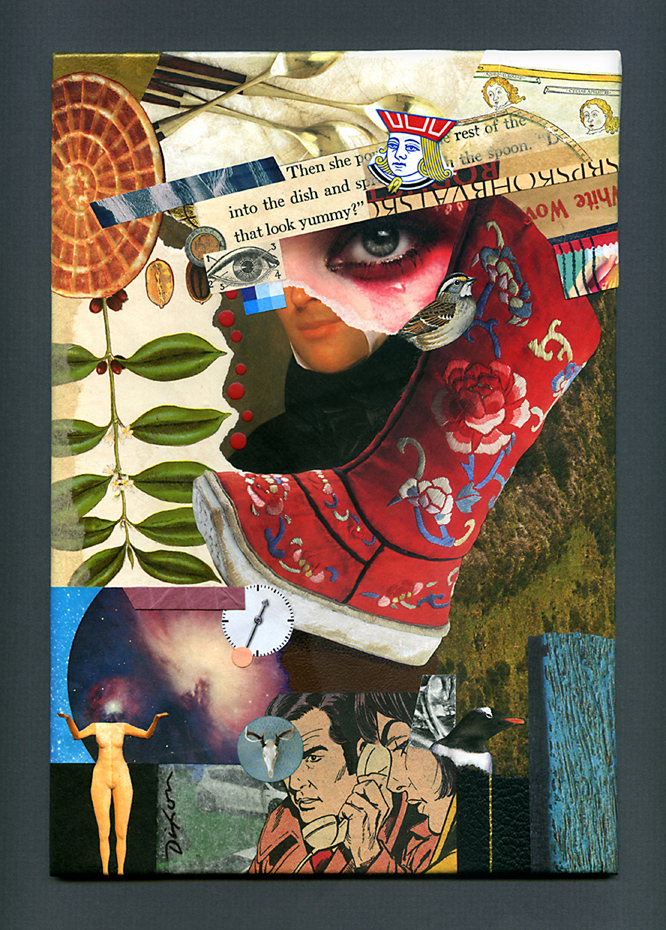
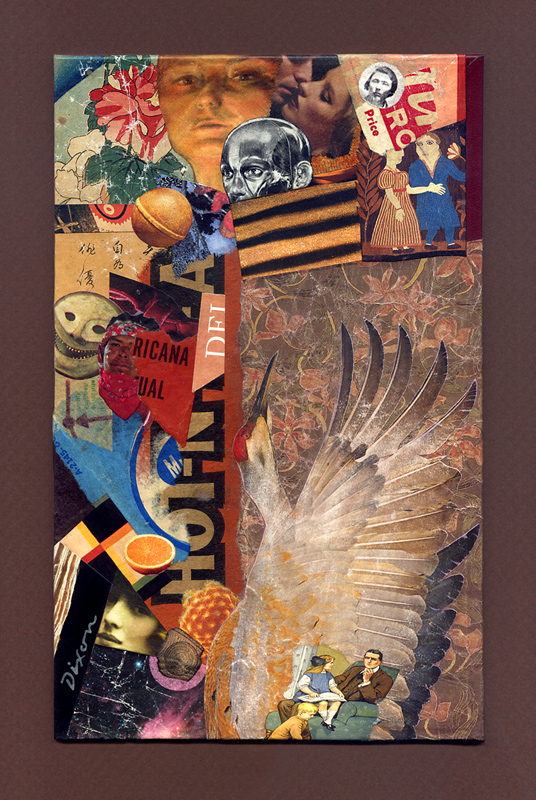
Obviously, collage is not made out of nothing, but the ingredient elements can be little more than rubbish — material of scant value, or literally with no intrinsic worth. Find the most rejected, undesirable, recycling-bin content, castoffs destined for a landfill, or something which never should have been thoughtlessly tossed out a truck window in the first place, and you have the potential for art. That idea excites me nearly as much as the ensuing process of reclaiming it for a new purpose.

Give Him Wine! ~ J A Dixon

Give Him Wine!
collage miniature by J A Dixon
6.5 x 9 inches
 
Purchase this artwork!
Collage and the Meaning of Existence

Sunday, January 31st, 2016

Sorry about that title. I am having a bit of fun with the search engines.

On a serious note, today’s entry is about how collage can be put to the service of more than irony, shock, whimsy, irreverence, or cynicism. Let me say first, if you please, that all those things can be valid, even pleasurable, effects. They are rooted deeply in the history of the medium. One could make the case that a collage artwork is never more than a step or two removed from the essence of dada, surrealism, or popism. On the other hand, for me, there are times when that creative genealogy is best put aside, in favor of a different tone.

Developing works with special meaning to those for which they were intended has always been some of the most fulfilling time I have spent as an artist. Collage has the potential to capture profound significance for a recipient, especially when it is personalized with meaningful artifacts and memorabilia. Also, there is an opportunity for the artist to thoughtfully select and integrate additional ingredient elements for greater depth and layered associations.

The project featured below began with a discussion about how all of us accumulate “stuff” that will never rise to the level of a family heirloom, but cannot be comfortably discarded because it has true meaning in the context of one’s journey in life. The patron took to heart my offer to embed many of these things in an artistic expression that would likely become a treasure for descendants instead of a burden of disposition. With the capacity to transcend the “scrapbook,” fine art collage is ideally suited for such an endeavor.

It was the client’s idea to approach the commission as a triptych, or three separate panels, that would convey the themes of body, mind, and spirit. I wanted the components to work as a total piece, but also for each to have a stand-alone quality. Whether they stay together or part company will be left to future circumstances and decisions. The resulting “legacy collage” is a distinctive creation that preserves images representing the life and guiding principles of a unique individual. It has been my honor to provide that creative service to her.
 

Body (for MJCB) ~ J A Dixon Mind (for MJCB) ~ J A Dixon Spirit (for MJCB) ~ J A Dixon

Body  ~  Mind  ~  Spirit
John Andrew Dixon
three legacy collage artworks on structured panels
16 x 24 inches each
private collection

Are there any rules for collage?

Sunday, January 24th, 2016

“Ever have one of those collages where every time you add something, it just makes it more difficult to finish?”
– T R Flowers

What Terry Flowers alludes to in his recent question to collage artists is certainly an ever-present concern for a minimalist, but even a maximalist can find it difficult to discover the proper conclusion for a collage. Some say that the medium of collage has no rules. I think of it more as the rules changing in front of us until a balanced resolution takes shape, and then, perhaps arbitrarily, victory can be declared.

Unit Citation ~ J A Dixon

Unit Citation
collage miniature by J A Dixon
7.5 x 9.375 inches
 
Purchase this artwork!
details from Pearallelograms

Sunday, January 17th, 2016

“The artist is a collector of things imaginary or real. He accumulates things with the same enthusiasm that a little boy stuffs his pockets. The scrap heap and the museum are embraced with equal curiosity.”
— Paul Rand
 

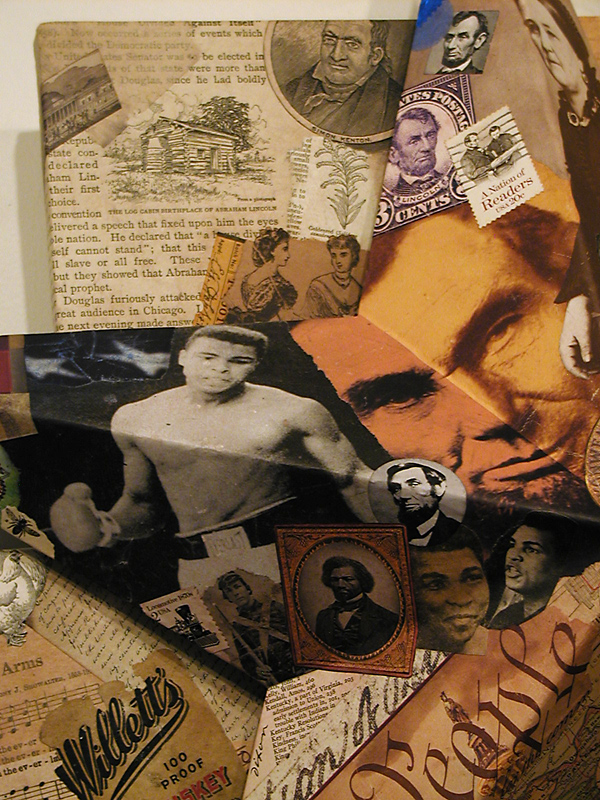
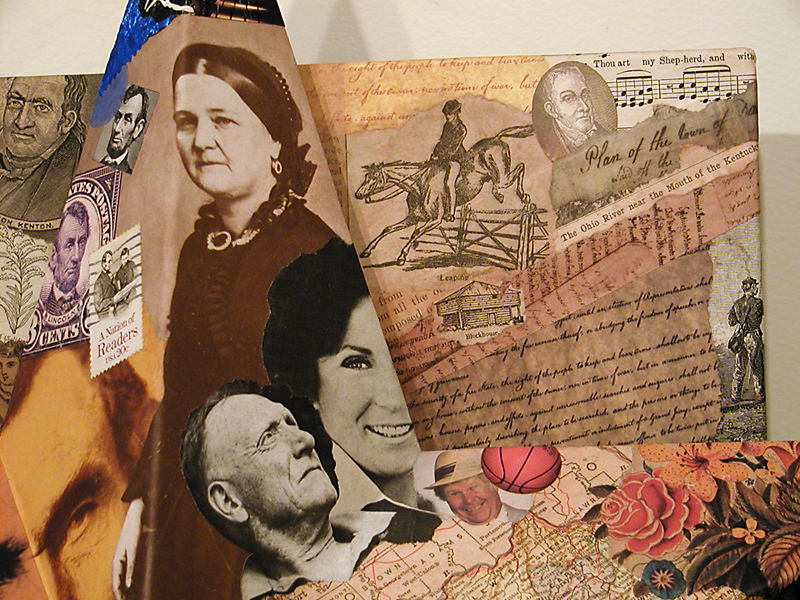
One of my first large-scale collage concepts was an artwork I called Pearallel Universe. When it was purchased by a regional health care system to hang in a new patient facility, I temporarily set aside the “visual pun.” After creating Pearental Discretion last year, I continued to accumulate images in anticipation of another takeoff on the pear theme. I also had been looking to break out of the conventional rectilinear format by exploring thumbnail concepts with polygonal shapes. When the parallelogram repeatedly occurred in my tiny sketches, the two ideas merged, unsurprisingly, as Pearallelograms.

This latest collage construction is another attempt to liberate collage from the typical “framed-behind-glass” approach, to recapture the medium’s painterly roots with an exposed surface that can stand on its own, and to introduce a more three-dimensional context that presents the end result as an “artifact.” I would hope that I had a bit of success at meeting these objectives. So far, the piece has been well received.

In what is becoming a ritual post-mortem for bigger collage artworks, I have repeatedly cropped the composition to explore and internalize aspects that may not have been apparent to me during creative formation. It is something I recommend to fortify intuition. To be honest, I would rather not be thinking consciously about the design dynamics in process, but I can only maintain that orientation by imposing a rational critique on my work after the fact. This sometimes leads to the closing refinement of an unfinished piece. More importantly, it also provides a stronger foundation for spontaneity in the future.
 

detail from Pearallelograms by John Andrew Dixon, Danville, Kentucky ~ internationally known as The Collage Miniaturist

My goal was to use many pears — as design elements,
for thematic rhythm, and as devices for a surreal touch.

detail from Pearallelograms by John Andrew Dixon, Danville, Kentucky ~ internationally known as The Collage Miniaturist

As elements, the chosen thematic objects should oscillate
between representation and abstraction.

detail from Pearallelograms by John Andrew Dixon, Danville, Kentucky ~ internationally known as The Collage Miniaturist

Diagonals with pears as “end points” were applied to
three negative areas that needed more spatial activation.

detail from Pearallelograms by John Andrew Dixon, Danville, Kentucky ~ internationally known as The Collage Miniaturist

The last pear image was positioned between profiles and
resonates with a more literal treatment at the very top.

detail from Pearallelograms by John Andrew Dixon, Danville, Kentucky ~ internationally known as The Collage Miniaturist

The final subject was “built” with an actual dried iris petal,
the torn image of a peacock feather, and a cut-paper stem.

Thanks for visiting! Forgive me if today’s entry is too verbose, because I generally try to avoid that. If, however, you don’t mind if I wax wordy, please register and comment here to let me know. I promise to reply.

Tender and Wild

Wednesday, December 23rd, 2015

“Art, in itself, is an attempt to bring order out of chaos.”
– Stephen Sondhiem

I was in the “Seasonal Zone,” listening to music and making a batch of hand-made greetings and collage miniatures. I began to recycle Christmas cards from previous years, and I had the idea of trying to visually merge two different but similar images. Nothing seemed to go right as my technique played out. One cannot anticipate nor contrive the “fortunate accidents” inherent in the medium. The resulting effect reminds me of an aging fresco, as if an artist had painted a Madonna and Child over another, with the decay of time and weather taking over. I rarely think too much about these things in process, with reflection arriving later. I especially enjoy when others make observations and symbolic associations of their own. Overall, I think my sweet obsession with collage may be about trying to bring some kind of harmony out of the sense of disorder that pervades much of modern perception, although I should hesitate to generalize about my personal state of being and apply it to the world.

a Christmas collage experiment by John Andrew Dixon

Tender and Wild
collage miniature by J A Dixon
7 x 9.5 inches
private collection

Ninety Naughty Gnats

Wednesday, October 21st, 2015

“A special thank you to Helen Reiss, who brought me this crazy manuscript and thought I might like to illustrate it. I had a better idea!”
– Allan Bealy
 

I am pleased to share an announcement from Allan Bealy that his newest publication is available— ABCurdities: A Collage Alphabet, and it is an honor to be part of an outstanding group that includes Allan, Matthew Rose, Ted Tollefson, Nikki Soppelsa, Zach Collins, Marc Deb, Frank Voigt, Musta Fior, Michael Tunk, and many other fine collage practitioners. Allan assigned 26 collage artists from around the world a letter of the alphabet and asked each of us to interpret a corresponding absurdist poem by Helen Reiss. The delightful result is now available for online purchase!

Helen’s wild verse for “N” offered a wealth of associations and challenged me to illustrate the perfect level of “visual naughtiness.” I also wanted to embed the letterform, but not in a way that would be too obvious. Do you see it? Some may not. I find it fascinating to observe how each of us used her poems as a catalyst for creativity, while investigating an individual approach to the medium — one more example of how collaboration can enhance the artistic process. A tip o’ the cap to the designer/compiler!
 

N ~ John Andrew Dixon ~ a collage contribution to ABCurdities: ~ compiled by Allan Bealy

N
collage miniature by J A Dixon
a contribution to ABCurdities: A Collage Alphabet
8 x 8 inches

Happy 33!

Friday, September 11th, 2015

Dana and I are observing 33 years of marriage, apart from each other. I have made an anniversary collage for her with the scraps of rubbish at hand. Is there not beauty and the potential for redemption in nearly everything, if you remember to look for it?
 

a hand-crafted 33rd anniversary card by John Andrew Dixon for his wife, Dana

Les Cheneaux Sails
collage miniature by J A Dixon
5 x 7 inches
collection of D L Dixon

A Kentucky Collaboration

Monday, August 24th, 2015

“I’ve collaborated with many artists over the years but never on a project of this size. The two pieces were to be 24″ x 24″ on structured panels. What made this collaboration successful was the interplay between the two artists. We both sent numerous pictures of our starts in progress and were able to play off the ideas and techniques the other was using, in this we created a true pair of collages instead of two separate pieces.”
— Robert Hugh Hunt
 

Collaboration between collage artists is a widespread, dynamic development within a medium that has shown extraordinary vitality after its centennial milestone in 2012. This very well may be part of a broader phenomenon, due in no small way to the explosion of social media and a greater networking among artists of all kinds. I was not surprised when, earlier this year, here in my home state, the Kentucky Artisan Center at Berea announced a major exhibition called It Takes Two: Collaborations by Kentucky Artisans.

In response to this opportunity, I decided to contact Robert Hugh Hunt, an artist from Richmond, Kentucky whose work I had come to respect after we made a connection through Facebook. Both of us were aware of our geographic proximity, but had not previously met in person, nor had we collaborated remotely on a casual project. Appreciating each other’s prior work is no guarantee that two artists will enjoy the collaborative process or value the creative end result. Only by risking a joint venture will both artists find out if they actually are “on the same wavelength.” I am pleased to report that the results of my teamwork with Robert exceeded our optimistic expectations, and that one of the two pieces we created was selected for the “Takes Two” show.

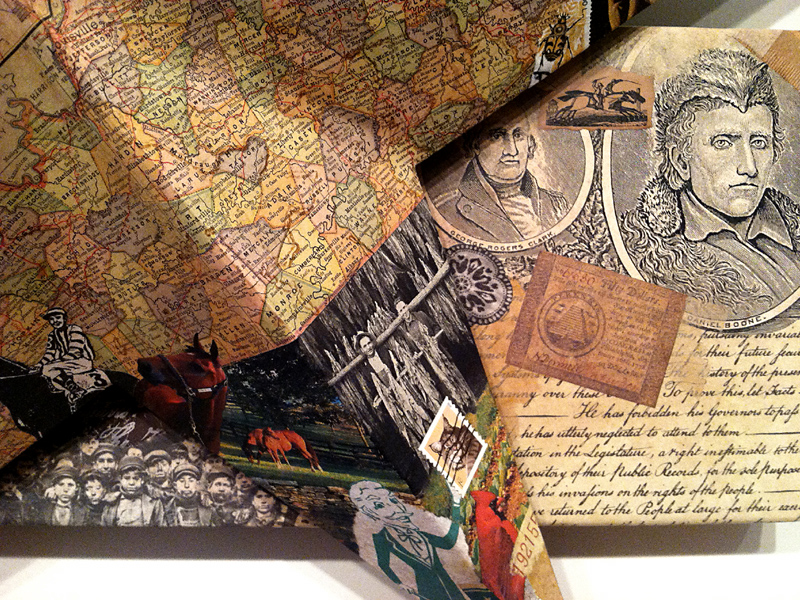
As artists, Robert and I both work regularly with combined mediums, but we chose collage as the foundation of our approach because we recognize how ideally suited it is for collaboration. There was no inclination to think small. We each fabricated larger dimensional panels and created a “start” for the other — to establish the background and organize the two-dimensional space with found material and other recycled/repurposed elements. collage collaboration ~ the start by Robert Hugh Hunt for Kentucky Sovereign ~ collage on structured panelAfter meeting for the first time (with spouses, over lunch at a delightful new Cuban eatery halfway between our studios), we exchanged the unfinished works to complete the compositions with additional ingredients and renderings. Robert’s recognized practice of layering his cut-and-paste collage artworks with mixed-media additions had already caught my attention, and his expressed aim to do the same within our collaboration inspired me to include a hand-rendered element as a focal point in my “finish,” which we titled Kentucky Sovereign. Robert’s finish, Kentucky Madonna, features multiple mixed-media treatments on top of my background shapes. The effect helps to integrate our respective techniques and to bond the artworks as a “true pair,” to use Robert’s phrase.

For my start, I began with a section of an Iraqi newspaper brought home by a member of the Kentucky National Guard. Robert made use of clippings from a 1940s-era newspaper that he got from fellow collage artist Ted Tollefson. collage collaboration ~ the start by John Andrew Dixon for Kentucky Madonna ~ collage on structured panelOur range of “merz-strokes” was unfettered, but we shared a desire to “Kentuckify” our choices, although neither of us knew exactly what we meant by that. Other ingredients include magazine scraps, printed papers, antique maps, used packaging, illustrations from discarded books, mesh bag material, tissue, fabric, plastic clasps, wood, gummed labels, metal, emptied tea-bags, produce stickers, foil, wallpaper, digital printouts, a paper doily, and more (with a modest assemblage aspect thrown in for good measure). As with any collaboration, the challenge is to discover a way to enhance the start in a complimentary manner and also to bring one’s personal approach to the finish. Our decision to avoid isolation was a good one. Images exchanged during development kept the creative energy in flux and maintained a visual cord (a common chord?) between the surfaces as they evolved separately. It was a positive experience for both of us and boosted our enthusiasm to continue as active collaborators.

Thanks, Robbo!
 

finish by John Andrew Dixon for Kentucky Sovereign ~ a collaboration with R H Hunt ~ collage on structured panel

Kentucky Sovereign
a collaboration by R H Hunt and J A Dixon
collage on structured panel, 24 x 24 inches
(start by Hunt, finish by Dixon)
selected for It Takes Two: Collaborations by Kentucky Artisans
available for purchase

finish by Robert Hugh Hunt for Kentucky Modonna ~ a collaboration with John Andrew Dixon ~ collage on structured panel

Kentucky Madonna
a collaboration by J A Dixon and R H Hunt
collage on structured panel, 24 x 24 inches
(start by Dixon, finish by Hunt)
available for purchase

Not So Big

Monday, August 3rd, 2015

“Shadow boxes become poetic theater or settings wherein are metamorphosed the elements of a childhood pastime.”
— Joseph Cornell
 

The creations of Joseph Cornell are small, and remained so throughout his unusual life as an artist, even as many of his contemporaries responded to the fashion of producing ever larger works. For me, a salute to this influential American seemed like the fitting approach when I decided to enter notBIG(3), an annual juried exhibition devoted to small art. I am pleased to have had a piece accepted to this show, which hangs from 8/11 to 9/11 at Lexington’s M S Rezny Studio/Gallery.

The “poetic theater” of little shadow boxes is not an isolated medium in collage/assemblage. To consider one’s activity in this comprehensive oeuvre as anything but an homage to Cornell would be an act of mild self-delusion. His singular, enduring presence overarching the genre must be acknowledged. There was a concern that my taking this approach with the notBIG(3) entry might appear to the juror as too derivative, but I pushed ahead with the “sincere flattery” of my plan. I had failed to crack this competition in its previous calls to artists, and I had hopes that the third time would be a charm for me. In addition, I wanted to assemble a range of ingredients outside my norm, including metal, wood, organic material, glass vials, and vinyl dimestore figures.

I created and entered two works as a pair — Histopia and Hertopia — a dual allusion to Utopia Parkway and its significance to the art history of the 20th century. It was not possible to enter both as a combined entry because the dimensions would have exceeded the size limitation of 12 x 12 inches. Only the first shadow box was selected. I was delighted to learn of my getting in the show, but it came with a small serving of disappointment, knowing that the gender balance of my overall idea would be lost with the “boy scene” presented to viewers by itself. It is something I can accept. Out of 380 works submitted, the 45 artists who make up the exhibition have a single artwork included. At any rate, this is what blogsites are for. Both pieces can be viewed together, and I have the opportunity to explain the whole thing to anyone kind enough to read this far. I also anticipate that many of you will be able to visit what appears to be shaping up as a strong exhibition. The opening reception is Friday evening, August 14th, 5 to 8 pm.
 

Histopia ~ collage/assemblage in shadow box frame by John Andrew Dixon

Histopia
collage/assemblage in shadow-box frame by J A Dixon
10 x 10 x 1.75 inches, available for purchase

Hertopia ~ collage/assemblage in shadow box frame by John Andrew Dixon

Hertopia
collage/assemblage in shadow-box frame by J A Dixon
10 x 10 x 1.75 inches, available for purchase

All Things Collage: Year Three

Monday, July 27th, 2015

Jamie Wyeth said, “You have to love a medium to work in it.” I have developed such an enthusiasm for collage that I also have been writing about it for three years at this blogsite. Miniatures are at the heart of what I enjoy doing most. The remarks accumulating here center on my recognition that what I can bring to the practice evolves from an ongoing investigation of the small format. When I do create larger pieces, I would hope that they are informed by my study of tiny, intimate visual relationships. Increasingly, I am embedding the miniature collage into these sized-up artworks, exploring the contrasts of scale and persuading the observer to step in very close — to interact with the ingredients at the artist’s viewing distance.

Over the coming year, I plan to profile other collage artists who exalt the small, and to highlight some of the “categories” of collage that recently have sparked my interest.

What’s in store?
• Merz-meisters: the dedicated aestheticians
• Endurance of the surreal face in collage
• The exemplars of erotic minimalism
• Die-hard collaborators gone wild
And, of course, much more . . .

When I used to put too much on my plate at meal time, my “Mombo” would say, “Your eyes are bigger than your stomach.” Perhaps there is an analogy to piling up my wish list for future entries, and I probably have made a few promises to readers that so far I have not kept. I shall do my best, and remind myself during year four that it’s not what one says about art that matters most.
 

Nancy Gene Armstrong
Who else recalls that nostalgia can be so surreal?

Laura Tringali Holmes
A diversity of approach — her singular sensibility.

Allan Bealy
This provocative soloist is a relentless collaborator.

Katrien De Blauwer
If you ever figure out how she does it, let me know.

Matthew Rose
He seriously does not take himself seriously. Seriously.

Selective Fusion

Monday, July 13th, 2015

“Schwitters subjected his bits of flotsam to an organizing principle resembling the vertical scaffolding of Analytic Cubism, thus transforming the diverse components into formal elements.”
— Nancy Spector

Color and composition may be the most common denominators of all visual art. Collage, by its nature, relies on a combination of separate, often disparate elements, and those two fundamentals generally play a more prominent role in the finished effect, but that does not make collage essentially a category of abstraction. A minimalist concept built on a provocative juxtaposition or image insertion can be a predominantly figurative or representational approach, even if symbolic or surreal ideas are introduced. On the other hand, collage artworks rooted in the seminal innovations of Kurt Schwitters pay primary tribute to a tradition of abstraction now more than a century old. Of course, the medium had other early pioneers, but it is difficult to imagine the trajectory that collage might have taken without his towering influence. Personally, I have no qualms about continuing to respectfully mine the rich vein of creative ore he helped to expose. Whether it proves to be a nonrenewable resource has yet to be shown.
 

Selective Fusion ~ John Andrew Dixon, collage artist

Selective Fusion
collage on structured panel by J A Dixon
13.375 x 11.75 inches
not for sale