Archive for the ‘Methodology’ Category
Wednesday, November 5th, 2014
“Curiosity about the unknown has no boundaries. Symbols, images, place and cultures merge. Time slips away. The stars, the cards, the mystic vigil may hold the answers. By shifting the point of view an inner spirit is released. Free to create.”
— Betye Saar
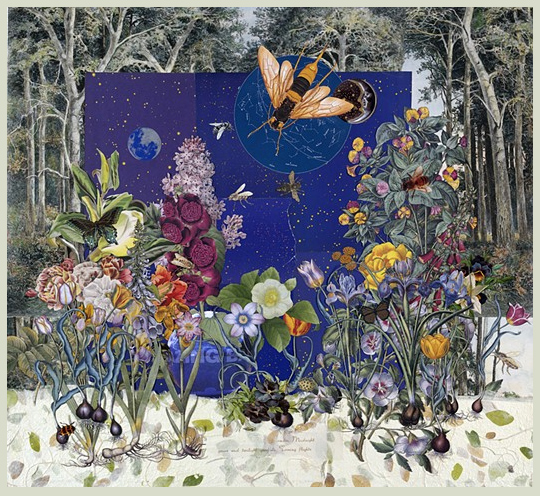
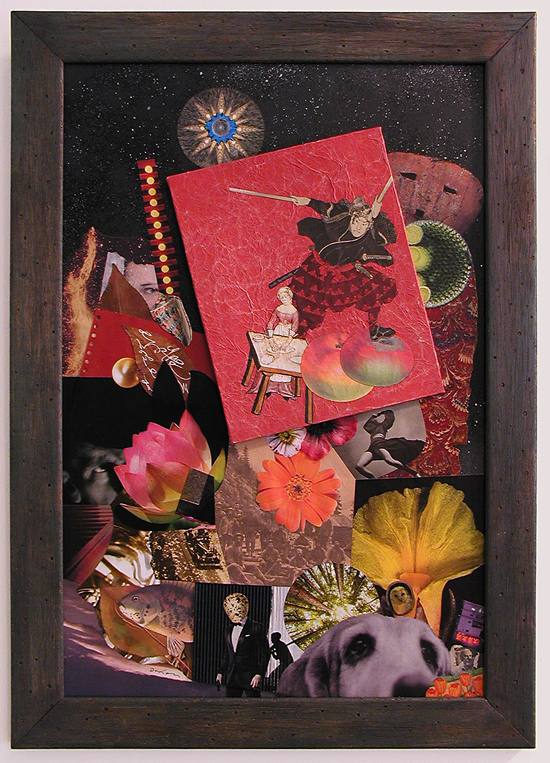
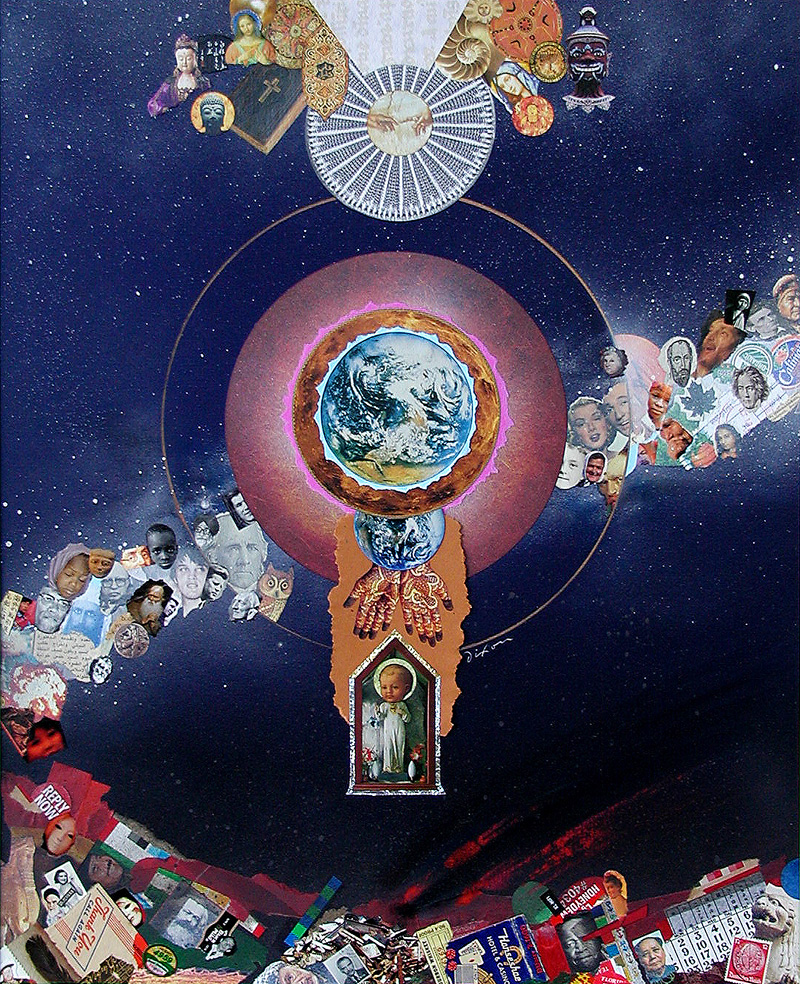
Cosmosaic was the word I chose in 1998 for a collage series that marked my first efforts at bringing to larger artworks what I had learned from creating numerous miniatures. They were intended as gifts for loved ones, with each focusing on the unique soul of the intended recipient. After completing fourteen of them over a seven-year span, I produced another in 2006 to exhibit with The Society of Layerists in Multi–Media. It relied on a more time-intensive technique than prior Cosmosaics, was more deliberate in conceptual development, was meant for no specific individual, and was more overtly metaphysical than any collage artwork I had done previously. As far as I was concerned, it was clearly a Cosmosaic, but it also stood apart from the series pattern and subsequently made the rounds of various exhibitions between periods of storage until we expanded our gallery space last year. Just as I had settled into the idea that this piece might always reside at my studio, it found a buyer this past weekend during the Open Studios ARTTOUR.
After looking through some old promotional notes, I was a bit surprised to discover the degree to which I had described the piece in spiritual terms:
“The largest composition in an eight-year series, this most recent ‘Cosmosaic’ represents my intensified concern with symmetry, proportion, and balance, both thematically and aesthetically. A spontaneous blending of found material — symbolic images, familiar icons, and mundane fragments — it shapes an interpretation of ‘the moving stream of life.’ The visual approach reinforces my sense of a profound interconnectedness, with eternal access to atonement, forgiveness, illumination, opportunity for soul attainment, and individual freedom through the Universal Christ.”

Fifteenth Cosmosaic
mixed-media collage by J A Dixon
17 x 21 inches
• S O L D
Posted in Collage, Combined Mediums, Cosmosaic Series, Exhibitions, Gift Art, J A Dixon, Larger Works, Links, Methodology, Symbolism, Technique, Theme/Variation | No Comments »
Sunday, October 5th, 2014
“As we mature, all of us learn to ‘put away childish things.’ Often, though, we do such a good job of growing up that we lose contact with our spontaneity, teaching ourselves to follow rules and habits that inhibit us from acting on our hunches and intuition.”
— W. Clement Stone
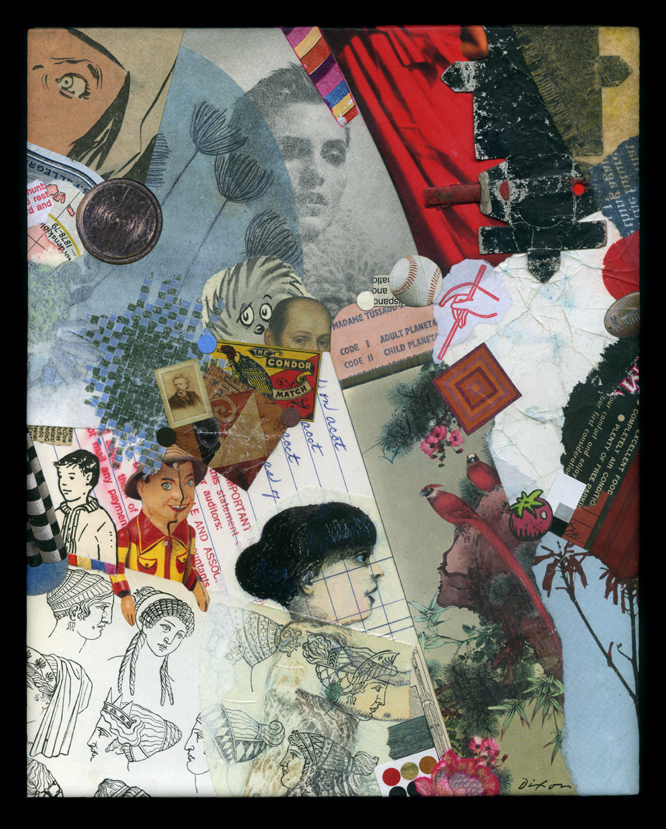
One of my earliest entries at this site made mention of the intuitive response in our process of collage creation. I have continued to ponder this idea of making visual decisions without conscious thought, especially after a lengthy discussion at the Collage Critique group in the facebook realm. There is something to be said for intuitive spontaneity with no preconceived notions, in contrast to the methodical execution of a concept. Collage as a medium is diverse enough to embody both approaches and everything in between. In my opinion, there is ample “non-thought thinking” taking place, even when no “idea” is driving the process. On the other hand, most of us can tell when a piece is struggling to be more than a mere stew of ingredients and the temptation to declare it “finished” should be resisted.
Personally, it is no longer possible for me to imagine coming to this activity without the foundation of art education, a rigorous training in graphic design, and 40 years of practice as a creative professional. I suspect that I have internalized all this to become part of an inner resource, so that when, at the conscious level, I put all of it out of mind, it still informs each spontaneous visual choice and the sense of something appearing “right” to the eye. Deciding that “an ingredient in play” has the right color, the right value, the right shape, the right texture, or the right spatial role often happens without rational awareness. That is my goal, at any rate, to keep such “non-thinking thought” in motion for as long as possible before I find myself falling back into outer rumination. It is not only a matter of aesthetics. The same phenomenon applies to thematic or symbolic associations, and the overall process of ingredient acquisition and selection that initiates and sustains the whole affair. Not that there is anything undesirable or distasteful about planning, calculation, and a deliberate methodology. Far from it. Nearly every work of art will involve some of that. It just happens to be that what I am most hoping to take place is something else — that the flow of assembly leading to a stimulating but balanced effect is the result of an artistic intention deeper than conscious decision making.

Arbitrary Mischief
collage on panel by J A Dixon
8 x 10 inches
Purchase this artwork!
Posted in 1) Available!, Collage, Graphic Design, Influences, Ingredients, J A Dixon, Methodology | No Comments »
Thursday, August 14th, 2014
“Individualism is rather like innocence; there must be something unconscious about it.”
— Louis Kronenberger
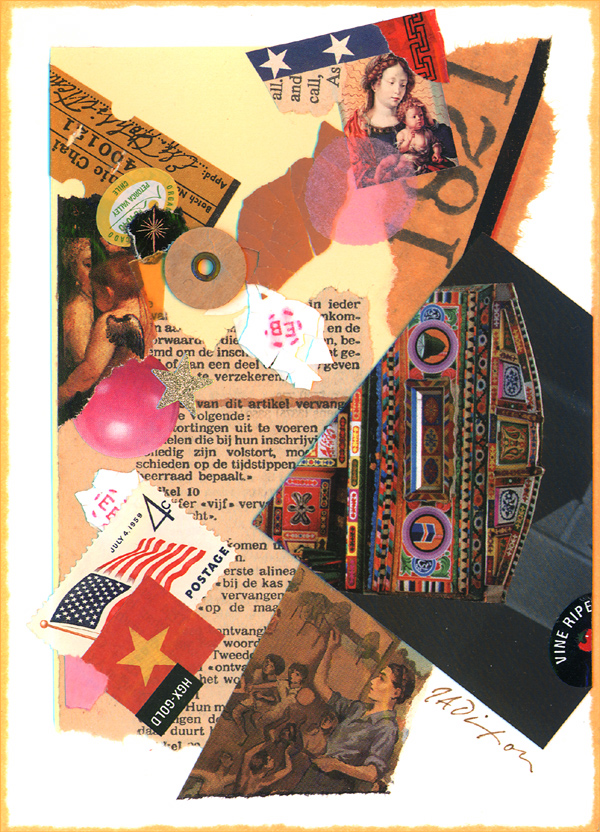
I often look back on the image of a personal miniature, long released into the intended realm of a friend, and I have no recollection of the process it underwent, but only a strong sense of the personality who inspired it. This is how it should be. I tend to be dubious of any artworks which retain too much of my methodology in their finished state. Calculation and contrivance are somehow out of place in a collage, but, of course, there are glorious exceptions to every rule. This also is how it should be.

Untitled (for Irina)
collage miniature by J A Dixon
estate of Irina Ilina
Posted in Collage, Haus of Cards, J A Dixon, Methodology | No Comments »
Thursday, July 31st, 2014
“When we remember we are all mad, the mysteries disappear and life stands explained.”
— Mark Twain
“Take what you can,
All you can carry.
Take what you can,
And leave your thoughts behind.”
— Tom Petty
“If everything you do must be measured against the good opinion of everyone else, what happens to your good opinion of yourself?”
— Wayne W Dyer
Hmmm . . . just realized that my line-up of quotations above might seem odd to some of you. At any rate, they capture a bit of what is on my mind, as I begin to reflect on a couple years of remarks about collage at this blogsite.
Like many others, I spend prayerful time caring for a parent with progressive dementia. The other day I was trying to explain to my mother, in terms she could appreciate, my burning desire to make collage artwork, and, touching on her prevailing sense of confusion, talked about my creative activity as a way to bring some kind of harmony out of the chaotic stream of disorder that dominates so much of current stimuli in our daily lives. It brought to my awareness the motivation at the center of what I love to do, but also fell short of the clarity for which I was reaching. Over the next year, I hope to find better words which get to the heart of that idea — how I take what I can carry into a process that leaves thinking behind, a kind of sweet madness that offers explanations difficult for me to achieve any other way. Of course, this is not the only approach to the medium. I hope to profile more collage artists who use a different methodology than my own — the extraordinary minimalists, the dedicated aestheticians, and those who continue to harness a kind of thoughtful irrationality that keeps me in awe.
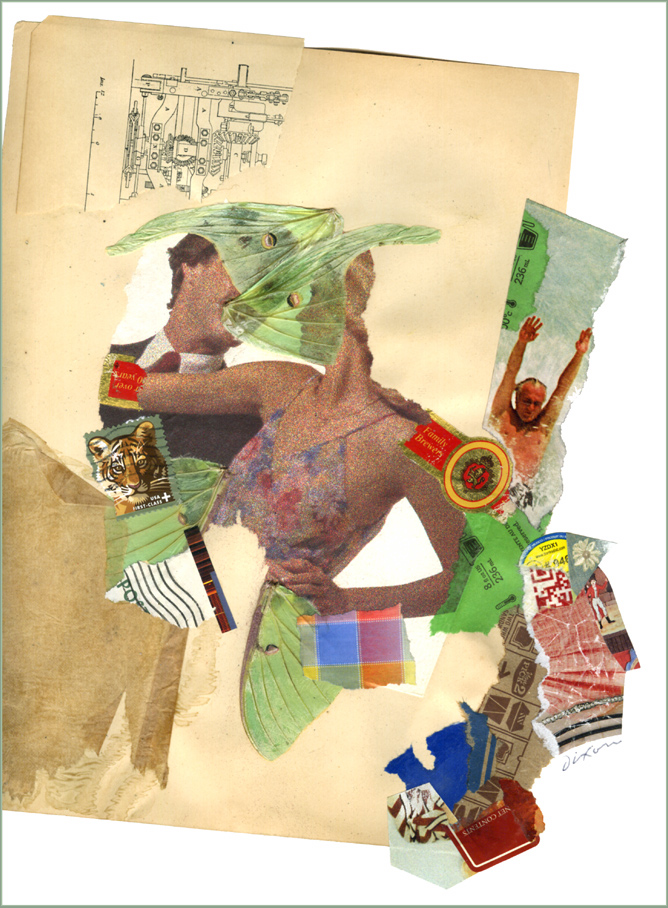
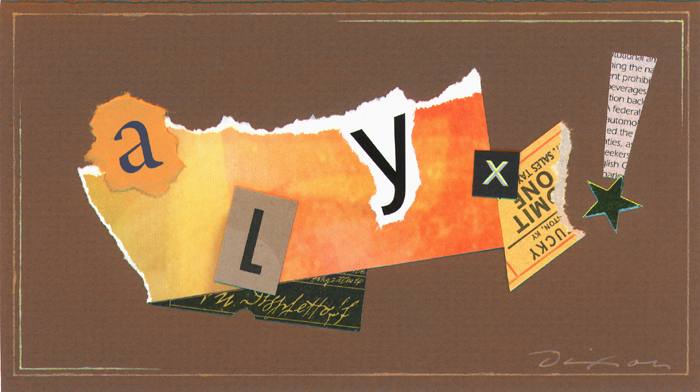
I just looked over my previous comments after a full year of blogging, and, as a result, I feel the need to temper my ambitions going into year three, but that is not my nature. There are too many interesting things to explore in the dynamic world of contemporary collage. One of them is the continued explosion of collaboration. Another is the influence of social networks. Nearly every day I see an artist defeat the purpose of the platform with overexposure, failing to keep the age-old quality-vs-quantity issue in balance. One of my goals for the coming year is to take a closer look at how the ease of internet sharing affects the challenge of striking an equilibrium between the imperative to follow one’s passion without regard for opinion and the practical aspects of seeking recognition and approval from others. As most of you already know, it is not an easy task to walk that tightrope.
And one more thing, dear visitor. Please let me know what I can do to make this site more interactive as a unique forum for discussion. Meanwhile, you can count on me to observe, write, and make more art. Stop back again!

Untitled (flutter)
collage experiment by J A Dixon
9 x 11 inches
not for sale
Posted in Blog Years, Collaboration, Collage, Experiments, Journal, M Twain, Methodology, Priorities, V E Dixon | No Comments »
Wednesday, July 23rd, 2014
“Somebody said once or wrote once: ‘We’re all of us children in a vast kindergarten trying to spell God’s name with the wrong alphabet blocks!’”
― Tennessee Williams, Suddenly Last Summer
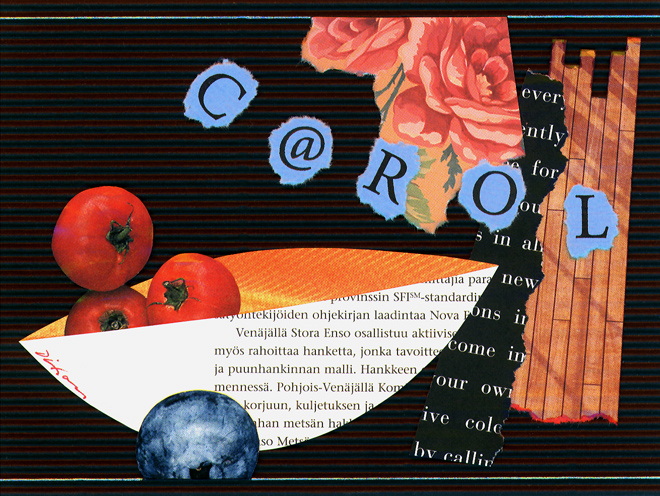
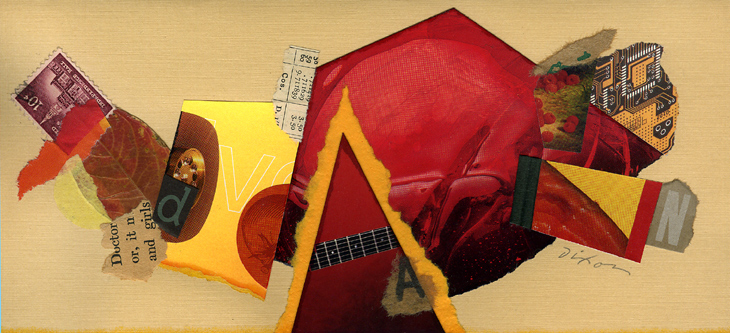
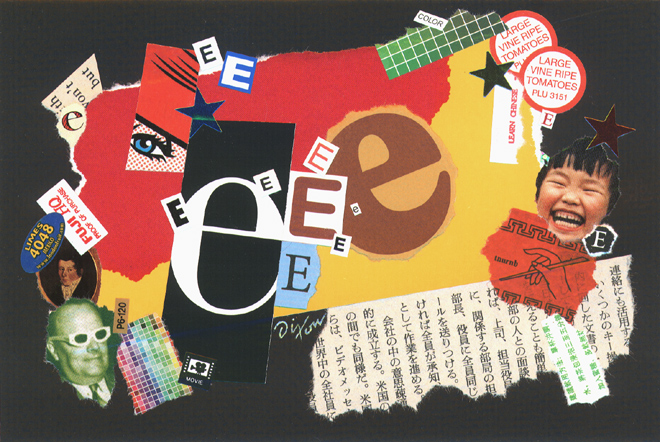
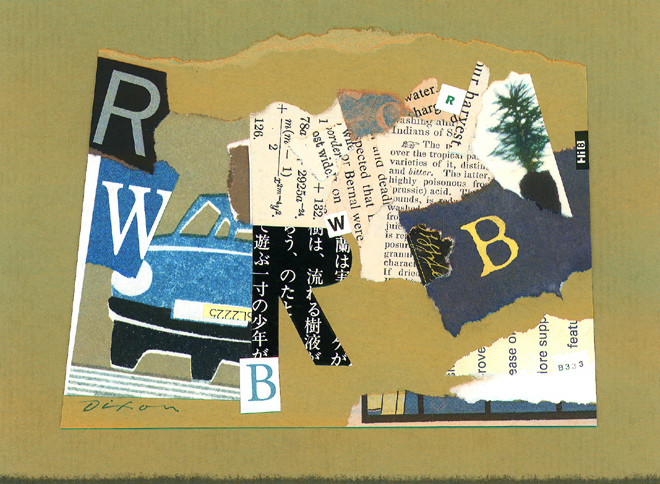
As is true with many graphic artists, I have been fascinated by letterforms since childhood. The first time I rendered the word “ICE” with frozen encrustations, it felt like a rite of passage for me. One of the reasons I shunned store-bought greeting cards in favor of my hand-crafted versions was to indulge a love affair with custom lettering. As collage miniatures began to dominate the character of my card making, the alphabet remained a key part of the visual vocabulary. As my enthusiasm for the medium of collage continued to expand, symbolic language became a re-occurring, vital ingredient in nearly all my artistic compositions.

collage miniature by J A Dixon
collection of A D Kenner

collage miniature by J A Dixon
collection of C Dixon

collage miniature by J A Dixon
collection of D R Dixon

collage miniature by J A Dixon
collection of E Debarone

collage miniature by J A Dixon
collection of R W Breidenbach
Posted in Collage, Haus of Cards, Ingredients, J A Dixon, Methodology, Symbolism | 2 Comments »
Friday, June 20th, 2014
“Art is the only way to run away without leaving home.”
— Twyla Tharp
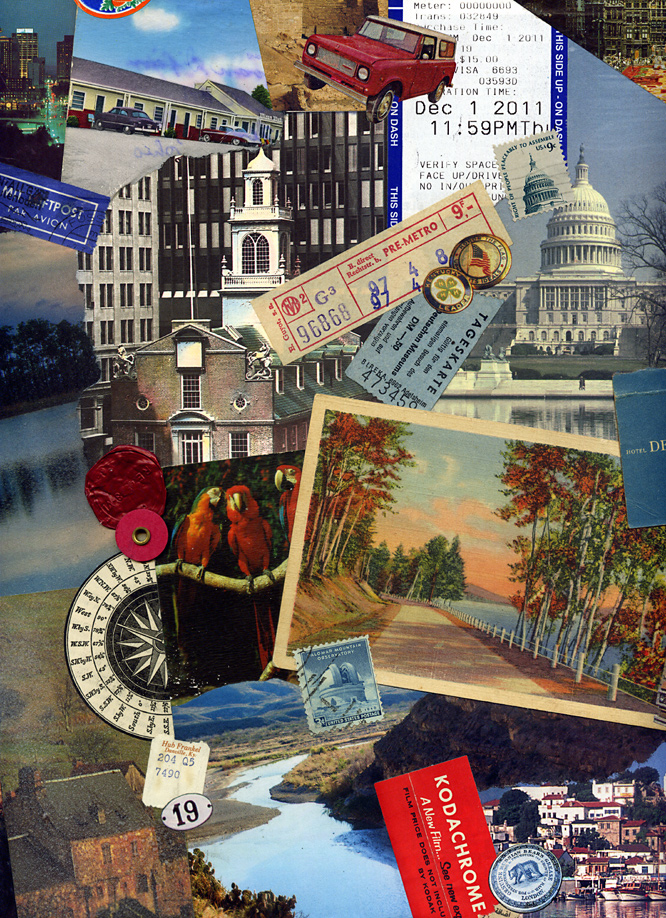
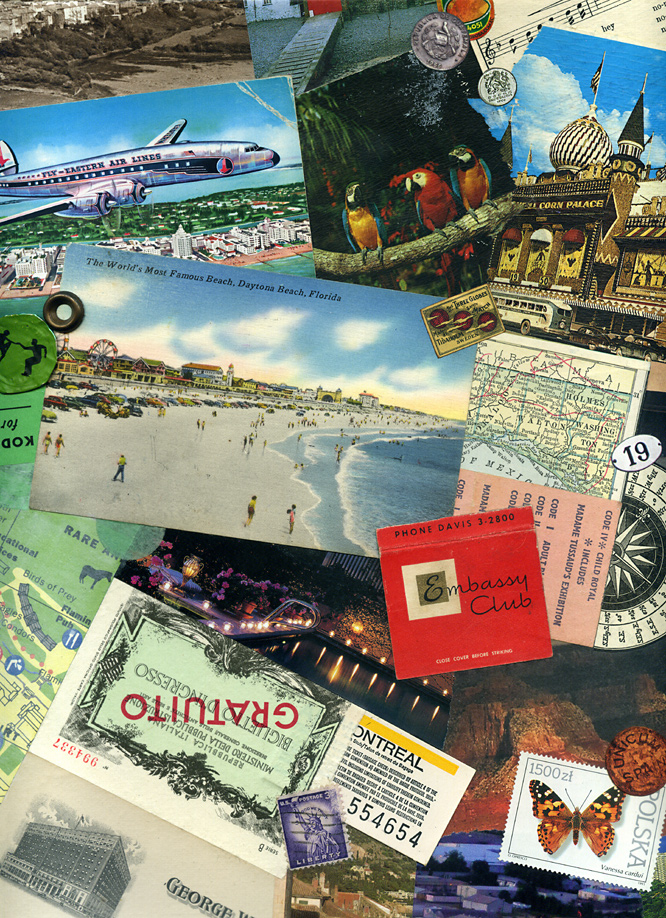
Places to go, ways to travel, and flights of fancy . . . A series of local exhibitions at the Boyle County Public Library’s Mahan Gallery has been an effective catalyst for me to create new pieces based on unifying themes. I have recently experienced mixed emotions about the ubiquity of vintage material in contemporary collage, but the topic of this show had me hunting through my morgue of old postcards and other relics to produce a pair of artworks on canvas. Yes, we all dig the instant “gravitas” of using old stuff, but will art historians say we copped out, if we do not accept the challenge of working with ingredients from our own present-day culture? I am just musing about the state of the medium, not any artist in particular. I see a hundred or more collage artworks posted online each week that rely exclusively on 20th-century material, and much of it seems stuck in a bygone avant-garde style. It is important for all of us to keep in mind that the Dada artists so widely emulated worked with material from their own time. Perhaps the opportune approach is to blend it all together, past and present. As post-centennial collage artists, we also owe each other a bit more constructive criticism than I currently observe. As the details below illustrate, I have absolutely nothing against using vintage material. I think that artists such as Hope Kroll or Fred Free or Matthew Rose (to offer only three examples) are creating some of the more exceptional work in the medium. On the other hand, there are many who seem to be using it as a crutch, over-relying on the antique impression of the ingredient material itself, rather than the juxtapositional synergy or overall aesthetic effect.
As the artworks for “Places” also demonstrate, I continue my effort to liberate a collage from the traditional glass barrier. To do so, it is necessary to find a proper level of protective sealant to balance visual appeal and durability. I prefer to avoid an overly polymerized impression with a finished surface. Because I primarily work with found material, I have had to learn which ingredients can handle direct exposure (for an effect similar to the painted surface). Nevertheless, some are simply too fragile and will always require a safe abode under glass.

left: Here and There (detail)
right: Now and Then (detail)
two collage artworks on canvas by J A Dixon
12 x 12 x 1.5 inches each
available for purchase
Posted in 1) Available!, Acrylic, Collage, Criticism, Dada, Details, Exhibitions, F Free, H Kroll, Ingredients, J A Dixon, Larger Works, Links, M Rose, Methodology, Morgue, T Tharp, Technique | No Comments »
Monday, June 9th, 2014
“We need a little confusion.”
— Neil Gaiman
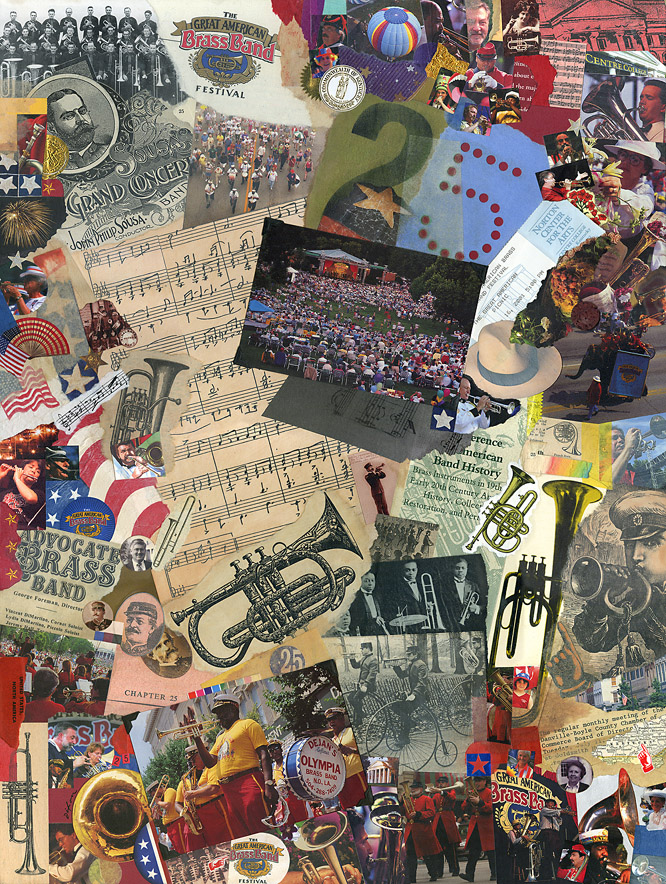
The Great American Brass Band Festival’s milestone 25th event is now in the archives. The finale was one of the most satisfying concerts in the history of the Kentucky festival. My appreciation goes to those who made it all happen one more time! I am pleased to have played a small part.
When I was first approached about lending my creative experience to the effort, I pitched the idea of a traditional collage to mark the 25th, using scraps from memorabilia of the last quarter century. A decision was made to go a different direction, but I could not put the idea aside. The result is “Brass 25,” a tribute to my community’s exceptional contribution to the American musical and cultural scene.
Is “commemorative collage” art? Perhaps not. Some might make the case that no example of the medium has approached “high art.” In my opinion, such a viewpoint fails to consider the 100-year impact that the medium has had on our visual landscape and the evolution of our aesthetic perceptions. It neglects the seminal role of Schwitters, Höch, Cornell, Kolář, and others. For me, the core relationship between mundane material and the art of collage transmits a unifying principle. When the remnants of ordinary life are physically re-purposed to resolve a unique compositional harmony, the culminating artifact can achieve a transcendent tone and offer a shared experience with each participating observer. If that is not art, stripped of elitist notions, then what is?

Brass 25
commemorative collage by J A Dixon
17.5 x 23.5 inches
available for purchase
Posted in 1) Available!, Applied Arts, Collage, H Höch, Illustration, Influences, J A Dixon, J Cornell, J Kolář, K Schwitters, Larger Works, Methodology | No Comments »
Saturday, May 10th, 2014
“What the Color Field painters shared most importantly with the Abstract Expressionists was the conviction that the role of art was not to report on the visible, but to reveal the unknown. They shared too, the belief that paintings that resembled nothing preexisting could have the presence, authority and associative richness of other real things in the world.”
— Karen Wilkin
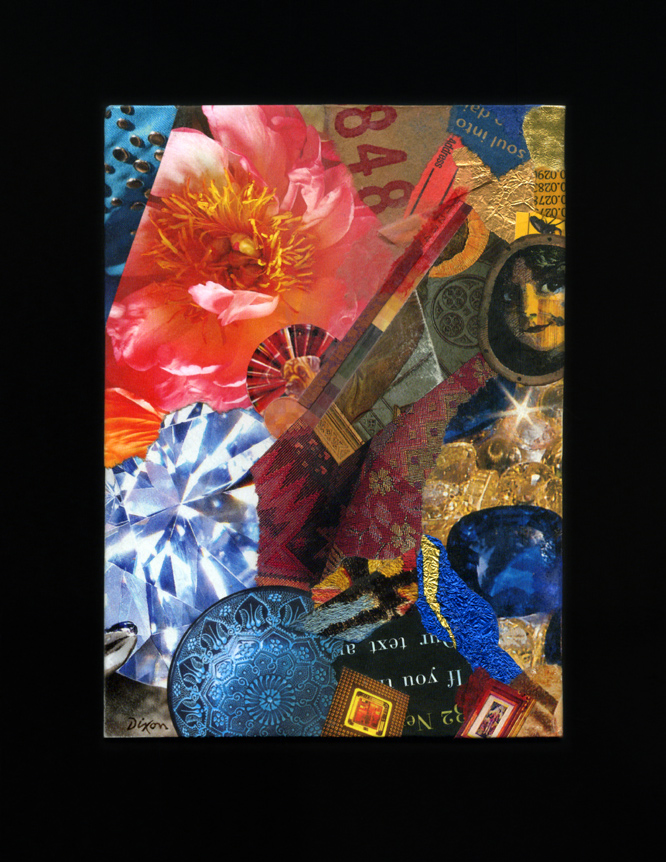
I began my Bibelot Series by recalling to mind the lost treasures of George Headley. With this 13th miniature, I am wondering if the meditation may have reached its culmination. The primary reason centers on the changes that occurred with my process while creating this most recent composition. Because I find myself thinking less about the precious fabrications that provided the initial inspiration and more about the aesthetic qualities of the artifact manifesting before me, the connection to the Headley works have diminished enough for me to consider whether or not the transition to a new investigation is taking place. The color and abstract relationships inherent in an evolving collage surface seem to exist for their own sake, rather than as an homage to other artistic ideas, and point to a deeper reality. What comes next? As a student of American History, the number 13 has never felt unlucky to me. We shall see what follows.

Spy (Bibelot 848)
collage miniature by J A Dixon
4 x 5.5 inches
Purchase this artwork!
Posted in 1) Available!, Abstract Expressionism, Bibelot Series, Color Field, Influences, J A Dixon, Methodology, Theme/Variation | No Comments »
Monday, March 17th, 2014
“If you want to get better at something, you have to do the reps. Dreams work the same way. You don’t get to pick and choose a life of home-run moments. You get to swing the bat, a lot. Some of them are going to connect; some of them won’t. But each one takes you one step closer to awesome.”
— Jon Acuff
I have crossed the halfway point in my March Exercise. Yesterday, I went to the plate one more time and met the ongoing challenge of creating a harmonious balance of counterpoise in a collage. For me, it is one of the most important factors that determine whether or not a composition is merely an active “stew” of ingredients. As I added another miniature to my Bibelot Series, I completed the exercise of using journal experiments to concentrate on a particular set of design principles — the visual support for any ideas at play in the artwork. Perhaps I should have made this parameter more clear at the beginning of the month, and explained the history of the annual regimen. One comment maker on Facebook asked me if I have been creating daily college entries for nine years. Any earlier concern I had about the potential for misinterpretation proved valid. A blogsite should not cause confusion for those kind enough to pay a visit. On the other hand, more and more people ask questions before spending enough time to comprehend a fuller picture of things. Nevertheless, I am always willing to interact with my guests and answer any inquiries. I have a great passion for working in this medium, but this online destination is meant for the observer (and remember: I have a thick skin, too!).

In Pomp Arrayed
collage miniature by J A Dixon
4 x 5.75 inches
on consignment
Purchase this artwork!
Posted in 1) Available!, Experiments, Ingredients, J A Dixon, Journal, March Exercise, Methodology | No Comments »
Monday, January 20th, 2014
“Starting a New Year is always an invitation to dream.”
— Wayne W Dyer
“Healthy striving is self-focused: ‘How can I improve?’ Perfectionism is other-focused: ‘What will they think?’”
— Brené Brown
Two-faced Janus scans both backward and forward, but, during the month that salutes his mythical duality, there is a third sight that also peers within. I have written about resolutions before. My essential take on the practice has not changed. This year, rather than focus on a checklist of objectives, I take personal aim at a phenomenon that plagues artists all along the spectrum of natural ability — perfectionism — a condition that tends to confound those who observe the creative class, as well as the people who wrestle with the disfunction. One of the most interesting scientists who writes about the subject is Brené Brown, PhD. She provides the clearest and most helpful understanding that I have discovered so far.
As dismissive as it may seem, it has been necessary for me to learn that I cannot care too much about what others think of me or think of what I create. For decades I have worn the hat of the designer or illustrator, which has sharpened my sensitivity to the perceptions and presumptions of others. Collage, for me, is the ideal antidote for perfectionism. For those of us who contend with the idea that something (anything! or everything!) must approach perfection, the notion of a “perfect collage” is absurd enough to defuse the fixation. There is no rule-book. There are no mistakes. There are no towering expectations. There is nothing upon which to heap all one’s perfectionist propensities. There is only the lure of investigation and the pleasure of discovery.

Gratuito
collage miniature by J A Dixon
5.375 x 5.25 inches
• S O L D
Posted in Collage, J A Dixon, Methodology | No Comments »
Wednesday, November 27th, 2013
“. . . the completion of a work is only ever an abandonment, a halt that can always be regarded as fortuitous in an evolution that might have been continued.”
— Paul Valéry
Whether one thinks of the anonymous medieval monk embellishing a pre-existing manuscript, of Leonardo da Vinci working on the surface of his older painting, or of George Lucas making alterations to the original Star Wars trilogy,
there is a long and sometimes controversial history of “refining” creative works already accepted as finished. I remember reading about Asian masters who thought nothing of making additions to artworks created in earlier eras. Apparently some art historians believe that halos were added to religious masterpieces much later. Duchamp did not draw those whiskers on the actual Mona Lisa, but he might have, had he been able to get away with it. What has all this to do with collage? Perhaps our entire genre came into being with the essential hunch that worthwhile art could result from revising something in contrast to its original purpose or frame of reference.
There is a wide spectrum to consider, if the subject under discussion is “altered art.” We might be talking about anchoring the concept for a collage on a singular appropriated image or transforming a mundane object into a new work of art. (L T Holmes recently shared a multi-part, personal tour of her Don’t Get Jittery On Me.) Or we might be referring to the simple idea of returning to a work already deemed complete and “writing a final chapter” to improve it. Think long enough about this topic and you may ask yourself whether any artwork is ever really done. Going back to Leonardo and Lucas for a moment, both turn up from time to time in attributions that suggest they also may have altered a version of the Valéry quotation more pithy than the poet most likely ever expressed.
“A poem is never finished, only abandoned.” — Paul Valéry
“Art is never finished, only abandoned.” — Leonardo da Vinci
“A movie is never finished, only abandoned.” — George Lucas
Forgive me if all of this undue rambling merely serves as an opportunity to highlight two “finished” collage artworks that I recently chose to revisit. Both examples also illustrate the complications of visually comparing two images created with different digital devices. After writing about a corresponding issue last week, I have since discovered S Caswell-Pearce’s related words from an April entry at paper with a past. My images for Rhapsody with Fever Chills demonstrate the same scanner/camera differential, although the scan of the new version is a better rendition of the artwork’s strong complementary effects. (This piece is currently on display with the “Seeing Red” exhibit in the McKinney Conference Center at Kentucky’s Constitution Square Historic Site.) The digital documentation of a revised Broken Qualifications, having shared the original version previously at this site, became a bit more challenging the second time around, given the addition of three-dimensional ingredients. At any rate, neither piece had ever felt fully resolved, although I had no specific plans to “reopen the case” until I made a broader reassessment of my inventory. Did I enhance them, ruin them, or just squander my time? You be the judge.


Rhapsody with Fever Chills
collage on paper by J A Dixon
7.5 x 10 inches, available for purchase


Broken Qualifications
collage/assemblage by J A Dixon
6 x 8 inches, available for purchase
Posted in 1) Available!, Assemblage, Collage, Exhibitions, G Lucas, Ingredients, J A Dixon, L da Vinci, L T Holmes, Links, M Duchamp, Methodology, S Caswell-Pearce | No Comments »