Archive for the ‘Methodology’ Category

Disinclination be damned

Friday, May 31st, 2013

“We must always work, and a self-respecting artist must not fold his hands on the pretext that he is not in the mood. If we wait for the mood, without endeavoring to meet it half-way, we easily become indolent and apathetic. We must be patient, and believe that inspiration will come to those who can master their disinclination.”
— Pyotr Ilyich Tchaikovsky

Like most collage artists, I usually don’t know immediately if what I’m producing “works.” Nevertheless, one has to buy into one’s process and trust that fruit is born through “stick-to-itiveness.” With diligence and a bit of perspective, it’s always possible to sort out the promising threads of creative direction. When they come into focus, keep moving. When they don’t, keep moving anyway.
 

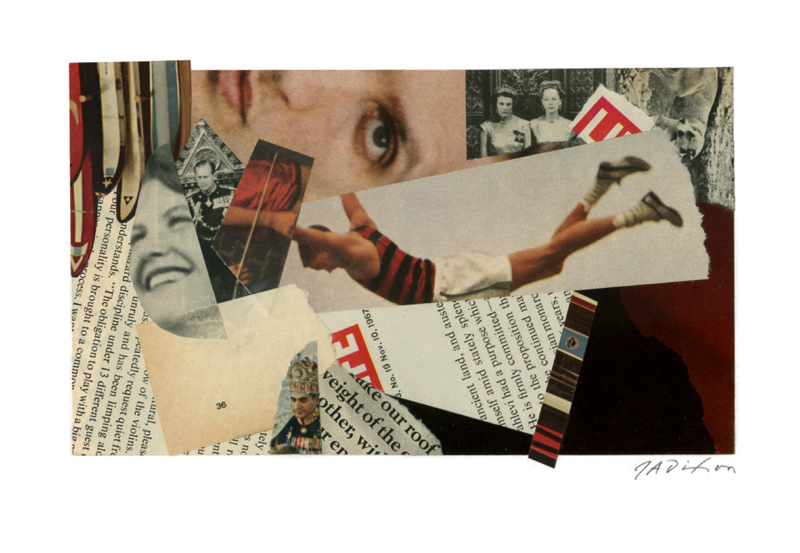
Partners in Crime
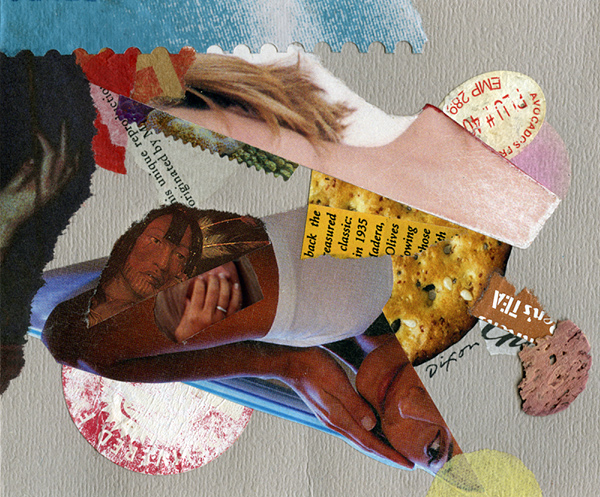
collage miniature by J A Dixon
4.5 x 6.25 inches
 
Purchase this artwork!

Mystery Solved ~ details

Sunday, May 19th, 2013

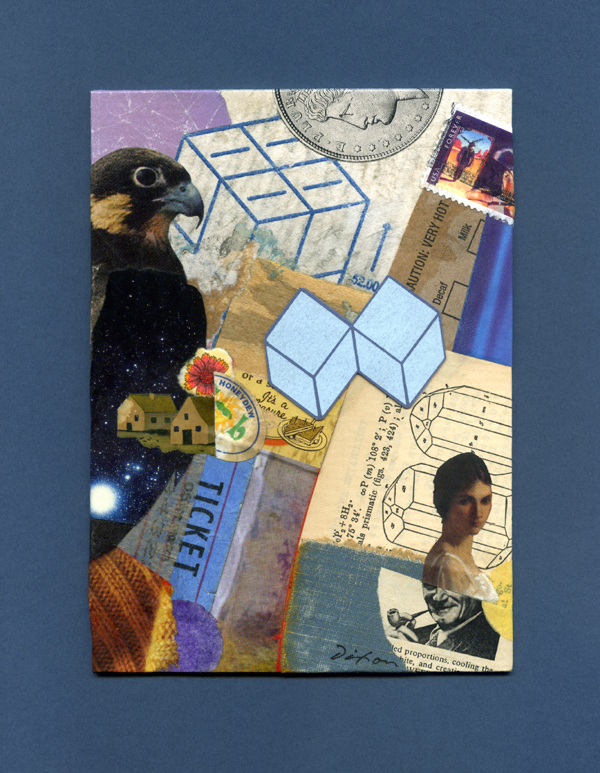
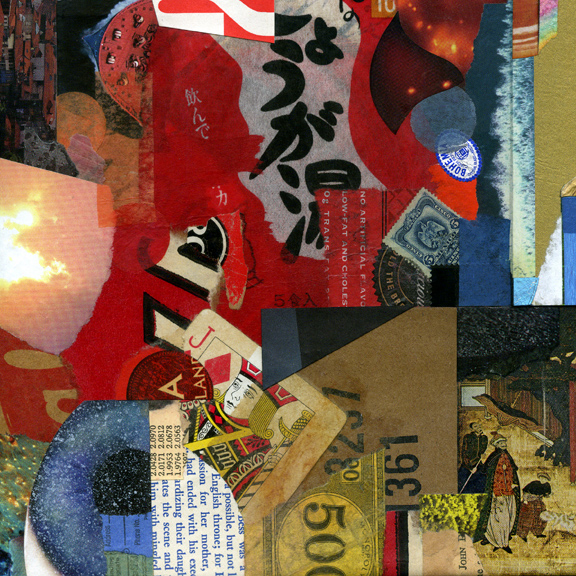
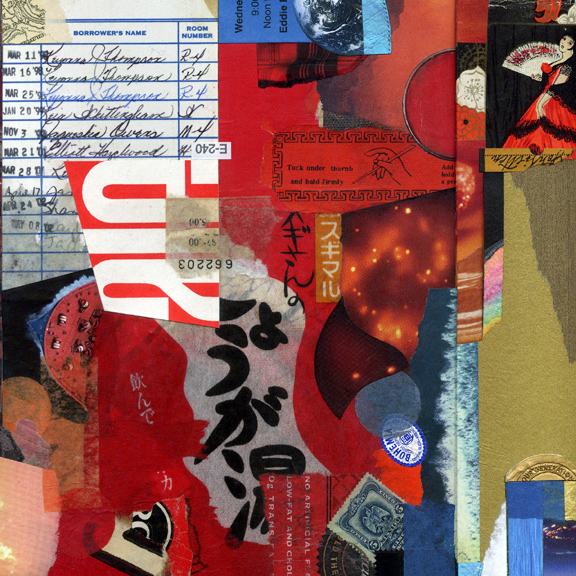
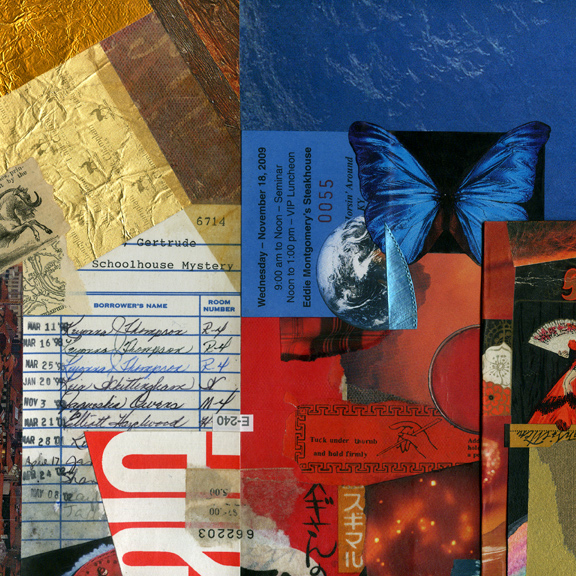
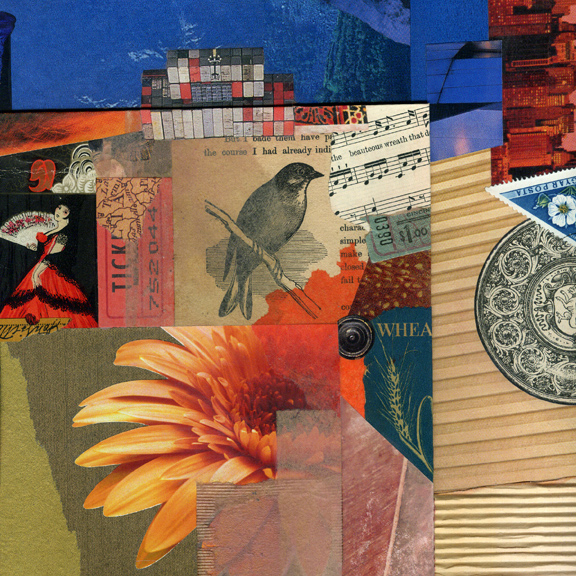
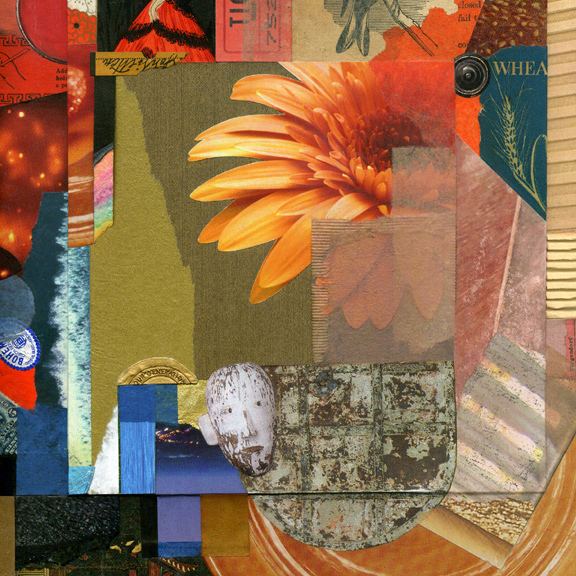
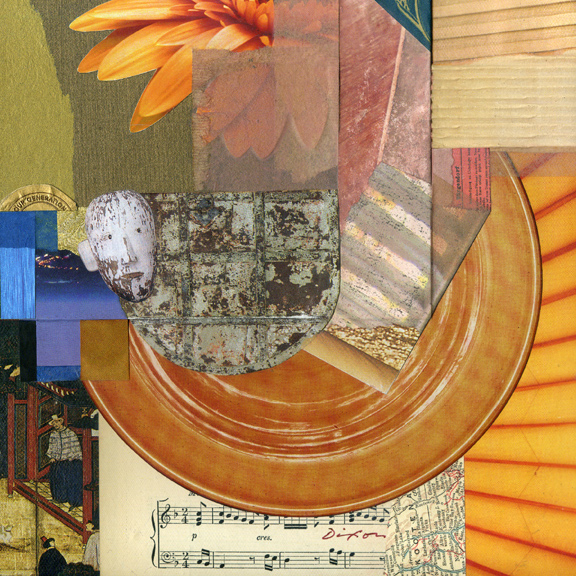
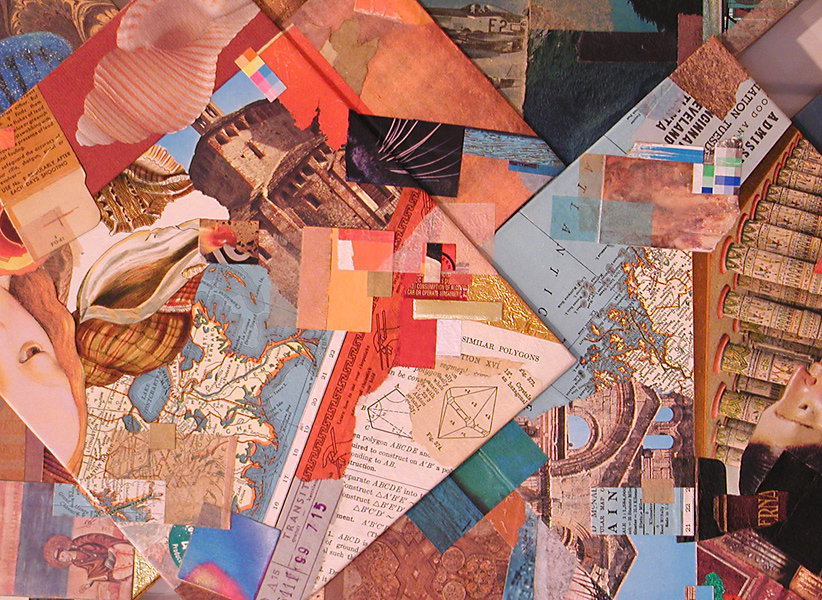
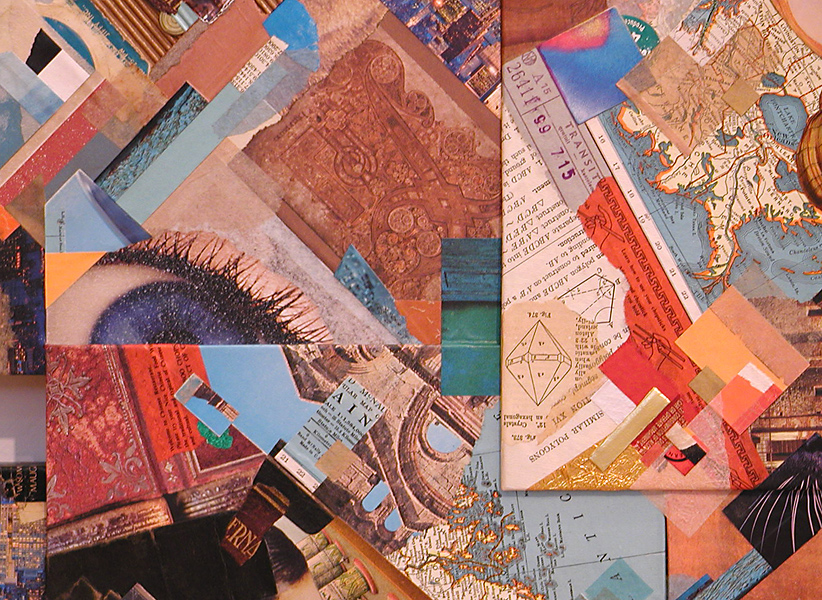
For the full viewing experience, one can never get too close to a collage, but this opinion from a person so enamored with the miniature probably comes as no surprise. When I create a larger piece, lessons learned from the small format have a strong bearing on my approach. As a concluding exercise to hone compositional awareness, it is beneficial to discover croppings that can stand successfully on their own. Before Mystery Solved left the studio, it was interesting to visually isolate six square miniatures, just to see if they might capture in microcosm the essence of the parent design.
 

A ‘Jack of Diamonds’ was too visually outstanding
at first and had to be massaged into balance.

I enjoy creating a montage of linguistic symbols,
but “a-l-e” was accidental (or perhaps subliminal;
one never really knows with collage).

Integration through color: photo of butterfly
specimen + ticket stub + magazine scrap.

Juxtaposition: illustration from an exotic soap
wrapper + book engraving + photo of flower.

The interesting effect of a raised panel: the
illusion of depth versus actual dimensionality.

From diverse sources: combining ingredients
that seem to have always belonged together.

Thanks again for looking. Please share your thoughts, suggestions, or constructive criticism (frankly, our medium of collage always needs a healthy dose of it).

Realms of Wonder ~ art by Kathleen O’Brien

Tuesday, April 16th, 2013

The primary reason that I look forward with great anticipation to this Friday’s LexArts Hop is because Kathleen O’Brien has a new solo exhibition. The opening reception for Realms of Wonder at the M.S.Rezny Studio & Gallery is from 5 to 8 pm, and it is certain to be one of the highlights of the evening. It was no surprise when a local Marketing Maven recently exposed herself as a Kathleen O’Brien “groupie,” and I suspect that there are far more than two of us. It’s not at all baffling to find oneself totally captivated by her visionary art.

Kathleen’s artwork clearly grows out of how she thoughtfully observes and attunes with the world of nature. It also literally contains and preserves natural ingredients. But in contrast to collage that maintains its focus on formal or intellectual juxtapositions, Kathleen’s art always nudges one toward a deeper sense of wholeness and the inner complexity of our balanced existence as both organic and spiritual beings. Without question, she has made a personal commitment to creating art as a mystical practice, and, on a communal level, to providing nature-inspired beauty as a source of healing in a fractured world. With the strong presence of these intangible dimensions, Kathleen’s art is always esoteric, and yet she manages to make the work accessible to all with her choice of subject matter and allegiance to traditional drawing. At the same time, she can delight the eye of a fellow artist with her methodology, aesthetic choices, and pictorial skill. I’m not ashamed to admit that much of Kathleen’s symbolic virtuosity is beyond my ken, but I appreciate that it’s all in play at the intuitive level. Being near the prolific output of her creative life is simply uplifting, and that’s because all the facets of her art —whether conscious or subliminal— unify as a total perception to nourish the mind, heart, and soul.
 

Here is a video of Kathleen in the studio discussing her art.
Find out more about the artist at her website or blog.

3 Worlds (detail, This World)
mixed-media collage, © Kathleen O’Brien
22 x 15 inches

Journal Collage  |  Fifth Page

Monday, February 25th, 2013

“Time consecrates and what is gray with age becomes religion.”
— Friedrich Schiller

The collage artworks of Kurt Schwitters possess a “vintage” appearance to our eye, but it is essential to keep in mind that his “Merz” ingredients were predominantly gleaned from a concurrent environment. It was Joseph Cornell, via the influence of Max Ernst and others, who consciously selected antique images to reinforce the romance and melancholy of feelings past. Apparently, a significant number of active collage artists limit their resources to vintage found material. Don’t get me wrong; I love this work. The immediate “retro effect” can be quite compelling. It would take a stronger soul than mine to dismiss the inherent dignity that comes with the marvelous scrap from an outdated encyclopaedia or the now-funky gravitas of post-war, mass-market magazines. However, from my perspective, a vital element of contemporary collage is the incorporation of present-day material and the recycling of twenty-first century detritus. I find it even more interesting to see vintage ingredients effectively juxtaposed with the ephemera of our own time. Nevertheless, every serious artist has a set of aesthetic considerations, genre goals, and process parameters that mold decisions. Due respect should be extended to the overall objectives that each collage artist brings to this exceptionally diverse media.
 

Untitled (Just Another Prophesy)
journal collage by J A Dixon
8.5 x 11 inches, not for sale

Fortune Collage Project

Wednesday, January 30th, 2013

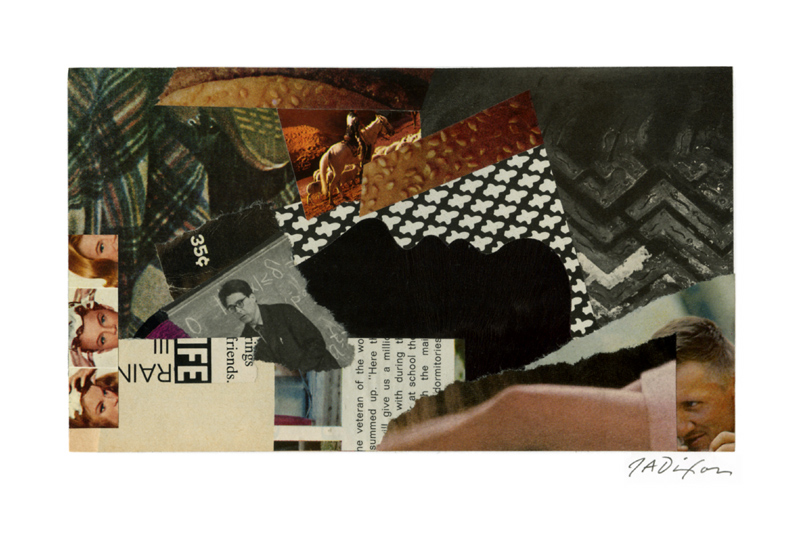
Here are the rest of the recent experiments from my participation in the Fortune Collage Project. Aside from the strict imposition of vintage magazine scrap, which dictates a particular look not in keeping with my typical eclectic mix of ingredients, the primary realization I gained from this exercise is a greater awareness of how much I rely on a series of closing decisions to fine tune my composition. A speed requirement strips nearly all of that phase from my process. It was interesting to observe the distinct difference between spontaneity and deliberate refinement. Each involves a different kind of intuitive response. 

A

B

C

D

A—   Life with Bobby
B—   Over the Weekend
C—   The Following Presentation
D—   Crocodile Tears

collage miniatures by J A Dixon
7.75 x 4.5 inches
Fortune Collage Project
available for purchase

Left Field Corner

Tuesday, January 15th, 2013

Degas: “Voilà! I have this great idea for a poem.”
Mallarmé: “Alors mon ami, poems are made out of
words, not ideas.”

It has been said that ingredients make the collage. One could argue that case. But what of the comprehensive whole? Does the effect of the artwork not rely on the compositional relationships and the interest of juxtapositions? Of course. But what could be expressed without the ingredients? What would a painting be without the paint? Do you know a collage artist who does not take special care with the selection of the physical components and does not thoughtfully compile, sort, edit, and re-edit before the process of assembly takes place? Some may emphasize the pictorial or symbolic qualities, while others may focus more on abstract or aesthetic attributes. Many give great attention to the sourcing or provenance, with personal criteria that must be met in service to a sought-after look or personal style. Others zero in on the transitory nature of ingredients, independent of representational aspects, with a keen regard for age, condition, and the sense of impermanence. But the bottom line for all— something a perceptive friend recently pointed out to me— is that each and every ingredient caught the artist’s eye in some significant, personal way, in some manner that gave glimpse to its ultimate visual potential. That was when I realized how most of my ingredients had run a long gauntlet of multiple scrutinies: First it was acquired and saved for some reason. Then it was retrieved from its repository for some reason (often years later). Then it was grouped with other worthy candidates for some reason. And then finally it was used in a work. It found a new purpose for which it was not originally intended, a place where it belonged, when other items were set aside (perhaps to win a role in another collage, or to eventually fall out of favor). It’s hard to disagree with the idea that the culminating gestalt of a collage determines its level of success, the degree to which it becomes more than the sum of its parts. Ah… but how we relish those parts!
 

Left Field Corner ~ J A Dixon

Left Field Corner
collage miniature by J A Dixon
5.5 x 5.5 inches
collection of R K Hower

Diamonds in the Rough ~ details

Wednesday, January 9th, 2013

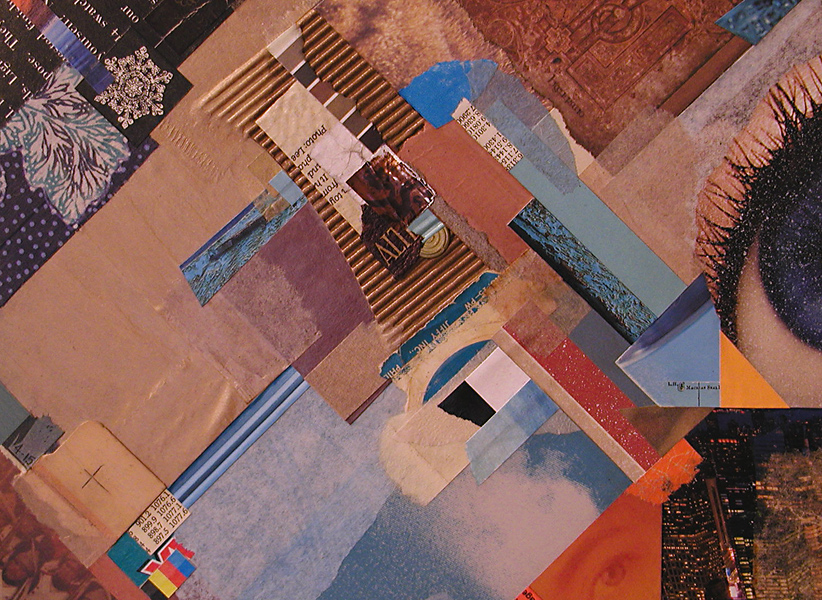
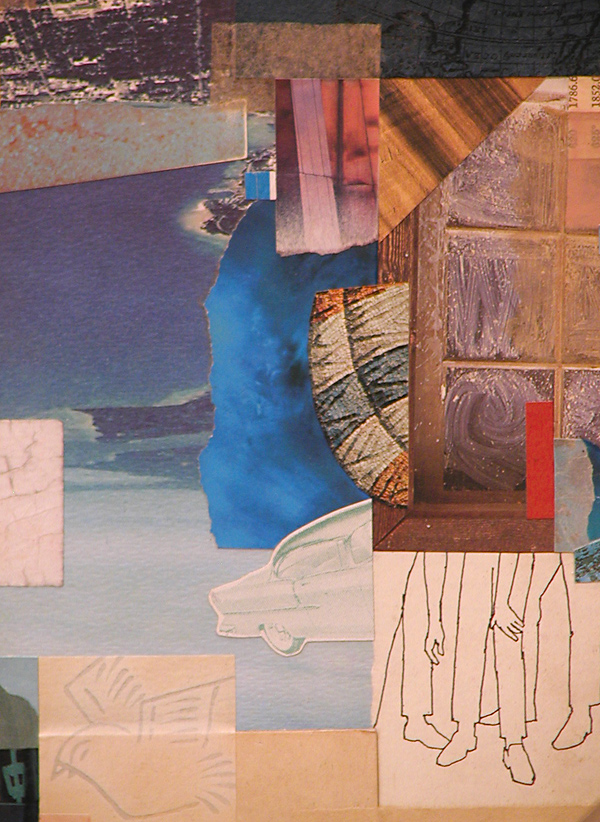
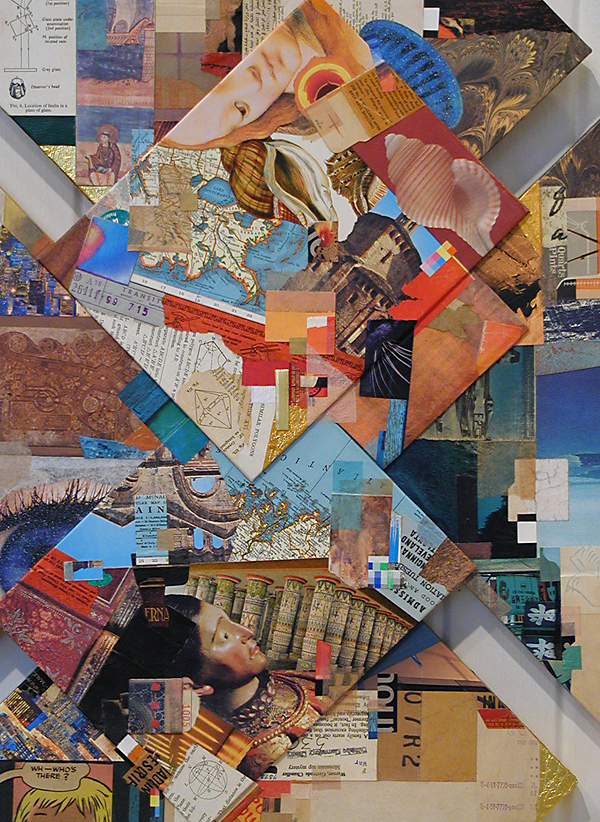
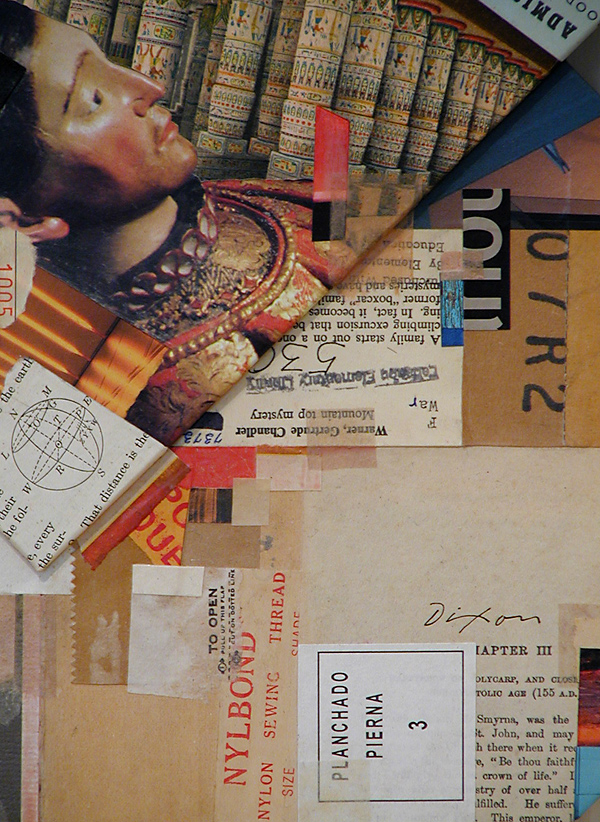
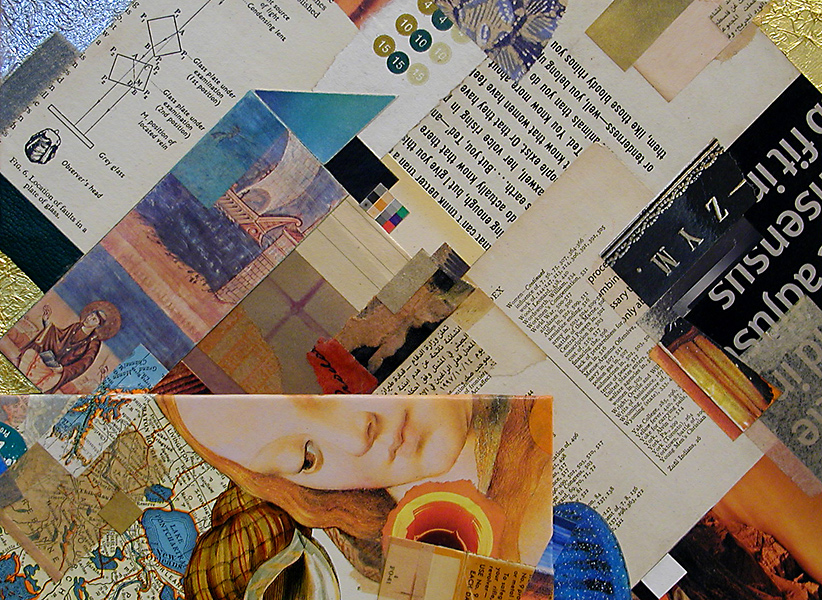
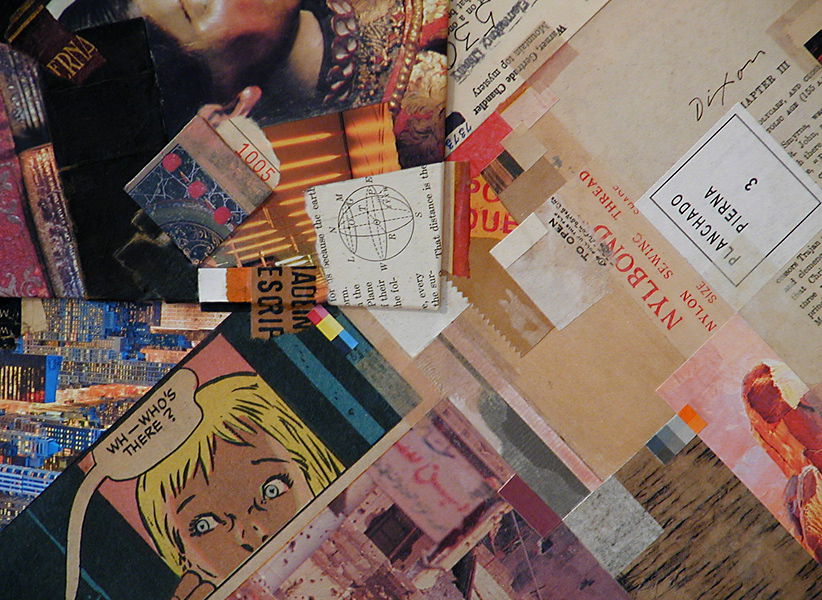
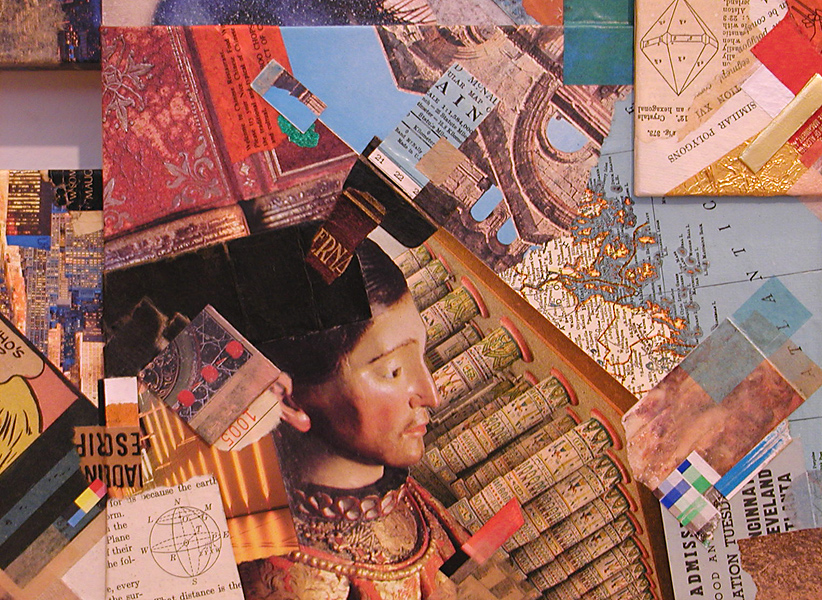
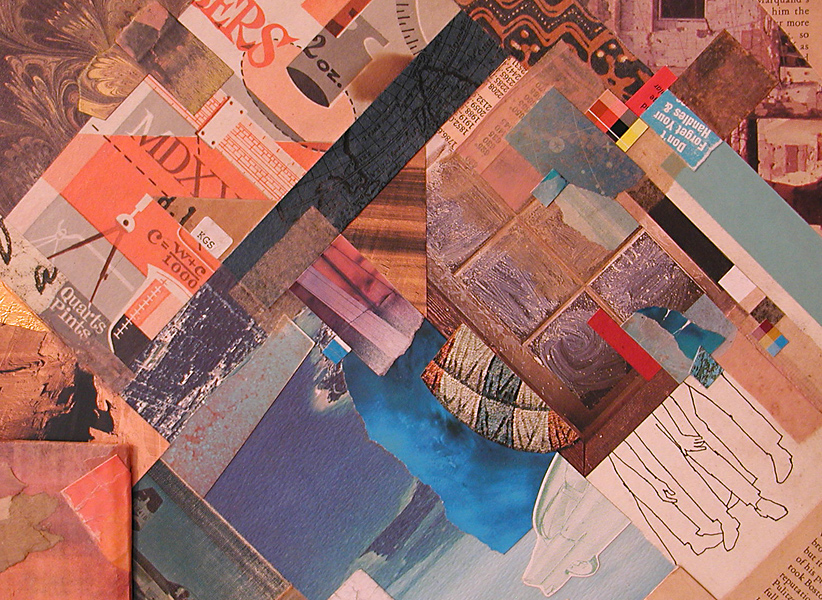
Collage for me is always an intimate viewing experience. You may find me with spectacles off and nose pressed near to the surface of any example within the medium. The scale of Diamonds in the Rough enhances the contrast between an up-close scrutiny and a step-back regard for the entire effect. With a large piece like this, I also enjoy visually cropping areas to create a series of virtual collage miniatures.
 

This micro view accentuates the ingredient elements, as in a collage miniature.
Visually, larger works are less ingredient centric, but still rely on their qualities.

I think my imagination would never tire of working with diagonals.
What is it about the diamond or the triangle that engages my mind’s eye?

This is one of my favorite areas within the total artwork.
Oddly, the legs and hands resonate with the Tapley drawing in the exhibition.

The composition’s focal center projects from the surrounding forms.
It differs energetically from the outer areas of structural perpendicularity.

To regularly bestow a new purpose on found material . . .
Without fear of contradiction, one could say that I am hooked.

The essence of collage is the contrast of the mundane and sublime.
At any rate, this is often how I perceive it.

WH—WHO’S THERE? (Look closely: Milt Caniff, that’s who.)
Somebody saw this as an homage to Roy, but Kurt used comics first.

A collage can rest divertingly upon layers of symbolic meaning.
Or it can be simply the harmonious resolution of aesthetic factors.

The dynamics of complementarity. (Is that a real word?)
More than one astute eye discovered my warm-cool “horizon.”

Composing with shape, color, contrast, rhythm, dimension.
At times, it need be about nothing more than that.

This image isolates a microcosm of the whole effect.
Are my larger works just a aggregation of collage miniatures?

Thanks for looking. Let me know what you think. Constructive criticism is encouraged at this site. To be honest, the medium of collage needs a bit more of it.

Blue Cracker Jacket

Wednesday, December 12th, 2012

“People often say that motivation doesn’t last. Well, neither does bathing and that’s why we recommend it daily.”
— Zig Ziglar   ( 1926–2012 ~ R I P )

I occasionally create, as a motivational exercise, a collage-miniature-as-greeting-card with no thought for who will eventually receive it, the opposite of making one by reflection on a particular soul. I cannot help but think that the intended individual is somehow— at a level hidden from outer consciousness and in a way we do not yet understand —part of the creative process. This is not unlike when people discover an unclaimed artwork and respond to it with the forceful conviction that it was produced specifically for them.
 

Blue Cracker Jacket by J A Dixon

Blue Cracker Jacket
collage miniature by J A Dixon
4.5 x 3.75 inches, not for sale

Broken Qualifications

Sunday, December 9th, 2012

“Any true artist is putting down the most accurate formula he can for what he perceives … The truth is the truth and you don’t want to change it to make it more palatable to reach more people.”
— Robert Motherwell

I frequently make reference to figures who have made their mark on art history, but I also find the work of my collage contemporaries very stimulating. An astonishing number of artists are exploring this vibrant medium who remain true to a keen perception that is beyond an art-buying public looking for familiar effects. This is nothing new, and presents a problem only for those who attempt to gain wide popularity. Occasionally, I am lured by a collage that has made a clear stab at shock, irony, or absurdity. These evocative goals, or some level of social commentary, are worthy objectives for collage as an art form (for which it can be strongly suited). They are among the different approaches to an orientation that Laura T Holmes refers to as “intentional design.” At any rate, I will usually set aside admiration for a conceptual process and re-focus on the visual aesthetics that continuously capture my interest: color, shape, texture, depth, rhythm, resonance, counterpoint, and compositional harmony. So much the better if layers of symbolic meaning emerge, and an observer brings his or her individual responses to the finished result.
 

Broken Qualifications by J A Dixon

Broken Qualifications
collage miniature by J A Dixon
6 x 8 inches
see the revised version

There I Was

Saturday, December 8th, 2012

“He spread flour and water over the paper, then moved and shuffled and manipulated his scraps of paper around in the paste…. Finally, he removed the excess paste with a damp rag, leaving some like an overglaze in places where he wanted to veil or mute a part of the color.”
— Charlotte Weidler

It has been more than a year since I had the humbling opportunity to study dozens of Kurt Schwitters originals at the Berkeley Art Museum. I read the description by the art historian Charlotte Weidler that same day, but I only recently decided to experiment with the paste method she observed. I have always worked with a variety of adhesives, and I often combine more than one in a single collage, never hesitating to literally mix them together (white glue + acrylic varnish, for example). I was impressed with how good some of Kurt’s compositions had held together after 70 to 80 years. I dug out a small package of paper-hanger’s wheat paste acquired in the 1970s, with the new intention of using it to produce a collage on canvas that would stand on its own as an object when finished. Although I expected to coat the final surface later with gel medium, for my first piece based on using the same adhesive as the pioneering artist, I was mainly interested in how wheat paste would affect my process.

The artwork is undone, but I share one of my separate experiments below. I could not be more pleased with the results of this approach. The paste dries slowly. This allows for repositioning, easy removal of excess, and it cures to a flat, velvety finish. I am especially pleased with how conducive it is to manipulating coated paper torn from magazines, an ingredient I am quite fond of. I lightly sand the reverse side, adding a bit of white glue to the paste for good measure, and, using this hand-pasting technique, I have never found “mag scrap” more easy to work with. It may not seem like a big deal to those who attend diverse workshops and demonstrations, but, as a self-taught collage artist, it feels like a significant breakthrough to me.

Now, the only question that remains is one of durability. The seminal works of K.S. show every sign of lasting a century in decent shape, but I am no museum expert, nor have I been as fixated on archival longevity as some collage artists I know. I expect my creations to age, perhaps in unexpected ways. This reminds me of an online discussion not long ago about using elements taken from newspapers. Many collage artists may share my expectation that a newsprint ingredient will simply mature as nature sees fit, adding a certain “wabi-sabi” aspect to a work of art that relies on found material. Who knows what Picasso or Braque thought about the nature of impermanence when each created their first collage with that famous wood-grain paper found in a store? Or, for that matter, what Schwitters himself thought when— with seemingly little regard for acid-free niceties —he built the enduring concepts of Merz on the detritus of ordinary life?
 

There I Was by J A Dixon

There I Was
collage experiment by J A Dixon
8.75 x 11.5 inches, not for sale

Is it or isn’t it?

Wednesday, November 14th, 2012

“Man himself is mute, and it is the image that speaks. For it is obvious that the image alone can keep pace with nature.”
—Boris Pasternak

Those who speak or write as though they understand everything about this medium do not know what they are talking about. But, to be honest, I have never met anyone who behaves that way, so perhaps my opening declaration is meaningless. Sometimes it is even difficult to classify what we do as artists in order to place the effort in some category. I just encountered an interesting chunk of round-table discourse by a new online discussion group struggling to define their area of focus. Most distinctions made between what artists call collage, montage, assemblage, construction, layerism, mixed-media, digital art, illustration, or graphic design are somewhat arbitrary, and we continue to see new terms coined by those who hope to distinguish what they perceive as a unique approach. At any rate, the intent of the artist is central. Clearly, definitions in art are rarely necessary except when attempting to trace a cross-pollination or lineage of influences, and when an organized effort or exhibition requires mutually acknowledged parameters. Additionally, there are always other important considerations to discuss, such as: What is an original? What is the relationship between process and artifact? What is the purpose of reproduction? Does a nomenclature based on exclusion have intellectual validity, or is it simply an adjunct to merchandising?
 

A likely story indeed! ~ J A Dixon

A likely story indeed!
collage miniature by J A Dixon
4 x 6 inches
 
Purchase this artwork!