Archive for the ‘Collage’ Category

Fears and Fancies

Wednesday, June 12th, 2013

“Art is never finished, only abandoned.”
— Leonardo Da Vinci

“A painting is never finished. It simply stops in interesting places.”
— Paul Gardner

One of the many fascinating aspects of this medium is that a collage can never be ruined, but only delayed. Perhaps it is the most forgiving of all art forms. Nevertheless, artists have been thinking about the issue of completion for a very long time, and a vital part of creating a collage is deciding when to quit. We see many examples that appear overworked to the point of exhaustion, or that fall short of a fitting denouement. Whether one considers it abandonment, suspension, or conclusion, the collage artist, like any creative person, must pay attention to a process that leads to the notion of “ahhh… the end.” When does the sculptor lay down the chisel? How does the choreographer know a dance is finished? When does the poet decide to stop revising?

A collage may languish in the working space for days, or even weeks, defying its appointed culmination. With experience, one can recognize the need for postponing a final resolution, and it usually involves matters of both compositional harmony and ingredient quality. While some arrangements follow a natural progression of assembly, others cannot be pushed to premature completion. If a “missing” element eludes the sought-after symbiotic result, one must wait until a solution is clear. In spite of its size, today’s featured miniature is such a case in point. Brought out several times for fresh review and incremental color refinements, it was deemed unfinished until a second egret presented itself. How does one know when a collage is done? For me, the more important consideration is learning how to see that it is not.
 

Fears and Fancies
collage miniature by J A Dixon
4.5 x 4.5 inches
private collection
 

Disinclination be damned

Friday, May 31st, 2013

“We must always work, and a self-respecting artist must not fold his hands on the pretext that he is not in the mood. If we wait for the mood, without endeavoring to meet it half-way, we easily become indolent and apathetic. We must be patient, and believe that inspiration will come to those who can master their disinclination.”
— Pyotr Ilyich Tchaikovsky

Like most collage artists, I usually don’t know immediately if what I’m producing “works.” Nevertheless, one has to buy into one’s process and trust that fruit is born through “stick-to-itiveness.” With diligence and a bit of perspective, it’s always possible to sort out the promising threads of creative direction. When they come into focus, keep moving. When they don’t, keep moving anyway.
 

Partners in Crime
collage miniature by J A Dixon
4.5 x 6.25 inches
 
Purchase this artwork!

Mystery Solved ~ details

Sunday, May 19th, 2013

For the full viewing experience, one can never get too close to a collage, but this opinion from a person so enamored with the miniature probably comes as no surprise. When I create a larger piece, lessons learned from the small format have a strong bearing on my approach. As a concluding exercise to hone compositional awareness, it is beneficial to discover croppings that can stand successfully on their own. Before Mystery Solved left the studio, it was interesting to visually isolate six square miniatures, just to see if they might capture in microcosm the essence of the parent design.
 

A ‘Jack of Diamonds’ was too visually outstanding
at first and had to be massaged into balance.

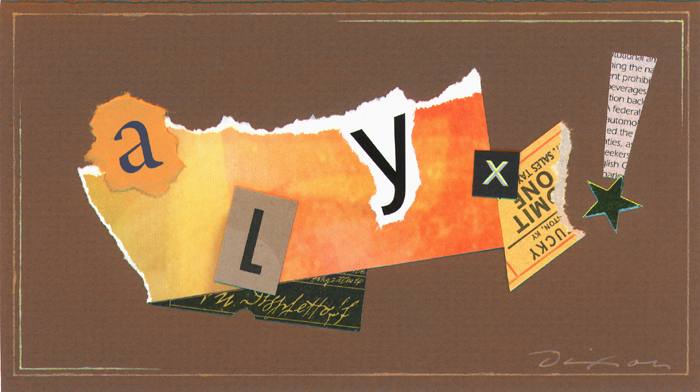
I enjoy creating a montage of linguistic symbols,
but “a-l-e” was accidental (or perhaps subliminal;
one never really knows with collage).

Integration through color: photo of butterfly
specimen + ticket stub + magazine scrap.

Juxtaposition: illustration from an exotic soap
wrapper + book engraving + photo of flower.

The interesting effect of a raised panel: the
illusion of depth versus actual dimensionality.

From diverse sources: combining ingredients
that seem to have always belonged together.

Thanks again for looking. Please share your thoughts, suggestions, or constructive criticism (frankly, our medium of collage always needs a healthy dose of it).

Realms of Wonder ~ art by Kathleen O’Brien

Tuesday, April 16th, 2013

The primary reason that I look forward with great anticipation to this Friday’s LexArts Hop is because Kathleen O’Brien has a new solo exhibition. The opening reception for Realms of Wonder at the M.S.Rezny Studio & Gallery is from 5 to 8 pm, and it is certain to be one of the highlights of the evening. It was no surprise when a local Marketing Maven recently exposed herself as a Kathleen O’Brien “groupie,” and I suspect that there are far more than two of us. It’s not at all baffling to find oneself totally captivated by her visionary art.

Kathleen’s artwork clearly grows out of how she thoughtfully observes and attunes with the world of nature. It also literally contains and preserves natural ingredients. But in contrast to collage that maintains its focus on formal or intellectual juxtapositions, Kathleen’s art always nudges one toward a deeper sense of wholeness and the inner complexity of our balanced existence as both organic and spiritual beings. Without question, she has made a personal commitment to creating art as a mystical practice, and, on a communal level, to providing nature-inspired beauty as a source of healing in a fractured world. With the strong presence of these intangible dimensions, Kathleen’s art is always esoteric, and yet she manages to make the work accessible to all with her choice of subject matter and allegiance to traditional drawing. At the same time, she can delight the eye of a fellow artist with her methodology, aesthetic choices, and pictorial skill. I’m not ashamed to admit that much of Kathleen’s symbolic virtuosity is beyond my ken, but I appreciate that it’s all in play at the intuitive level. Being near the prolific output of her creative life is simply uplifting, and that’s because all the facets of her art —whether conscious or subliminal— unify as a total perception to nourish the mind, heart, and soul.
 

Here is a video of Kathleen in the studio discussing her art.
Find out more about the artist at her website or blog.

3 Worlds (detail, This World)
mixed-media collage, © Kathleen O’Brien
22 x 15 inches

The March Exercise

Thursday, February 28th, 2013

“The unshakable rule is that you don’t have a really good idea until you combine two little ideas. That is why you scratch for little ideas. Without the little ideas, there are no big ideas.”
— Twyla Tharp

For a number of years, the month of March has held a special distinction for me as an artist. It all began in 2006 as a month-long experiment in focused awareness and evolved into an annual exercise to discover, refine, and internalize creative habits. Tomorrow morning the practice will commence again as I produce and post a collage miniature each day for the duration of the month. Of course, this is not a new idea. When it comes to doing this sort of thing online, most of us who concentrate in the medium will immediately think of Randel Plowman, the artist, author, curator, and blogger, who holds the A Collage A Day web domain. His successful publication, The Collage Workbook, brought heightened attention to the art form during its centennial year. Another individual who has made the online commitment is Portuguese artist Dilar Pereira, who maintains the Daily Collage Project. But when it comes to the ritual itself, who can hold a candle to the late John Evans? The New York artist created a daily collage for 37 years (except for a single day when he was too ill). Now that’s what I call an exercise!
 

Color Chart
collage on paper by Randel Plowman
8 x 8 inches
A Collage A Day

O Beijo
collage on canvas by Dilar Pereira
13 x 13 centimeters
Daily Collage Project

6-24-87
collage and watercolor on paper by John Evans
12 x 9 inches

Journal Collage  |  Fifth Page

Monday, February 25th, 2013

“Time consecrates and what is gray with age becomes religion.”
— Friedrich Schiller

The collage artworks of Kurt Schwitters possess a “vintage” appearance to our eye, but it is essential to keep in mind that his “Merz” ingredients were predominantly gleaned from a concurrent environment. It was Joseph Cornell, via the influence of Max Ernst and others, who consciously selected antique images to reinforce the romance and melancholy of feelings past. Apparently, a significant number of active collage artists limit their resources to vintage found material. Don’t get me wrong; I love this work. The immediate “retro effect” can be quite compelling. It would take a stronger soul than mine to dismiss the inherent dignity that comes with the marvelous scrap from an outdated encyclopaedia or the now-funky gravitas of post-war, mass-market magazines. However, from my perspective, a vital element of contemporary collage is the incorporation of present-day material and the recycling of twenty-first century detritus. I find it even more interesting to see vintage ingredients effectively juxtaposed with the ephemera of our own time. Nevertheless, every serious artist has a set of aesthetic considerations, genre goals, and process parameters that mold decisions. Due respect should be extended to the overall objectives that each collage artist brings to this exceptionally diverse media.
 

Untitled (Just Another Prophesy)
journal collage by J A Dixon
8.5 x 11 inches, not for sale

Shadows of Joseph

Monday, February 11th, 2013

“From the beginning he had responded to the avant-garde developments of his time with admirable swiftness and sureness. It is hard to think of another American artist who was receptive to so many different art movements or who managed to win the admiration of everyone from the Surrealists in the 1940s to the Abstract Expressionists in the 1950s to the Pop Artists in the 1960s. Artists who agreed on little else agreed on Cornell.”
—Deborah Solomon

“The central themes of Pop Art were sub-culture, folk cultures, media imagery, new technologies, design, the consumer goods and engineering industries, the inter-relationships between these phenomena and their effect on human beings.”
—Tilman Osterwold

Osterwold’s analysis suggests that traditions, fashions, and even avant-gardist achievements could no longer be the norm after Pop Art, which swept away the boundaries of artistic development with its focus on a “consciously perceived and reflected present-day existence.” Having just finished Deborah Solomon’s biography of Joseph Cornell (Utopia Park: The Life and Work of Joseph Cornell), I am struck by how Cornell anticipated Pop Art with his focus on the appropriated elements of mass culture and his various obsessions with celebrities, while at the same time demonstrating an abiding indifference to the cult of personal fame so typically associated with the movement. Walter Hopps stated that Cornell was “Schwitters’ greatest successor.” Cornell was certainly aware of Schwitters, for he was highly cognizant of nearly everything about the onrushing stream of modern art (in contrast to the misconception that he was some sort of urban hermit), but the precise lineage of artistic influence may never be fully known. Perhaps it was Cornell’s connection with Max Ernst that is a key factor. In my opinion, Ernst was not a giant of 20th-century collage, but did have a vital influence on the genesis of Cornell’s art. It is well recognized that Joseph began and ended his unique body of work with the medium of collage. One of the things that astonishes me is how he could be so attuned to the advancing frontier of present-day art (often staying a step or two ahead of it) and, at the same time, carry such a personal dysfunction that derived from the driving intensity of his inner world. Was that the nature of his genius? At any rate, his strange but amazing ability to synthesize powerful emotional and cultural content by inventing (virtually from scratch) a distilled form of assemblage continues to set the standard for almost everything in the mix of media that has followed in its wake. Hardly a day goes by that I don’t observe an artwork that can be traced directly to his seminal vision. But rarely do I see another artist infuse their juxtapositions with a rich symbolism to compare favorably with his complex associations. Most of the art I see with an obvious Cornellian tone owes more to surrealist automatism or atmospheric illustration than to the intricate blend of embedded meaning and refined intuition that characterized his enduring originality.
 

Knave Child
Kurt Schwitters, 1921
Collage on paper
Sprengel Museum, Hannover.

plate from La Femme 100 Têtes
Max Ernst, 1929
Collage novel
Published Éditions du Carrefour, Paris

Untitled (Schooner)
Joseph Cornell, 1931
Collage on paperboard

Untitled (Girl and Two Columns)
Joseph Cornell, c. 1950
Glass, wood, tempera and printed paper collage

Circe III — Surface and Volume in Nature
Joseph Cornell, c. 1961-66
Collage on masonite

Left Field Corner

Tuesday, January 15th, 2013

Degas: “Voilà! I have this great idea for a poem.”
Mallarmé: “Alors mon ami, poems are made out of
words, not ideas.”

It has been said that ingredients make the collage. One could argue that case. But what of the comprehensive whole? Does the effect of the artwork not rely on the compositional relationships and the interest of juxtapositions? Of course. But what could be expressed without the ingredients? What would a painting be without the paint? Do you know a collage artist who does not take special care with the selection of the physical components and does not thoughtfully compile, sort, edit, and re-edit before the process of assembly takes place? Some may emphasize the pictorial or symbolic qualities, while others may focus more on abstract or aesthetic attributes. Many give great attention to the sourcing or provenance, with personal criteria that must be met in service to a sought-after look or personal style. Others zero in on the transitory nature of ingredients, independent of representational aspects, with a keen regard for age, condition, and the sense of impermanence. But the bottom line for all— something a perceptive friend recently pointed out to me— is that each and every ingredient caught the artist’s eye in some significant, personal way, in some manner that gave glimpse to its ultimate visual potential. That was when I realized how most of my ingredients had run a long gauntlet of multiple scrutinies: First it was acquired and saved for some reason. Then it was retrieved from its repository for some reason (often years later). Then it was grouped with other worthy candidates for some reason. And then finally it was used in a work. It found a new purpose for which it was not originally intended, a place where it belonged, when other items were set aside (perhaps to win a role in another collage, or to eventually fall out of favor). It’s hard to disagree with the idea that the culminating gestalt of a collage determines its level of success, the degree to which it becomes more than the sum of its parts. Ah… but how we relish those parts!
 

Left Field Corner ~ J A Dixon

Left Field Corner
collage miniature by J A Dixon
5.5 x 5.5 inches
collection of R K Hower

An exhibition in Durango.

Saturday, January 12th, 2013

My appreciation to Cecil Touchon for including one of my works in a collage exhibition at the Durango Art Center. Cecil has said, in his typically understated manner, “I just grabbed some things off the walls at the archives, with the thought of techniques used as examples for the upcoming workshop, which is sold out already … and I also wanted to show the international nature of the collection.” He often refers to the International Museum of Collage, Assemblage and Construction, but not to his impressive labor as a preservationist and his effort to raise the profile of the medium during its centennial year.

Plate Touchonics ~ J A Dixon

Plate Touchonics
collage on canvas
by J A Dixon
12 x 12 inches
collection of the
Ontological Museum

Diamonds in the Rough ~ details

Wednesday, January 9th, 2013

Collage for me is always an intimate viewing experience. You may find me with spectacles off and nose pressed near to the surface of any example within the medium. The scale of Diamonds in the Rough enhances the contrast between an up-close scrutiny and a step-back regard for the entire effect. With a large piece like this, I also enjoy visually cropping areas to create a series of virtual collage miniatures.
 

This micro view accentuates the ingredient elements, as in a collage miniature.
Visually, larger works are less ingredient centric, but still rely on their qualities.

I think my imagination would never tire of working with diagonals.
What is it about the diamond or the triangle that engages my mind’s eye?

This is one of my favorite areas within the total artwork.
Oddly, the legs and hands resonate with the Tapley drawing in the exhibition.

The composition’s focal center projects from the surrounding forms.
It differs energetically from the outer areas of structural perpendicularity.

To regularly bestow a new purpose on found material . . .
Without fear of contradiction, one could say that I am hooked.

The essence of collage is the contrast of the mundane and sublime.
At any rate, this is often how I perceive it.

WH—WHO’S THERE? (Look closely: Milt Caniff, that’s who.)
Somebody saw this as an homage to Roy, but Kurt used comics first.

A collage can rest divertingly upon layers of symbolic meaning.
Or it can be simply the harmonious resolution of aesthetic factors.

The dynamics of complementarity. (Is that a real word?)
More than one astute eye discovered my warm-cool “horizon.”

Composing with shape, color, contrast, rhythm, dimension.
At times, it need be about nothing more than that.

This image isolates a microcosm of the whole effect.
Are my larger works just a aggregation of collage miniatures?

Thanks for looking. Let me know what you think. Constructive criticism is encouraged at this site. To be honest, the medium of collage needs a bit more of it.

First exhibition of 2013

Saturday, January 5th, 2013

“What makes a painting meaningful is the spectacle of the ordinary content living together with the equally important life of the picture plane and the unity of the whole surface.”
— Gillian Pederson Krag

It pleases me to say that my most recent large-scale artwork will be on display and available for purchase as part of an invitational exhibition now hanging in my hometown.

NEW YEAR NEW ART ~ Community Arts Center, Danville, Kentucky
January 2 to 26, 2013 ~ Reception: January 10, 6–8 pm

The invitation to participate is an honor for two reasons. It is always good for one to know that local people appreciate collage, especially the more esoteric kind. Even more humbling is to be included among some truly outstanding Kentucky artists, such as Sheldon Tapley, Helene Steene, Kathleen O’Brien, and Marianna McDonald. I’m looking forward to the reception this Thursday. Mayor Steven Connelly of nearby Berea will speak on the powerful effect the arts can have on local economies. According to Programming Director Brandon Long, the intention is to showcase “fresh, new art that has the kind of excitement and energy of artists who know their work will go on display.” Many of the diverse works were created specifically for the exhibition, and that includes mine. Everything accepted had to have been executed since September.

Diamonds in the Rough is a composite of panels and stretchers. It is my latest effort to free collage from behind glass and approach the medium in a manner similar to the painted surface that stands on its own. I also departed from my typical rectilinear format, yet sought to maintain the type of perpendicularity that I frequently exploit for a unified structure. As usual, the color balance of found material plays a vital role in my overall composition. The lineage of the collage miniature is strong here. In fact, nearly everything I do to produce a major work comes from what I have learned from the small-format approach. This recognition is not meant in any way to devalue the miniature. I would hope that you have come to know my penchant well enough by now to appreciate that.

The next entry will include some detail crops and perhaps a few remarks about the process, too.
 
Diamonds in the Rough ~ J A Dixon

Diamonds in the Rough
collage construction by J A Dixon
36 x 36 inches
available for purchase