Archive for the ‘Artists/Collage’ Category

By Dint of Maple

Wednesday, October 3rd, 2012

“This is the modern attitude—reactions are based on intellect and preconceived ideas instead of a response to natural, immediate experience. Art is the last refuge. It need not
be rationalized.”
—Harlan Hubbard

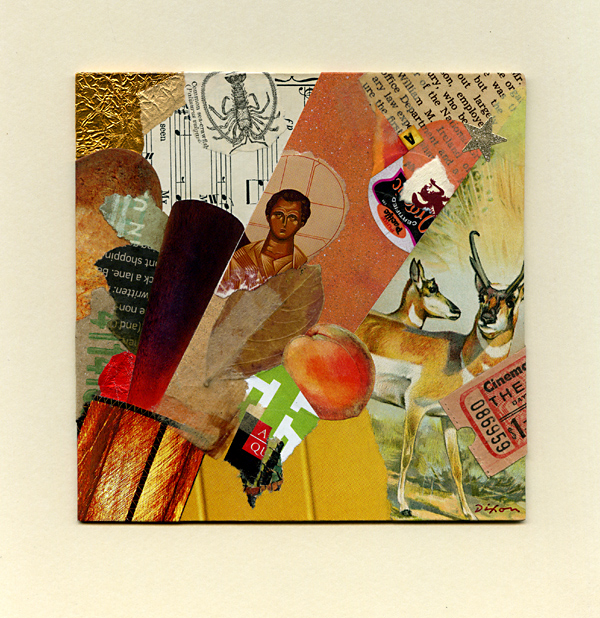
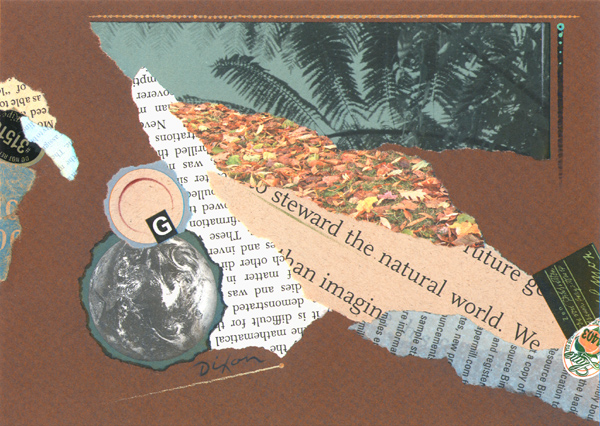
There is often a direct relationship between a collage and Nature, especially when ingredient elements are drawn from the organic or botanical wonders that surround us. Certainly, there is no way to classify all the indirect relationships, whether they involve images of the natural world or structures that reflect the cosmic order. Frequently, the quality of found material itself conveys the very essence of natural impermanence and the cycles of creation and decomposition. In the final analysis, can there be anything more natural than a spontaneity of eye, hand, and the intuitive psyche?
 
By Dint of Maple by J A Dixon

By Dint of Maple
collage miniature by J A Dixon
collection of Wesley W Bates

Unconditional Surrender

Saturday, September 29th, 2012

“To say that Kurt Schwitters was an amazingly versatile artist and anticipated much is such an absurd understatement that the remark is almost Dada.”
—Walter Hopps

“And so you will understand why we have had enough of Dada. The mirror that indignantly rejects your worthy countenance, that in mirroring it banishes it, such a mirror does not love you, it is in love with the very opposite.”
—Kurt Schwitters

To perpetually imitate KS is to be as unlike him as one could conceive. He was always pushing forward into the untried. But it is not for every artist to cross a boundary into the unknown. Some of us might be better suited to settling the frontier. There may be some among us more appropriately equipped to continue investigating the discoveries of a pioneering original— by sharing these visual concepts with a broader audience, by weaving them into a greater tapestry of the visual landscape, and, with a bit of luck, by finding a way to fuse our unique perspective with what has been handed off to us, in order to express new ideas that further cultivate a valuation of the past.Collage and Dada

I am not an expert on Dada or the relationship of Schwitters with the phenomenon. I am always learning more. I just know that he was never fully accepted by the movement at its peak, and that he was compelled to articulate his own vision of Merz. Perhaps much of it relates to Fascist oppression and the resulting geographic disruption, but I’ve always believed there was more to it than that. More important to me is an ongoing effort to unravel the underlying differences. A certain veneration for painting, design, and the aesthetics of beauty probably set KS apart from some of his rejectionist or surrealist contemporaries, but that is what gives his creations a unique, seminal power for me and for others. His perseverance in the face of daunting circumstances and a professed goal of “creating relationships, preferably between all things in the world” fly in the face of a nihilist orientation. Although I remain awed by surrealism in collage, and I am as tickled by irreverent juxtapositions as the next guy, there is an inherent pessimism or metaphysical anarchy in the “art of weirdness” that never seems to resonate with my deepest creative urge. I cannot say that I fully understand that, or that I am not occasionally moved to place a fish head on a reclining nude or mask a face with a front-loading washer. Is it even productive for me to engage in such self-analysis? Or, is it important only to submit to the most undeniable inner motivations when in the studio, sorting through another pile of visual fragments that await an intuitive response?
 

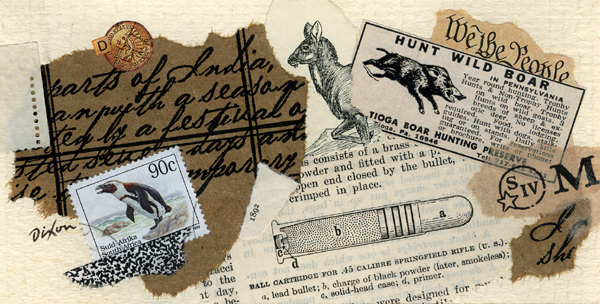
Unconditional Surrender
collage artifact by J A Dixon
collection of Nancy and Charles Martindale

Kurt Schwitters: Color and Collage

Sunday, September 23rd, 2012


“The language of Merz now finds acceptance, and today there is scarcely an artist working with materials other than paint who does not refer to Schwitters in some way.”
—Gwendolen Webster

“I could see no reason why used tram tickets, bits of driftwood, buttons, and old junk from attics and rubbish heaps should not serve well as materials for paintings; they suited the purpose just as well as factory-made paints.”
—Kurt Schwitters

Last November I had the good fortune to find myself close enough to Berkeley, California to attend Kurt Schwitters: Color and Collage, the first U.S. museum exhibition in 25 years to focus exclusively on his towering work. I was able to spend as much time as I wanted (at the Berkeley Art Museum & Pacific Film Archive), studying about 80 examples of his collage and assemblage. It was an experience that is almost impossible for me to describe. I suppose that I should at least try.K S, date unknown

KS has been a powerful influence on my personal artistic journey, for good or ill. When I first learned of this exhibition, it seemed beyond my Kentucky reach, but circumstances conspired to place me in the Bay Area on the day after Thanksgiving. During the trip west, I began to greatly anticipate what I knew would constitute more than a singular research event for me. It felt like a pilgrimage, or a potential culmination of sorts, that might “release” me in some meaningful way. My notion could not have been more off target. Hours of arms-length appreciation and up-close inspection served only to solidify my bond with the German innovator. Seeing masterpiece after masterpiece would crystallize a deep awareness that one need not ever shy away from drawing water from the well of this man’s insights, any more than a musician might hold at a distance Wagner, Stravinsky, or Ellington. Should I be concerned a critic may judge my works as derivative of his? Should a mathematician fear being described as an imitator of Einstein? Should a naturalist worry that others might say, “He thinks too much like Darwin”?

The works were superbly organized in a space that allowed for the full range of observation. The guiding concept of the exhibition was the idea that the artist always considered himself a painter. As Clare Elliott writes, “His practices of painting and collage were so intertwined that it is often difficult to determine if paint was applied to paper before or after it was pasted onto the surface, or mixed into the paste itself.” I doubt if KS, a trained painter, made any distinction. We must remind ourselves that there was no clear sense of collage as a separate medium, in the way we understand it today. It was more about his drive to radically expand the choices involved in how one creates a painting to include any material from the surrounding environment of mundane existence.

The rooms were dotted with descriptive panels that presented some of the most incisive remarks I had ever read about Schwitters. Sadly, the catalog edited by Isabel Schulz had already sold out. (Now available for $200 from Amazon, it was being offered for $40 when the show opened.) On top of it all, I did an inordinate amount of note taking and dared to strike up conversations with strangers viewing the show— something I recall never having done before at a museum. Needless to say at this point, it was a pinnacle experience for me. I finally understood that to entertain the hope of moving beyond an artistic influence of this magnitude, I needed to internalize it as fully as possible to discover my own points of departure. I needed to understand how Merz was fundamentally different than Dada, how KS became a revolutionary without being a rejectionist, and how strongly he must have believed in his initiating a spirit of unification that would encompass artistic methods and approaches not even “invented” yet.


Mz 601 by Kurt Schwitters

Mz 601
collage by Kurt Schwitters, 1923
paint and paper on cardboard
15 x 17 inches, Sprengel Museum, Hanover

Grateful Ode to Merz

Monday, September 17th, 2012

“When we look at (the work of) Schwitters, we must realize that it was made in a time with its own historical zeitgeist. The attitudes of the time, the philosophies, the hopes and the fears are impossible to duplicate today. We live in a different age, with three times the population, with technologies they could only dream about. So if one finds inspiration … it must manifest itself in the present. This has deep implications. The radical-ness, the surprise and sense of discovery, and the freshness that Schwitters was able to experience through his process is now a known part of history.”
—George Rodart

Four of my works have been acquired by the Ontological Museum in connection with the centennial of collage, 1912–2012. Collage artists worldwide owe a debt of gratitude to Cecil Touchon for his extraordinary labor on behalf of the medium. Working for years to establish this important institution, his efforts leading up to and during 2012 will be long considered one of the most significant developments (if not the most significant) during this milestone year. The centennial exhibition in Pagosa Springs opened last week. It features more than 400 works contributed to the museum’s permanent collection from artists living in 30+ countries and will be on view through May, 2013. This exceptional exhibition can be viewed online in its entirety.

No visual art form is more vital than collage on its one-hundredth birthday. Certainly there are antecedents in mosaic, the fabric arts, and various folk traditions, but historians have decided that either a Frenchman or a Spaniard first crossed a significant threshold a dozen years into the previous century. Some may continue to debate whether collage as a technique was “invented” by Georges Braque or Pablo Picasso, but in my considered view, the seminal genius of the medium was Kurt Schwitters, perhaps the first modern artist to fully master the process. I’m not alone in this opinion, and my conviction should be no surprise to anyone who has discovered this blog.
Grateful Ode to Merz ~ John Andrew Dixon

Grateful Ode to Merz
collage miniature on Bristol by J A Dixon
homage to Kurt Schwitters
collection of The Ontological Museum

Structural Integrity

Friday, September 7th, 2012

“Though he was not connected with any political party, his art was regularly vilified as a threat to traditional German values, while he himself was denounced as ‘unpatriotic’ or, just as often, insane. Yet Schwitters thrived on public opposition, and from 1919 to 1923 he created a succession of Merz pictures which are now seen as his greatest contribution to twentieth century art. These pictures carry an inner tension that derives from the sensitive juxtaposition of abstraction and realism, aesthetics and rubbish, art and life, and their innate dynamism is one of the characteristics of Merz.”
— Gwendolen Webster

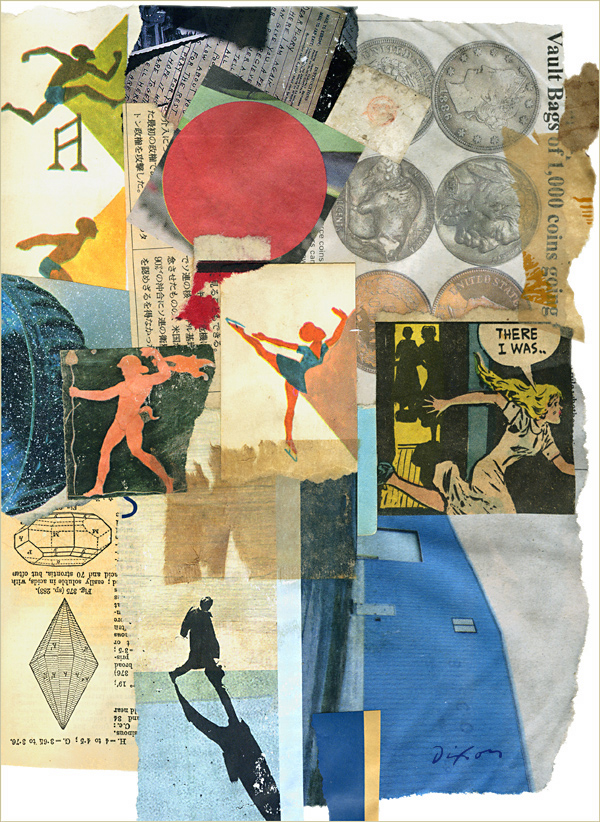
Today’s featured collage, inspired by some of the superlative work being done by my friends during this centennial year for the medium, is a bit larger than my typical miniature. To produce an “artifact,” I began with the cover of a ruined book, and before long I realized I had a strictly nonrepresentational composition on my hands. Created spontaneously at a close viewing distance, it wasn’t until I stepped back after completion that it brought to mind the kind of image one might view from the window of an upper story, looking across an urban landscape, with light and shadow playing off facades and roof lines. The way in which the mind attempts to unravel layers of symbolic meaning from the purely abstract is endlessly intriguing to me.

Those of us who create art within this particular genre are indebted to the increasingly exalted legacy of Kurt Schwitters and his original conception of Merz. I often think about how we have been liberated to explore the inexhaustible potential of this approach and to disclose our aesthetic vision within the accepted playground of modern art. Never forget that the man who fully defined this visual language for us did so at genuine risk to his personal freedom and safety. We may not always describe our works as a tribute to the enduring idea of Merz, but that is precisely what they are. Schwitters said, “Merz means creating relationships, preferably between all things in the world.” One fine aspect of that is the new connections and friendships that grow out of mutual interest in collage during its one-hundredth year. Check out the online galleries of Launa D Romoff, Teri Dryden, Scott Gordon, and Joan Schulze. You may agree with me that these artists are among today’s “Heirs to KS.” I hope to discover many more and to share their creative output at this site. Please stop by again soon.
 
Structural Integrity by J A Dixon

Structural Integrity
collage artifact by J A Dixon
8 x 10.5 inches

•  S O L D

Surfacing

Wednesday, September 5th, 2012

“O happy living things! no tongue
Their beauty might declare:
A spring of love gushed from my heart,
And I blessed them unaware . . . ”
—Samuel Taylor Coleridge

More often than not, the genesis of an idea for a collage miniature derives from the ingredient material itself, whether magazine cutting, ruined-book plate, or environmental found fragment. At other times, random visual stimuli cry out to be interpreted more traditionally as representational compositions. I can be influenced in this vein by images of “primitive” objects or folk art. Less often, conventional nature photography will trigger the pictorial urge. Creatures, faces, and figures hold a particular appeal for me. These types of small works have frequently taken the form of cards or gifts, but my current intention is to make more of these spontaneous creations available in the future to collectors.
 

Surfacing by J A Dixon

Surfacing
collage miniature by J A Dixon
4.5 x 3.5 inches, not for sale

Moon Blues

Friday, August 31st, 2012

“Structures can be understood and qualities felt in a single, balanced perception of order. Art attempts to discern order relations in nature. Data are set out in terms of recreated sensed forms; and the felt order is expressed in sensible structures exhibiting properties of harmony, rhythm, and proportion.”
—Gyorgy Kepes

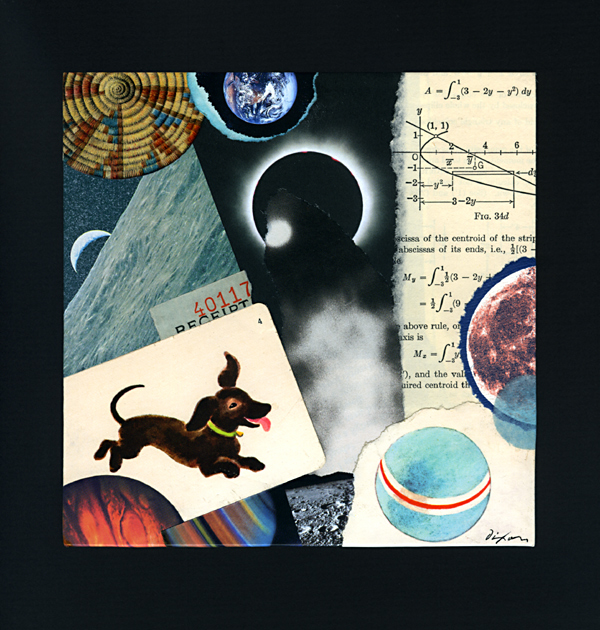
What is it about seeing two full moons balanced on the first and last day of the month that compels me to create a collage with subjective connotations? The wonder of the celestial (and the potential for visual juxtapositions of the macro- and micro-cosmic) has long held me in its spell.

It is advantageous for a collage artist to have a well-organized “morgue” of categorized scrap readily available, in order to quickly assemble ingredient elements when a creative concept takes hold. It frees one to follow the germ of an idea with associative intuition. To tell the truth, I would not know any other way to successfully approach this type of collage. Having to hunt for an image is a spontaneity killer. One’s collection of pieces and parts should be based on one’s unique way of making connections. As with most artists, I began to save images in my youth, according to a personal and natural sense of classification. Over the years, the collection has been subjected to periodic refinement and culling, although I cannot bring myself to cut off the acquisitions for good, even though I know I shall never compose all the artworks that lay fallow in those file cabinets. There are, of course, other ways to catalyze and create a collage, and I shall talk about them at a future instance.

R.I.P. ~ Mission Commander Armstrong . . .
 

Moon Blues by J A Dixon

Moon Blues
collage miniature by J A Dixon
5 x 7 inches

•  S O L D

Non-thought thinking

Wednesday, August 29th, 2012

“Artists have a vested interest in our believing in the flash of revelation, the so-called inspiration … shining down from the heavens as a ray of grace. In reality, the imagination of the good artist or thinker produces continuously good, mediocre, or bad things, but his judgment, trained and sharpened to a fine point, rejects, selects, connects … All great artists and thinkers are great workers, indefatigable not only in inventing, but also in rejecting, sifting, transforming, ordering.”
—Friedrich Nietzsche

Chuck Close encapsulated this notion in his famous quote, “Inspiration is for amateurs; the rest of us just show up and work.” Although the source of Woody Allen’s similar remark is unclear, he reportedly said, “Eighty percent of success is showing up.” In The Creative Habit, Twyla Tharp spends most of her extraordinary book driving home the same point. To those who were listening in the 1800s, Ralph Waldo Emerson explained the idea almost 20 years before Nietzche in The Conduct of Life. He probably got it from Montaigne, who probably lifted it from some long-dead guy who wrote in Latin.

For me, as a collage artist, the important thing to internalize from this is the necessity of regularly exerting diligent effort at the table cutting and pasting. I’m a big believer in non-thought thinking (or non-thinking thought, if one prefers to think about it that way). It may feel like a flow of intuitive, subconscious responses, but make no mistake about it— the brain is making discreet associations, evaluations, decisions —all in fractions of seconds, as it processes the material one presents to it, by the hand and through the eye. And, if one deems it so, the activity is guided more by the heart’s intent than by outer cognition. Do this often enough and more creative possibilities will emerge than can be successfully fulfilled. That is precisely when the conscious mind must step in and take the helm.
 

Peppermint Condition by J A Dixon

Peppermint Condition
collage miniature by J A Dixon
6 x 6 inches

But is it art?

Sunday, August 26th, 2012

“With the institutionalization of belief, art becomes an instrument of social enhancement instead of what it is— a basic instinct of the human species.”
—Milton Glaser

For more than a century or two, the distinction between the illustrator and the artist has been an ongoing debate. Is there a significant difference, or is it primarily an artificial disparity? Most would agree that there is a contrast of intent— the applied artist subordinates certain aspects of personal expression for a commercial or social objective, and the fine artist is accountable only to the creative self. But what about the illustrator who is handed no constraints by the client, or the fine artist with a market-driven agenda? Like most things, shades of gray preside and one is left to place each instance on a spectrum, or to disregard all attempts to categorize the creative impulse in the first place. I’ll admit that I’ve always been more impressed with the very best of illustration, vintage or current, than with run-of-the-mill fine art, but who am I to judge what is “very best” or “run-of-the-mill?” Regardless of what critics, academics, or connoisseurs may think, the phenomenon of “to each his own” will always play a major role in the world of art. On top of that, public taste, analytical opinion, and the viewpoint of art historians can change radically over time. Thomas Bewick, Alphonse Mucha, Henri Toulouse-Latrec, Jessie Willcox Smith, Adolphe Jean-Marie Mouron, Jessie Marion King, N.C. Wyeth, Charles Rennie Mackintosh, Elenore Abbott, Charles Marion Russell, and Norman Rockwell are examples to consider (to name only a few from the past). Who knows how those in the future will classify Betye Saar, Al Hirschfeld, Bob Peak, Brad Holland, Gary Larson, Jack Unruh, Jean-Michel Folon, James McMullan, or Milton Glaser?

So, you may now ask, since you’ve been kind enough to read this far, what’s the point of all this name dropping and what does it have to do with collage? I suppose that I’m inviting you also to think about what causes an artwork to have an “illustrative look,” separate from the circumstances of its creation. Perhaps the variance between the fine and applied arts has as much to do with appearance as with motivation. I’m interested in your viewpoint, dear reader, and I hope you share it here with your comment. Are there effects a fine artist must always strive to elicit with a collage, if it is to be perceived as art, or methods that should be guarded against, to avoid the verdict of illustration? If a collage is used for editorial purposes, for promotion, or packaging, does that automatically make it an illustration or a graphic design? If a collage is composed for optimum appeal to the perceptions of a particular type of buyer (or a prospective collector who responds to nostalgia, a period look, or the bizarre), does that disqualify it as fine art?
 

Festive Tones by J A Dixon

Festive Tones
collage miniature by J A Dixon
6 x 6 inches

•  S O L D

Get the jumper cables

Saturday, August 25th, 2012

I’m keen on art history to quench a dry spell. Here’s my suggestion to a collage artist in a slump.

• Browse modern art movements that have influenced collage: cubism, dada, constructivism, expressionism, surrealism, pop art.

• Relax and study the seminal masters of the medium: Cornell, Paolozzi, Höch, Hausmann, Schwitters.

• Then go to your “morgue” of images, textures, ephemera, and found material: group various ingredients into piles, responding quickly, intuitively, and without conscious thought for composition or symbolic associations.

• Before you know it, you’ll have more ideas and embryonic projects than you can immediately deal with. React first to the ones that won’t be denied. With a bit of luck, a new series will emerge.
 

Tatlin at Home by Raoul Haussmann

Tatlin at Home
by Raoul Hausmann
1920

A Book About Death

Wednesday, August 22nd, 2012

“Ray didn’t talk about it, he just did it. That’s why you don’t find art magazines lying around quoting the art philosophy of Ray Johnson.”
—Toby Spiselman

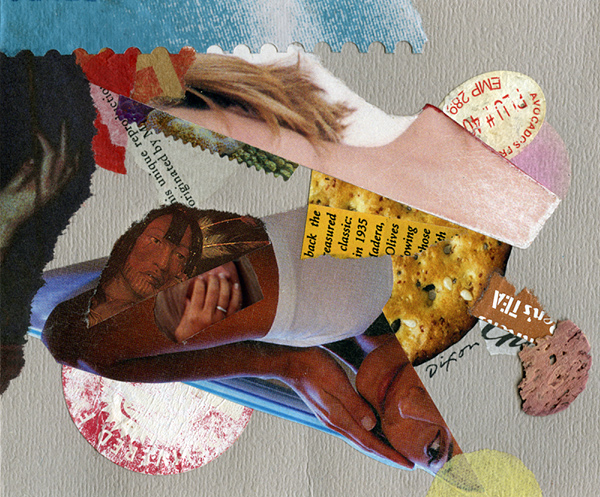
Ray Johnson, the original “most famous unknown artist in the world,” produced his A Book About Death during the years 1963 to 1965. The pages were randomly mailed and offered for sale. Complete copies were compiled by a rare few. Johnson was a significant bridge between the groundbreaking work of Schwitters, the sensibilities of Cornell, and the emergence of what would become the most widely recognizable features of Pop Art. He was highly influential in the Mail Art, Installation Art, and Performance Art movements, as well as late 20th-century neo-Dadaist trends. Paris-based Matthew Rose has actively aroused a worldwide interest and vitality that perpetuates the legacy of A Book About Death, including a 2010 incarnation (in which I made a small contribution). The full history can be studied at this site.
 
ABAD 2010 by J A Dixon

ABAD 2010
collage miniature by J A Dixon
6 x 4 inches, not for sale