Archive for the ‘Artists/Collage’ Category

Where credit is due . . .

Tuesday, August 21st, 2012

“I never made ‘Who’s Who,’ but I’m featured in ‘What’s That?’”
—Phyllis Diller

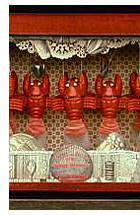
America has lost not only a pioneering comedic performer, but also a multi-talented artist. Nevertheless, the image that is circulating in the wake of her demise is not a Diller self-portrait, but a work by skilled assemblage artist Jason Mecier, who had an exhibition called “Celebrity Junkdrawers.” Notice that his ability to create strong illusions of visual depth does not rest on the inherent dimensionality of ingredient objects, but on an astute interpretation of light and shadow.
 
Phyllis Diller gold by Jason Mecier

Phyllis Diller gold
mosaic portrait by Jason Mecier
40 x 40 inches

Marty’s Borggrrrl

Saturday, August 18th, 2012

“Art is the greatest risk of all because when you’re making something, you’re constantly asking yourself what the hell you’re doing.”
—James Rosenquist

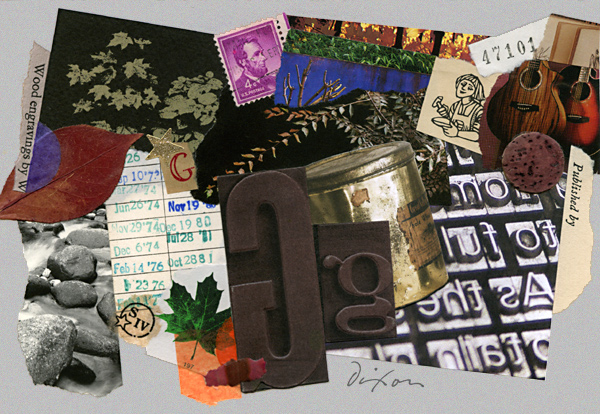
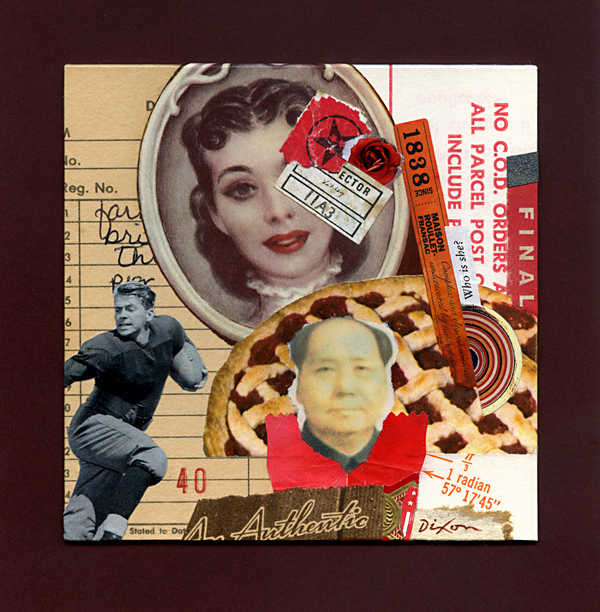
The century-long history of collage casts a deep shadow into the creative present and beyond. It is startling to realize that even Pop Art has been around over half that time. There aren’t many things that haven’t already been tried, or many effects that stake their ground removed from Dada, Surrealism, Constructivism, or one of the other movements influenced thereby. A collage artist must respect and acknowledge the past with a clear mind, internalize it as a part of the intuitive process, and follow a personal investigation anchored on risk. It’s not easy to successfully defy expectations, whether one’s own or the anticipated response, but everything else is practicing etudes or mere fabrication for the marketplace.
 

Marty’s Borggrrrl

Marty’s Borggrrrl
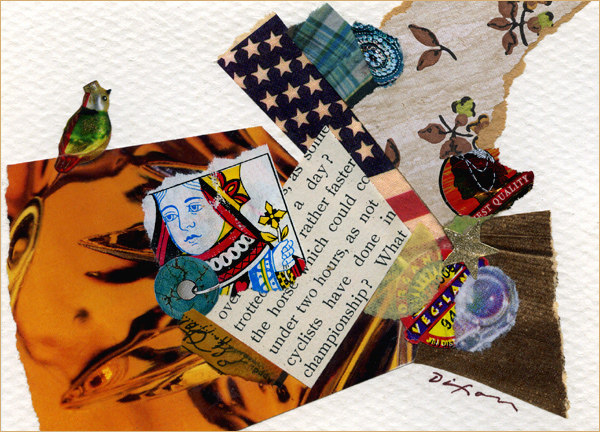
collage miniature by J A Dixon
collection of J M Strock, Jr

Fifty Camels

Thursday, August 16th, 2012

“Synchronicity takes the coincidence of events in space and time as meaning something more than mere chance, namely, a peculiar interdependence of objective events among themselves as well as with the subjective states of the observer or observers… a picture of the moment that encompasses everything down to the minutest nonsensical detail.”
—C G Jung

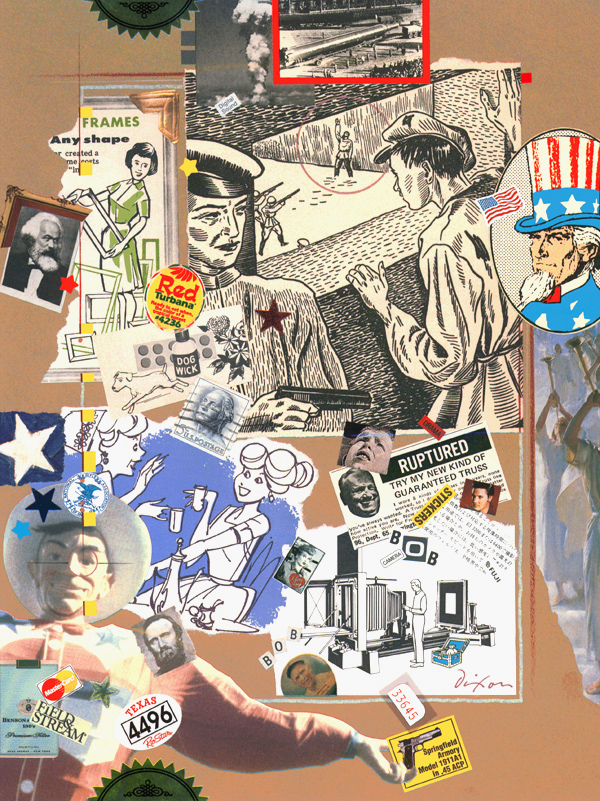
When I read Jung’s description of an idea he called “synchronicity,” it seems to align with everything I consider to be the essence of collage as an artistic phenomenon. It speaks to the inseparability of the creator to the artifact, of the artifact to the viewer, of the creator as viewer, and of the viewer as co-creator. The collage is a picture of many moments— dynamic moments of creation and of observation, with each element an intrinsic part of the character of the whole, and each response to the whole an intrinsic part of the relationships among elements.
 

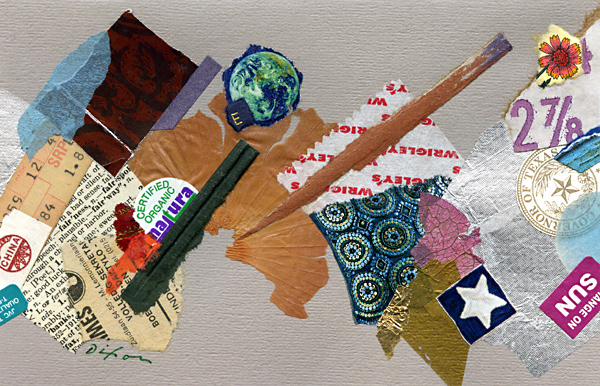
Fifty Camels by J A Dixon

Fifty Camels
collage miniature by J A Dixon
collection of J E Dixon

Of Independent Mind

Sunday, August 12th, 2012

“There is no substantial difference by which we can attribute a higher aesthetic value to one choice or the other. Our preference is a question of a personal, irrepressible urge.”
—Leo Lionni

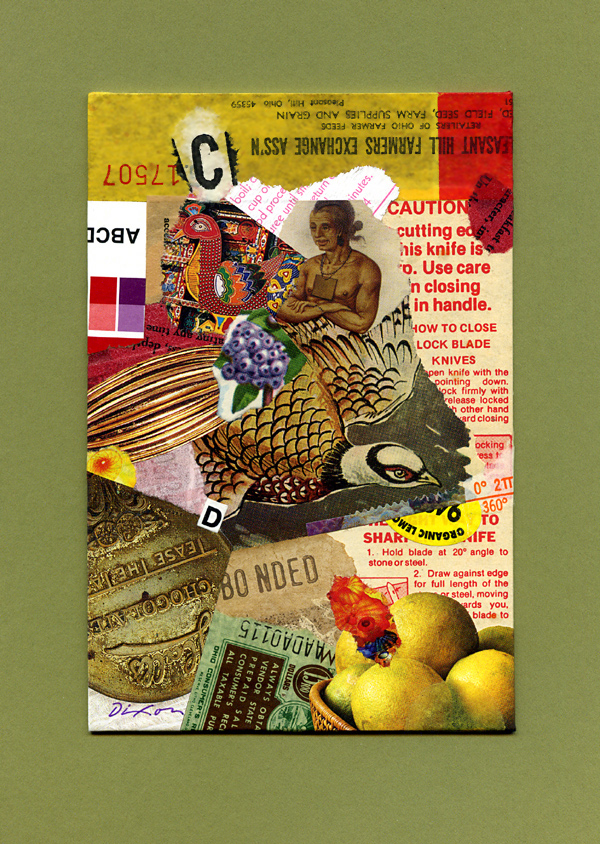
From my first encounter with Lionni’s sweeping assertion, I have been simultaneously haunted and liberated by the full ramifications of his claim. It topples the notion of making art for validation by others. Approval or disapproval is stripped of significance, and a creative person is left with nothing more than a responsibility to one’s own impulse. Personal or institutional systems that score art on some artificial scale ring hollow. The artist is freed to listen and look inside, but must face a daunting accountability that comes from within. Can I say that I have no regard for what others may think of my work? No, I cannot. The observer is a vital part of what, to my way of thinking, remains, at its essence, a collaborative act.
 

Of Independent Mind by J A Dixon

Of Independent Mind
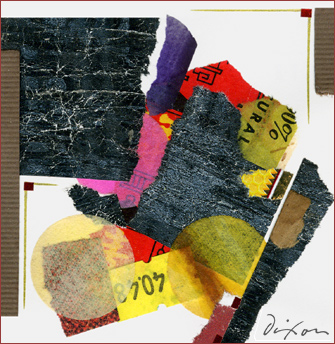
collage miniature by J A Dixon
6 x 6 inches

•  S O L D

Keeping Score

Sunday, August 5th, 2012

“Woodblock printing has been said to have reached Europe around 1400. Thirty years after that, intaglio printing emerged as an alternative technique, and in the 1450s the first mechanical printing presses were in use. From the outset, playing-cards seem to have been among the stock-in-trade of these processes.”
—Trevor Denning

In addition to matchbooks, ticket stubs, crash numbering, tea-bag tabs, chopstick wrappers, and produce stickers, playing-cards hold a distinct visual fascination for me. I would never think to ruin an intact set of cards, but always jump at the opportunity to secure an “orphan.” Introduced into Europe through Arab sources, the centuries-old history of these gaming aids provide an interesting glimpse into the evolution of printing, design, advertising, gender roles, and our ever-ticklish relationship with power.
 

Keeping Score by J A Dixon

Keeping Score
collage miniature by J A Dixon
5 x 5 inches

•  S O L D

The ’61 Olds

Friday, August 3rd, 2012

“A ship in harbor is safe, but that is not what ships are built for.”
—John Shedd

For some time now I’ve been observing how Matthew Rose and Randel Plowman make effective use of birds, and I acknowledge that there is something irresistible about including them in a collage. Most likely, it goes back to Joseph Cornell’s aviaries. I also noticed that I placed a bird in my Face with Asparagus as a sort of eyebrow. I intend to use that image as the “face” of The Collage Miniaturist. Below is a study lifted from one of my personal journals, which tend to be caught between a collection of organizational lists, private anecdotes, and diary of thumbnail sketches.

Since I’ve posted my review of Kathleen O’Brien’s recent exhibition, it’s probably time to sail this boat out into open water. Thinking of birds, perhaps I should say instead, fly out of the nest, —or— drive that ’61 Oldsmobile to a destination unknown. Tomorrow sounds good.
 

The ’61 Olds by J A Dixon

The ’61 Olds
collage miniature by J A Dixon
3 x 3 inches, not for sale

Old friends . . .

Thursday, August 2nd, 2012

“The road to success is always under construction.”
—Lily Tomlin

Putting a few more finishing touches on this site before launch. I intend to showcase my collage with images from my private journals, from my long-running Haus of Cards series, and from my collection of works that are available for purchase. Quite soon I shall address the need to include some provisional feature for kind people who want to buy a piece upon which they stumble here.
 

Old Friend by J A Dixon

Sign Up For Another (detail)
collage miniature by J A Dixon
collection of S J Montgomery

Seminal influences

Wednesday, August 1st, 2012

“Books are to be called for and supplied on the assumption that the process of reading is not a half-sleep; but in the highest sense an exercise, a gymnastic struggle; that the reader is to do something for himself.”
—Walt Whitman

When I hear artists say they try to limit their influences, I think, “Nonsense.” Outside of some strange brand of sensory or cultural deprivation, it is simply not possible to avoid influences. That being said, why not regularly go to the masterworks and primary sources for direct, conscious influence to balance or offset the continuous bombardment of visual input from a culture steeped in nth-generation bastardizations? One cannot drive down a street, walk through a shop, or scan the media without being influenced in some way by a legion of art directors, graphic designers, and photographers—and these individuals may or may not have any direct knowledge of how they are re-cycling the ideas of innovative artists. Great writers understand where the basic narrative modes originated. Serious filmmakers know who first did this or that—a dream montage, in-camera trick, or other cinematic effect. One cannot imagine a Morricone who did not know a Beethoven who had never listened to Bach or Haydn. There is no way to conjure up an Emerson who did not know a Montaigne who had never read Lucretius or Diogenes.

The point of this is not to find fault, but to serve as a lead-in for what I intend to be a series of posts about my take on the primary innovators within the evolving medium of collage. Credit must be given to Braque, Picasso, Gris, Duchamp, and others, but, for me, the study must begin with Kurt Schwitters and Joseph Cornell. Any person dedicated to collage who neglects these masters will fail to understand the foundation of the art form. What student hasn’t thrilled to her first startling, Höch-like montage, cut and assembled from discarded magazines? What young person does not, at some point in his creative formation, place a few found objects in a small box, pause to consider the intriguing effect, and not wonder, “Is it art?” Ultimately, what I end up saying here about the key historical figures is far less important than the overwhelming need for you to put your ideas and feelings into context with each one’s remarkable body of work, according to your own perceptions and priorities. For those who encounter their creations for the first time, the inevitable thought will be, “So, he was the first guy to do that…” (except in the case of Höch, of course). Whether one rejects, reveres, ignores, imitates, or “rips off” the great seminal works of collage, one must do so with full awareness. Walt Whitman’s admonishment to writers can equally apply to visual artists. Except for those who approach the medium of collage as a hobbyist, we owe it to ourselves to partake of the “gymnastic struggle.”

Gris | Schwitters | Höch | Cornell

Pearallel Universe

Monday, July 30th, 2012


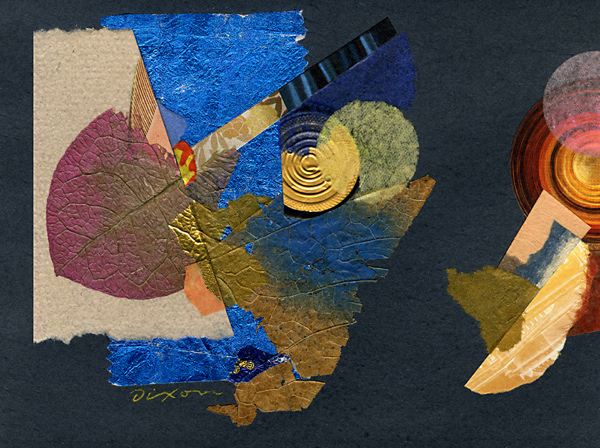
Pearallel Universe

Pearallel Universe
collage with combined mediums by J A Dixon
private collection

Whoahh, Terie!

Sunday, July 29th, 2012

“You are lost the moment you know what the result will be.”
—Juan Gris

Years ago, as an old-school graphic designer and illustrator, I found myself rapidly adapting to a more computer-oriented profession. As a response, I began creating more greeting cards by hand to preserve my manual dexterity. I’d been making cards since youth, but this provided a new opportunity to experiment with greater intuitive spontaneity, so I created over a thousand hand-crafted “miniatures” between 1999 and 2003. Most of these exercises took the form of birthday, anniversary, and holiday cards. The near-daily practice established a foundation and direction for my current work as a collage artist who focuses on the small format. I still produce as many as 100 cards a year, most of which rely on “found material,” as with the works I make available for purchase by collectors.
 

Whoahh, Terie! by J A Dixon

Whoahh, Terie!
collage miniature by J A Dixon
collection of T L Strock

Gardenshapes ~ art by Kathleen O’Brien

Saturday, July 28th, 2012

“Beauty should be shared, for it enhances our joys.
To explore its mystery is to venture towards the sublime.”
―Joseph Cornell


I hesitate to use a sports term to begin this review, but, since the Summer Olympics opened last night, I’ll set my disinclination aside to state emphatically that artist Kathleen O’Brien is at the top of her game!

Gardenshapes —an exhibition of her mixed-media collage finishing its run in the main gallery of Danville’s Community Arts Center— has ample proof to support my claim. I made one more return visit yesterday to experience the diverse subtleties of her singular creations.

Inspired by birds and flowers, and exploring the garden as a metaphor, this collection of artworks represents everything that has captivated me for years about Kathleen’s approach. These works have clearly grown out of how she thoughtfully observes and attunes with nature. They also literally contain and preserve natural ingredients. But in contrast to collage that maintains its focus on formal or intellectual juxtapositions, Kathleen’s art always nudges one toward a deeper sense of wholeness and the inner complexity of our balanced existence as both organic and spiritual beings. Without question, she has made a personal commitment to creating art as a mystical practice, and, on a communal level, to providing nature-inspired beauty as a source of healing in a fractured world.

With the strong presence of these intangible dimensions, Kathleen’s art is always esoteric, and yet she manages to make the work accessible to all with her choice of subject matter and allegiance to traditional drawing. At the same time, she can delight the eye of a fellow artist with her methodology, aesthetic choices, and pictorial skill. I’m not ashamed to admit that much of Kathleen’s symbolic virtuosity is beyond my ken, but I appreciate that it’s all in play at the intuitive level. Being near the prolific output of her creative life is simply uplifting, and that’s because all the facets of her art —whether conscious or subliminal— unify as a total perception to nourish the mind, heart, and soul.

Getting back to the show, I was initially struck by the five largest pieces (28 x 36 inches), beautifully presented against white in deep gallery-style frames of natural wood. This “look” is familiar to those who know Kathleen’s art, and enhances the work’s identity as an unique artifact, preserved behind glass, like a rare botanical or zoological specimen. They are titled with reference to the garden theme. In contrast, a separate piece (24 x 30 inches) is presented with its surface exposed in the manner of an easel painting. It looks equally at home, released from behind the glass, expertly varnished in a way that does not distract. Its name is Heaven & Earth, Yin & Yang, Dark & Light, Birds & Trees, Flowers & Bees. My eyebrows lifted as I began to read the lengthy title, but was pleased with the closing rhyme as I finished. This artist always has a quiet surprise in store. Each of the large works is visually distinctive, but very much a cohesive part of a series unified by her long dedication to compositional abstraction, to a consistent theory of color, and to diligent mark making.

The large piece titled Garden for Queen Anne’s Lace is marked by a cellular pattern resembling microscopic tissue, which, while remaining highly abstract, transforms itself into a flower garden, with an interesting emphasis on each “drop of Queen’s blood” that, when closely examined, becomes a dance of circles, squares, and triangles —a dynamic that exemplifies Kathleen’s knack for taking the observer/participant through layers of meaning. The design also incorporates the application of illustrated postage stamps. Kathleen is never far removed from a devotion to cultural references and ephemera, and her Joseph Cornell influences are ever present. A fine example of this are four pieces dedicated to bird-species (16 x 20 inches) that combine found printed patterns with her typical labor of liquid media. Nests are created with random shards and colorful scraps. Dried and painted star-like blossoms effectively merge the organic, symbolic, and celestial. In Kathleen’s collage there are many allusions to language, both literal and archetypal, and here we discover many fragments of the printed word, as well as her “trademark” calligraphy. I was particularly drawn to Garden for Blue Grosbeaks, a strong arrangement of symmetrical and asymmetrical elements that carries out more of her evident investigation into fundamental shapes —circle, square, and triangle. These compositions are anything but static, a characteristic of Kathleen’s art built on a myriad of ways in which she provokes eye movement by simulating the dynamic patterns of nature, often with the application of actual plants and minerals. A perfect case in point is 9 Bird Eggs (30 x 30 inches), with its nimble use of botanicals most artists would overlook as raw material, through which she creates a variety of rhythms within a formal, 3×3 grid structure.

I should mention that Kathleen’s control of what I call “implied viewing distance” is masterful. Enjoying her watercolor effects and hidden treasures up close is inevitably a satisfying experience, as is true with much of current small-scale mixed media collage, but her pieces also can be savored at a distance. I found myself continually studying a work from across the room and then, taking off my eye-wear, sticking my nose near the glass to examine fine detail. Whether from this point of view or from half a block away, Kathleen’s distinctive impression is always recognizable, an enviable accomplishment for any artist. For example, both Royal Lily Garden and Staple Garden contain brushwork that only can be achieved by someone who is continuously handling liquid on a tool and is fully at ease with her surface. On the other hand, she uses this micro-fluency to create the intended multi-layered depth of her macro-composition, and yet I was constantly invited to step back into the intimacy of the picture plane, much as one feels when standing back to admire a flower garden, while being compelled to converge at hand’s length, only to spy a miniature surprise —a dutiful pollinator or tiny feat of nature’s diversity within repetition.

With my fixation on the bigger paintings, it was too easy to neglect the smaller items, so I had to instruct myself to visually isolate and appreciate several other works. Two of these were within squares, and each have treatments not as pronounced elsewhere in the exhibition. Feathers uses paper itself as a dimensional medium, and The Blessing of Rain features a darker atmospheric background —a shimmering chalk texture that makes me wish Kathleen would more intensively explore the potential of pastel effects. In addition, there are three bird portraits (9 x 12 inches), with coatings of what appeared to be beeswax, which recall for me the investigations of 19th-century naturalists. My favorite is Garden for Eastern Bluebirds, with its deft pencil work and luscious color palette. Kathleen pushes her highly capable layering beyond technique to create a sense of time distortion, an interplay of wildlife and cultural antiquity that makes certain the work is much more than a lovely rendering of birds. Throughout this outstanding show are many such allusions to natural and human-made cycles that fuse the worlds of growing things and a striving race that has always responded with symbolic culture to seek a balanced place in the scheme of life.

Indeed, Kathleen O’Brien has found her place. With a home studio close to nature, and a creative passion that distills her observations and meditations through heart, head, and hand, she is a gold-medal artist of the soul.

© 2012, John Andrew Dixon

Garden for Eastern Bluebirds and Garden for Scarlet Tanagers
by Kathleen O’Brien