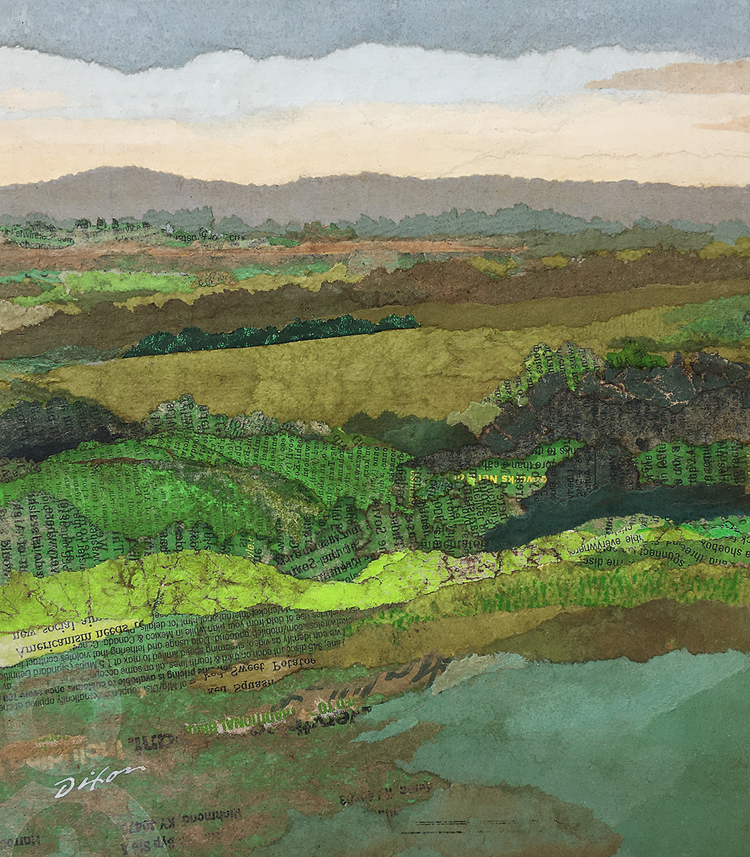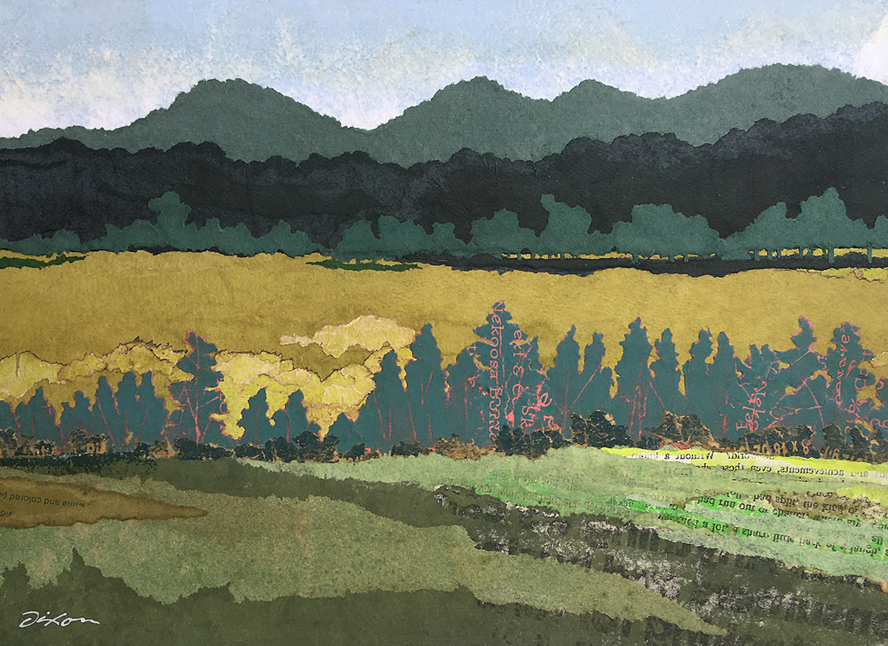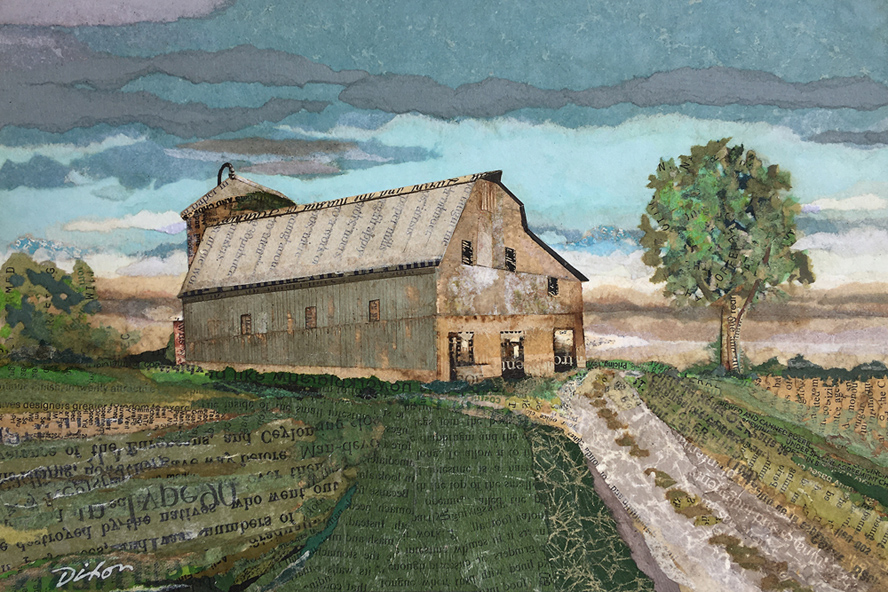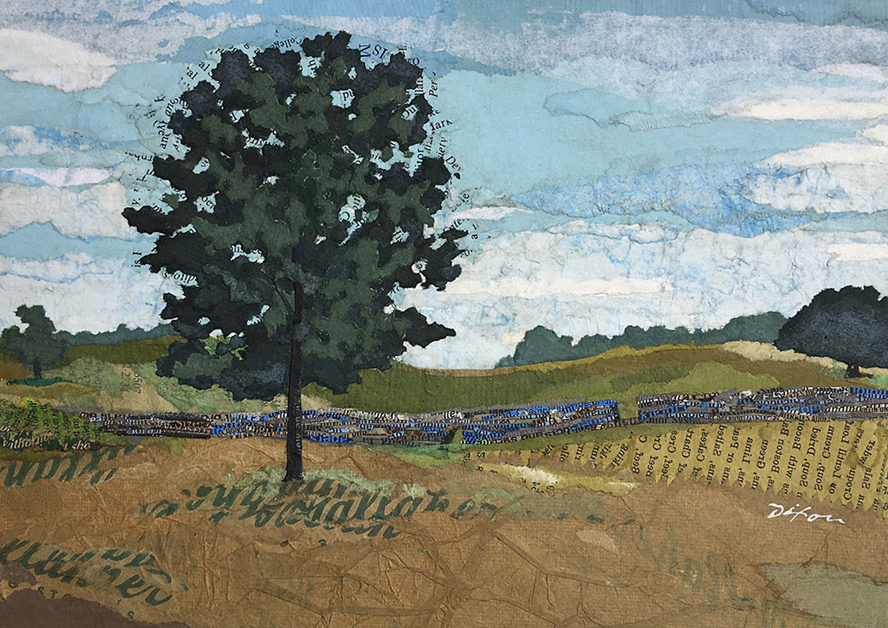
Posts Tagged ‘landscape’

PAACK kicks off 2022 season!

Thursday, April 14th, 2022

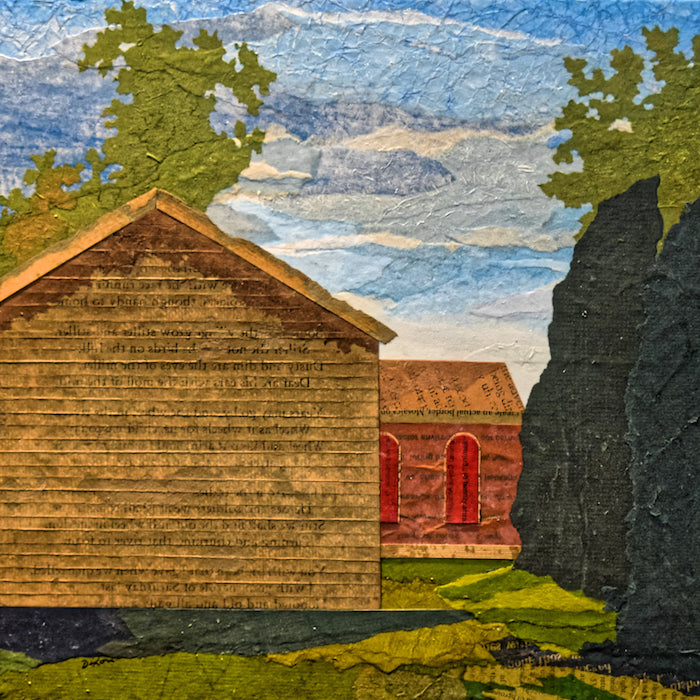
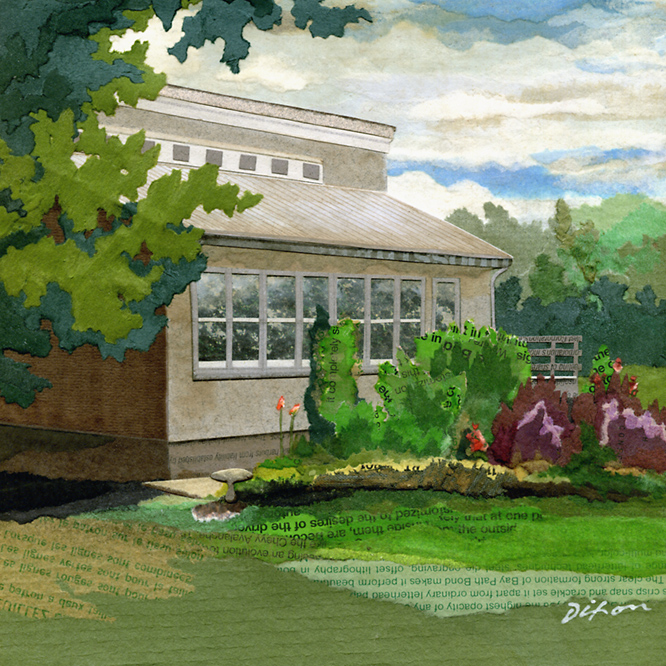
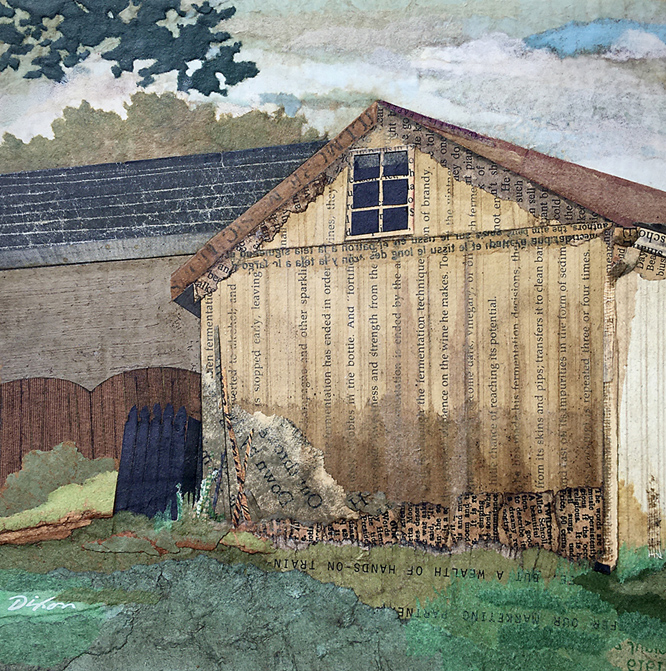
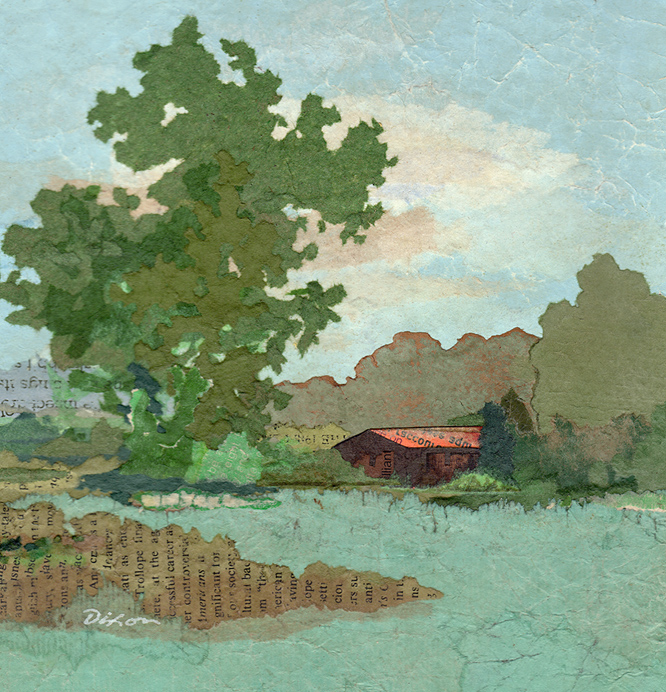
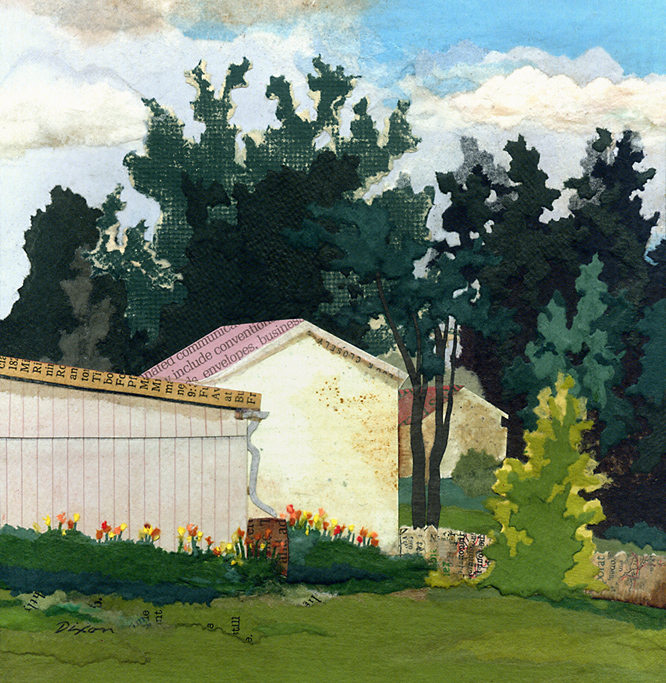
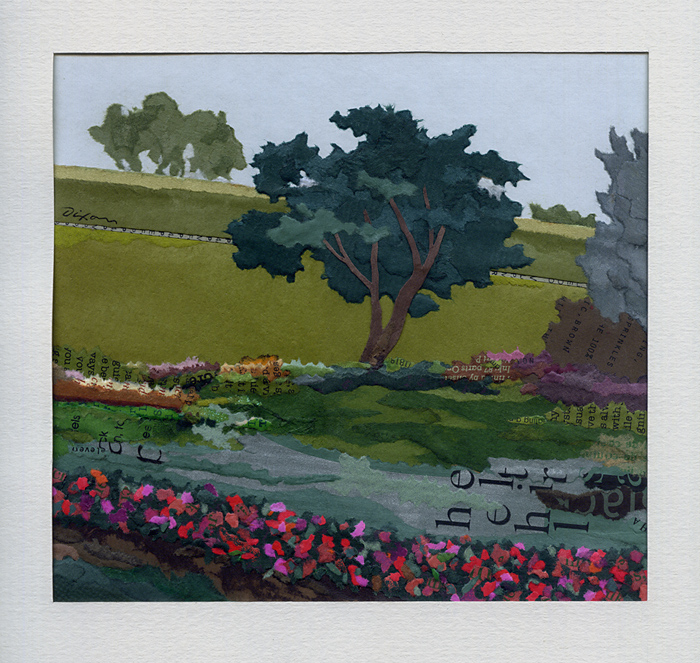
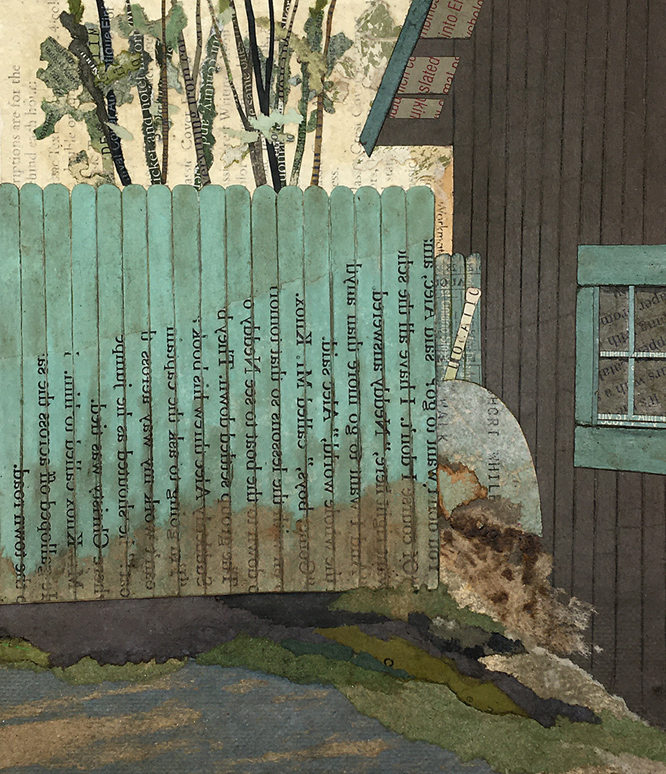
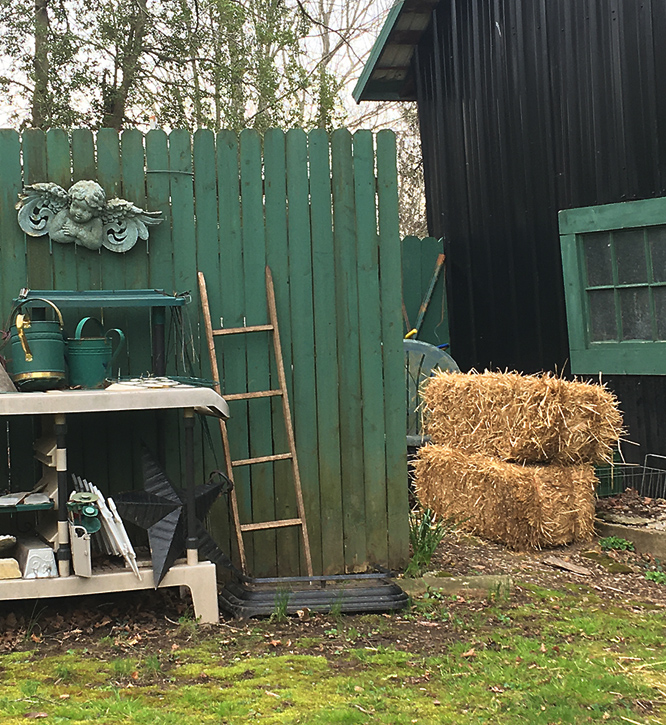
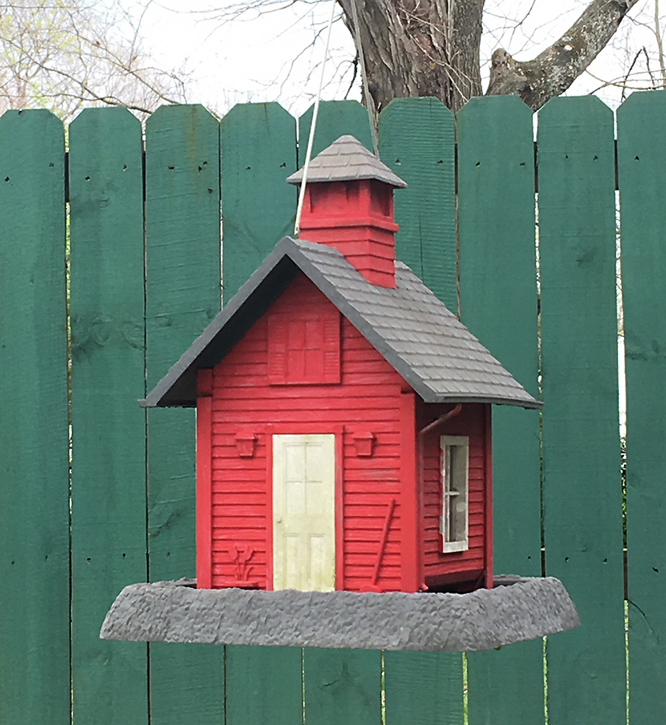
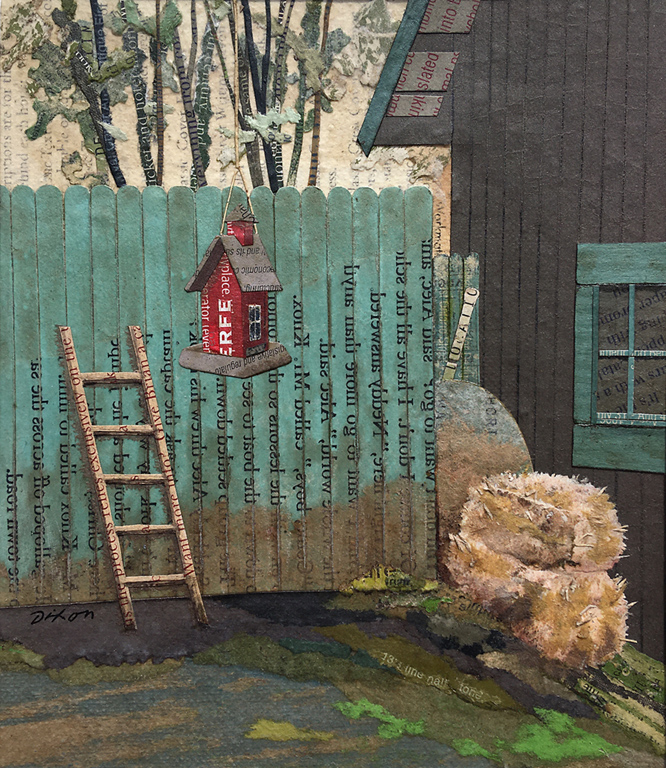
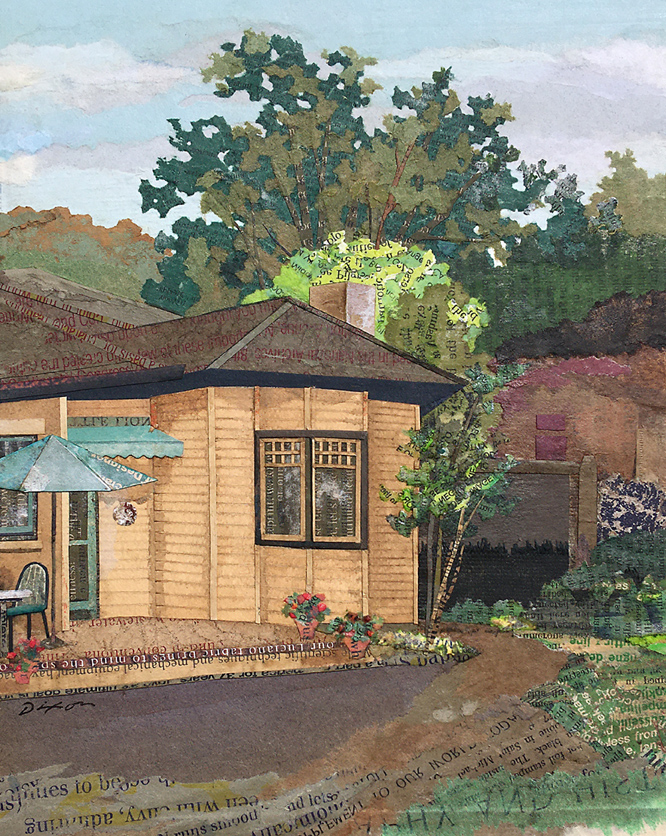
I really enjoyed PAACK’s chilly kickoff outing at the home of Mrs. Penn. As everyone began to focus on her exploding flower beds, I turned my attention in the other direction (for some odd reason). I couldn’t deny an interest in her staging nook near a teal fence (in the same way I was captivated by the back of Tillie’s garage last year). I’m completing the collage I started that day, and it will be a challenge to finish it for our summer show within the 50:50 limitation. I wouldn’t mind interpreting the gardening table, but I’ll need to omit that element to pull this off. I’d rather “move” the nearby bird feeder into my composition for a splash of complementary color, and also to find some way, within the remaining time, to “paint” the hay bales with paper ingredients.

Do I have to count the minutes I spend staring at my reference photo?


My 50:50 time constraint will necessitate simplification,
but inserting the colorful bird feeder is a given!

Tenth chapter — Painting from nature with paper . . .

Saturday, February 19th, 2022

“Follow the ways of natural creation, the becoming, the functioning of forms, then perhaps starting from nature you will achieve formations of your own, and one day you may even become like nature yourself and start creating.”
— Paul Klee
 

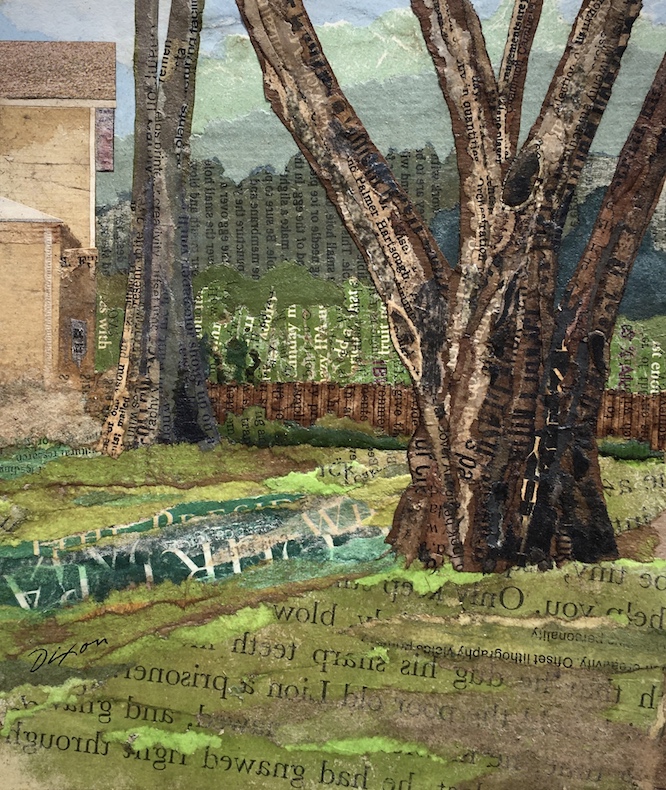
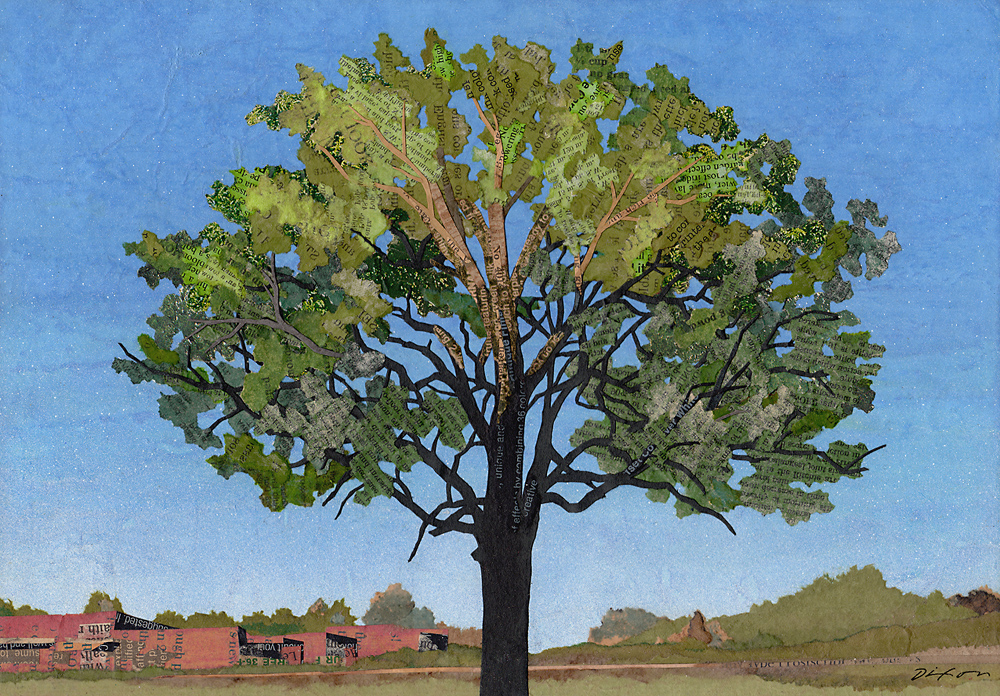
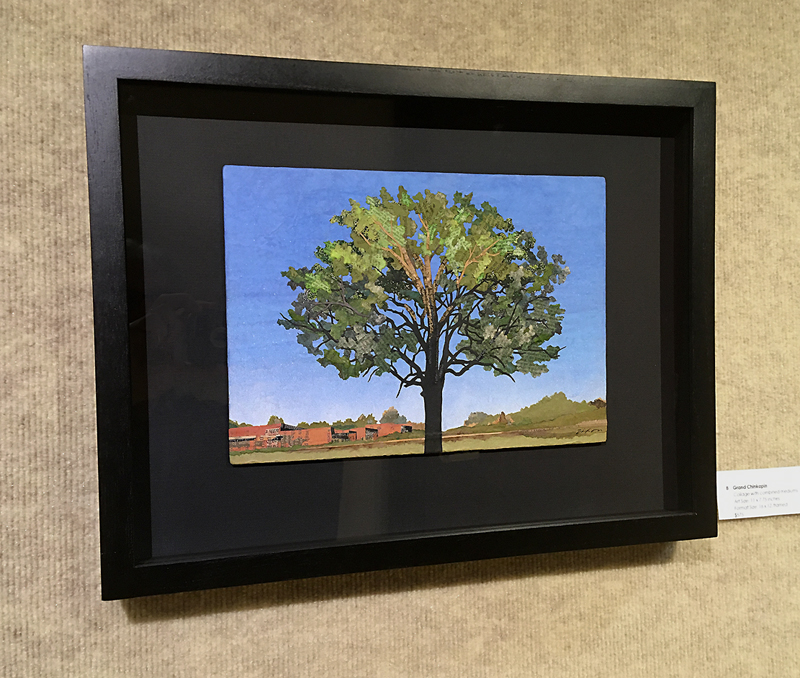
As I pushed toward the hanging date for CHANGE OF SEEN last month, I pulled out an unfinished work. In 2020 it had been my hope to complete it as part of the Paint By Nature entry — an interpretation of an urban oak tree. Everything was done except for the tree itself, which I’d wanted to paste together in a burst of spontaneity. The “start” went into cold storage when I ran out of time for two submissions. Fast forward to January 2022. Now I had the ideal scenario. My tight deadline would not allow me to indulge any slowdown or second guess. Positive, unanticipated things often happen when I occasionally challenge myself to work under a severe constraint. The hesitant, rational mind is sidelined in favor of an intuitive response that is rooted in everything one has ever created. This can be the case with music, writing, or nearly any artistic format, but the phenomenon especially lends itself to painting.

Interestingly, I’ve always preferred watercolors to other paint mediums because of its unpredictability and the “happy accidents” that occur. I admire oils greatly, but they hold no attraction for me as I approach my 70s. I hadn’t expected to discover that “painting in papers” could captivate me so and knit a reverence for nature into my art. One of the primary appeals of collage is total flexibility. It’s almost impossible to make a blunder, if one stays “in the zone” without letting the intellect gain an upper hand. When others use words such as exacting or meticulous to describe what I do, it usually throws me, because I consider my approach as more instinctive. And yet, there is no denying the presence of “artisanship.” With any task at hand, craft is essential. It was drilled into me with rigor after I chose the path of applied design. (That the young are asked to dedicate themselves to a particular discipline and to ignore countless alternatives is a weird fact of life. Many of us spend decades unraveling it.) So, a certain precision is fused into my method, even when I’m racing the clock. One man’s chaos is another man’s perfectionism.

I’ve lived my adult life trying to spin creative gold in a studio of one sort or another. A supremacy of the natural world in my youth had been set aside as part of an itinerary toward the graphic arts profession. Reflecting on a long journey that leads to the ever-rolling “now,” I recognize that nature was always calling. It influenced my leaving big cities for a smaller community. It provided a firm foundation for my diet and a health-oriented lifestyle. It was an unfailing source for well-being when conditions seemed out of balance. Even so, an unsatisfied need remained elusive until I finally took paper and paste outdoors, where the potential for inspiration was out of arm’s reach. That I could respond with collage, and find it so rewarding, is something I hadn’t foreseen.

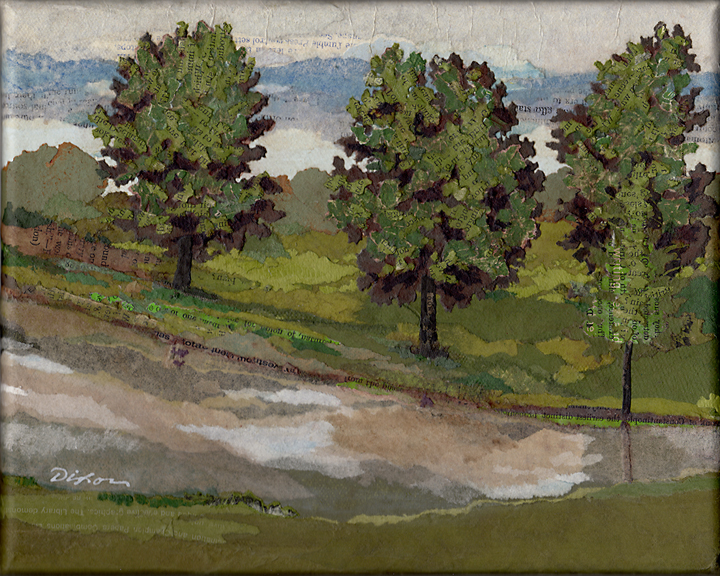
If you want to start with the first chapter, you can find that story here. It’s been almost five years of direct observation, and I’m itching to begin a new season of working en plein air. The broader point I’d like to make is how the experience also has invigorated the way I approach representational collage in the studio. It feels like it’s all been funneled into an evolving intuition. Working outside has transformed how I make visual decisions even when using photographic reference under pressure, as I did with Grand Chinkapin. After quickly preparing piles of printed scrap that seemed appropriate for tree foliage, I was able to explode those ingredients into place with a minimum of conscious thought — not unlike I try to do every time I take my collage kit on location. “Painting from nature with paper” has become a more integrated practice, inside or outside. Change of Seen shares this adventure with others.


Grand Chinkapin
collage with combined mediums by J A Dixon
0% / 100% — site to studio
11 x 7.75 inches + shadow-box frame

•  S O L D

Wednesday, January 26th, 2022

CHANGE OF SEEN
collage landscapes by John Andrew Dixon

curated by Kate Savage, Arts Connect
for the John G Irvin Gallery at
Central Bank, Lexington, Kentucky

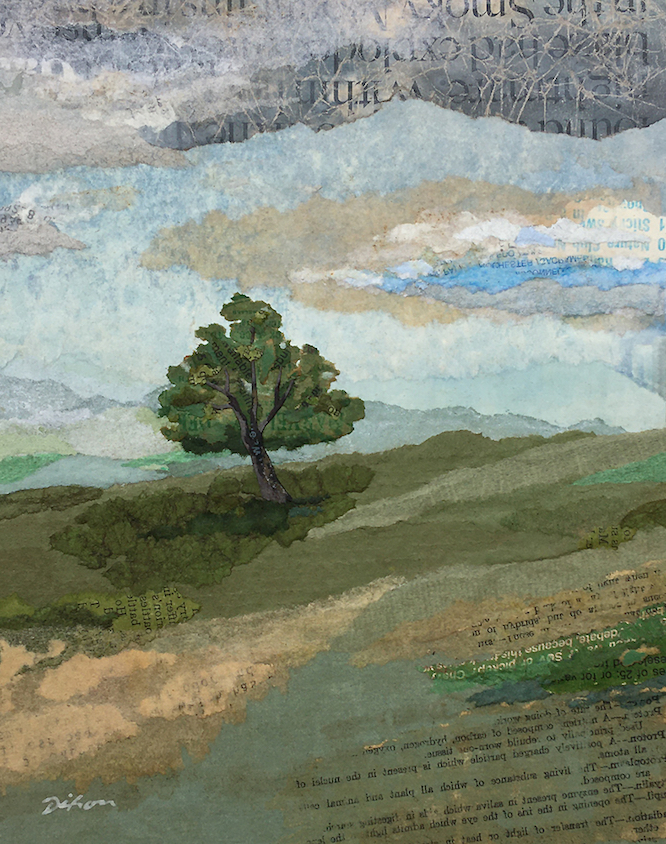
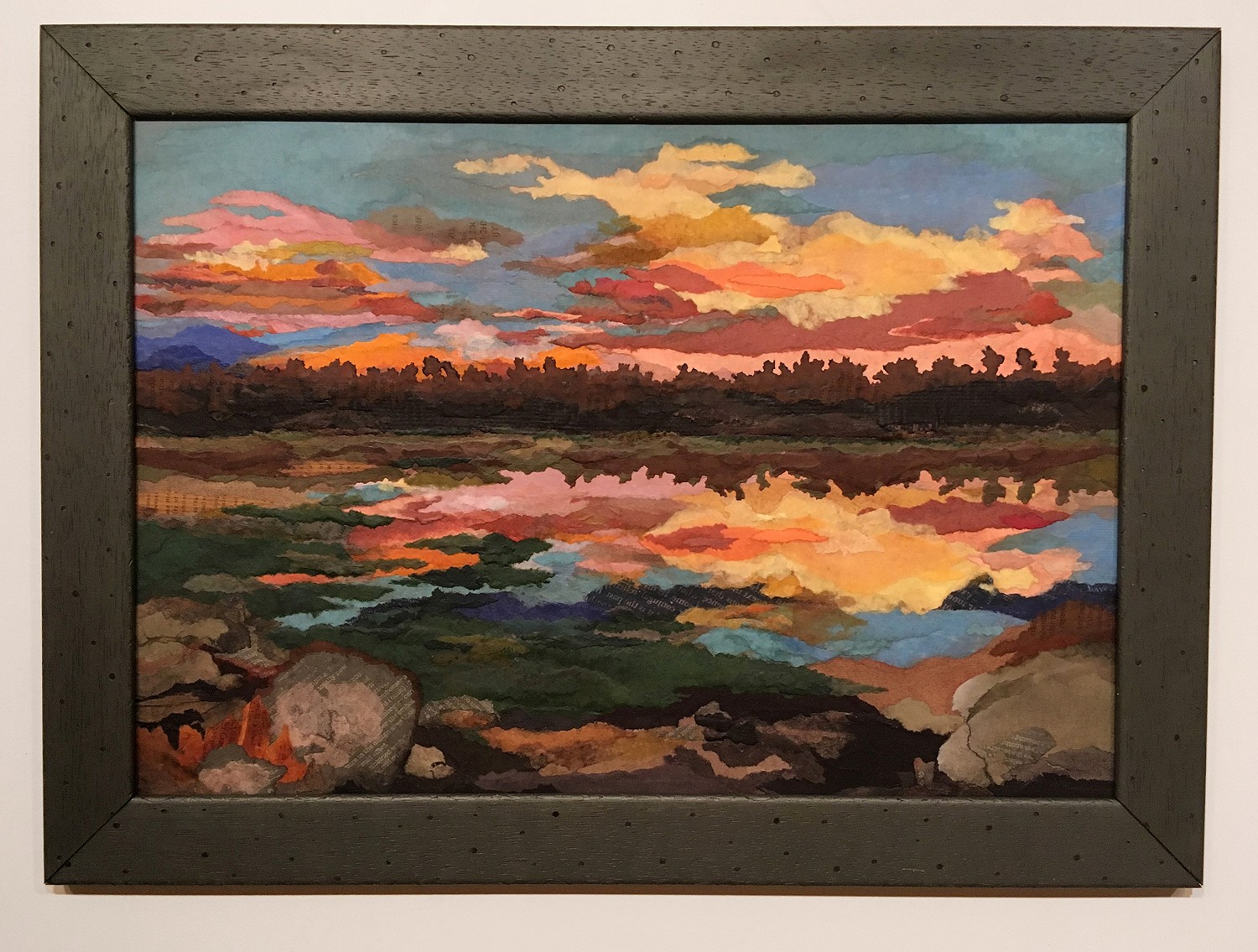
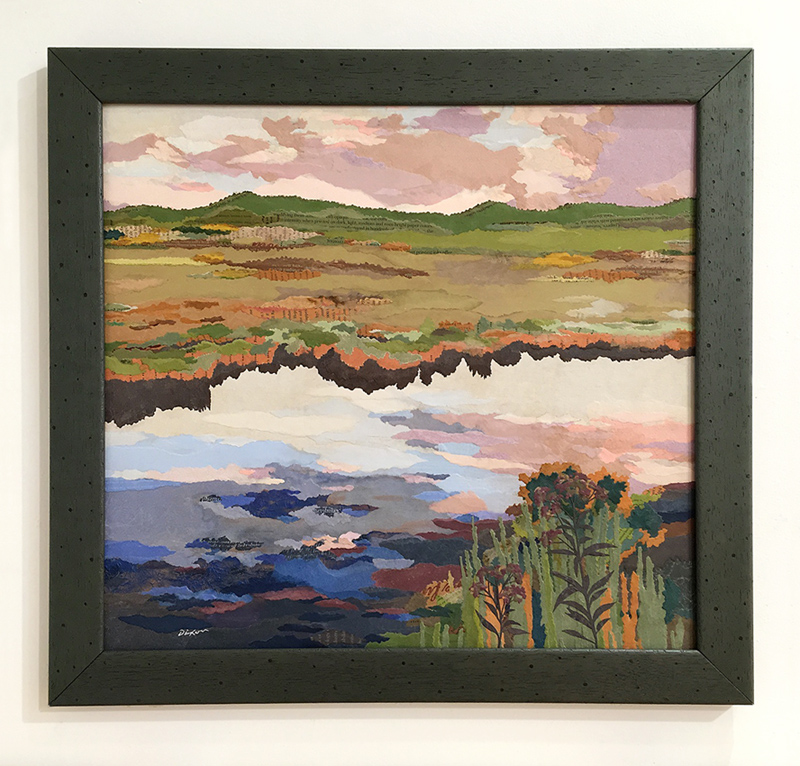
Below are a pair of small skyscapes that I finished just before hanging “Change of Seen,” my collage exhibition curated by Arts Connect for a two-level bank gallery in downtown Lexington — 31 works total. A couple of studio miniatures seemed a fitting addition to what coalesced as my first all-landscape display and a retrospective of sorts for my five-year journey into representational collage. All during 2021, I couldn’t take my eyes off the changing sky, or stop thinking about how I might interpret it by pasting colored paper, tissue, and reclaimed tea bags. These two pieces are from imagination and memory. I kept layering torn ingredients until I was satisfied with the impression.

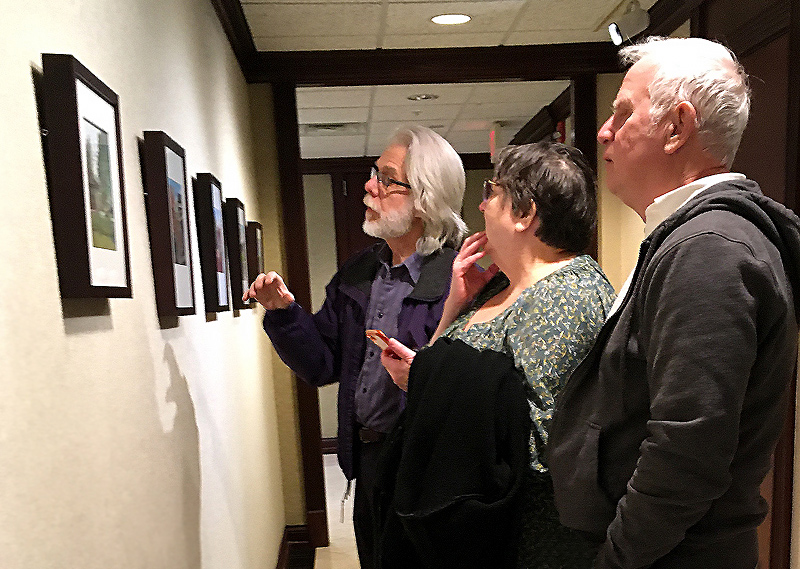
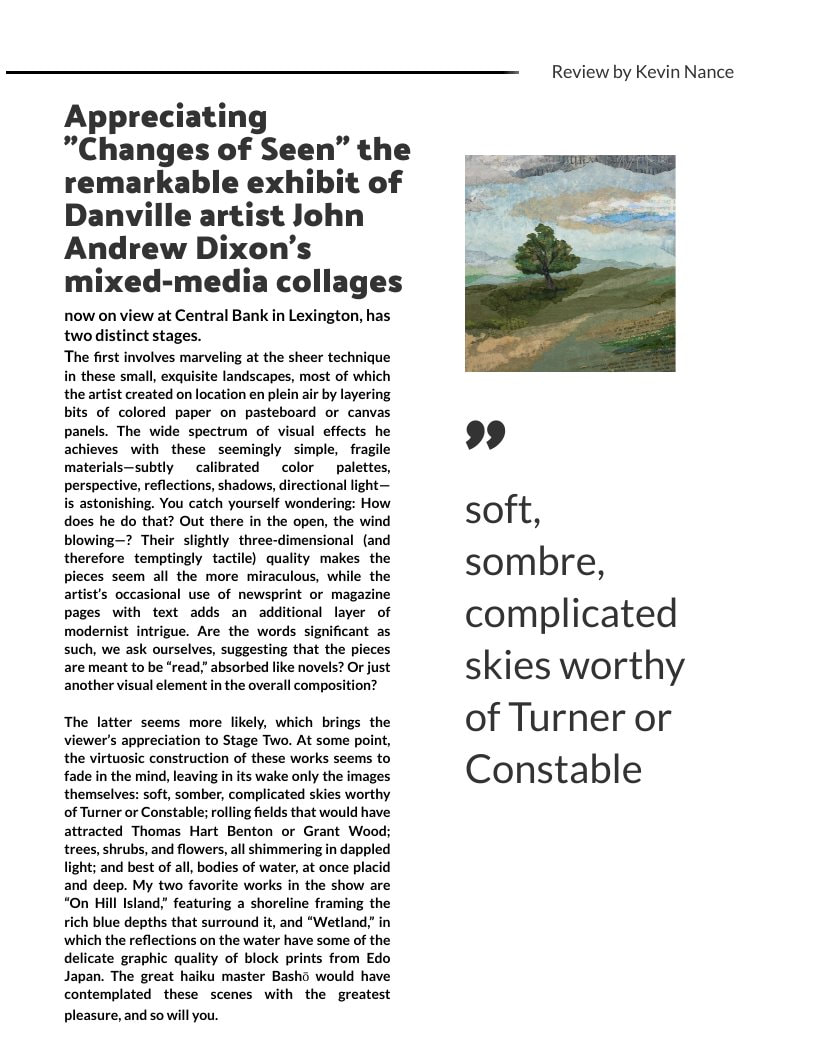
Kevin Nance wrote a brief review of the show that was perhaps too flattering. It’s been almost a week since the opening and my feet aren’t fully back on the ground yet. I cannot imagine a more able curator/impresario than the assiduous Kate Savage, a tireless catalyst for all things ART in our Bluegrass region. As just one of the multiple services she’s offering to help spread the word, her non-profit will sponsor a shopping page at the Arts Connect website during the run of my exhibition.

Please check it out!


Rose at Daybreak
collage miniature by J A Dixon
6 x 7 inches

•  S O L D


Summer Sundown
collage miniature by J A Dixon
6 x 7 inches

•  S O L D

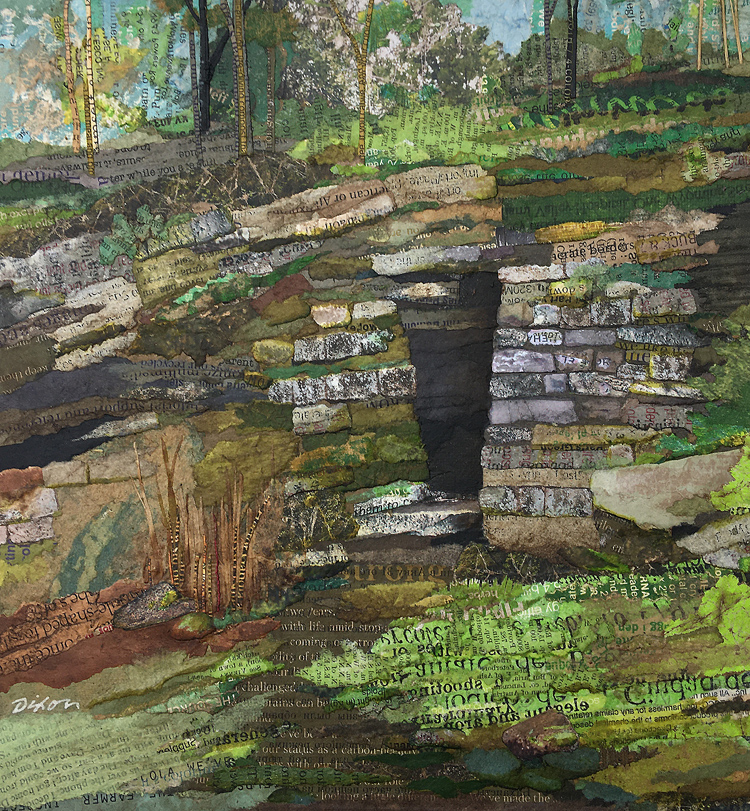
Cave Spring | 2019-2021

Friday, October 29th, 2021

“The most important thing
a painter can do is find
a good place to sit.”
— J.E.H. MacDonald
 

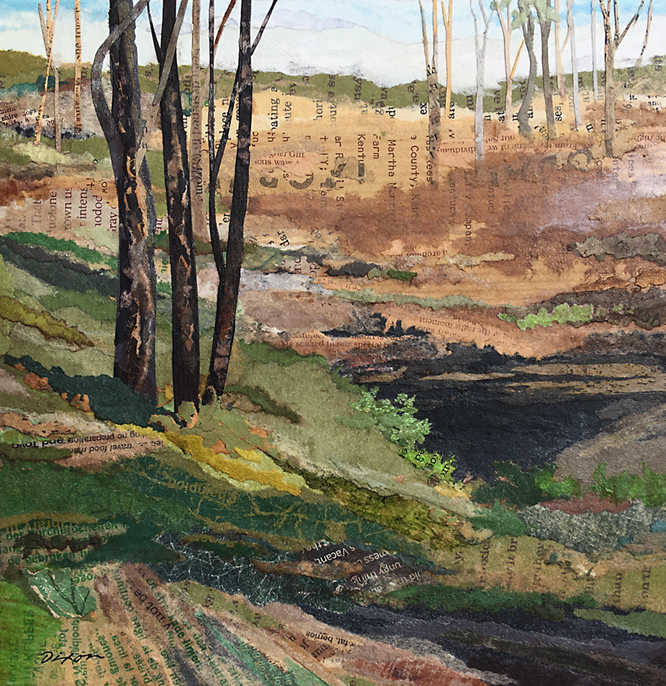
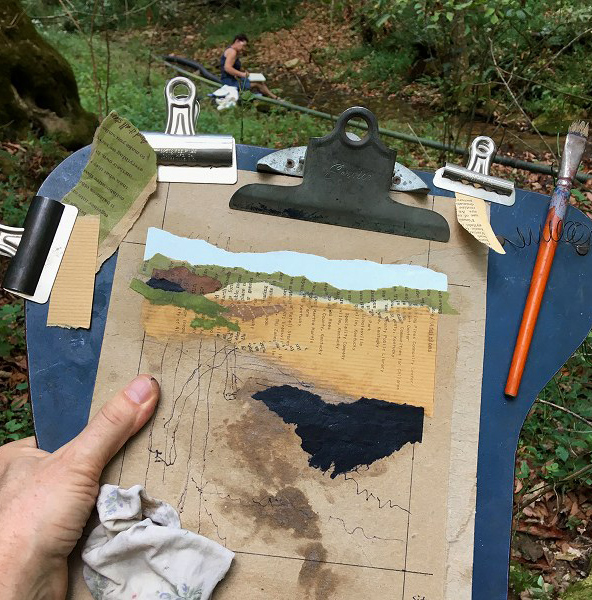
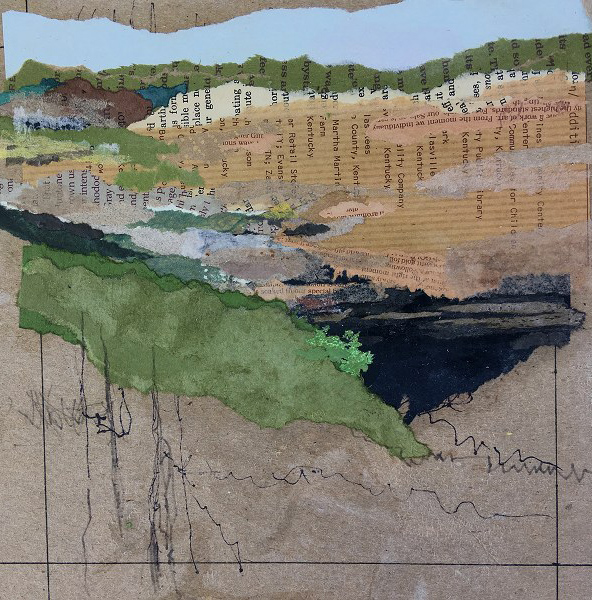
I started this miniature on location in 2019, deep into a hollow that reveals a natural site which offered the only large amount of “refrigeration” available to Kentucky pioneers in the region. My vision for a final look required more indoor time than could ever meet a qualification for en plein air. Paper can be a stern schoolmaster in the studio at times, and I’ve been known to get prickly under his tutelage, but Mother Nature smiles when I “return home.”


(above, left) A collage ‘start’ in the woods taking shape on my clipboard.

(above, right) The completed location work fell short of a finished landscape.


Cave Spring
collage miniature by J A Dixon
started on location / finished indoors
7.25 x 7.5 inches

•  S O L D

Eighth Chapter: Annual PAACK show opens . . .

Friday, August 27th, 2021

En Plein Air
an exhibition of recent
work by the Plein Air
Artists of Central Kentucky

It’s been an exceptional season for making art outdoors, and our local Art Center of the Bluegrass is currently presenting many of the resulting creations. I have six collage miniatures on display as part of the show. Enjoy the exhibit in-person or browse the virtual gallery until 9/11.

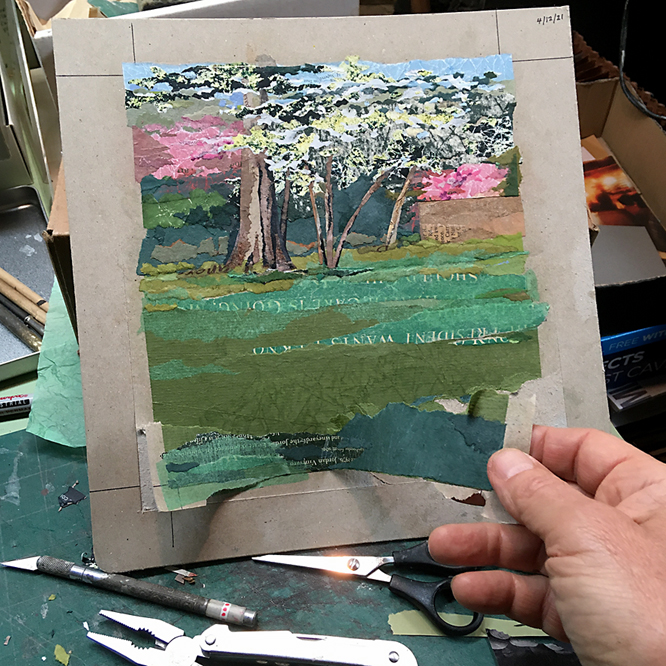
One of the highlights of the spring was our gathering at the backyard of Lee and David Simpson, with its quiet explosion of white and pink dogwood trees. They were certainly calling attention to themselves here and all over Danville. What a perfect day to be outside with the PAACK and “painting with paper,” thanks to my mobile collage kit. After some initial work, I gradually became convinced the scene was taking shape. As location coordinator for the day, I’d gotten off to an awkward start. I eventually came away from the pleasurable day with a solid interim stage, but as I began to finish the trees in the studio, it was clear that the piece needed more than details to improve it. When I decided that the foreground was too deep, I impetuously peeled off the base and moved it up an inch or so — after all, this is collage. That one modification helped everything about the look. The rest of the process became obvious. If I reinforced the sun-activated colors and spent a bit more time with the fence area on the right side, I could declare it finished, as long as I stayed within an overall time allocation that was legitimately en plein air. I was pleased to achieve a 70%/30% solution.
Whenever I gather under the sky with traditional landscape painters, their impressive work challenges me to “do my thing” with paper. With each outing, it’s feeling more like I’m painting, too! This was true in May, when we spread out to interpret the country home site of Paula and Ken Scott. A particular view of their wrap-around porch and surrounding garden captured my eye. I wanted to combine some hard-edge cutting with my evolving “brushstroke” technique. As is often the case, I pushed the finishing touches back in the studio to the 50/50 limit, matching my location time with more detailed refinements indoors. I’m still trying to solve how to bring something closer to a level of interesting density while still outside. Perhaps I’ll find that, by necessity, a totally site-based collage needs to be simpler in expression and more decisive in composition. A milestone in June and the subsequent Paint the Town experience would drive home the point, and also emphasize the importance of having a supply of “prepared papers” on hand to boost speed and expand my available vocabulary of effects.
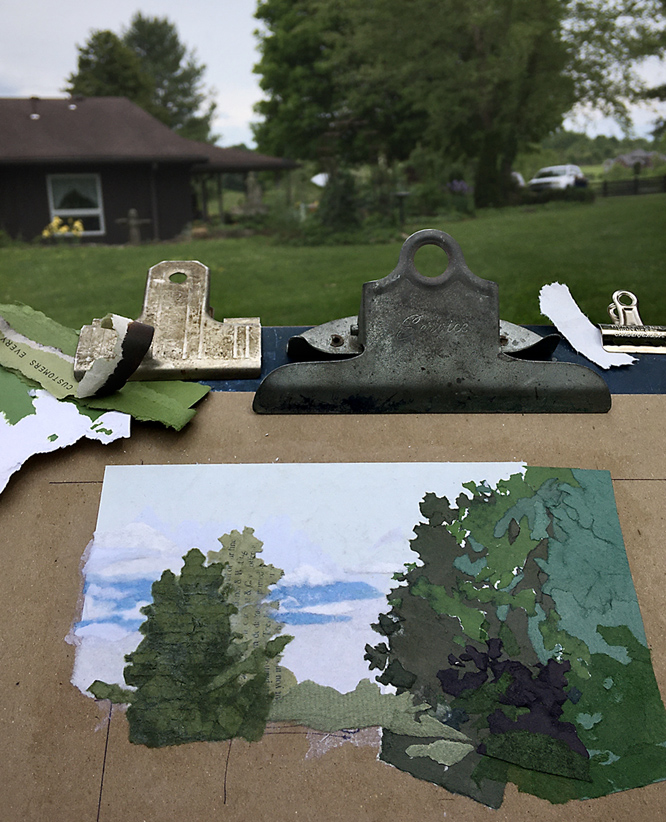
I like to work outside because I like to be outside. When I formerly thought of myself as an amateur triathlete, I’d cross-train right through the hottest days of the summer. It doesn’t bother me to extend an Art Out into the late afternoon. Sometimes the morning shade has long since abandoned me. If I’m well into the groove, I can barely notice. Before I get totally off the subject here, I should state that I actually rely on direct sunlight to promote the drying of my collage surface, since I’m usually working wet-on-wet. A good example of this was the day PAACK gathered in the nearby Forkland community. I don’t fault others for finding a shady spot to paint. I set up not far away in the open sun.

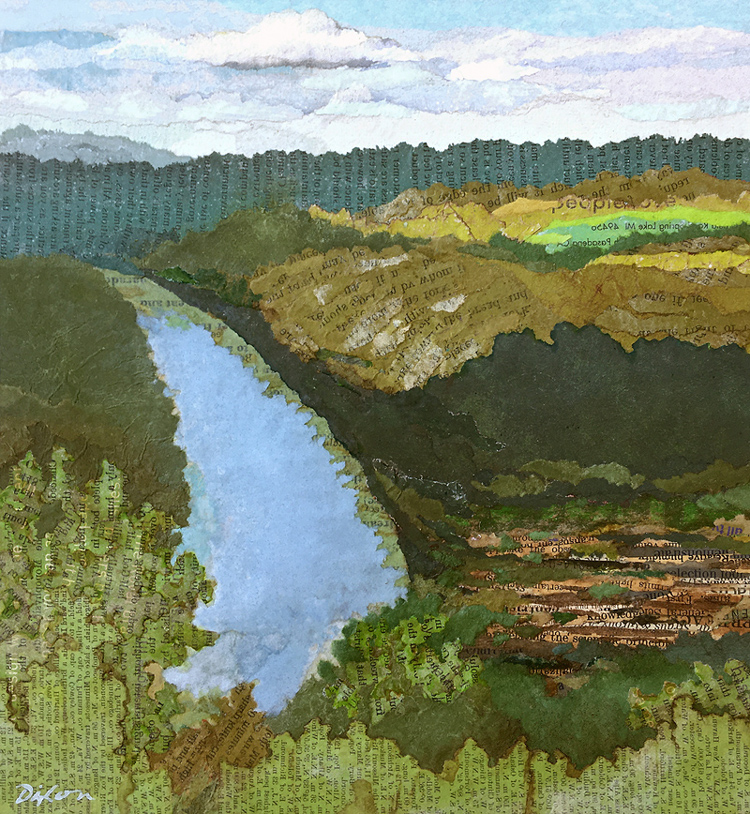
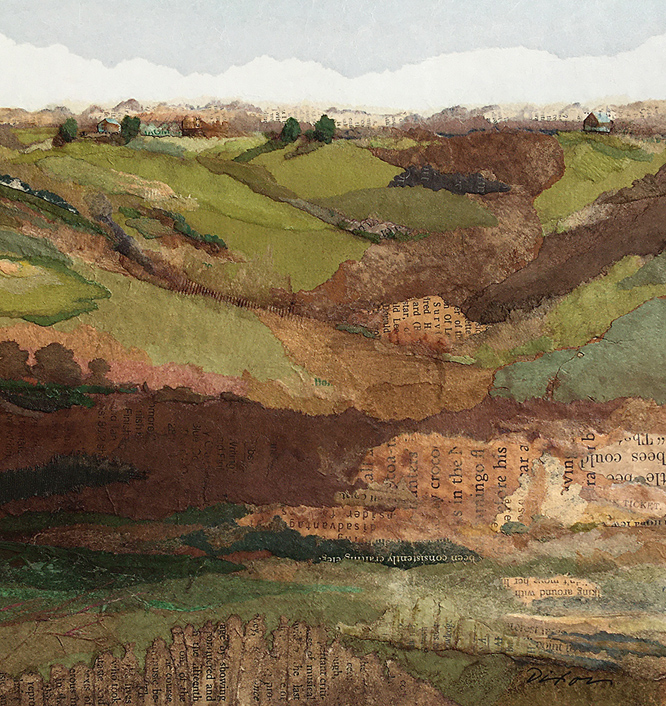
In the decades since this Ohioan adopted Central Kentucky as my permanent home, I’ve developed an affection for the distinct topography and knobby woodlands of our area. Sure, the famous horse farms and limestone palisades are always handy, but I’ll never get enough of the unique contours of a “gumdrop horizon.” The Forkland community, which straddles three adjacent counties, was a destination that fit my attachment to “The Knobs”. The result was On the North Rolling Fork, one of my favorite landscape miniatures of the year.


Dogwood Day
collage miniature by J A Dixon
70% / 30% — site to studio
8 x 7.75 inches

•  S O L D


Country Porch
collage miniature by J A Dixon
50% / 50% — site to studio
7.75 x 7.75 inches

•  S O L D


On the North Rolling Fork
collage miniature by J A Dixon
50% / 50% — site to studio
8 x 7.75 inches

•  S O L D
Best in Show: Sycamore Reach

Monday, January 11th, 2021

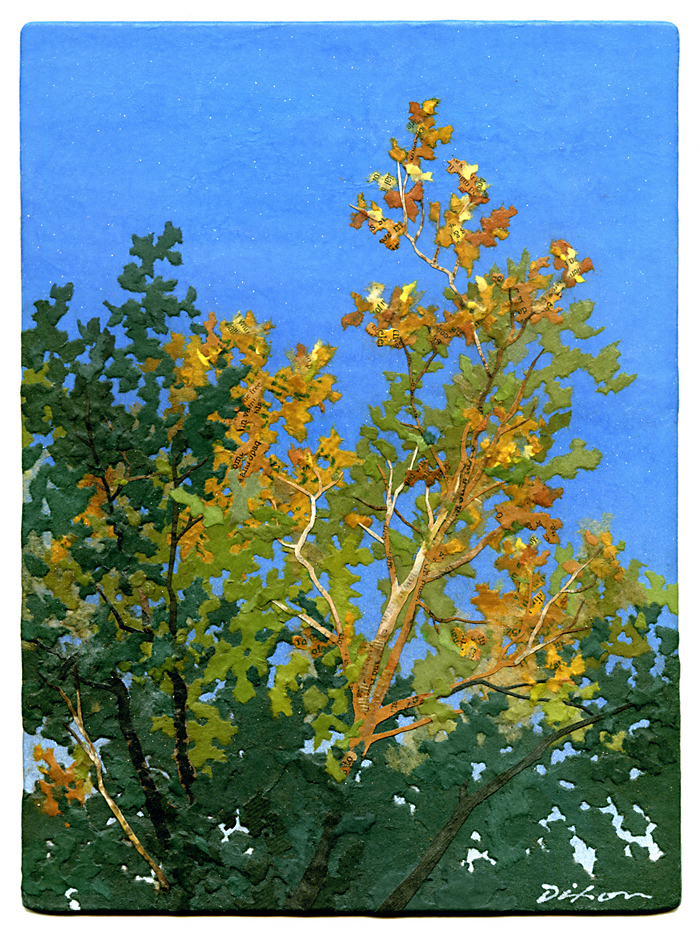
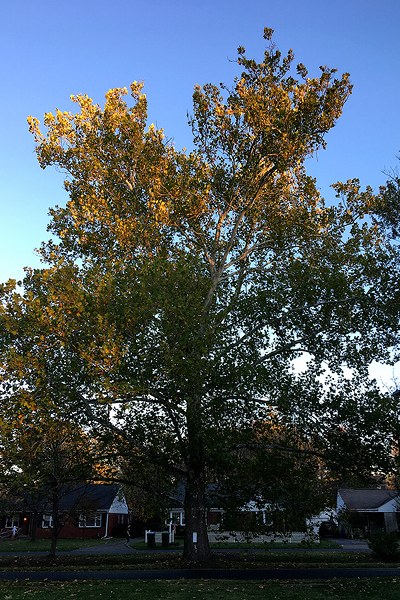
The sun was setting. Late November light penetrated the very top of a tall sycamore. It looked as if the tree was reaching up into the deep blue sky of autumn to capture the final rays.

The email notice stunned me for a moment. Sycamore Reach, my latest example of “painting nature with paper,” had been chosen for a top local prize. I knew I’d worked at the pinnacle of my abilities, and my fingers were crossed that it might be well received, but it was an unexpected thrill nonetheless. My surprise soon gave way to satisfaction, and I was left with the fullness of gratitude — a good place to be left.

Paint by Nature: Trees was a stimulating opportunity to bring into the studio everything that I learned from another season of plein-air outings. Using photos I took with a smartphone, my subject would be a grand American Sycamore that inhabits the median of Lafayete Parkway in Lexington. I’d looked at a few arboreal candidates during my research trip to the city, including a majestic Chinkapin Oak. There wasn’t much direct illumination left when I got to the sycamore, my last destination. The lighting turned out to be ideal for a reference image.

It’s a privilege to dedicate my creative effort to promoting the important role of trees and the priorities of Live Green Lexington. My appreciation to Jeanette Tesmer, Alice Hilton, plus everyone who helped organize this nature-inspired arts event — and especially to show judge Leah Castleman, an art educator, avid painter, and outdoors enthusiast.

The exhibition is located in the upstairs community gallery of the Pam Miller Downtown Arts Center through Friday, February 26, but the center is closed “until further notice due to red zone status of COVID-19.” You’re invited to take a Virtual Tour of the show, and think of me when you vote for People’s Choice!
 

Sycamore Reach
mixed media collage by J A Dixon
8 x 10.75 inches

•  Best in Show / People’s Choice / S O L D

Knobland

Monday, October 5th, 2020

“It may be that when we no longer know what to do, we have come to our real work and when we no longer know which way to go, we have begun our real journey. The mind that is not baffled is not employed. The impeded stream is the one that sings.”
― Wendell Berry
 

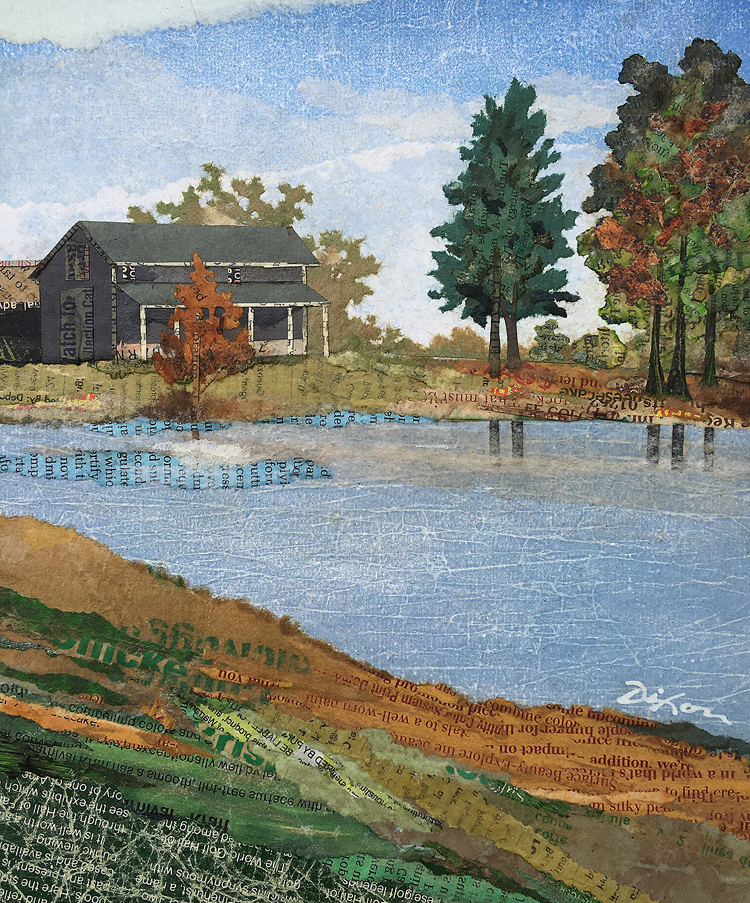
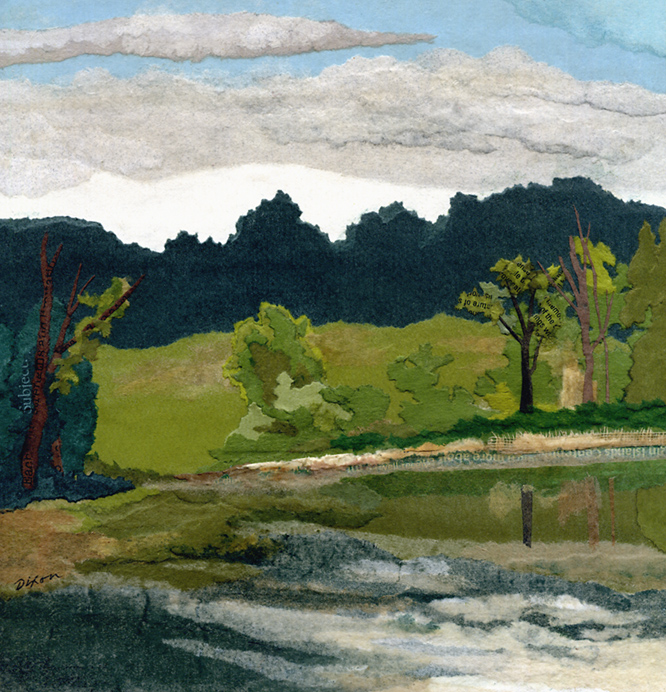
I spent a hot but glorious day with the August sun and “knobs” of Boyle County, Kentucky. At first it looked as if I didn’t need to do much with this one when I examined it in the studio, because I’d decided to ignore any evidence of habitation at the rural setting. Something convinced me that wasn’t the way to go, so I decided to plunge back in, referring back to my photo reference. As usual, I was bound and determined to avoid exceeding the time I’d spent on location or to ruin the impression that I’d already captured. I didn’t know exactly what to do. That I couldn’t leave well enough alone was clear enough. Working more from a memory of how the farmstead was tucked into the countryside, I completed the miniature within the desired limitation. To be totally honest, I still don’t know if the result is an artistic improvement, but the presence of people with a relationship to this particular natural place ended up being an overwhelming necessity for my landscape. You can be the judge of its final merit as well as I.
 
 
Knobland ~ plein air collage miniature by J A Dixon

Knobland
plein air collage miniature by J A Dixon
50% /50% — site to studio
6.9375 x 7 inches

•  S O L D

Final Line

Tuesday, August 18th, 2020

As the full impact of navigating a declaration of pandemic struck everyone in early 2020, there was an activity that offered the sense of continuity many of us needed and a behavior that provided the social distancing all of us were expected to fulfill — a new season of creating artwork en plein air which allowed us to experience nature directly as an individual. In retrospect, I found it to be a profound source of consolation in a period of unprecedented disruption.

The first PAACK “art out” that I joined this year was a day at Perryville Battlefield, considered one of the most pristine sites where a Civil War conflict took place. There was a distinct awkwardness in the air when we met at the gathering point, but everybody soon shrugged it off and dispersed to scout locations. I found an appealing view of a hilltop and tree line off Oscar Bradley Road. A marker designated the location as where the final line of Union troops overlooked a strategic crossroads. I took a softer, more abstract approach with torn paper than I previously had. Perhaps it was something to do with a clear impression of being on hallowed ground. I left with a solid interim piece of work and strong feelings that went beyond artistic gratification. It didn’t take much follow through in the studio to complete this one to my satisfaction.
 
 
Final Line ~ plein air collage miniature by J A Dixon

Final Line
plein air collage miniature by J A Dixon
65% /35% — site to studio
7 x 7.0625 inches
collection of the artist

I finally help to “paint the town” of Lexington!

Friday, July 17th, 2020

 
Paint the Town is an annual plein-air-oriented landscape exhibition in Lexington, Kentucky. The parameters of the traditional twelve-hour event are strict, and I’ve always had the notion of it as a flat-out competition — sort of a bass tournament for artists, if I may indulge a silly exaggeration.
 
 
With the current societal restrictions having caused so many art shows to be postponed or cancelled, it’s a distinct credit to ARTSconnect that a way was found to make the event happen at all in 2020. The Pam Miller Downtown Arts Center reopened to host the exhibition. Many of the more stringent guidelines (and, sadly, all the hospitality enhancements) were stripped out of this year’s version.

I’m willing to admit that the relaxed standards were enough to convince me to take part, not having participated in this kind of gig before. I was eager to gather what I’ve learned from my plein-air experience and “paint with paper” in the studio. The goal was to fuse the spontaneity of working outdoors with a more deliberate process that I’ve explored by using photo references to create a larger landscape on panel. I can’t be more pleased with the results. I continue to incorporate white tissue for desired cloud effects, and I’ve come to rely on reclaimed teabag material as a beneficial adjunct to colored papers. I work at not overdoing tinted sealants, but the added depth is worth a cautious, mixed-media enhancement (especially when I mix acrylic gel medium with a rare portion of walnut juice from Richard Taylor).

Please take a Virtual Tour of the show. My 90-second sound bite is included, or you can listen to the audio by clicking here. Of course, there’s a YouTube video of all the artwork, too. My two collage miniatures enjoy some great company, and it pleases me to point out that juror Bruce Neville designated Byway Corner with an Honorable Mention. Current gallery hours at the Pam Miller Downtown Arts Center are Wed/Thurs/Friday, noon to 5pm. The show lasts until August 3, 2020.


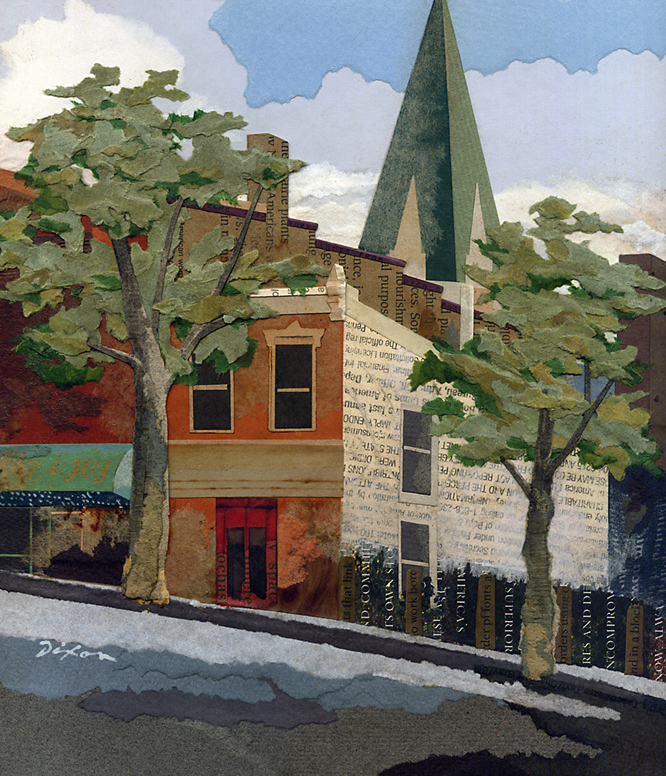
Byway Corner
collage landscape by J A Dixon
7 x 7.125 inches
available for purchase

•  Honorable Mention


Along Market
collage landscape by J A Dixon
7 x 7.125 inches
available for purchase

Fifth Chapter: Sparring with the breeze . . .

Saturday, October 5th, 2019

“This idea of having something that isn’t quite in focus, something that isn’t quite understood, is interesting. I think details that are over-plentiful, details that are very dense, are lifelike. They exist in natural environments. Forests have a huge amount of details, because they are not built on a human level, so they are impossible to analyze at first glance, and I think we can only recreate what nature has done already, so I don’t think that the idea of simplifying something is a good thing.”
— Édouard Lock
 

August and September provided a stretch of exceptionally dry weather that was a disappointment for farmers in the Bluegrass, but valued by our intrepid PAACK of regional artists who work out of doors. I was able to create three more satisfying landscape miniatures.

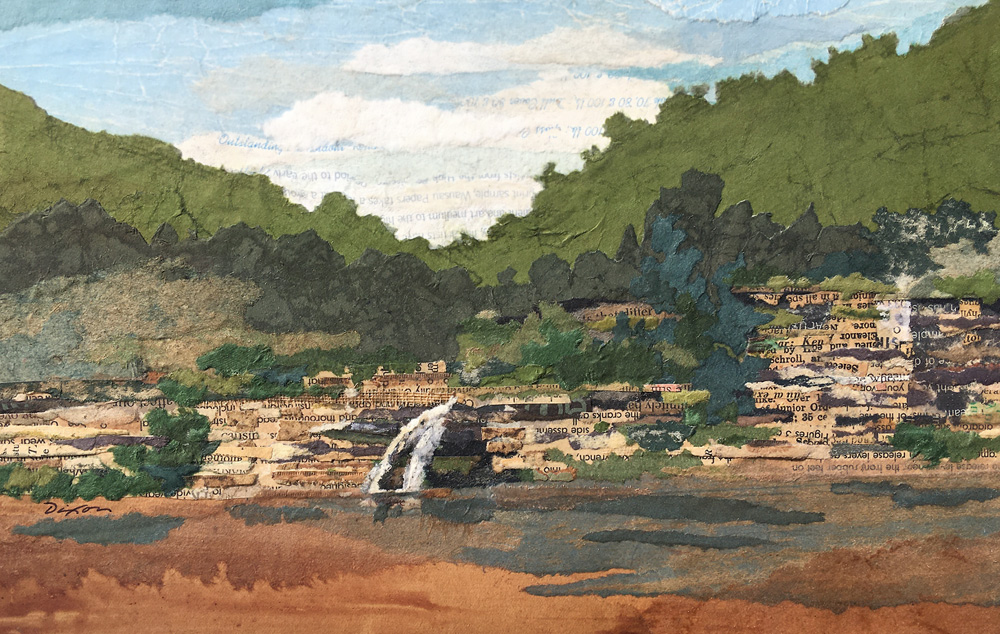
Those who have followed this sequence of descriptions realize it hasn’t been that long since I met the challenge of doing collage en plein air. It has evolved as a gradient progression of discoveries. I’ve learned to think of my application of paper ingredients as a density of “brushstrokes” rather than the placement of simple design elements into a composition. The two-year process has brought my artwork from a crafted illustration with cleanly pasted elements to a more layered, painterly effect. I’m tending to work wet-on-wet, using sandpaper and blades to score and feather edges. The thickness of papers is torn into “veneers” with areas that can achieve a blended translucency, and I’m more routinely taking advantage of recycled tea-bag “skins” to add warmth, texture, or visual softness. I continue to use three different liquid adhesives — wheat paste, white glue, and polymer gel — which offer contrasting levels of stickiness and drying time. I saturate the paper for manipulations not available with dry material and then flatten the surface with a cloth or burnisher, depending on a desired level of dimensionality. Bits of printed text continue to appear as part of my treatment, providing subtle highlights or more overt suggestions of pattern. This growing vocabulary of techniques has given me more confidence to tackle scenes that might have looked too difficult not so long ago. Attempting to “paint” a pond fountain or a rocky outcrop with only paper would have seemed more daunting when I first started to do this.

None of it would be possible without the generosity of those who host our outings. With a spirit of hospitality, the diversity of two farms and a wonderful view of the Dix River were each made available to us for a day. I rely on a square viewing card to select my composition and the all-important place to sit.
 

A point of self-criticism: my plein-air “collage rig” had gradually crept into the forbidden zone of overkill, so I made an effort to lighten my load before the next PAACK venture.

My goal has been a self-imposed limitation of studio follow-through, equal to or less than the amount of time I spend at the original site. I was able to meet that comfortably with August Afternoon, for a 50/50 allocation. When completing Fountain and Shadow, I had to suspend my detailed labor on the central tree. I’d prefer to invest less time indoors and was able to do that with Reflection on an Outcrop (a more desirable 60/40 ratio). Having been studio oriented in my art practice, I always need to guard against allowing the concluding phase to upstage a vital plein-air impression. I’ll rely on memory as much as I do an iPhone photo taken on location. It’s also important to remind myself that, as much as I enjoy my “maximalist” propensity, the objective should be a creative interpretation instead of a literal rendering. It is, after all, a collage artwork.

Collage Madness, my joint exhibition with Connie Beale, is currently on display here in Danville, Kentucky at the Mahan Gallery of Boyle County Public Library. It has provided the first ideal opportunity to showcase my approach to plein air collage and I’ll explain my process to visitors at a Gallery Talk on Saturday afternoon, October 19th. I’ve covered a number of bases as an artist and designer, but I have to say that this has been one of the most personally rewarding projects I’ve begun. Perhaps many of you can be there to hear my remarks.
 
 
August Afternoon ~ plein air collage miniature by J A Dixon

August Afternoon
plein air collage miniature by J A Dixon
7.25 x 7.125 inches
available for purchase

 
Fountain and Shadow ~ plein air collage miniature by J A Dixon

Fountain and Shadow
plein air collage miniature by J A Dixon
6 x 6.375 inches

•  S O L D
 
Reflection on an Outcrop ~ plein air collage miniature by J A Dixon

Reflection on an Outcrop
plein air collage miniature by J A Dixon
6.375 x 6.625 inches

•  S O L D
A gallery talk about plein-air collage . . .

Friday, October 5th, 2018

“The most important thing a painter can do is find
a good place to sit.”
— J.E.H. MacDonald
 

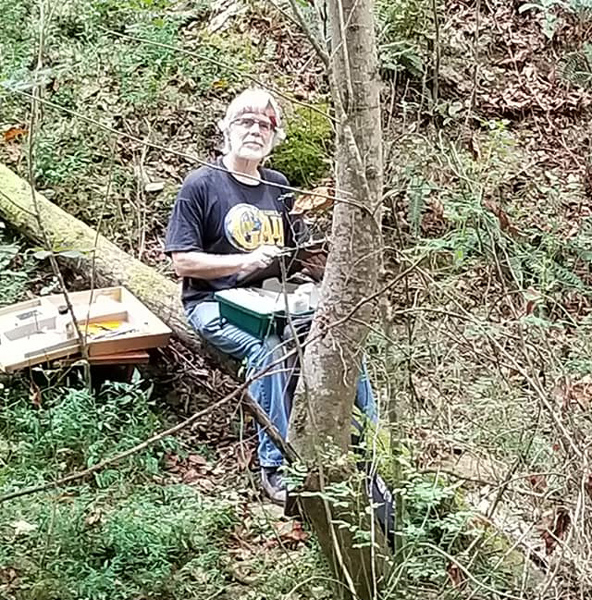
As many of you already know, my warm-season activity was sharply curtailed by a mishap that diverted much energy into healing a traumatized left knee. As a result, I was unable to take advantage of the many “art-outs” organized by our Plein Air Artists of Central Kentucky. However, I took part in their annual exhibition and was invited to make remarks at a recent “gallery talk” and describe the plein-air collage kit that I assembled last year. Here is an excerpt from my presentation:

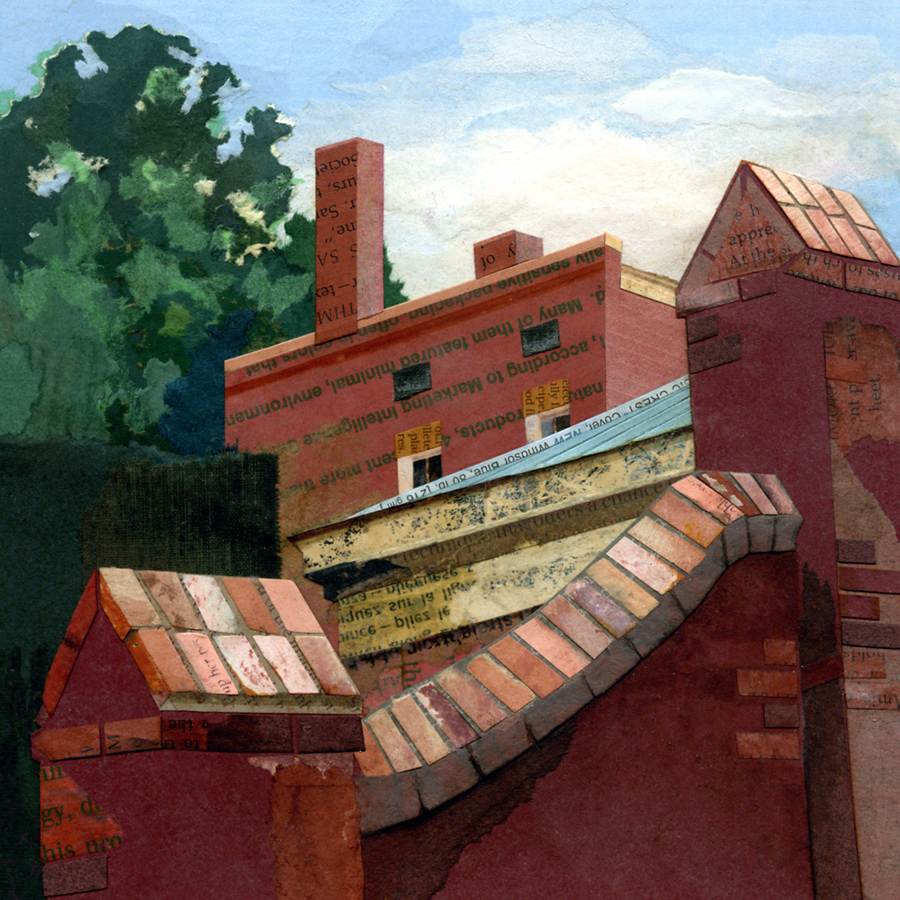
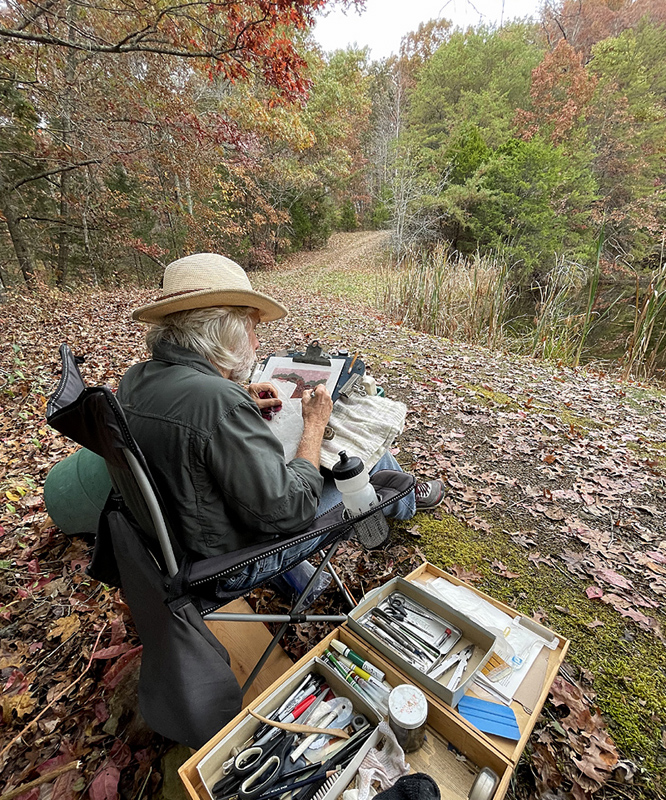
“One of the nicer things about the art-out gatherings is knowing that someone has volunteered to find a great setting, and to arrange all the details with the hosts. So, there you are, arriving at a new location filled with possibilities. Personally, I find that it’s important to not spend too much time selecting a spot to sit, even though, in my mind, the entire enterprise rests upon that decision. I want the act to be part of the overall intuitive process to which my day is pledged. For example, at Cambus-Kenneth Farm, it was tough to avoid squandering valuable minutes, since there were barns, ponds, pastures, an impressive Italianate home, and many remarkably preserved 18th- and 19th-century brick outbuildings, including an icehouse, springhouse, and slave quarters. To keep the inertia, I decided I needed to crop the setting like a photographer, using a viewing card with square window. It was a rare treat for our group to be offered the opportunity to wander among the paddocks and historic structures in such a serene environment, but a plein-air artist is on a mission, the sun does not pause, and there is no room for indecision. If an artist wants to cultivate self-trust and forward momentum in technique, a regular plein-air challenge is the way to do it.”


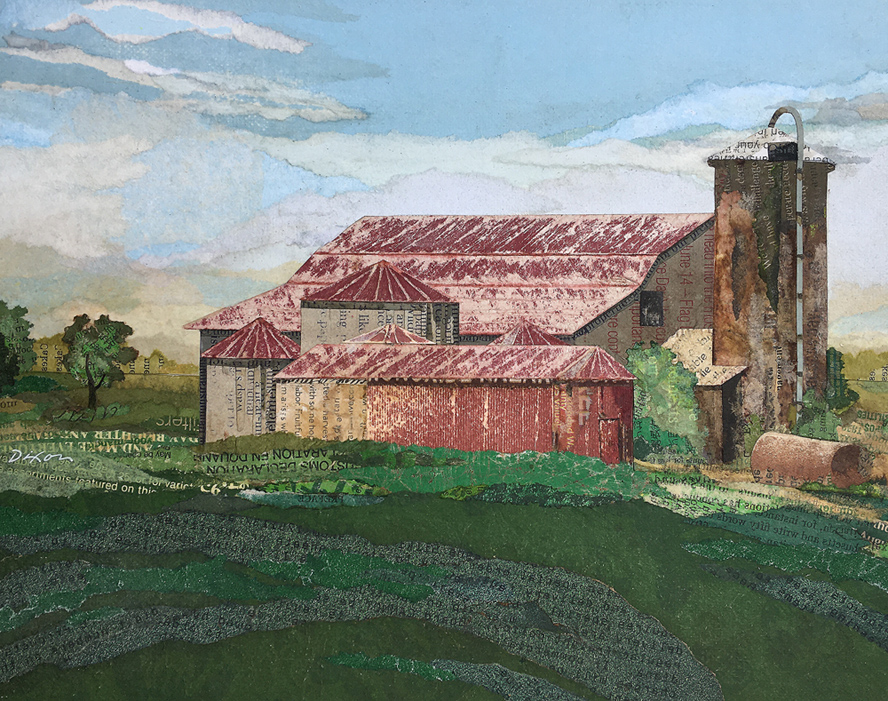
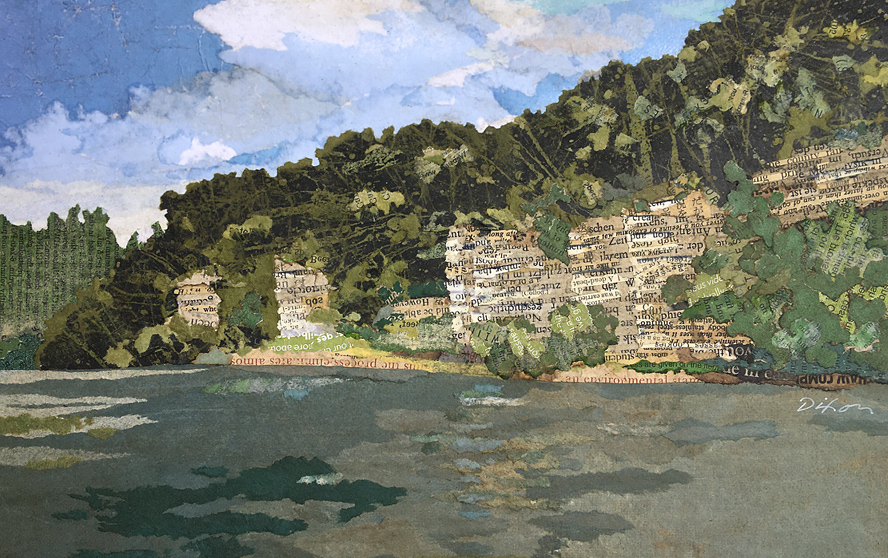
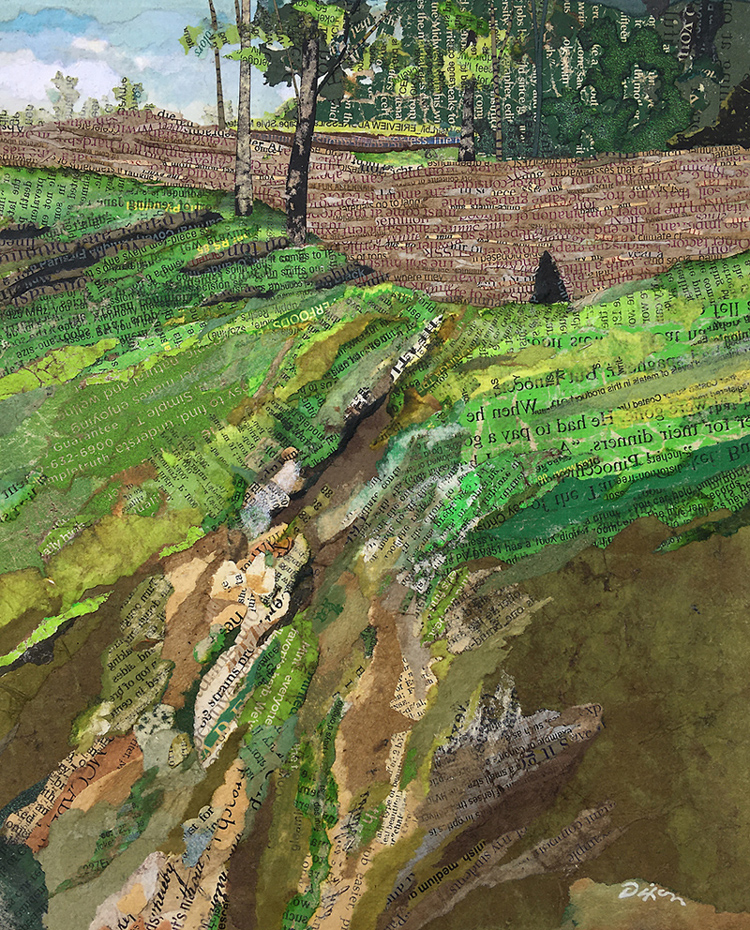
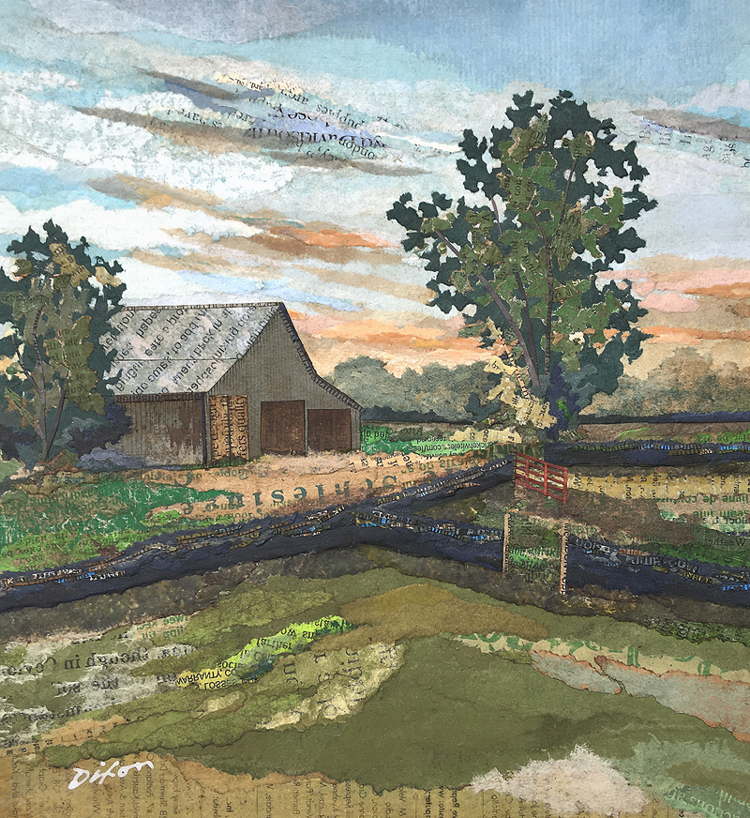
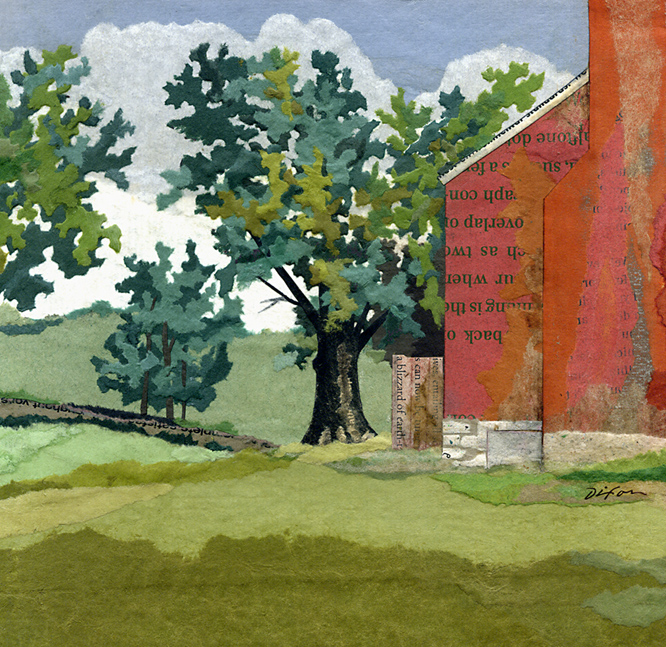
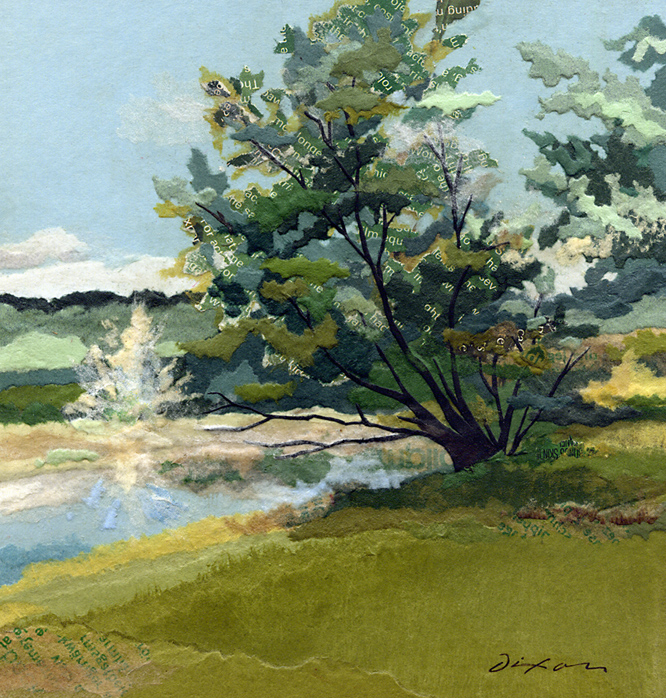
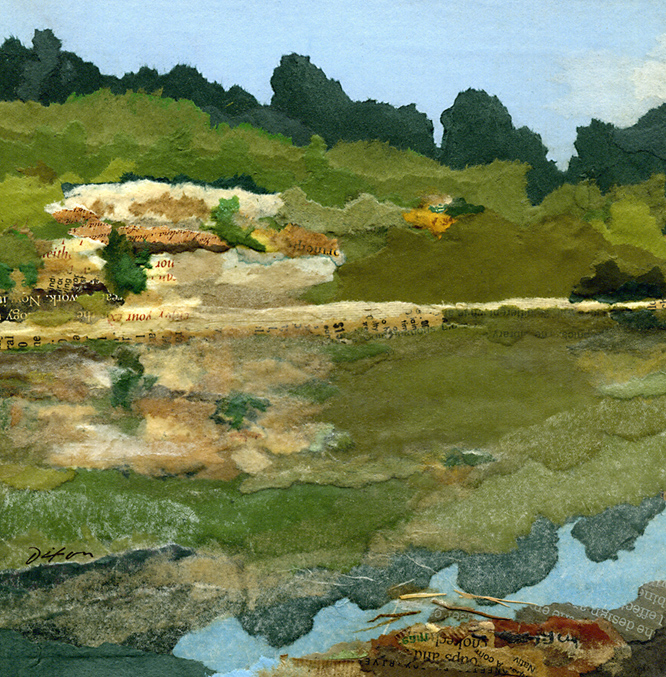
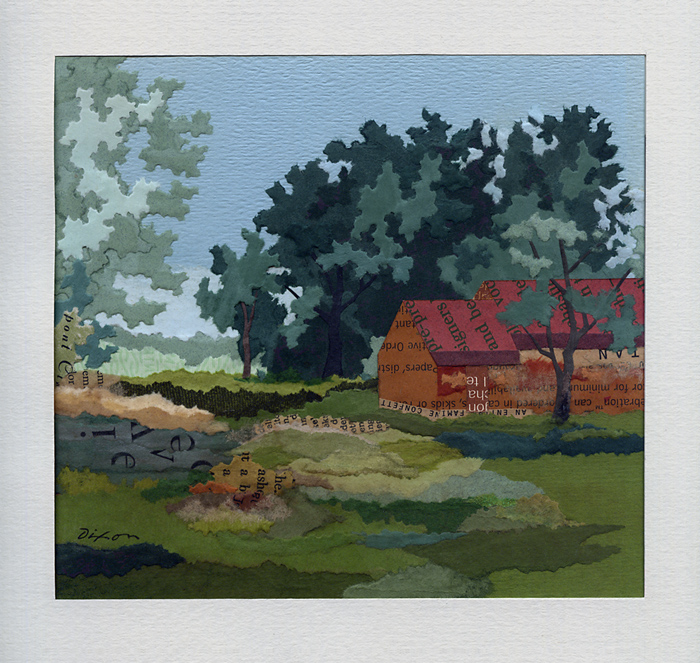
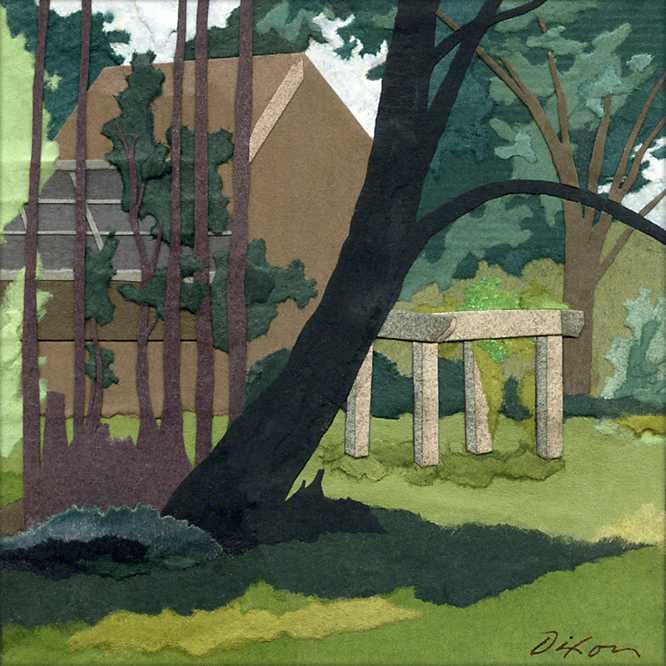
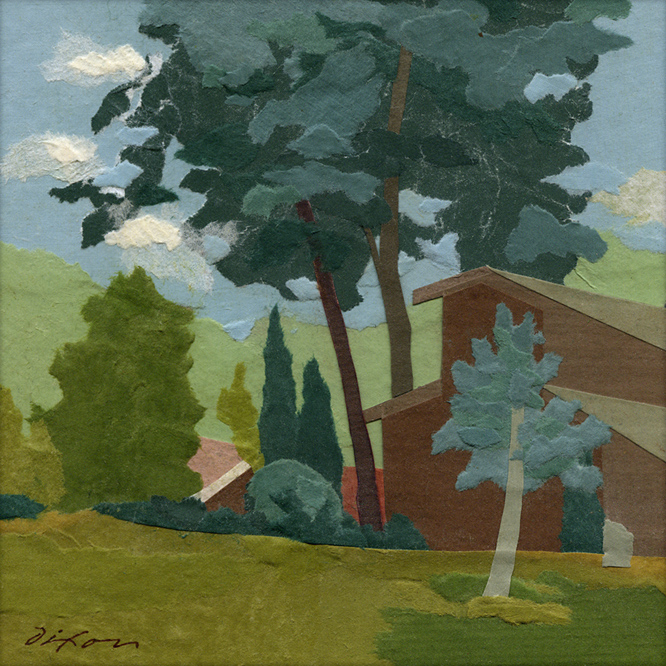
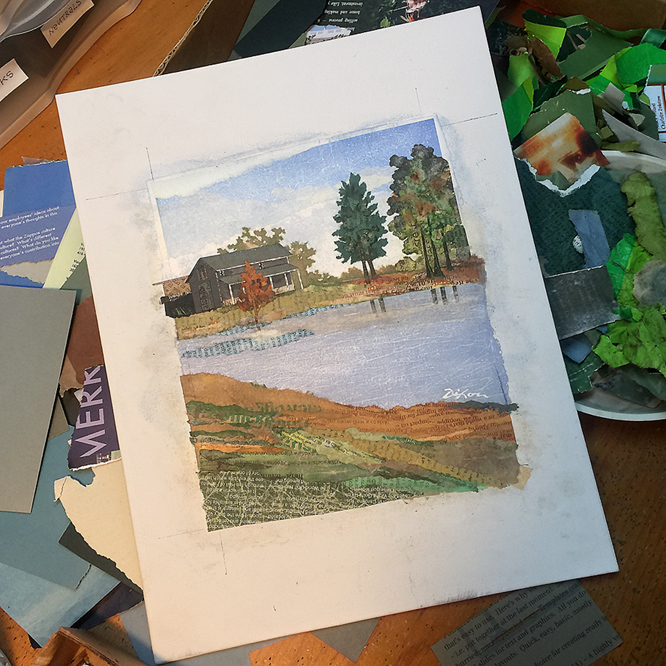
(above) details from plein-air collage artworks by J A Dixon

(below) the artist describes his plein-art collage kit at a recent gallery talk