Archive for the ‘Movements’ Category

Much more about JUXTAPOSE . . .

Monday, February 29th, 2016

Friend and fellow collage artist Kathleen O’Brien is in the midst of her countdown to a big solo show in April. She asked me to do a favor and share a guest review as part of her final promotions for JUXTAPOSE before Drawn to the Earth requires her full concentration. As excited as I am about the group exhibition in Danville, it was a tougher post to write than I first anticipated. Collage is not the easiest art form on which to expound, perhaps because it relies on the “logic” of irrational choices.

At any rate, my dedicating a blogsite to that very topic was nobody else’s idea, so I best not complain to those of you kind enough to visit here. Would I rather be making art? Of course. Even so, I cannot constrain my enthusiasm for all things collage. Here’s my take on a great show. Be forewarned: If you’re looking for some criticism, you won’t find it!


I’ll admit it. I can’t get enough of JUXTAPOSE. The current exhibition of collage and assemblage is at the Community Arts Center until April 2nd. That’s not exactly the most humble thing to say, considering it features a dozen works by yours truly, so I won’t pretend that I can offer an unbiased review. Program director Brandon Long has organized a finely curated, must-see destination that brings together over a thousand examples of the two associated mediums (literally, but I’ll explain that in a moment). This is an unprecedented group show for the Bluegrass-based artists involved, and I am thrilled to be exhibiting side-by-side with Kathleen O’Brien, Teri Dryden, Robert Hugh Hunt, Meg Higgins, Connie Beale, Cynthia Carr, and many others. No doubt my enthusiasm has something to do with its location less than a city block from my studio, which bestows the luxury of repeated immersions, and there is over a month left in the duration!

There are more participants than I can profile individually, and far too many artworks to highlight. The best example of this is a room devoted to three complete year-long series of collage-a-day works by O’Brien, Long, and Nan Martindale. Combined with almost one hundred seventy of Robert Hugh Hunt’s provocative collage collaborations, the magnitude of miniature artworks presented in a single space could be overwhelming. As an exhibition designer, Long uses geometric grids, browsing boxes, and two flat-screen displays to make the huge collection comprehensible for viewers. O’Brien’s sensitive, meticulously layered collection of daily two-sided postcards is a journey to which I surrender with pleasure each time I visit, but only after a jolting romp through Hunt’s rarely exhibited Hillbilly Voodoo series with T R Flowers.

An opportunity to view works by six outstanding Louisville-based artists is worth the trip to Danville. Several major works by Meg Higgins captured my first impression. Two enormous pieces composed with transparent elements sandwiched between Plexiglas are suspended between the vestibule and grand gallery. I was equally impressed by a smaller collage on wood panel, Japanese Peony Goes to Italy, with its exquisite East-West flavor. Brad Devlin’s solid but clever exploitation of found objects yields bold abstractions that simultaneously maintain a strong environmental essence. His Open Sunday is also physically more complex than it first appears, and this allows the artisanship of his assemblage to become a secondary experience deserving of scrutiny. Masters of juxtaposition who reinforce the theme of the exhibition as well as anyone taking part, Patrick Donley, Lisa Austin and Brandon Bass each define a distinctive individual style. Approach to composition, color considerations, and a playful choice of ingredients form undercurrents that tie their pieces together, and Long knows how to modulate the walls in a way that makes groupings of their work satisfying to study. Although she has recently gained attention for her paintings, there are at least seven panels by Teri Dryden from a handsome body of work created from discarded books. Her Monteith’s Marrakesh exemplifies how her investigation successfully transcended the source material. Personally, I hope she rotates to collage again for another dynamic round of re-purposing cast-off items.

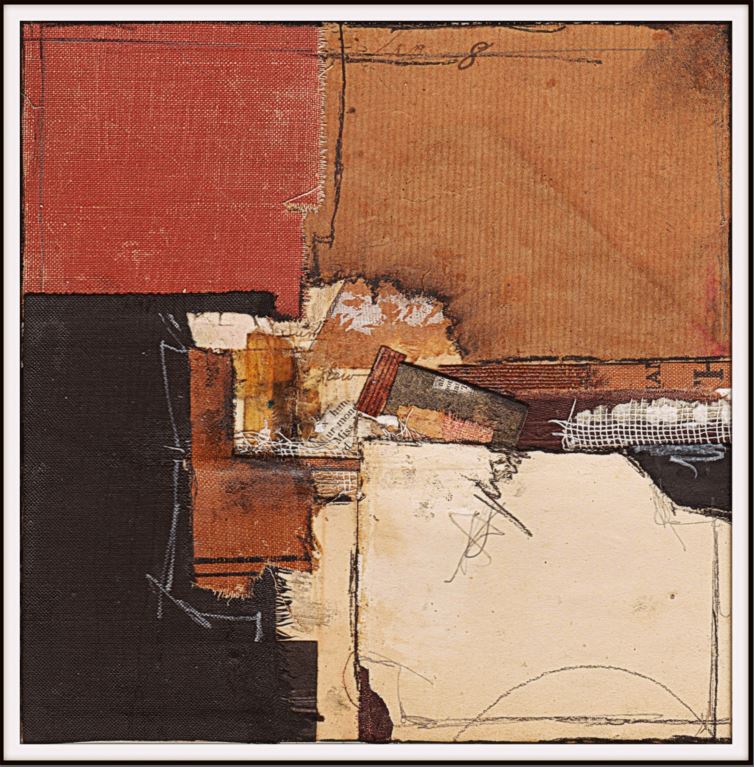
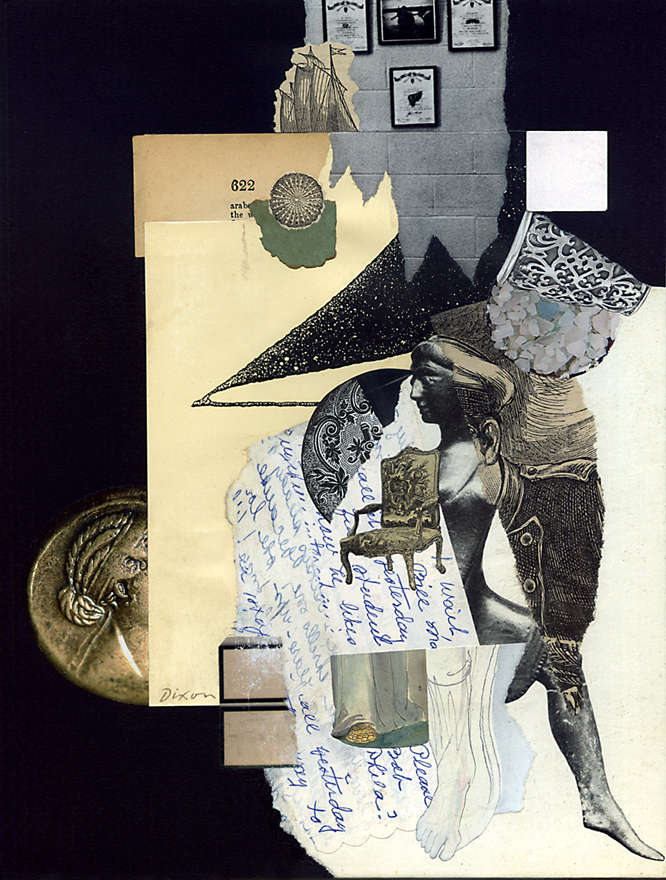
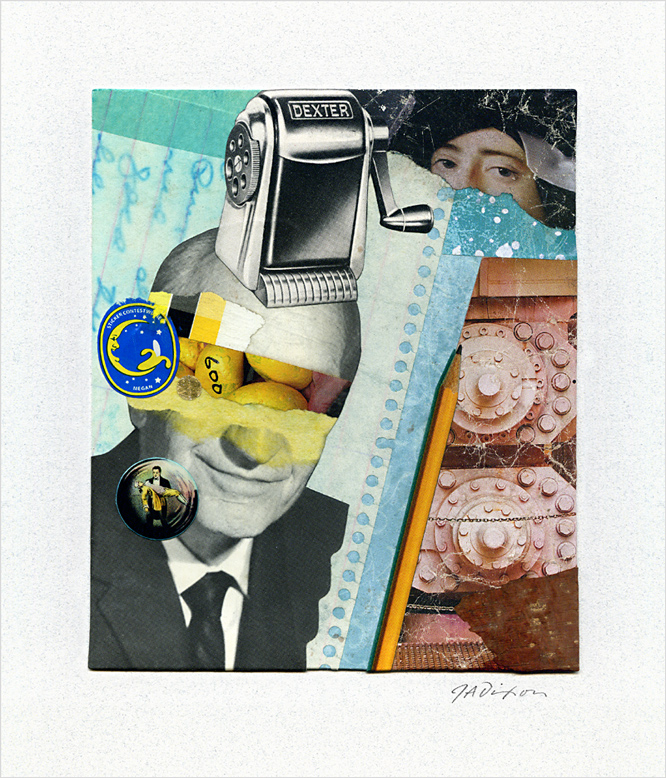
detail from Reliquia ~ collage on framed panel by John A. DixonIn addition to displaying a pair of shadow boxes, my only surrealist assemblage, and six favorite collage miniatures, JUXTAPOSE provides an opportunity to exhibit Bull’s-eye Nosegay for the first time, which I created for the Target Practice Project initiated by L T Holmes. Also, I did two larger collage artworks especially for this show. Each makes more than a fleeting nod to artists who I admire. What is it about Cherry Balm that causes me to think I just might be “tipping my beret” to the inimitable Matthew Rose? Reliquia is my tribute to the late Fred Otnes, a giant within the medium who has been a force in my consciousness since adolescence. Pearallelograms was held over from the previous exhibition at the institution, but the crowning delight for me may well be the presence of Kentucky Madonna, last year’s “finish” by Robert Hugh Hunt to my “start.” The collaborative piece is a companion to one currently hanging with the IT TAKES TWO exhibition of collaborations at the Kentucky Artisan Center in Berea. Robert and I can’t ask for more than to know that both are now available for public observation (unless someone wants to give them a good home).

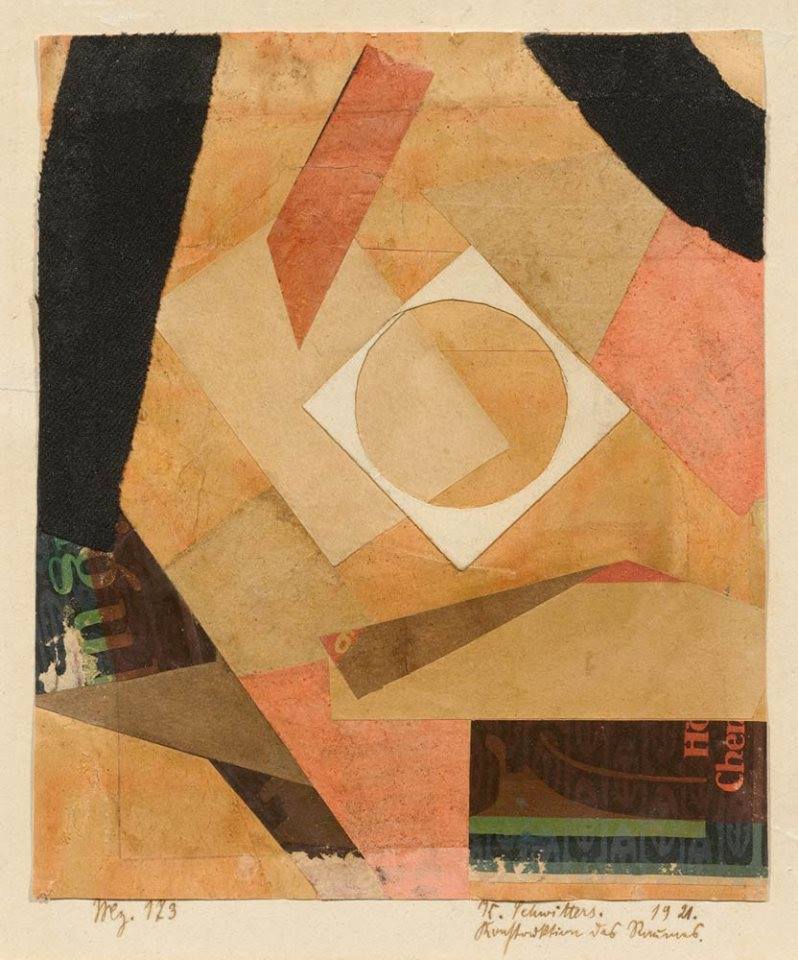
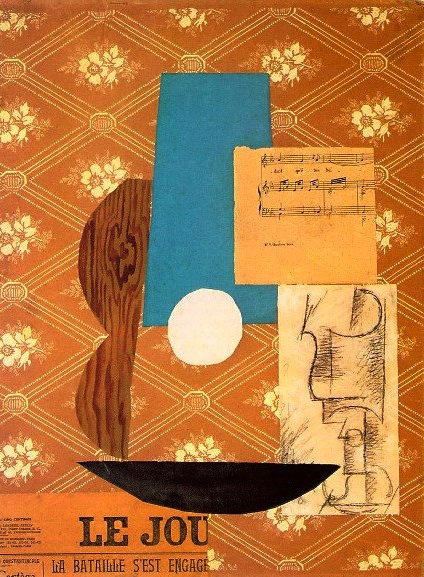
I am no art historian, but I can’t help but be mindful of the pioneering artists who laid a hundred-year foundation for the sweeping diversity of this exhibition. The creative innovations of Picasso, Braque, Duchamp, Schwitters, Höch, Cornell, Johnson, and Kolář reverberate throughout the building. In many respects, all contemporary collage/assemblage is a tacit homage to these seminal influences, but that is never the only thing at work nor the only phenomena to be perceived when one indulges an exhibition of this scope. Most artists are striving for a personal means of expression informed by those who have made their enduring mark on a medium. I am convinced, more than ever, that what distinguishes contemporary collage/assemblage artists is their keen connection to the mundane “stuff” of culture and the inner need to bring a measure of order and harmony from the sheer volume of material produced by our throw-away society, with its chaotic effect on our sensibilities — to create value where none exists, or to find wonder, meaning, significance, and beauty where none can be expected.
 

Japanese Peony Goes to Italy ~ Meg Higgins, Louisville, Kentucky

Japanese Peony Goes to Italy
Meg Higgins
collage on wood panel

Open Sunday ~ B Devlin

Open Sunday
Brad Devlin
assemblage, found objects

Strength ~ P Donley

Strength
Patrick Donley
mixed-media on wood

Bird’s Eye View ~ L Austin

Bird’s Eye View
Lisa Austin
collage

Monteith’s Marrakesh ~ T Dryden

Monteith’s Marrakesh
Teri Dryden
collage from discarded books on panel

Cherry Balm ~ John Andrew Dixon, collage artist, Danville, Kentucky

Cherry Balm
John Andrew Dixon
collage on canvas
available for purchase

Reliquia ~ John Andrew Dixon, collage artist, Danville, Kentucky

Reliquia
John Andrew Dixon
collage on framed panel

•  S O L D

Spot Checker

Monday, February 22nd, 2016

“I force myself to contradict myself in order to avoid conforming to my own taste.”
— Marcel Duchamp

The generous invitation to create new works for JUXTAPOSE had me thinking about constructing my first surrealist assemblage, but I had no specific concept in mind. I had some ruined wood frames, ornate in style, and started cutting them with a mitre saw to form a Swiss cross. To be honest, I didn’t want to use that symbol, so it was easy to “cancel” the idea by rotating it 45 degrees, and now I had an X to “mark the spot.” Dead end? There had to be more to it than that. I shifted my attention to completing a collage, and I must have unwittingly assigned the problem to my subconscious, because I awoke after a night’s sleep with the total solution in my head. How can one explain something like that (or Dada, for that matter)?

A few words of caution, however: Don’t actually plug it in.
 
Dixon_SpotChecker

Spot Checker
assemblage by J A Dixon
30 x 30 inches (+ “tail”)
available for purchase

Collage and the Meaning of Existence

Sunday, January 31st, 2016

Sorry about that title. I am having a bit of fun with the search engines.

On a serious note, today’s entry is about how collage can be put to the service of more than irony, shock, whimsy, irreverence, or cynicism. Let me say first, if you please, that all those things can be valid, even pleasurable, effects. They are rooted deeply in the history of the medium. One could make the case that a collage artwork is never more than a step or two removed from the essence of dada, surrealism, or popism. On the other hand, for me, there are times when that creative genealogy is best put aside, in favor of a different tone.

Developing works with special meaning to those for which they were intended has always been some of the most fulfilling time I have spent as an artist. Collage has the potential to capture profound significance for a recipient, especially when it is personalized with meaningful artifacts and memorabilia. Also, there is an opportunity for the artist to thoughtfully select and integrate additional ingredient elements for greater depth and layered associations.

The project featured below began with a discussion about how all of us accumulate “stuff” that will never rise to the level of a family heirloom, but cannot be comfortably discarded because it has true meaning in the context of one’s journey in life. The patron took to heart my offer to embed many of these things in an artistic expression that would likely become a treasure for descendants instead of a burden of disposition. With the capacity to transcend the “scrapbook,” fine art collage is ideally suited for such an endeavor.

It was the client’s idea to approach the commission as a triptych, or three separate panels, that would convey the themes of body, mind, and spirit. I wanted the components to work as a total piece, but also for each to have a stand-alone quality. Whether they stay together or part company will be left to future circumstances and decisions. The resulting “legacy collage” is a distinctive creation that preserves images representing the life and guiding principles of a unique individual. It has been my honor to provide that creative service to her.
 

Body (for MJCB) ~ J A Dixon Mind (for MJCB) ~ J A Dixon Spirit (for MJCB) ~ J A Dixon

Body  ~  Mind  ~  Spirit
John Andrew Dixon
three legacy collage artworks on structured panels
16 x 24 inches each
private collection

Not So Big

Monday, August 3rd, 2015

“Shadow boxes become poetic theater or settings wherein are metamorphosed the elements of a childhood pastime.”
— Joseph Cornell
 

The creations of Joseph Cornell are small, and remained so throughout his unusual life as an artist, even as many of his contemporaries responded to the fashion of producing ever larger works. For me, a salute to this influential American seemed like the fitting approach when I decided to enter notBIG(3), an annual juried exhibition devoted to small art. I am pleased to have had a piece accepted to this show, which hangs from 8/11 to 9/11 at Lexington’s M S Rezny Studio/Gallery.

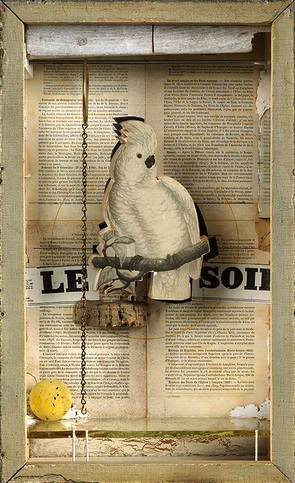
The “poetic theater” of little shadow boxes is not an isolated medium in collage/assemblage. To consider one’s activity in this comprehensive oeuvre as anything but an homage to Cornell would be an act of mild self-delusion. His singular, enduring presence overarching the genre must be acknowledged. There was a concern that my taking this approach with the notBIG(3) entry might appear to the juror as too derivative, but I pushed ahead with the “sincere flattery” of my plan. I had failed to crack this competition in its previous calls to artists, and I had hopes that the third time would be a charm for me. In addition, I wanted to assemble a range of ingredients outside my norm, including metal, wood, organic material, glass vials, and vinyl dimestore figures.

I created and entered two works as a pair — Histopia and Hertopia — a dual allusion to Utopia Parkway and its significance to the art history of the 20th century. It was not possible to enter both as a combined entry because the dimensions would have exceeded the size limitation of 12 x 12 inches. Only the first shadow box was selected. I was delighted to learn of my getting in the show, but it came with a small serving of disappointment, knowing that the gender balance of my overall idea would be lost with the “boy scene” presented to viewers by itself. It is something I can accept. Out of 380 works submitted, the 45 artists who make up the exhibition have a single artwork included. At any rate, this is what blogsites are for. Both pieces can be viewed together, and I have the opportunity to explain the whole thing to anyone kind enough to read this far. I also anticipate that many of you will be able to visit what appears to be shaping up as a strong exhibition. The opening reception is Friday evening, August 14th, 5 to 8 pm.
 

Histopia ~ collage/assemblage in shadow box frame by John Andrew Dixon

Histopia
collage/assemblage in shadow-box frame by J A Dixon
10 x 10 x 1.75 inches, available for purchase

Hertopia ~ collage/assemblage in shadow box frame by John Andrew Dixon

Hertopia
collage/assemblage in shadow-box frame by J A Dixon
10 x 10 x 1.75 inches, available for purchase

Selective Fusion

Monday, July 13th, 2015

“Schwitters subjected his bits of flotsam to an organizing principle resembling the vertical scaffolding of Analytic Cubism, thus transforming the diverse components into formal elements.”
— Nancy Spector

Color and composition may be the most common denominators of all visual art. Collage, by its nature, relies on a combination of separate, often disparate elements, and those two fundamentals generally play a more prominent role in the finished effect, but that does not make collage essentially a category of abstraction. A minimalist concept built on a provocative juxtaposition or image insertion can be a predominantly figurative or representational approach, even if symbolic or surreal ideas are introduced. On the other hand, collage artworks rooted in the seminal innovations of Kurt Schwitters pay primary tribute to a tradition of abstraction now more than a century old. Of course, the medium had other early pioneers, but it is difficult to imagine the trajectory that collage might have taken without his towering influence. Personally, I have no qualms about continuing to respectfully mine the rich vein of creative ore he helped to expose. Whether it proves to be a nonrenewable resource has yet to be shown.
 

Selective Fusion ~ John Andrew Dixon, collage artist

Selective Fusion
collage on structured panel by J A Dixon
13.375 x 11.75 inches
not for sale

Windows of Opportunity

Saturday, January 24th, 2015

 
Windows Of Opportunity ~ collage miniature by John Andrew Dixon

Windows of Opportunity
collage miniature for mail art by J A Dixon
4 x 5 inches
collection of N G Armstrong

More than a dalliance this time . . .

Wednesday, January 21st, 2015

“The best part about mail art is that you don’t have to be there in person to be in on the action.”
— Anna Banana

First of all, I must admit I do not know all that much about the practice of “postal art.” Although I have mailed thousands of gift art items over the decades (usually disguised as greeting cards), I have never considered myself a “mail art” enthusiast, having had only indirect contact with the popular activity. I am aware that Ray Johnson was a seminal force in the phenomena, and that many think he envisioned the virtual community long before today’s online social networks took hold. Blogsites such as Jennie Hinchcliff’s exuberant every day should be a red letter day have enabled me to experience an enthusiasm for the genre in a vicarious way. For those who create collage, the art form has overlapped with collaboration to some degree, with the essential exchange of creations taking place. Like many artists, I have some major problems with the “art world” as an entrenched, elitist institution, but, because I have no philosophical bias against the idea of an “art marketplace,” the correspondence art movement never has had much of a grip on my sentiments or available time. Nevertheless, I strongly identify with the inclusiveness and magnanimity at the heart of the practice.

I am not entirely sure why I responded to a recent mail art proposition from Nancy Gene Armstrong, but I had taken note of her work for the first time last year and the appeal of having an example of it arrive for me in the mail was undeniable. It came as a vertical design, nearly 26 inches tall, that unfolded in a paced, rolling presentation. Below are two exquisite details from her generous offering.
 

mail art detail ~ Nancy Gene Armstrong


mail art detail ~ Nancy Gene Armstrong

two mail art details
collage by N G Armstrong
collection of J A Dixon

The Other Doorway

Tuesday, November 25th, 2014

“Art comes out of art, and you are just another stone in the wall.”
— Richard Serra

My “Partner In All Things” has outdone herself again. She prepared an outstanding dinner last night in celebration of our grandson’s 23rd birthday, including “game stew” with rabbit and venison, plus the tastiest cherry-raspberry pie ever.cherry-raspberry pie As for my part, I completed a collage miniature for him that took off on a phrase he said to me over a year ago while unraveling some difficult life choices. I am very proud of the young man, for many reasons having nothing to do with his being a great source of encouragement as I continue to create work that puzzles a majority of art buyers. Some time ago, L T Holmes introduced her online followers to the idea of producing a collage “under the influence” of a fellow artist. I admire her for elevating it to an exercise in perceptual focus. It is good to be mindful of influences, because they are not necessarily at a level of awareness. Today’s featured image is an example of how I have come to recognize the unconscious influence of peers after a work is finished. I am not sheepish about admitting it. Inviting the artistic strengths of others to rub off a bit is why we regularly partake of the excellence in our medium. The collage artworks of my friend Connie Beale, a retailer and accomplished interior designer, touch on the irrational aspects of environments and room-like enclosures with effects that are unsettling yet also whimsical. The prolific Eugenia Loli consistently captures the surreal potential of spatial contrasts and arresting juxtapositions. Perhaps a shade of both can be found in my grandson’s gift.
 

The Other Doorway ~ J A Dixon

The Other Doorway
collage miniature by J A Dixon
6.25 x 7.75 inches
collection of J M Strock, Jr

a message to Aunt Erma, 1964

Wednesday, July 16th, 2014

“Have been real bad about not writing.”
—Miles, Jr.

My collage on 50-year-old postcard arrived in Wales and it was posted to the ABAD site today. The reverse of the vintage card is probably more interesting than my improvisation on the image side. A message from Miles, Jr. (sitting in the Louvre, resting feet more tired than eyes) was written on July 10th and received an Army Air Force postmark on July 13th. Apparently his Aunt Erma was in the hospital — a nephew reaching out to “the only family person who knows these places.” Whether or not she ever came home is unknown, but we can only imagine that the card from Paris evoked for her more than a few memories of Europe, the bitter as well as the sweet.
 

ABAD 2014 (reverse of vintage postcard substrate)
collage on 1964 postcard by J A Dixon
6 x 4 inches, not for sale

A Book About Death ~ Wales

Thursday, July 3rd, 2014

“The project has become The Book About Living.
—Sonja Benskin Mesher

Ray Johnson, the original “most famous unknown artist in the world,” produced his A Book About Death during the years 1963 to 1965. The pages were randomly mailed and offered for sale. Complete copies were compiled by a rare few. Johnson was a significant bridge between the groundbreaking work of Schwitters, the sensibilities of Cornell, and the emergence of what would become the most widely recognizable features of Pop Art. He was highly influential in the Mail Art, Installation Art, and Performance Art movements, as well as late 20th-century neo-Dadaist trends.

Since 2008, Paris-based Matthew Rose has actively aroused a worldwide interest and vitality that perpetuates the legacy of A Book About Death. A new call to artists from the Royal Cambrian Academy in Wales and the full history of ABAD can be studied at this site. An exhibition at MoMA Machynlleth planned for later this year will include a collage from me (featured below, produced on a 50-year-old postcard). An online archive will share details of the exhibition and record artworks as they come in. Participate! You have until September 30th to mail your contribution.
 

ABAD 2014
collage on 1964 postcard by J A Dixon
6 x 4 inches, not for sale

“Oh, the Places You’ll Go”

Friday, June 20th, 2014

“Art is the only way to run away without leaving home.”
— Twyla Tharp

Places to go, ways to travel, and flights of fancy . . . A series of local exhibitions at the Boyle County Public Library’s Mahan Gallery has been an effective catalyst for me to create new pieces based on unifying themes. I have recently experienced mixed emotions about the ubiquity of vintage material in contemporary collage, but the topic of this show had me hunting through my morgue of old postcards and other relics to produce a pair of artworks on canvas. Yes, we all dig the instant “gravitas” of using old stuff, but will art historians say we copped out, if we do not accept the challenge of working with ingredients from our own present-day culture? I am just musing about the state of the medium, not any artist in particular. I see a hundred or more collage artworks posted online each week that rely exclusively on 20th-century material, and much of it seems stuck in a bygone avant-garde style. It is important for all of us to keep in mind that the Dada artists so widely emulated worked with material from their own time. Perhaps the opportune approach is to blend it all together, past and present. As post-centennial collage artists, we also owe each other a bit more constructive criticism than I currently observe. As the details below illustrate, I have absolutely nothing against using vintage material. I think that artists such as Hope Kroll or Fred Free or Matthew Rose (to offer only three examples) are creating some of the more exceptional work in the medium. On the other hand, there are many who seem to be using it as a crutch, over-relying on the antique impression of the ingredient material itself, rather than the juxtapositional synergy or overall aesthetic effect.

As the artworks for “Places” also demonstrate, I continue my effort to liberate a collage from the traditional glass barrier. To do so, it is necessary to find a proper level of protective sealant to balance visual appeal and durability. I prefer to avoid an overly polymerized impression with a finished surface. Because I primarily work with found material, I have had to learn which ingredients can handle direct exposure (for an effect similar to the painted surface). Nevertheless, some are simply too fragile and will always require a safe abode under glass.


left: Here and There (detail)
right: Now and Then (detail)
two collage artworks on canvas by J A Dixon
12 x 12 x 1.5 inches each
available for purchase