Archive for the ‘Ingredients’ Category

Left Field Corner

Tuesday, January 15th, 2013

Degas: “Voilà! I have this great idea for a poem.”
Mallarmé: “Alors mon ami, poems are made out of
words, not ideas.”

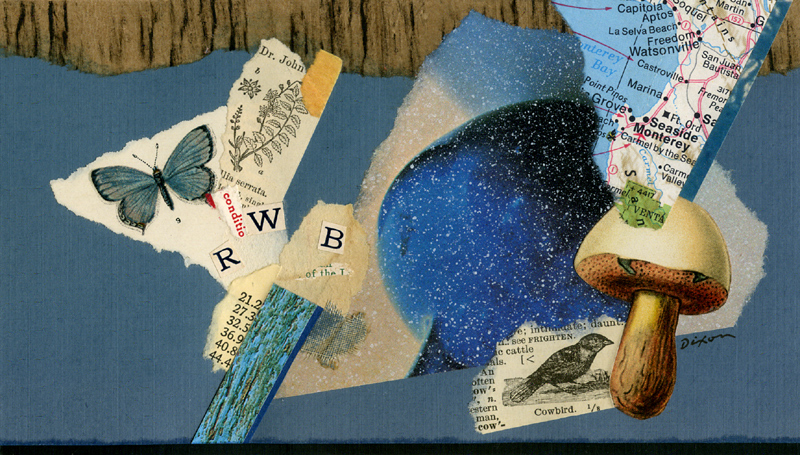
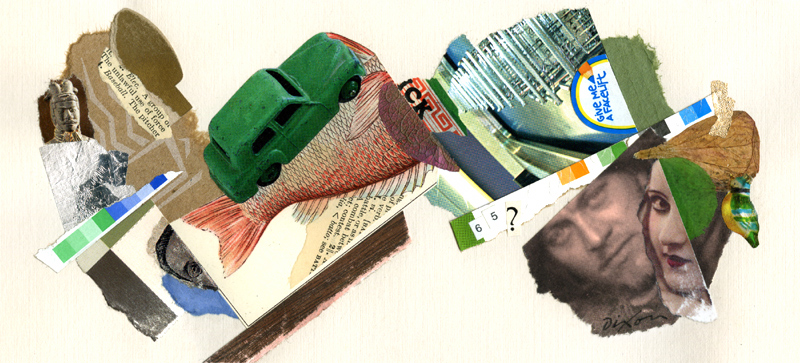
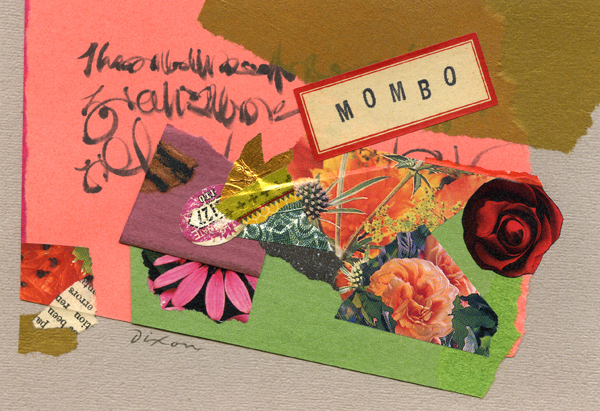
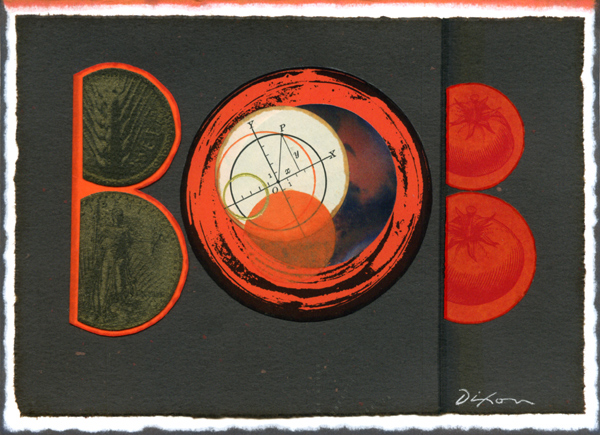
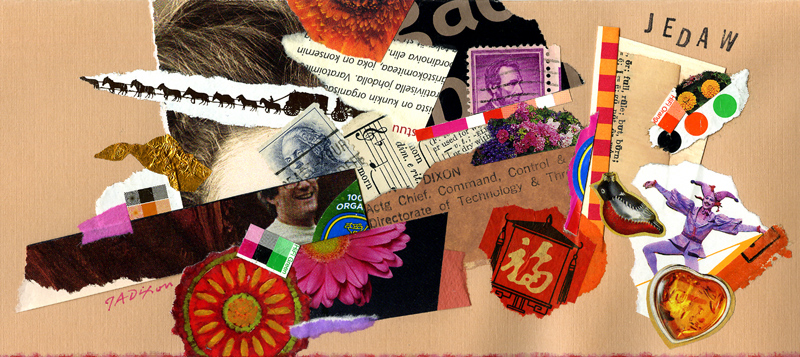
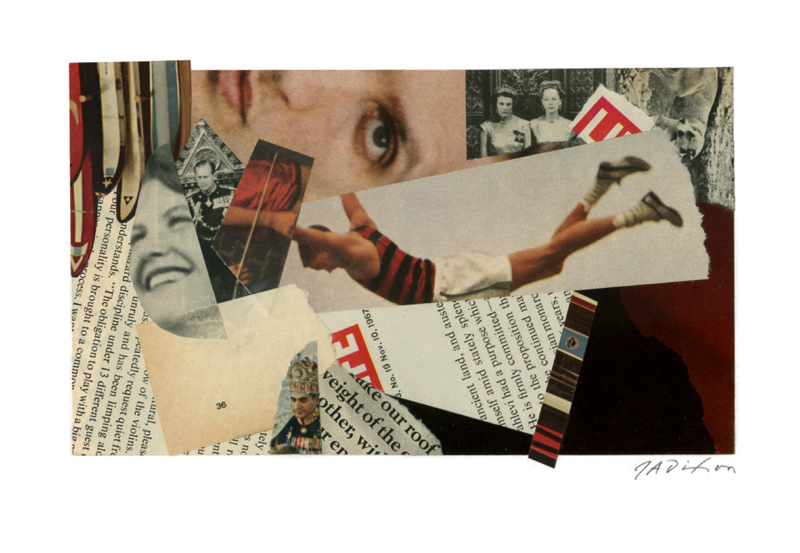
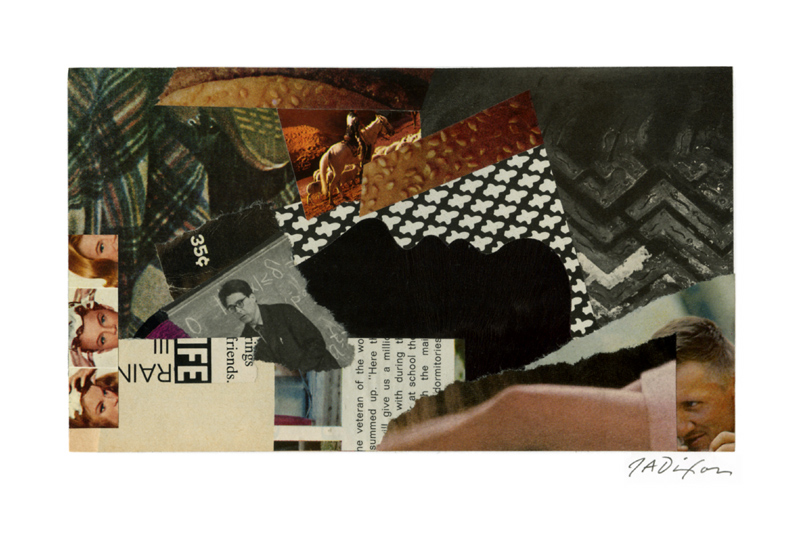
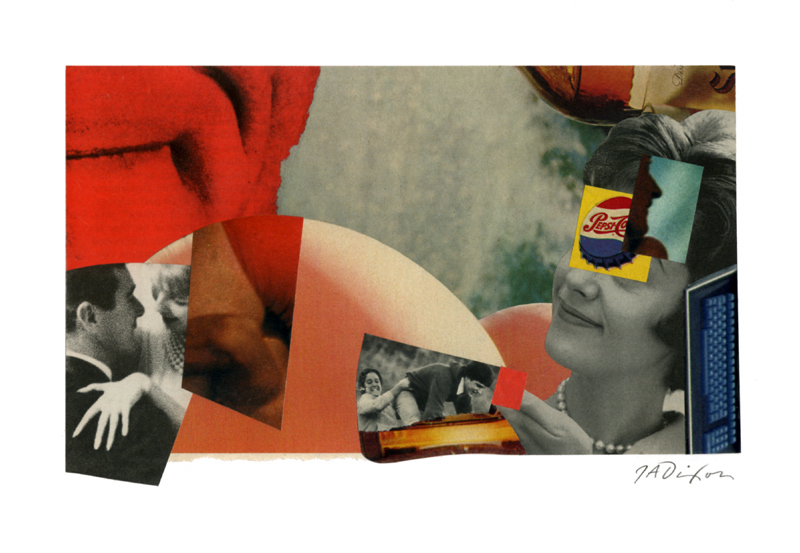
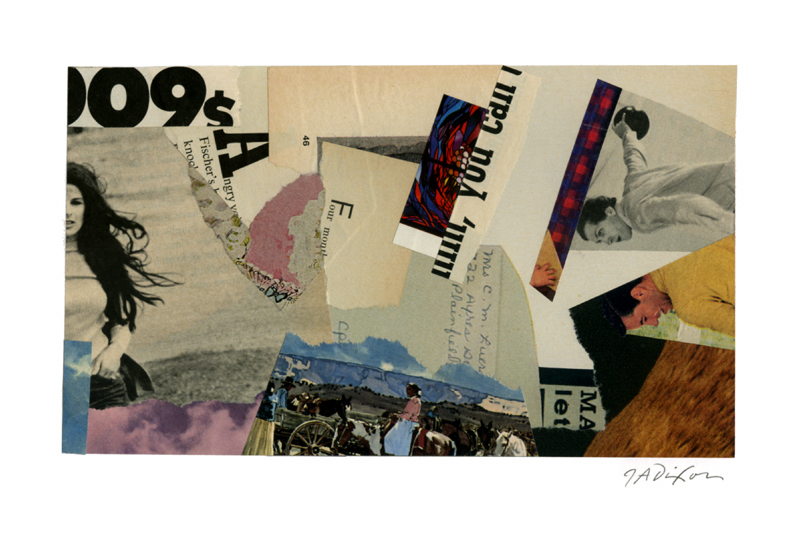
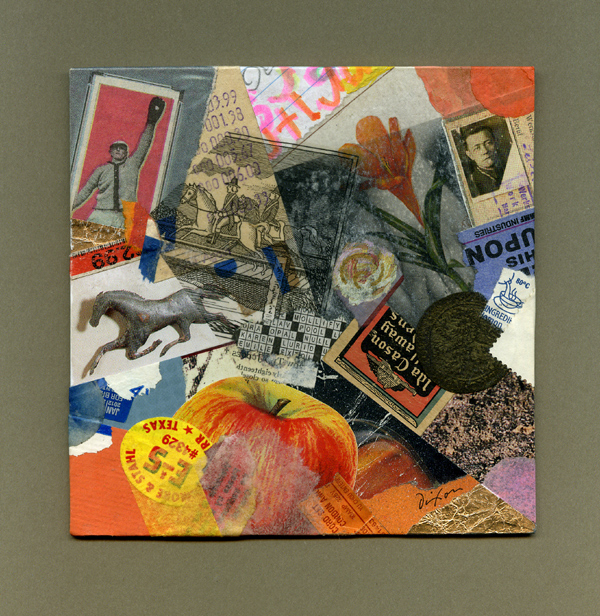
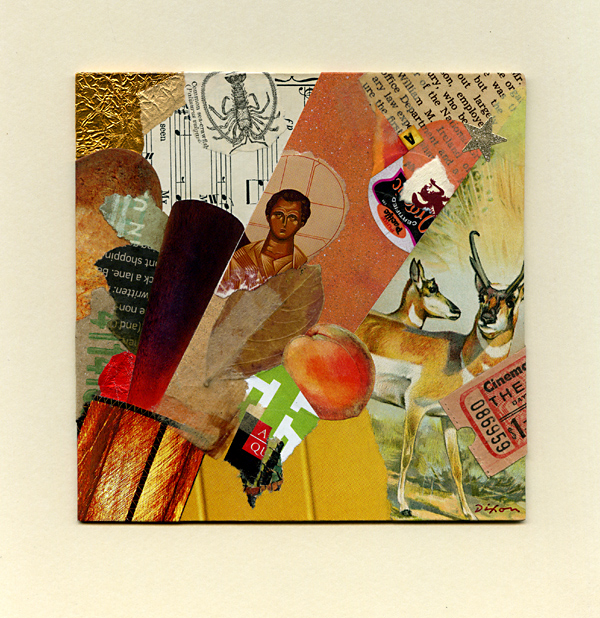
It has been said that ingredients make the collage. One could argue that case. But what of the comprehensive whole? Does the effect of the artwork not rely on the compositional relationships and the interest of juxtapositions? Of course. But what could be expressed without the ingredients? What would a painting be without the paint? Do you know a collage artist who does not take special care with the selection of the physical components and does not thoughtfully compile, sort, edit, and re-edit before the process of assembly takes place? Some may emphasize the pictorial or symbolic qualities, while others may focus more on abstract or aesthetic attributes. Many give great attention to the sourcing or provenance, with personal criteria that must be met in service to a sought-after look or personal style. Others zero in on the transitory nature of ingredients, independent of representational aspects, with a keen regard for age, condition, and the sense of impermanence. But the bottom line for all— something a perceptive friend recently pointed out to me— is that each and every ingredient caught the artist’s eye in some significant, personal way, in some manner that gave glimpse to its ultimate visual potential. That was when I realized how most of my ingredients had run a long gauntlet of multiple scrutinies: First it was acquired and saved for some reason. Then it was retrieved from its repository for some reason (often years later). Then it was grouped with other worthy candidates for some reason. And then finally it was used in a work. It found a new purpose for which it was not originally intended, a place where it belonged, when other items were set aside (perhaps to win a role in another collage, or to eventually fall out of favor). It’s hard to disagree with the idea that the culminating gestalt of a collage determines its level of success, the degree to which it becomes more than the sum of its parts. Ah… but how we relish those parts!
 

Left Field Corner ~ J A Dixon

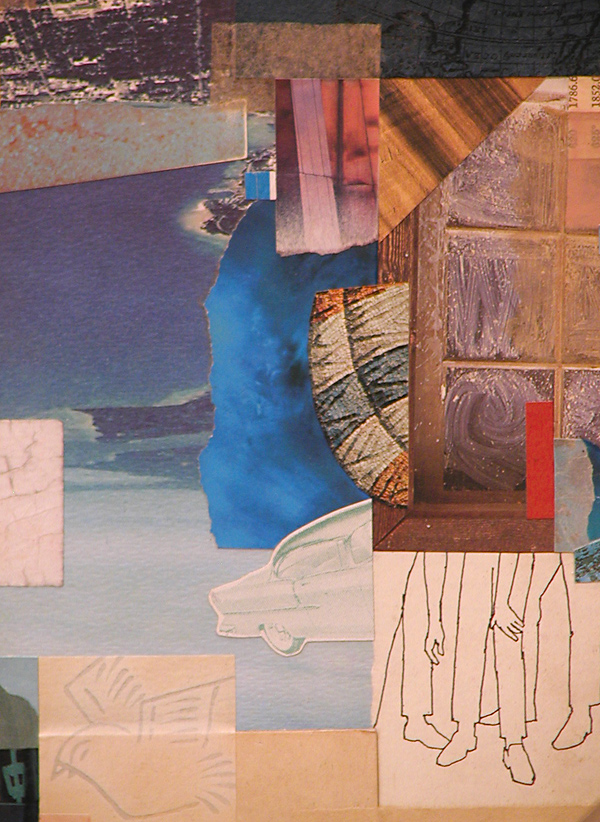
Left Field Corner
collage miniature by J A Dixon
5.5 x 5.5 inches
collection of R K Hower

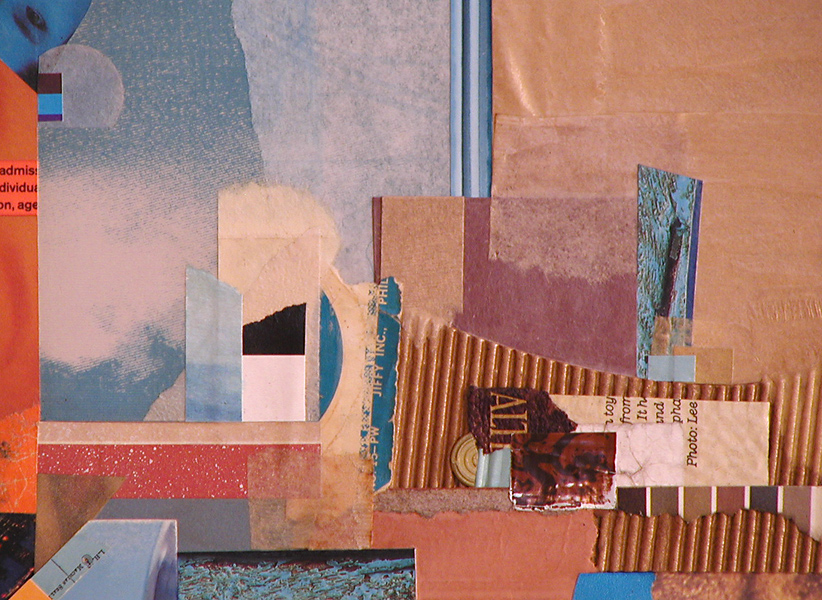
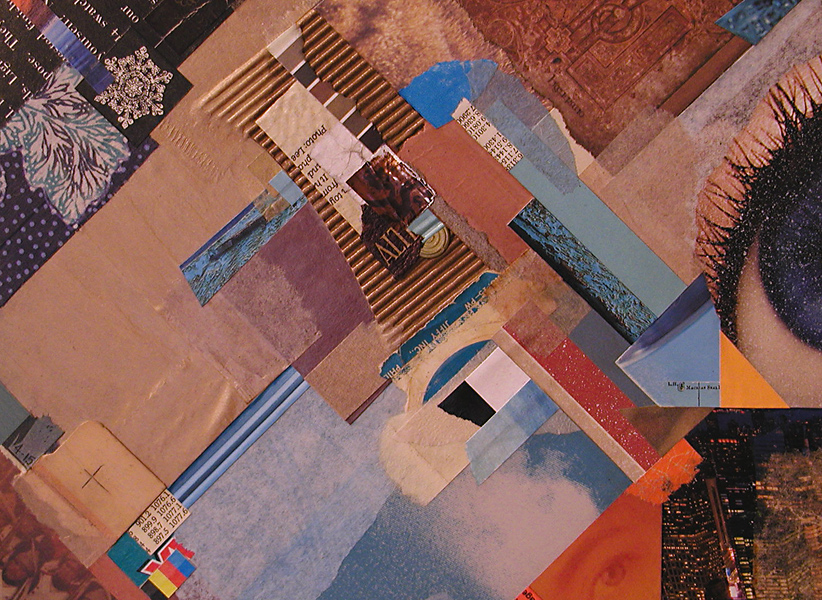
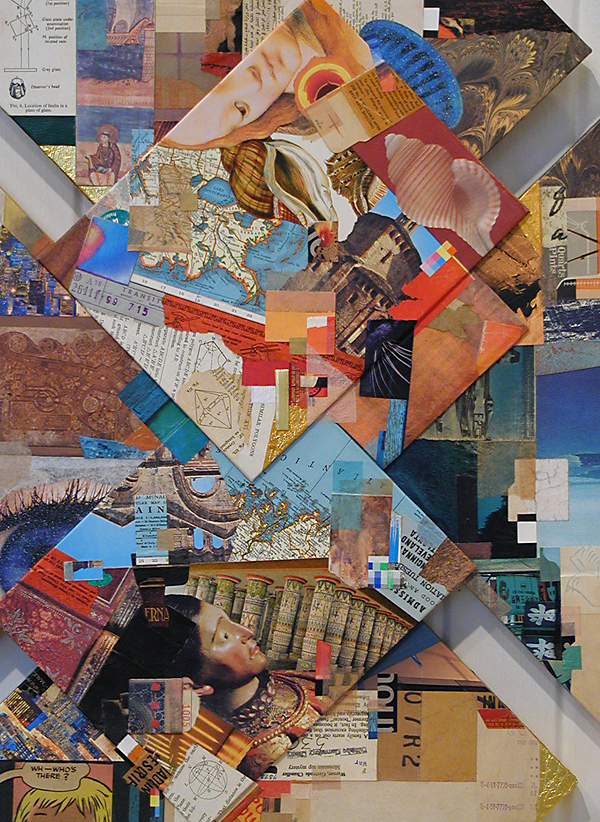
Diamonds in the Rough ~ details

Wednesday, January 9th, 2013

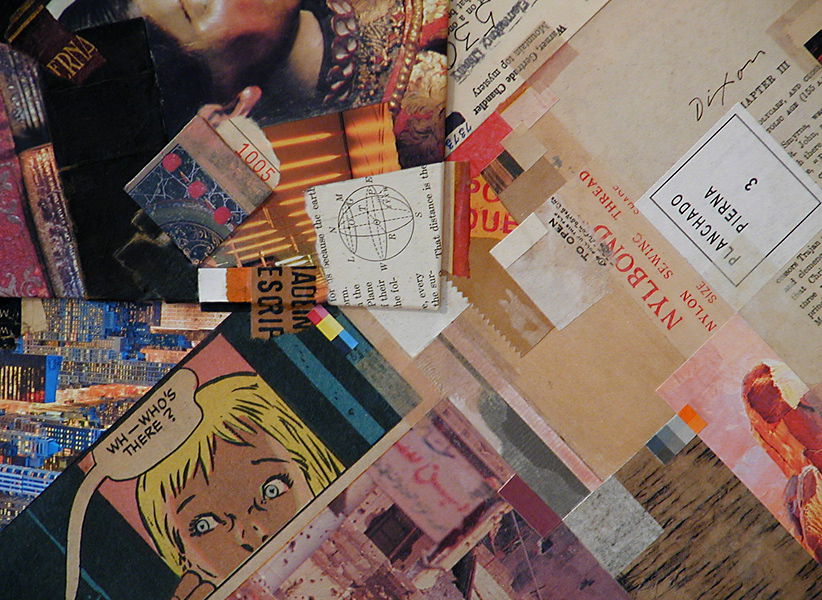
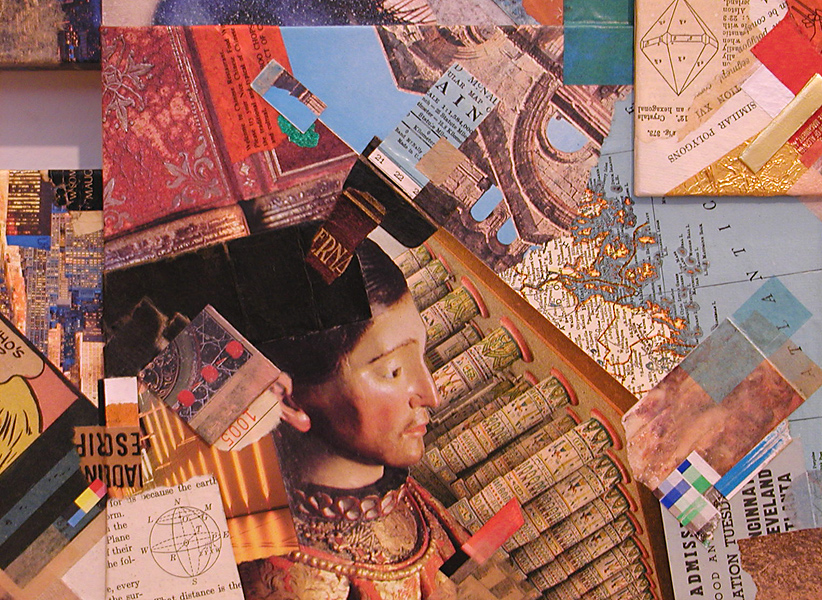
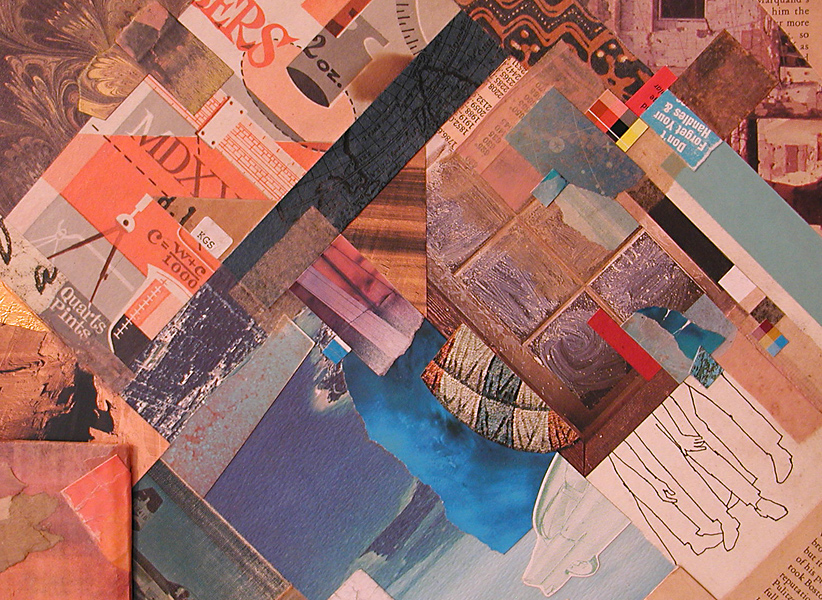
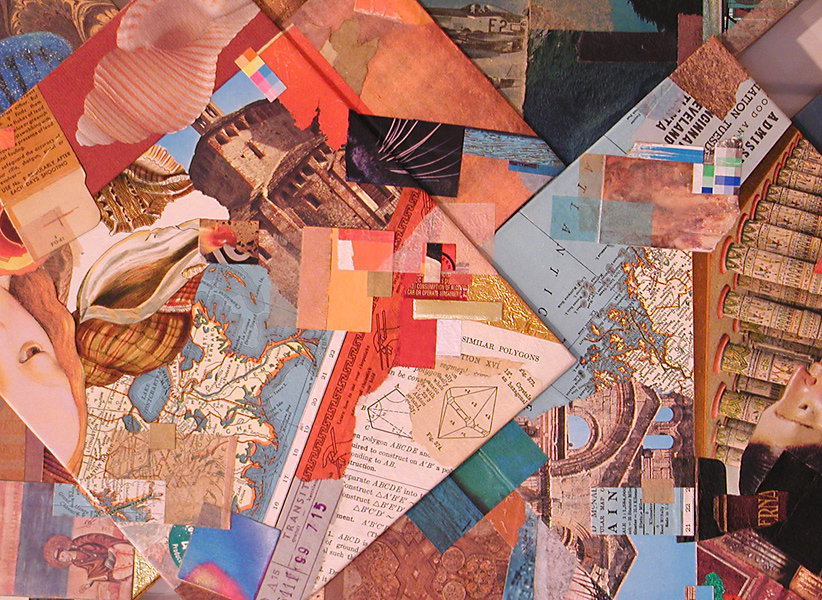
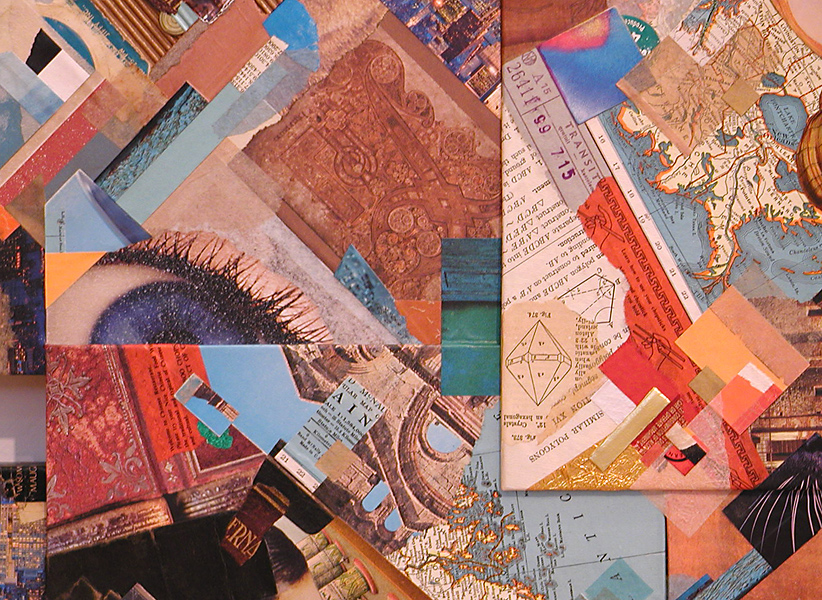
Collage for me is always an intimate viewing experience. You may find me with spectacles off and nose pressed near to the surface of any example within the medium. The scale of Diamonds in the Rough enhances the contrast between an up-close scrutiny and a step-back regard for the entire effect. With a large piece like this, I also enjoy visually cropping areas to create a series of virtual collage miniatures.
 

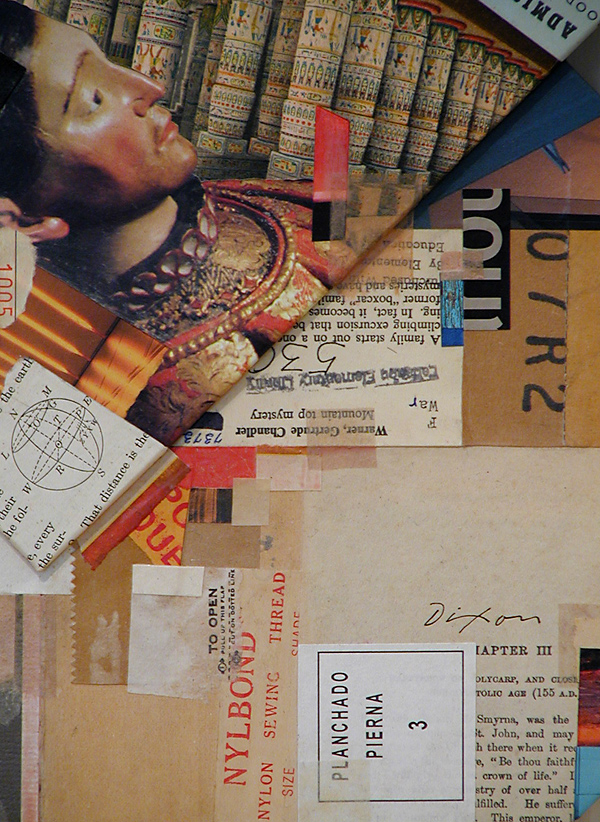
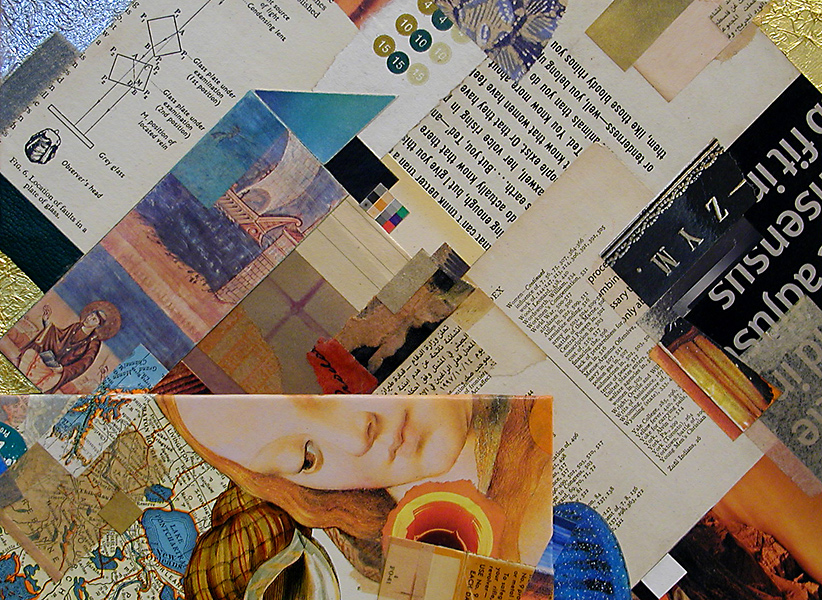
This micro view accentuates the ingredient elements, as in a collage miniature.
Visually, larger works are less ingredient centric, but still rely on their qualities.

I think my imagination would never tire of working with diagonals.
What is it about the diamond or the triangle that engages my mind’s eye?

This is one of my favorite areas within the total artwork.
Oddly, the legs and hands resonate with the Tapley drawing in the exhibition.

The composition’s focal center projects from the surrounding forms.
It differs energetically from the outer areas of structural perpendicularity.

To regularly bestow a new purpose on found material . . .
Without fear of contradiction, one could say that I am hooked.

The essence of collage is the contrast of the mundane and sublime.
At any rate, this is often how I perceive it.

WH—WHO’S THERE? (Look closely: Milt Caniff, that’s who.)
Somebody saw this as an homage to Roy, but Kurt used comics first.

A collage can rest divertingly upon layers of symbolic meaning.
Or it can be simply the harmonious resolution of aesthetic factors.

The dynamics of complementarity. (Is that a real word?)
More than one astute eye discovered my warm-cool “horizon.”

Composing with shape, color, contrast, rhythm, dimension.
At times, it need be about nothing more than that.

This image isolates a microcosm of the whole effect.
Are my larger works just a aggregation of collage miniatures?

Thanks for looking. Let me know what you think. Constructive criticism is encouraged at this site. To be honest, the medium of collage needs a bit more of it.

By Heaven’s Good Grace

Friday, December 28th, 2012

“Whatever an artist’s personal feelings are, as soon as an artist fills a certain area on the canvas or circumscribes it, he becomes historical. He acts from or upon other artists.”
— Willem De Kooning

“You can never see too many things in a work of art. Itself, the work is a means for discovering what is already within us. The true work of art is more than its creator; it is always beyond him; soon it enters another orbit not his, because the artist changes, he dies, while the work lives in others.”
— Michel Seuphor

As I look back on six months of producing this site, I recognize that there are probably only a handful of people who currently pay a visit. To those of you who do, please accept a sincere tip of the hat. I hope that you find my periodic entries to be stimuli worthy of your time. Perhaps 2013 will bring a wider audience.

Collage is a distinctively collaborative medium, at times directly, but always indirectly. We are continuously interacting with those responsible for the ingredients we value enough to incorporate into a work. They might include one of the finest masters of the brush, an outstanding photographer, a bull-pen illustrator, an obscure commercial artist, or an anonymous shipping-carton keyliner. All that matters is this: Each has in some way caught hold of our eye, mind, or heart. Each has become an influence and unwitting contributor. For reasons not entirely clear, some of us attempt to have a more active effect on the state of our art by regularly making words, too. Allow me to bring a few stimulating blogs to your attention, if you haven’t already discovered them—

matthew rose studio
kathleen o’brien studio
a collage a day
daily collage project
with scissors by hand
paper with a past
every day should be a red letter day
lynn whipple’s blog
janice mcdonald collage art studio
four corners design
the altered page
collage clearinghouse


By Heaven’s Good Grace ~ J A Dixon

By Heaven’s Good Grace
collage miniature by J A Dixon
5 x 5 inches
 
Purchase this artwork!

There I Was

Saturday, December 8th, 2012

“He spread flour and water over the paper, then moved and shuffled and manipulated his scraps of paper around in the paste…. Finally, he removed the excess paste with a damp rag, leaving some like an overglaze in places where he wanted to veil or mute a part of the color.”
— Charlotte Weidler

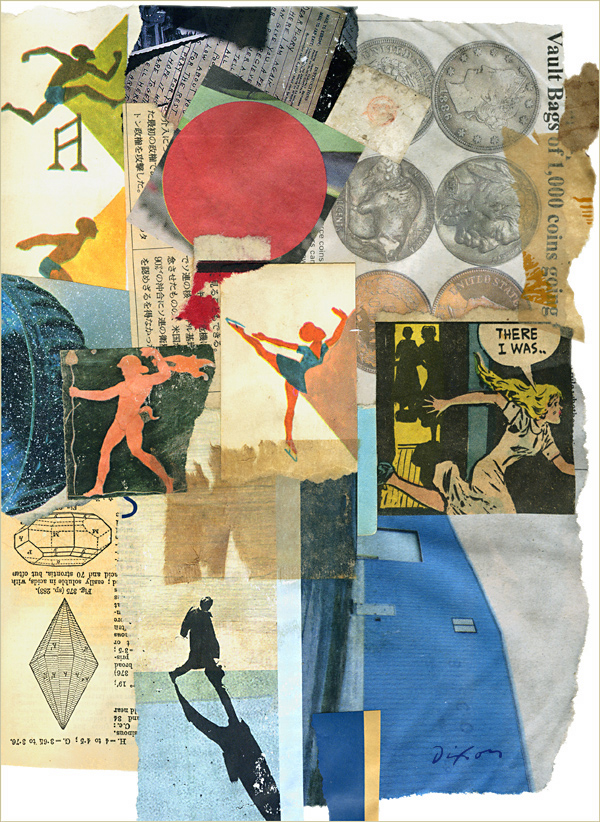
It has been more than a year since I had the humbling opportunity to study dozens of Kurt Schwitters originals at the Berkeley Art Museum. I read the description by the art historian Charlotte Weidler that same day, but I only recently decided to experiment with the paste method she observed. I have always worked with a variety of adhesives, and I often combine more than one in a single collage, never hesitating to literally mix them together (white glue + acrylic varnish, for example). I was impressed with how good some of Kurt’s compositions had held together after 70 to 80 years. I dug out a small package of paper-hanger’s wheat paste acquired in the 1970s, with the new intention of using it to produce a collage on canvas that would stand on its own as an object when finished. Although I expected to coat the final surface later with gel medium, for my first piece based on using the same adhesive as the pioneering artist, I was mainly interested in how wheat paste would affect my process.

The artwork is undone, but I share one of my separate experiments below. I could not be more pleased with the results of this approach. The paste dries slowly. This allows for repositioning, easy removal of excess, and it cures to a flat, velvety finish. I am especially pleased with how conducive it is to manipulating coated paper torn from magazines, an ingredient I am quite fond of. I lightly sand the reverse side, adding a bit of white glue to the paste for good measure, and, using this hand-pasting technique, I have never found “mag scrap” more easy to work with. It may not seem like a big deal to those who attend diverse workshops and demonstrations, but, as a self-taught collage artist, it feels like a significant breakthrough to me.

Now, the only question that remains is one of durability. The seminal works of K.S. show every sign of lasting a century in decent shape, but I am no museum expert, nor have I been as fixated on archival longevity as some collage artists I know. I expect my creations to age, perhaps in unexpected ways. This reminds me of an online discussion not long ago about using elements taken from newspapers. Many collage artists may share my expectation that a newsprint ingredient will simply mature as nature sees fit, adding a certain “wabi-sabi” aspect to a work of art that relies on found material. Who knows what Picasso or Braque thought about the nature of impermanence when each created their first collage with that famous wood-grain paper found in a store? Or, for that matter, what Schwitters himself thought when— with seemingly little regard for acid-free niceties —he built the enduring concepts of Merz on the detritus of ordinary life?
 

There I Was by J A Dixon

There I Was
collage experiment by J A Dixon
8.75 x 11.5 inches, not for sale

Extracting value out of the worthless

Monday, October 22nd, 2012

“I could see no reason why used tram tickets, bits of driftwood, buttons, and old junk from attics and rubbish heaps should not serve well as materials for paintings; they suited the purpose just as well as factory-made paints.”
— Kurt Schwitters

There may be no more delightful aspect of collage than the realization that this medium can be pursued endlessly without the need for costly materials. The only significant budgetary item is creative time. True, we all want to document our work and frame it handsomely, but that same desire is an across-the-board constant for all fine artists. The activity itself is within the reach of everyone, regardless of economic means. Anyone can create value from substance that has virtually no intrinsic worth. An artist who uses nothing more than a pencil still wants to draw on a lovely, well-made piece of paper. By contrast, the working surface for a collage can derive from the same cast-off resources as the ingredient found material. How wonderful a world is that?
 

Disney Sauce by J A Dixon

Disney Sauce
collage miniature by J A Dixon
3 x 3 inches, not for sale

By Dint of Maple

Wednesday, October 3rd, 2012

“This is the modern attitude—reactions are based on intellect and preconceived ideas instead of a response to natural, immediate experience. Art is the last refuge. It need not
be rationalized.”
—Harlan Hubbard

There is often a direct relationship between a collage and Nature, especially when ingredient elements are drawn from the organic or botanical wonders that surround us. Certainly, there is no way to classify all the indirect relationships, whether they involve images of the natural world or structures that reflect the cosmic order. Frequently, the quality of found material itself conveys the very essence of natural impermanence and the cycles of creation and decomposition. In the final analysis, can there be anything more natural than a spontaneity of eye, hand, and the intuitive psyche?
 
By Dint of Maple by J A Dixon

By Dint of Maple
collage miniature by J A Dixon
collection of Wesley W Bates

Kurt Schwitters: Color and Collage

Sunday, September 23rd, 2012


“The language of Merz now finds acceptance, and today there is scarcely an artist working with materials other than paint who does not refer to Schwitters in some way.”
—Gwendolen Webster

“I could see no reason why used tram tickets, bits of driftwood, buttons, and old junk from attics and rubbish heaps should not serve well as materials for paintings; they suited the purpose just as well as factory-made paints.”
—Kurt Schwitters

Last November I had the good fortune to find myself close enough to Berkeley, California to attend Kurt Schwitters: Color and Collage, the first U.S. museum exhibition in 25 years to focus exclusively on his towering work. I was able to spend as much time as I wanted (at the Berkeley Art Museum & Pacific Film Archive), studying about 80 examples of his collage and assemblage. It was an experience that is almost impossible for me to describe. I suppose that I should at least try.K S, date unknown

KS has been a powerful influence on my personal artistic journey, for good or ill. When I first learned of this exhibition, it seemed beyond my Kentucky reach, but circumstances conspired to place me in the Bay Area on the day after Thanksgiving. During the trip west, I began to greatly anticipate what I knew would constitute more than a singular research event for me. It felt like a pilgrimage, or a potential culmination of sorts, that might “release” me in some meaningful way. My notion could not have been more off target. Hours of arms-length appreciation and up-close inspection served only to solidify my bond with the German innovator. Seeing masterpiece after masterpiece would crystallize a deep awareness that one need not ever shy away from drawing water from the well of this man’s insights, any more than a musician might hold at a distance Wagner, Stravinsky, or Ellington. Should I be concerned a critic may judge my works as derivative of his? Should a mathematician fear being described as an imitator of Einstein? Should a naturalist worry that others might say, “He thinks too much like Darwin”?

The works were superbly organized in a space that allowed for the full range of observation. The guiding concept of the exhibition was the idea that the artist always considered himself a painter. As Clare Elliott writes, “His practices of painting and collage were so intertwined that it is often difficult to determine if paint was applied to paper before or after it was pasted onto the surface, or mixed into the paste itself.” I doubt if KS, a trained painter, made any distinction. We must remind ourselves that there was no clear sense of collage as a separate medium, in the way we understand it today. It was more about his drive to radically expand the choices involved in how one creates a painting to include any material from the surrounding environment of mundane existence.

The rooms were dotted with descriptive panels that presented some of the most incisive remarks I had ever read about Schwitters. Sadly, the catalog edited by Isabel Schulz had already sold out. (Now available for $200 from Amazon, it was being offered for $40 when the show opened.) On top of it all, I did an inordinate amount of note taking and dared to strike up conversations with strangers viewing the show— something I recall never having done before at a museum. Needless to say at this point, it was a pinnacle experience for me. I finally understood that to entertain the hope of moving beyond an artistic influence of this magnitude, I needed to internalize it as fully as possible to discover my own points of departure. I needed to understand how Merz was fundamentally different than Dada, how KS became a revolutionary without being a rejectionist, and how strongly he must have believed in his initiating a spirit of unification that would encompass artistic methods and approaches not even “invented” yet.


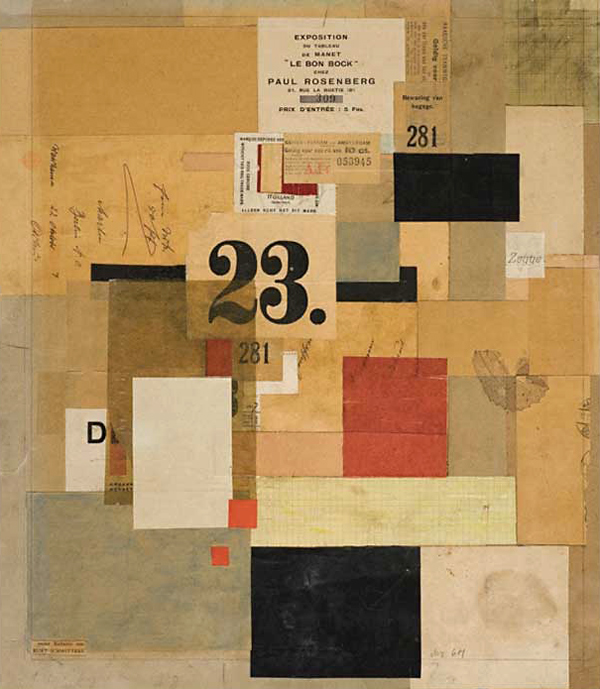
Mz 601 by Kurt Schwitters

Mz 601
collage by Kurt Schwitters, 1923
paint and paper on cardboard
15 x 17 inches, Sprengel Museum, Hanover

Surfacing

Wednesday, September 5th, 2012

“O happy living things! no tongue
Their beauty might declare:
A spring of love gushed from my heart,
And I blessed them unaware . . . ”
—Samuel Taylor Coleridge

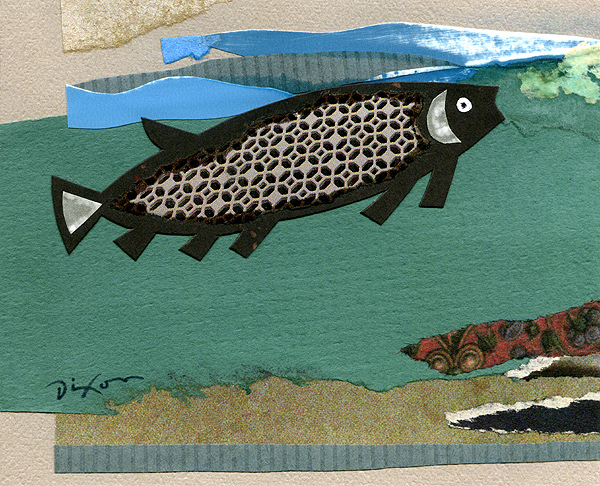
More often than not, the genesis of an idea for a collage miniature derives from the ingredient material itself, whether magazine cutting, ruined-book plate, or environmental found fragment. At other times, random visual stimuli cry out to be interpreted more traditionally as representational compositions. I can be influenced in this vein by images of “primitive” objects or folk art. Less often, conventional nature photography will trigger the pictorial urge. Creatures, faces, and figures hold a particular appeal for me. These types of small works have frequently taken the form of cards or gifts, but my current intention is to make more of these spontaneous creations available in the future to collectors.
 

Surfacing by J A Dixon

Surfacing
collage miniature by J A Dixon
4.5 x 3.5 inches, not for sale

Moon Blues

Friday, August 31st, 2012

“Structures can be understood and qualities felt in a single, balanced perception of order. Art attempts to discern order relations in nature. Data are set out in terms of recreated sensed forms; and the felt order is expressed in sensible structures exhibiting properties of harmony, rhythm, and proportion.”
—Gyorgy Kepes

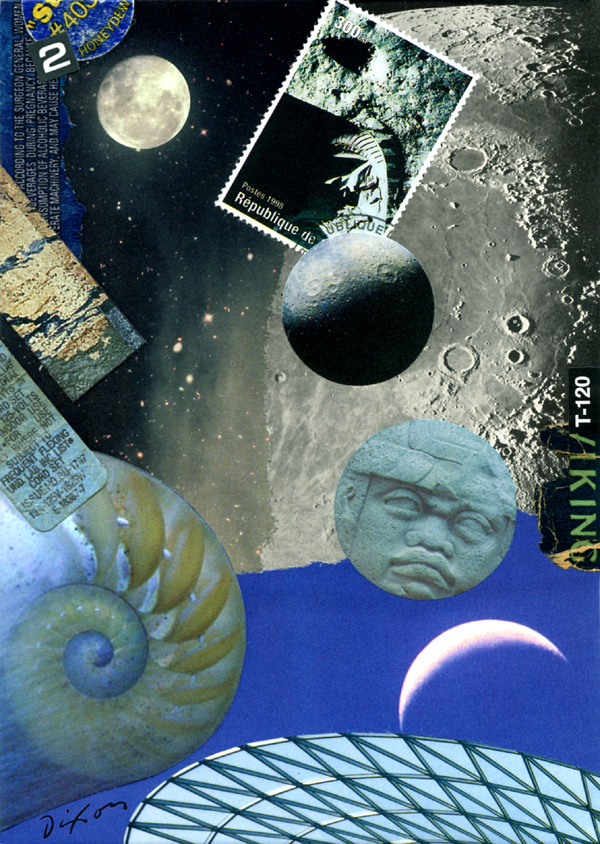
What is it about seeing two full moons balanced on the first and last day of the month that compels me to create a collage with subjective connotations? The wonder of the celestial (and the potential for visual juxtapositions of the macro- and micro-cosmic) has long held me in its spell.

It is advantageous for a collage artist to have a well-organized “morgue” of categorized scrap readily available, in order to quickly assemble ingredient elements when a creative concept takes hold. It frees one to follow the germ of an idea with associative intuition. To tell the truth, I would not know any other way to successfully approach this type of collage. Having to hunt for an image is a spontaneity killer. One’s collection of pieces and parts should be based on one’s unique way of making connections. As with most artists, I began to save images in my youth, according to a personal and natural sense of classification. Over the years, the collection has been subjected to periodic refinement and culling, although I cannot bring myself to cut off the acquisitions for good, even though I know I shall never compose all the artworks that lay fallow in those file cabinets. There are, of course, other ways to catalyze and create a collage, and I shall talk about them at a future instance.

R.I.P. ~ Mission Commander Armstrong . . .
 

Moon Blues by J A Dixon

Moon Blues
collage miniature by J A Dixon
5 x 7 inches

•  S O L D

Get the jumper cables

Saturday, August 25th, 2012

I’m keen on art history to quench a dry spell. Here’s my suggestion to a collage artist in a slump.

• Browse modern art movements that have influenced collage: cubism, dada, constructivism, expressionism, surrealism, pop art.

• Relax and study the seminal masters of the medium: Cornell, Paolozzi, Höch, Hausmann, Schwitters.

• Then go to your “morgue” of images, textures, ephemera, and found material: group various ingredients into piles, responding quickly, intuitively, and without conscious thought for composition or symbolic associations.

• Before you know it, you’ll have more ideas and embryonic projects than you can immediately deal with. React first to the ones that won’t be denied. With a bit of luck, a new series will emerge.
 

Tatlin at Home by Raoul Haussmann

Tatlin at Home
by Raoul Hausmann
1920

Keeping Score

Sunday, August 5th, 2012

“Woodblock printing has been said to have reached Europe around 1400. Thirty years after that, intaglio printing emerged as an alternative technique, and in the 1450s the first mechanical printing presses were in use. From the outset, playing-cards seem to have been among the stock-in-trade of these processes.”
—Trevor Denning

In addition to matchbooks, ticket stubs, crash numbering, tea-bag tabs, chopstick wrappers, and produce stickers, playing-cards hold a distinct visual fascination for me. I would never think to ruin an intact set of cards, but always jump at the opportunity to secure an “orphan.” Introduced into Europe through Arab sources, the centuries-old history of these gaming aids provide an interesting glimpse into the evolution of printing, design, advertising, gender roles, and our ever-ticklish relationship with power.
 

Keeping Score by J A Dixon

Keeping Score
collage miniature by J A Dixon
5 x 5 inches

•  S O L D