Archive for the ‘Experiments’ Category

Journal Collage  |  First Page

Thursday, February 21st, 2013

“At first I put anything and everything in — phone numbers, appointments, grocery lists, in addition to things related to what I was thinking about for my work. Over the years the contents have become a shade more formal, and much more visual. There’s less of my hand (in the sense of sketches and drawings), more reliance on found material. But I’ve tried to keep the whole thing as loose and freewheeling as possible.”
— John Willenbecher

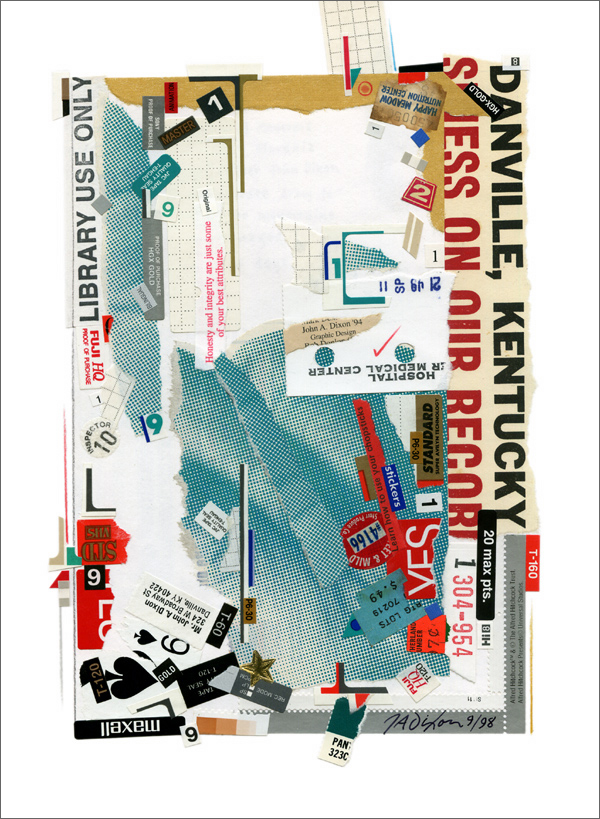
When I was 21, I had a single conversation with a man named Henry who boarded at the Cincinnati house where I lived. He seemed much older at the time, but I would guess now that he was barely 25. What I took away from that one exchange was Henry’s strong conviction that I should start a journal, as he had done several years before. Heeding his invaluable advice, I kept an active journal close at hand from that point forward. At first, it was just words, because I already had various sketchbooks as a student. Eventually, it became a comprehensive repository for personal notes, musings, doodles, and thumbnail ideas. As time passed, the content took on more of the character of visual exploration, with whole pages devoted to spontaneous collage experiments and studies for what might or might not lead to a finished artwork. I discovered that John Wllenbecher and others were calling their volumes “commonplace books,” a term more strictly applied to a “verbal scrapbook.” For some reason, mine also seemed a bit large for that particular name (sometimes 11 x 14, but most often 8.5 x 11), and so I’ve always continued to think of them as my journals. In combination with the many hundreds of handmade greeting cards I’ve created over the same period of time (nearly 40 years now), these private “chronicles” have served as the primary incubator for my work as a collage artist.
 

Untitled (Library Use Only)
journal collage by J A Dixon
8.5 x 11 inches, not for sale

Fortune Collage Project

Wednesday, January 30th, 2013

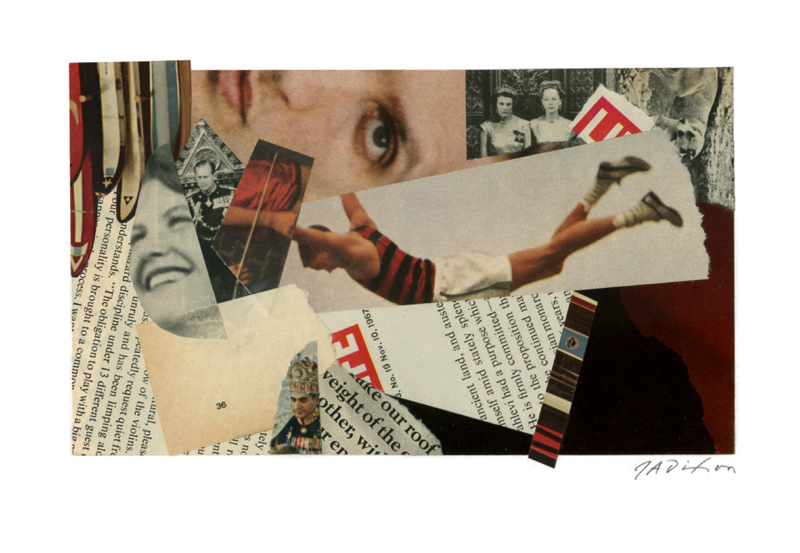
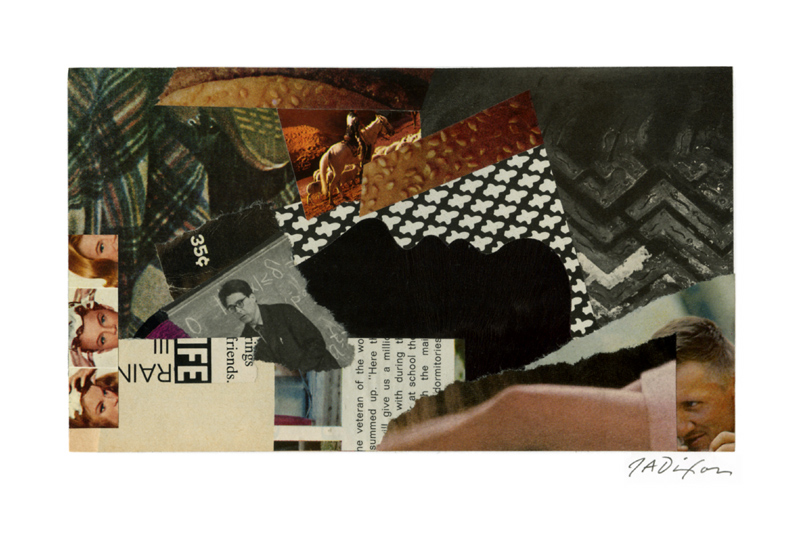
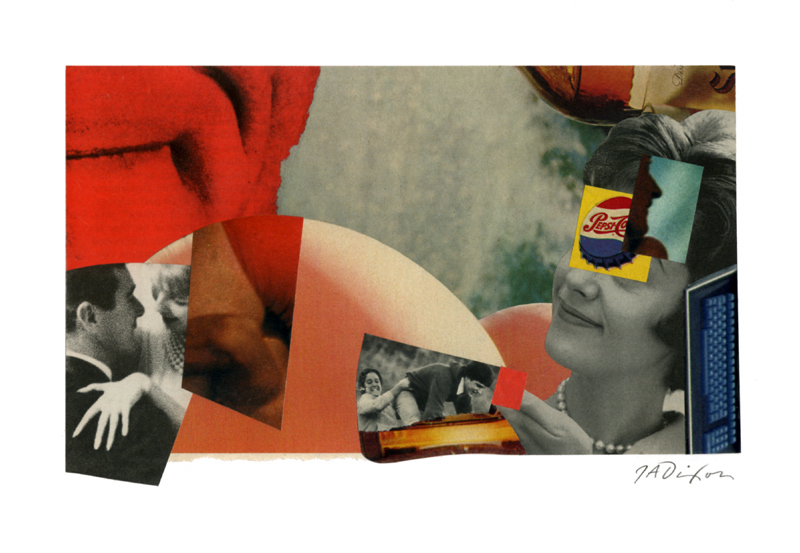
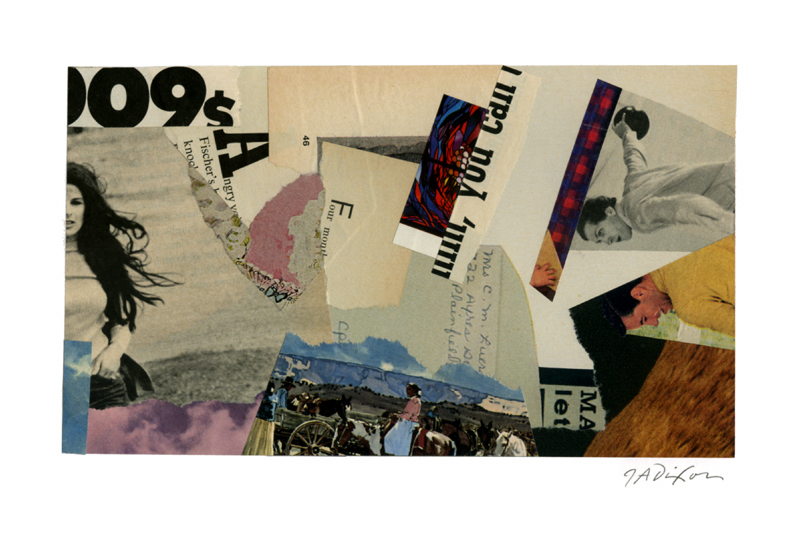
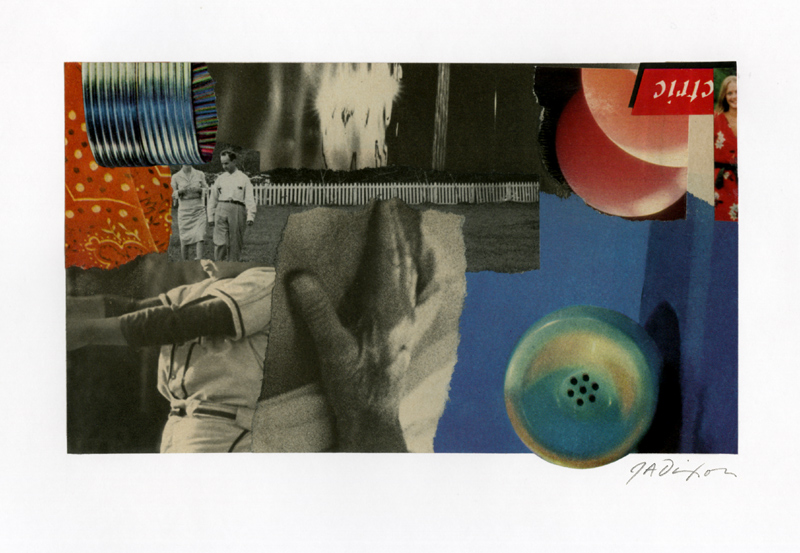
Here are the rest of the recent experiments from my participation in the Fortune Collage Project. Aside from the strict imposition of vintage magazine scrap, which dictates a particular look not in keeping with my typical eclectic mix of ingredients, the primary realization I gained from this exercise is a greater awareness of how much I rely on a series of closing decisions to fine tune my composition. A speed requirement strips nearly all of that phase from my process. It was interesting to observe the distinct difference between spontaneity and deliberate refinement. Each involves a different kind of intuitive response. 

A

B

C

D

A—   Life with Bobby
B—   Over the Weekend
C—   The Following Presentation
D—   Crocodile Tears

collage miniatures by J A Dixon
7.75 x 4.5 inches
Fortune Collage Project
available for purchase

Daze of Yore

Thursday, January 24th, 2013

“Creativity arises out of the tension between
spontaneity and limitations . . . ”
— Rollo May

If you want to see just how quickly 30 minutes can zip by, try your hand at the Fortune Collage Project. Charles Wilkin currently has a bunch of us speed-pasting his vintage scrap, as we take part in the latest collaborative exercise among facebook friends. It’s important to keep these kinds of involvements under control, but Wilkin has put together a thoughtful ritual that I could not resist. I have a tendency to pride myself on a high level of spontaneity, so occasionally I have to put it to a true test. It can be fun, informative, and more than a bit humbling, too. 

Daze of Yore
collage miniature by J A Dixon
7.75 x 4.5 inches
Fortune Collage Project
available for purchase

There I Was

Saturday, December 8th, 2012

“He spread flour and water over the paper, then moved and shuffled and manipulated his scraps of paper around in the paste…. Finally, he removed the excess paste with a damp rag, leaving some like an overglaze in places where he wanted to veil or mute a part of the color.”
— Charlotte Weidler

It has been more than a year since I had the humbling opportunity to study dozens of Kurt Schwitters originals at the Berkeley Art Museum. I read the description by the art historian Charlotte Weidler that same day, but I only recently decided to experiment with the paste method she observed. I have always worked with a variety of adhesives, and I often combine more than one in a single collage, never hesitating to literally mix them together (white glue + acrylic varnish, for example). I was impressed with how good some of Kurt’s compositions had held together after 70 to 80 years. I dug out a small package of paper-hanger’s wheat paste acquired in the 1970s, with the new intention of using it to produce a collage on canvas that would stand on its own as an object when finished. Although I expected to coat the final surface later with gel medium, for my first piece based on using the same adhesive as the pioneering artist, I was mainly interested in how wheat paste would affect my process.

The artwork is undone, but I share one of my separate experiments below. I could not be more pleased with the results of this approach. The paste dries slowly. This allows for repositioning, easy removal of excess, and it cures to a flat, velvety finish. I am especially pleased with how conducive it is to manipulating coated paper torn from magazines, an ingredient I am quite fond of. I lightly sand the reverse side, adding a bit of white glue to the paste for good measure, and, using this hand-pasting technique, I have never found “mag scrap” more easy to work with. It may not seem like a big deal to those who attend diverse workshops and demonstrations, but, as a self-taught collage artist, it feels like a significant breakthrough to me.

Now, the only question that remains is one of durability. The seminal works of K.S. show every sign of lasting a century in decent shape, but I am no museum expert, nor have I been as fixated on archival longevity as some collage artists I know. I expect my creations to age, perhaps in unexpected ways. This reminds me of an online discussion not long ago about using elements taken from newspapers. Many collage artists may share my expectation that a newsprint ingredient will simply mature as nature sees fit, adding a certain “wabi-sabi” aspect to a work of art that relies on found material. Who knows what Picasso or Braque thought about the nature of impermanence when each created their first collage with that famous wood-grain paper found in a store? Or, for that matter, what Schwitters himself thought when— with seemingly little regard for acid-free niceties —he built the enduring concepts of Merz on the detritus of ordinary life?
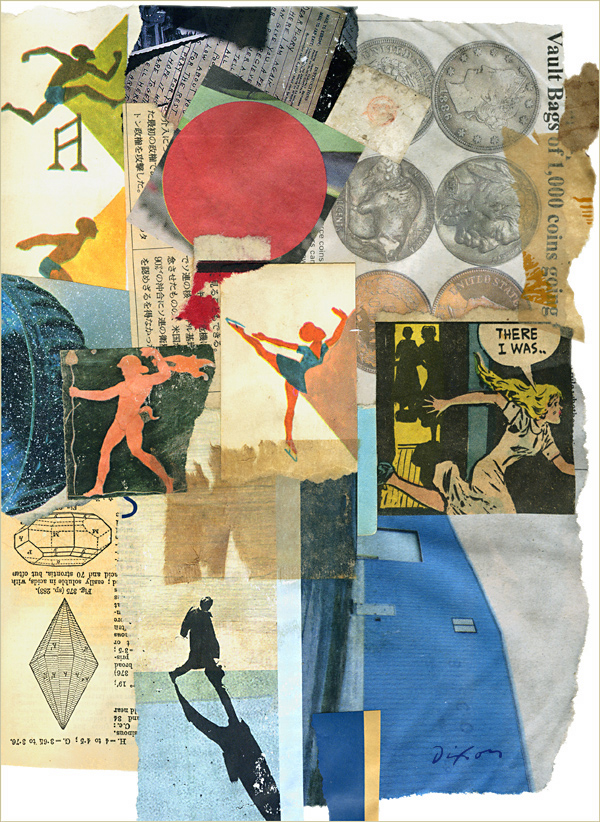
 

There I Was by J A Dixon

There I Was
collage experiment by J A Dixon
8.75 x 11.5 inches, not for sale