Archive for the ‘Artists/Other’ Category

March Exercise  |  year nine, day eighteen

Tuesday, March 18th, 2014

“All of old. Nothing else ever. Ever tried. Ever failed. No matter. Try again. Fail again. Fail better.”
— Samuel Beckett

I cannot lay claim to having unraveled any of the perplexities of Worstward Ho or Waiting for Godot, but Beckett’s famous quotation about perseverance rings especially true for me. There are times when I look at a collage artwork just finished and, to be honest, I am unable to tell if it is a success or a failure. However, one thing is certain — I am always one step closer to knowing. Let us keep failing better.
 

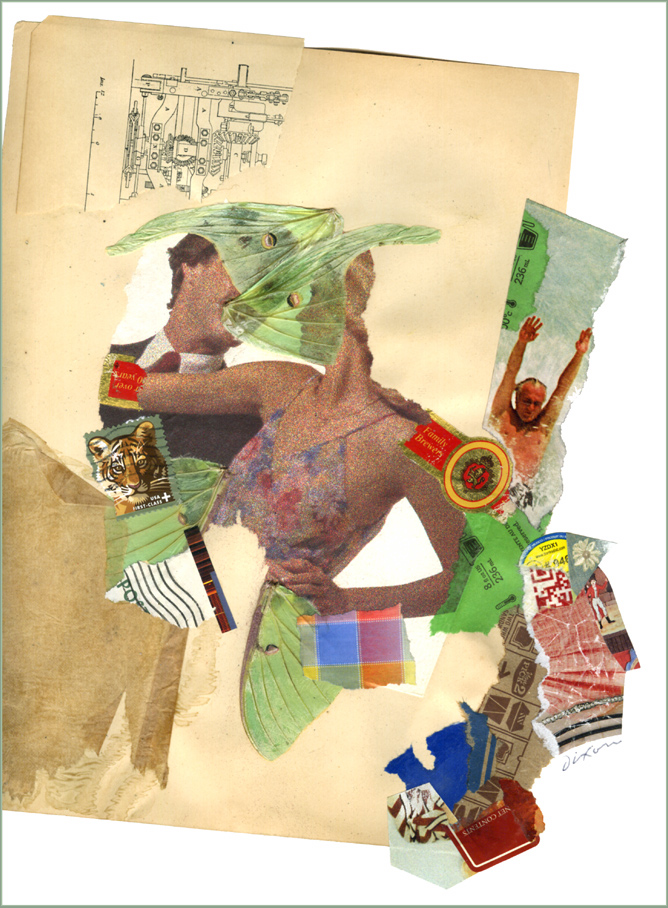
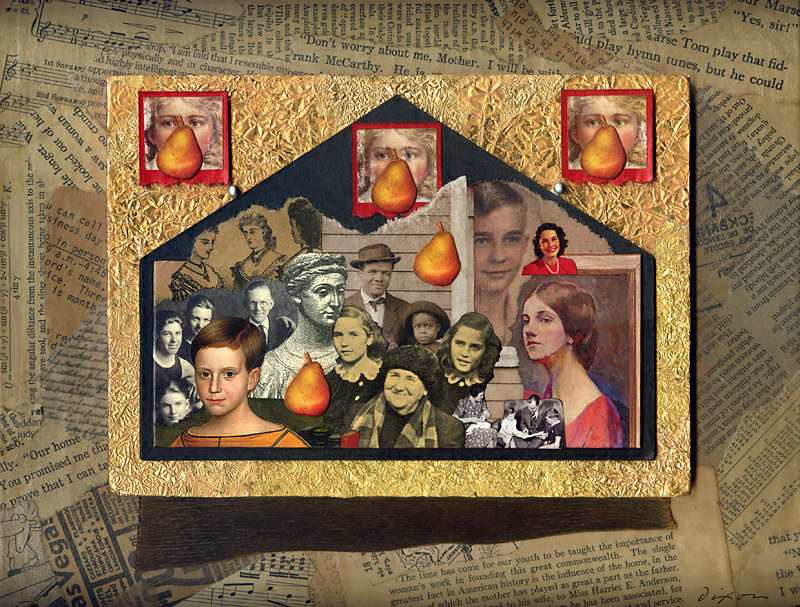
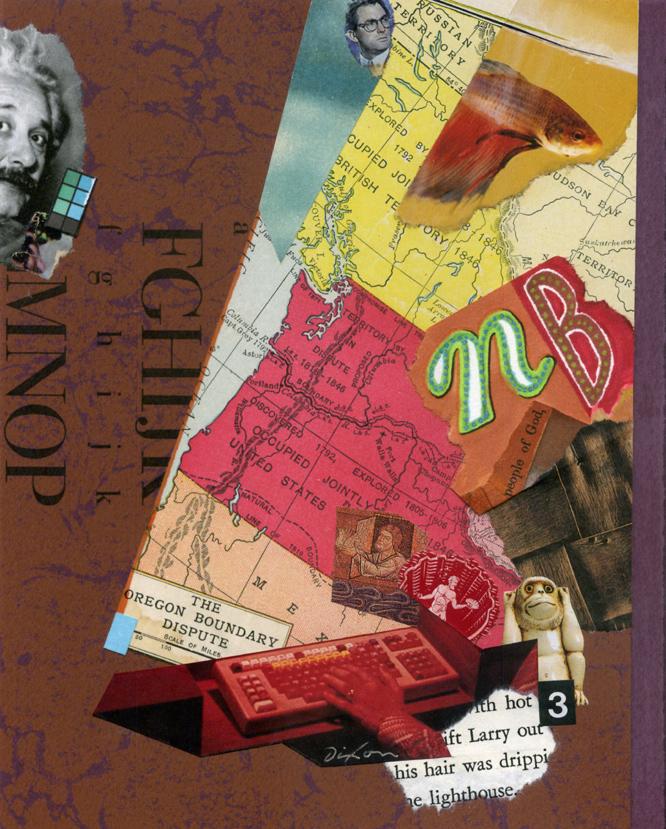
Fresh Catch By John
collage artifact by J A Dixon
10.5 x 9 inches
 
Purchase this artwork!

Sustained Diversion

Friday, February 21st, 2014

“Works of art do not force meanings on their audience; meaning emerges, adds up, unfolds…”
— Robert Hughes

Today’s featured artwork is one of the most satisfying pieces I have created so far this year. It can be viewed in person at Ingredients Reclaimed, my solo exhibition that lasts until Friday the 28th. As we know, February is a short month, so it is no surprise to realize that the display is down to its last week. Fortunately, the Boyle County Public Library is open every day. Dana (a partner in all things and my most constructive critic) thinks that this is my most cohesive, best-looking show ever, and I cannot disagree. The Mahan Gallery is a fine space — an ideal, intimate setting for someone to study the progress I have made with my investigations over the past year. I hope as many people as possible in the geographic area are able to spend a bit of time at the show, and to let me know how they feel about my work. It is such a subjective medium. For me, the echoed response of an observer has always been at the heart of collage.
 

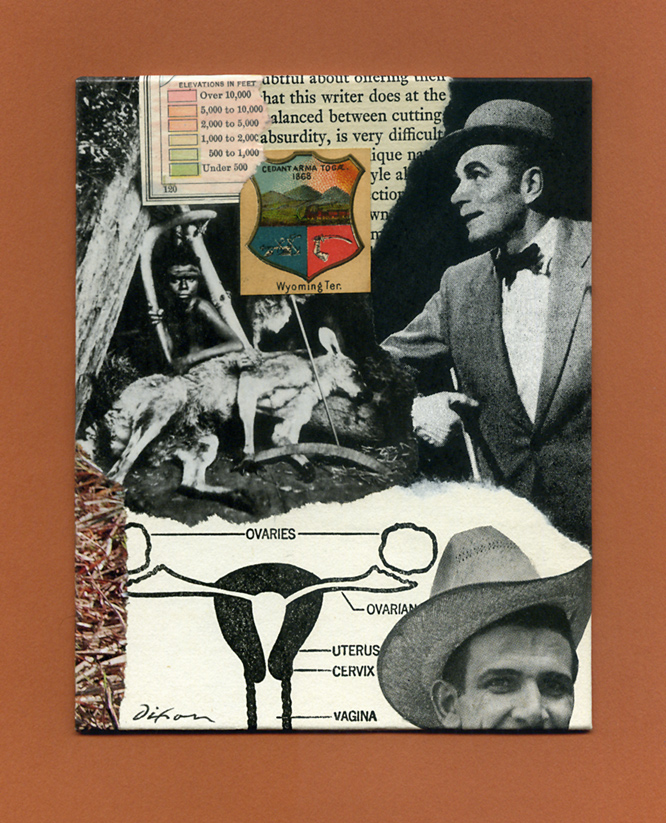
Sustained Diversion
mixed-media collage by J A Dixon
11 x 14.875 inches
available for purchase

On reworking a “finished” piece . . .

Wednesday, November 27th, 2013

“. . . the completion of a work is only ever an abandonment, a halt that can always be regarded as fortuitous in an evolution that might have been continued.”
— Paul Valéry

Whether one thinks of the anonymous medieval monk embellishing a pre-existing manuscript, of Leonardo da Vinci working on the surface of his older painting, or of George Lucas making alterations to the original Star Wars trilogy, there is a long and sometimes controversial history of “refining” creative works already accepted as finished. I remember reading about Asian masters who thought nothing of making additions to artworks created in earlier eras. Apparently some art historians believe that halos were added to religious masterpieces much later. Duchamp did not draw those whiskers on the actual Mona Lisa, but he might have, had he been able to get away with it. What has all this to do with collage? Perhaps our entire genre came into being with the essential hunch that worthwhile art could result from revising something in contrast to its original purpose or frame of reference.

There is a wide spectrum to consider, if the subject under discussion is “altered art.” We might be talking about anchoring the concept for a collage on a singular appropriated image or transforming a mundane object into a new work of art. (L T Holmes recently shared a multi-part, personal tour of her Don’t Get Jittery On Me.) Or we might be referring to the simple idea of returning to a work already deemed complete and “writing a final chapter” to improve it. Think long enough about this topic and you may ask yourself whether any artwork is ever really done. Going back to Leonardo and Lucas for a moment, both turn up from time to time in attributions that suggest they also may have altered a version of the Valéry quotation more pithy than the poet most likely ever expressed.

“A poem is never finished, only abandoned.” — Paul Valéry
“Art is never finished, only abandoned.” — Leonardo da Vinci
“A movie is never finished, only abandoned.” — George Lucas

Forgive me if all of this undue rambling merely serves as an opportunity to highlight two “finished” collage artworks that I recently chose to revisit. Both examples also illustrate the complications of visually comparing two images created with different digital devices. After writing about a corresponding issue last week, I have since discovered S Caswell-Pearce’s related words from an April entry at paper with a past. My images for Rhapsody with Fever Chills demonstrate the same scanner/camera differential, although the scan of the new version is a better rendition of the artwork’s strong complementary effects. (This piece is currently on display with the “Seeing Red” exhibit in the McKinney Conference Center at Kentucky’s Constitution Square Historic Site.) The digital documentation of a revised Broken Qualifications, having shared the original version previously at this site, became a bit more challenging the second time around, given the addition of three-dimensional ingredients. At any rate, neither piece had ever felt fully resolved, although I had no specific plans to “reopen the case” until I made a broader reassessment of my inventory. Did I enhance them, ruin them, or just squander my time? You be the judge.
 

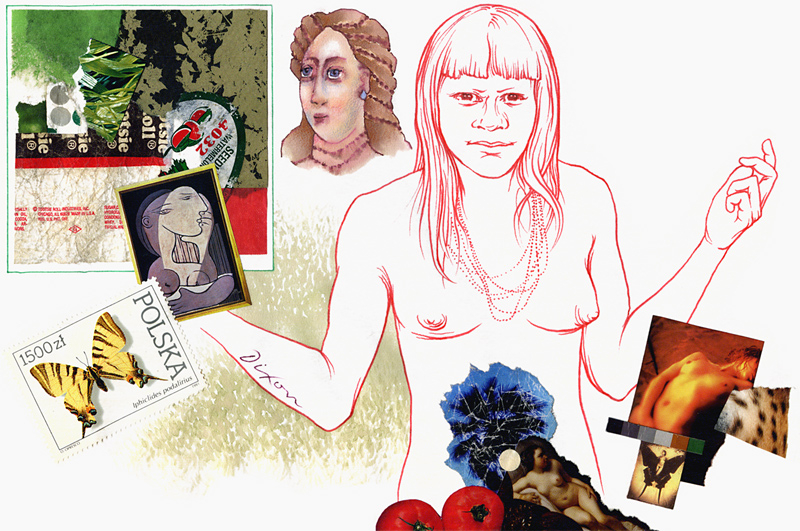
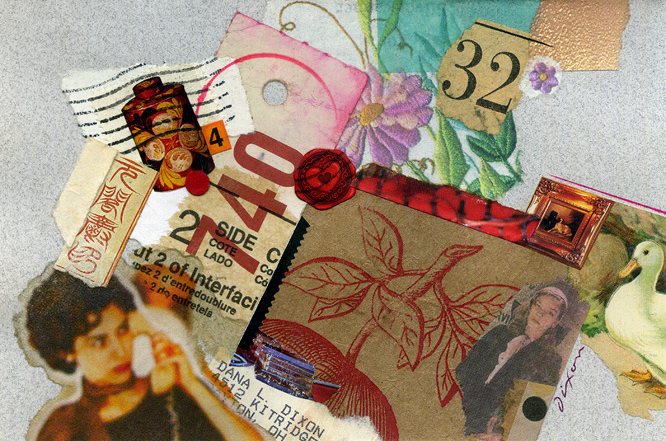
Rhapsody with Fever Chills
collage on paper by J A Dixon
7.5 x 10 inches, available for purchase

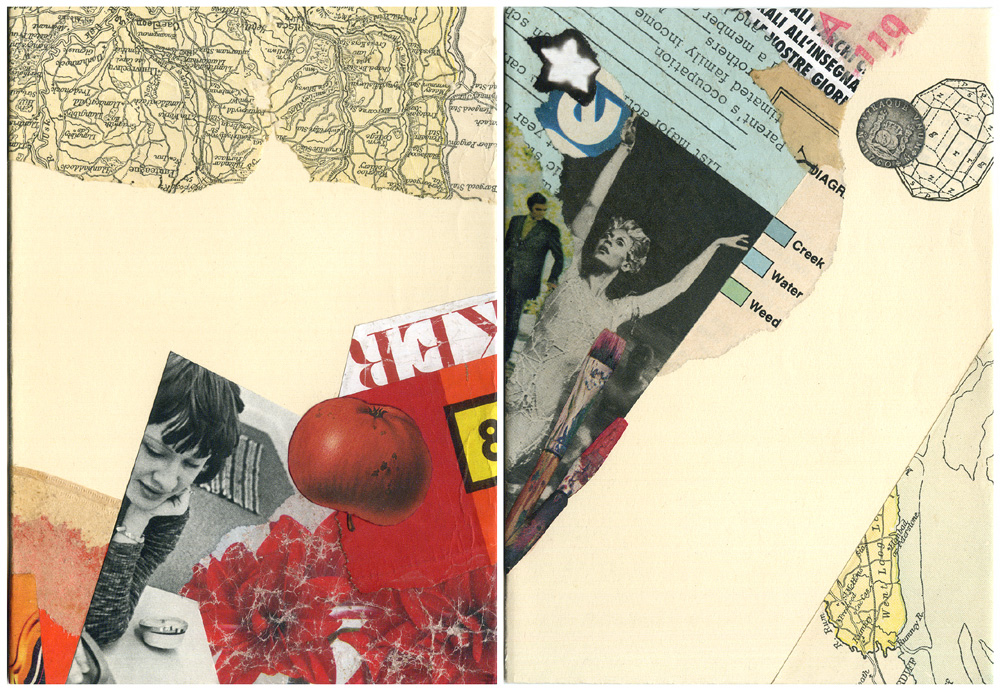
Broken Qualifications
collage/assemblage by J A Dixon
6 x 8 inches, available for purchase

this thing we all do . . .

Wednesday, November 20th, 2013

In response to an assertion that his environmental works are impossible to visually document—

James Turrell: “Well, someone has to make up for all the work that photographs better than it is.”
 

Mr. Turrell’s recent quip brings to the forefront a distinct feature of representing or documenting one’s artwork. Does it really look like the image being included with a call for entries, posted at an online marketplace, or shared on a social network? Of course, the photographing of artwork to enhance its appeal did not begin with digital devices or the World Wide Web. Most of us are familiar with the curator’s disclaimer that reserves their right to reject artwork which arrives substantially different than visually represented when proposed. Even non-artists know how easy it is to boost the contrast or color saturation of a digital image. Setting apart from our discussion works that are essentially digital from the outset, it is important for anyone working in the medium of traditional collage to squarely meet this challenge: How do we properly interpret the visual experience of seeing our artwork firsthand?

Needless to say, faithfully photographing or scanning conventional artwork is something that professionals face every day, but how can it ever be an exact science? What is the “true” appearance of anything? As the three examples below demonstrate, one of my recent collage artworks photographed differently under three different lighting conditions, before it was delivered. The more neutral version is closer to how it might “typically” appear, but perhaps the most faithful rendition would be an image made in the setting for which the piece was commissioned, under the unique lighting conditions of that particular environment, and then subsequently balanced for a reasonable match to the naked eye.

I review nearly a hundred collage artworks a day, as my eye passes over numerous online displays each week. What percentage of these creations actually look like the corresponding digital image? We all know what it’s like to see something and think, “I wonder if it really looks like that.” On the other hand, we also know what it’s like to scan a piece and think, “Wow. That looks better than I expected.”

All that any of us can do is establish a level of integrity about representing work to others. For those who routinely cheat or push an ethical boundary? Rest assured; the habit will eventually come back to haunt their studios.

And now, a few words about today’s collage example. I must first express my appreciation to Lee and David Simpson for the commission that resulted in this thing we all do, a mixed media and collage artwork on canvas. To infuse the composition with images that represent aspects of significance to their lives, this piece was personalized by using the clients’ own artifacts and memorabilia, as well as additional ingredients carefully selected from my morgue. Creating works with special meaning to those for which they were intended has always been some of the most fulfilling time I have spent as an artist.


this thing we all do (three different digitals)
collage with combined mediums on canvas by J A Dixon
15.75 x 27.75 inches (22.50 x 34.50 inches, framed)
collection of L and D Simpson

this thing we all do (detail)
collage with combined mediums on canvas by J A Dixon
(photographed and digitally balanced to match original)
 

Bibelot Series

Tuesday, November 5th, 2013

“The museum suffered a crisis in July 1994, when burglars broke into the jewel room and stole 103 pieces worth $1.6 million, including most of the bibelot collection. The biggest art heist in Kentucky history remained a mystery for five years, and then a group of Ohio thieves was caught and convicted. Unfortunately, the bibelots apparently had been dismantled and sold as scrap for a fraction of their value.”
— Tom Eblen, Lexington Herald-Leader

I made a visit to the Jewel Room at the Headley-Whitney Museum only once, many years ago, and I was deeply inspired by the capacity to bring raw imagination into physical manifestation. The heartbreaking theft of numerous bibelot masterworks makes it nearly impossible for me to return and view a diminished collection. I have dedicated this series of miniatures to my vivid memory of what used to be.


Dedicated to the lost masterworks of George Headley.
Click on a thumbnail image to preview each miniature.

Dawn Goes Down to Day

Saturday, November 2nd, 2013

Day One / Open Studios ARTTOUR —
How much sleep I got last night will remain a secret, but I crossed the finish line with everything in place to welcome the public today. We had a steady trickle of folks who enjoyed viewing and talking about art. The design studio, art studio, and gallery/meeting space were looking fine (not to mention the exterior facade), and it feels like I have not caught my breath for several months. Dana outdid herself with some tasty punch and snacks for guests, and she was bragging on my collage all day. Nothing feels like reaching an ambitious goal with a kindred spirit, and I wish every friend in the world had been with me today, too.
 

Dawn Goes Down to Day
collage miniature by J A Dixon
4 x 4 inches
 
Purchase this artwork!

Haus of Cards ~ Series Alpha

Tuesday, September 3rd, 2013

“If everybody was treated like they matter — everyday; birthdays wouldn’t be so special.”
— Mokokoma Mokhonoana

Over the years, many hundreds of hand-crafted cards have left my work surface, bound for celebrating recipients. Even when I return to the simple expression of a person’s name, strong elements of collage will inevitably enter into the equation.
 

collage miniature by J A Dixon
collection of A Anderson

collage miniature by J A Dixon
collection of R D Dixon

collage miniature by J A Dixon
collection of C L Hellyer

collage miniature by J A Dixon
collection of D L Dixon

collage miniature by J A Dixon
collection of E Dixon

Maximalism and Minimalism in Collage, part 5

Tuesday, August 20th, 2013

“I have devoted myself to the technique of cut-paper collage.”
— Hope Kroll

Mysterious and spooky? Could it be possible that I am examining an art collection in the Addams mansion? No. The essence is far too rarefied for that. Do I instead find myself at a museum of lost Victorian curiosities? No. The effect is much too audacious for that. Perhaps you already have guessed my desirable plight. Yes, dear reader, I am slowly steeping in the sublime virtuosity of a Hope Kroll collage.

Known to many as the “paper surgeon,” the artwork of Hope Kroll would be astonishing enough for her extraordinarily meticulous “scissorship,” but she has clearly decided to put her demanding technique into service for eloquent visual statements that intrigue both the mind and eye. As Cecil Touchon points out, this would be outstanding enough, but she does not stop there. In most of her collage assemblies, she also introduces a signature three-dimensionality to heighten the surreal impression. A maximalist at heart, the prolific artist would certainly agree with Milton Glaser that “Less in not necessarily more.” Somehow she manages, time after time, to achieve unified outcomes from highly complex compositions, while at the same time evoking a powerful atmosphere that first entices, then engrosses, and finally beguiles the observer. I occasionally find her work a bit unsettling, but never unsavory, and always aesthetically exquisite. Like a fine bouillabaisse, her creations delight multiple senses.

Sample a few of her delicious recipes below and “hope,” as I do, that she continues to make many more.
 

Reconfiguration
Hope Kroll, 2003

Grooming
Hope Kroll, 2006

The Way Children Learn
Hope Kroll, 2010

Science And Faith
Hope Kroll, 2008

Thought Process
Hope Kroll, 2009

Ghost in the Machine
Hope Kroll, 2012

Back Here in 43119

Sunday, July 14th, 2013

“I am looking for an art to serve the new millennium, to re-define its culture, to question its philosophy, to re-examine its images. What we thought of as art is about to be reconfigured by a new generation born after 1985…”
— George Rodart

George R drew my attention to a thought provoking post from 2008.

If painting can survive the transition from cave art to Byzantine frescoes, through the Renaissance, the conquest of a new hemisphere, the rise of the machine, and planetary war on an industrial scale, it can surely navigate an emerging globalization based on the total commercialization of culture. A small few will redefine it. Some will understand it. Many will reject it. Most will just consume. Until the next ricochet.

Collage grew out of painting. To many, the essence of it has never been anything but painting. Will others eventually look back and say that collage penetrated and shaped all other media, or will they say that painting reclaimed collage to transform itself yet again?
 

Back Here in 43119
collage miniature by J A Dixon
6.5 x 7 inches
 
Purchase this artwork!

He Smiled With His Mind

Tuesday, July 2nd, 2013

“I believe it is impossible for a man to tell the truth about himself or to avoid impressing the reader with the truth about himself.”
— Mark Twain

It is highly doubtful that any blogger can evade the pitfalls so evident over a century ago to one of the first modern minds that America produced. At any rate, I shall attempt to be as candid as possible about my own artwork, as well as the current output of contemporary collage artists. Today’s featured item stumbled badly out of the starting gate and remained in a suspended mode until a color scheme and visual subtext came into focus. What do you think of it?

Do not forget that I have a thick skin. As a firm believer that we learn more through a constructive critique than through a casual note of praise, I shall anticipate your comments at this site. Please register today and help make The Collage Miniaturist a destination for those who are not timid about having a frank discussion about this medium.
 

He Smiled With His Mind
collage miniature by J A Dixon
9.25 x 7 inches
 
Purchase this artwork!

Fallen Body

Monday, June 24th, 2013

“Less is not necessarily more.”
— Milton Glaser

A profusion of collage artwork has recently come to my attention that makes use of only two or three elements. When this type of minimalist approach is successful, the result can be quite arresting to the eye and mind. More often than not, it looks uninteresting or unfinished to me. It may come as no surprise that I am more of a maximalist, preferring to build a layering of ingredients that transcends the intrinsic quality of the found material. I suppose that I have been more influenced by Schwitters than Cornell. Although there is nothing inherently unappealing to me about “sparsity,” admiring those who employ the methodology with skill, I have found myself pulled toward “density’ for the past few years. Some artists may think that if one hasn’t achieved a solution with fewer than a dozen parts, the essence of the piece has escaped. I appreciate that viewpoint, and respect those who consistently meet the challenge of limitation. For me, the working surface calls out for more, until a balance of “visual polyphony” takes form, and the dynamic aspects of color, shape, composition, and symbolic communication have resolved themselves as a distinctive, unified whole.
 

Fallen Body
collage artifact by J A Dixon
7.5 x 10.5 inches
available for purchase