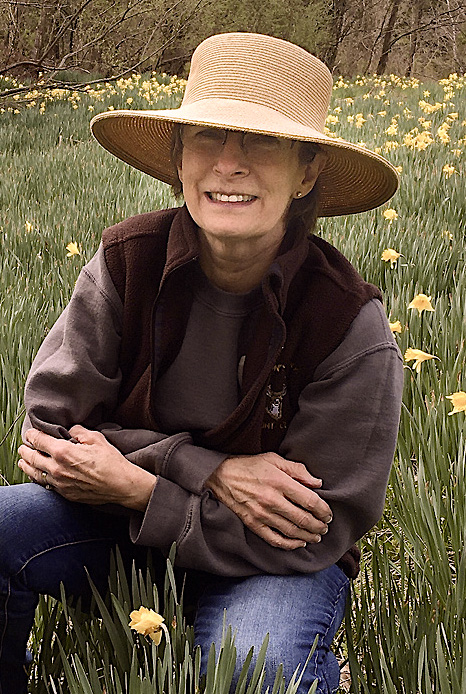
Betsy ‘Lee’ Holland Simpson
1 9 5 2 – 2 0 2 6
a dear friend
and valued patron
of boundless vitality,
insight, and courage
R
I
P
Betsy ‘Lee’ Holland Simpson
1 9 5 2 – 2 0 2 6
a dear friend
and valued patron
of boundless vitality,
insight, and courage
R
I
P
“I don’t want a picture, I want a painting.”
— Raimonds Staprāns
Sometimes a day on location feels like “going to work in the morning again.” By the time I find a good spot to sit, everything changes. Being present in a natural place elicits the rapt attention that calls for the immediacy and spontaneity of painting from life. For me, it just happens to be paper and paste. That it would turn out this way is something I never could’ve predicted. Included here is my “start” from a recent outing to Marion County, Kentucky. In the studio (without a breeze), I shall add two round bales and the essential dose of March daffodils.
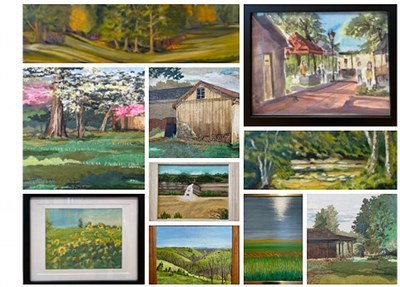 En Plein Air
an exhibition of recent
work by the Plein Air
Artists of Central Kentucky
It’s been an exceptional season for making art outdoors, and our local Art Center of the Bluegrass is currently presenting many of the resulting creations. I have six collage miniatures on display as part of the show. Enjoy the exhibit in-person or browse the virtual gallery until 9/11.

One of the highlights of the spring was our gathering at the backyard of Lee and David Simpson, with its quiet explosion of white and pink dogwood trees. They were certainly calling attention to themselves here and all over Danville. What a perfect day to be outside with the PAACK and “painting with paper,” thanks to my mobile collage kit. After some initial work, I gradually became convinced the scene was taking shape. As location coordinator for the day, I’d gotten off to an awkward start. I eventually came away from the pleasurable day with a solid interim stage, but as I began to finish the trees in the studio, it was clear that the piece needed more than details to improve it. 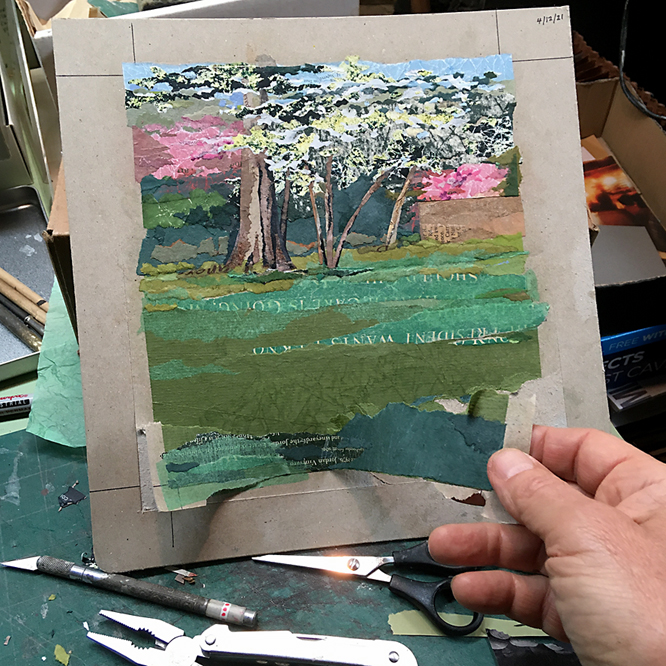 When I decided that the foreground was too deep, I impetuously peeled off the base and moved it up an inch or so — after all, this is collage. That one modification helped everything about the look. The rest of the process became obvious. If I reinforced the sun-activated colors and spent a bit more time with the fence area on the right side, I could declare it finished, as long as I stayed within an overall time allocation that was legitimately en plein air. I was pleased to achieve a 70%/30% solution.
Whenever I gather under the sky with traditional landscape painters, their impressive work challenges me to “do my thing” with paper. With each outing, it’s feeling more like I’m painting, too! 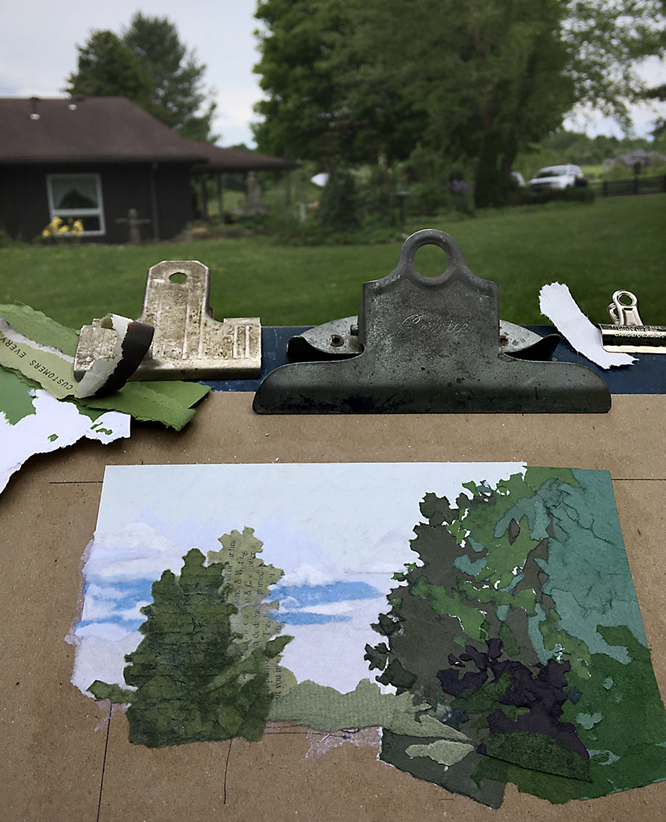 This was true in May, when we spread out to interpret the country home site of Paula and Ken Scott. A particular view of their wrap-around porch and surrounding garden captured my eye. I wanted to combine some hard-edge cutting with my evolving “brushstroke” technique. As is often the case, I pushed the finishing touches back in the studio to the 50/50 limit, matching my location time with more detailed refinements indoors. I’m still trying to solve how to bring something closer to a level of interesting density while still outside. Perhaps I’ll find that, by necessity, a totally site-based collage needs to be simpler in expression and more decisive in composition. A milestone in June and the subsequent Paint the Town experience would drive home the point, and also emphasize the importance of having a supply of “prepared papers” on hand to boost speed and expand my available vocabulary of effects.
I like to work outside because I like to be outside. When I formerly thought of myself as an amateur triathlete, I’d cross-train right through the hottest days of the summer. It doesn’t bother me to extend an Art Out into the late afternoon. Sometimes the morning shade has long since abandoned me. If I’m well into the groove, I can barely notice. Before I get totally off the subject here, I should state that I actually rely on direct sunlight to promote the drying of my collage surface, since I’m usually working wet-on-wet. A good example of this was the day PAACK gathered in the nearby Forkland community. I don’t fault others for finding a shady spot to paint. I set up not far away in the open sun.
In the decades since this Ohioan adopted Central Kentucky as my permanent home, I’ve developed an affection for the distinct topography and knobby woodlands of our area. Sure, the famous horse farms and limestone palisades are always handy, but I’ll never get enough of the unique contours of a “gumdrop horizon.” The Forkland community, which straddles three adjacent counties, was a destination that fit my attachment to “The Knobs”. The result was On the North Rolling Fork, one of my favorite landscape miniatures of the year.

Dogwood Day
collage miniature by J A Dixon
70% / 30% — site to studio
8 x 7.75 inches
• S O L D

Country Porch
collage miniature by J A Dixon
50% / 50% — site to studio
7.75 x 7.75 inches
• S O L D

On the North Rolling Fork
collage miniature by J A Dixon
50% / 50% — site to studio
8 x 7.75 inches
• S O L D
In response to an assertion that his environmental works are impossible to visually document—
James Turrell: “Well, someone has to make up for all the work that photographs better than it is.”
Mr. Turrell’s recent quip brings to the forefront a distinct feature of representing or documenting one’s artwork. Does it really look like the image being included with a call for entries, posted at an online marketplace, or shared on a social network? Of course, the photographing of artwork to enhance its appeal did not begin with digital devices or the World Wide Web. Most of us are familiar with the curator’s disclaimer that reserves their right to reject artwork which arrives substantially different than visually represented when proposed. Even non-artists know how easy it is to boost the contrast or color saturation of a digital image. Setting apart from our discussion works that are essentially digital from the outset, it is important for anyone working in the medium of traditional collage to squarely meet this challenge: How do we properly interpret the visual experience of seeing our artwork firsthand?
Needless to say, faithfully photographing or scanning conventional artwork is something that professionals face every day, but how can it ever be an exact science? What is the “true” appearance of anything? As the three examples below demonstrate, one of my recent collage artworks photographed differently under three different lighting conditions, before it was delivered. The more neutral version is closer to how it might “typically” appear, but perhaps the most faithful rendition would be an image made in the setting for which the piece was commissioned, under the unique lighting conditions of that particular environment, and then subsequently balanced for a reasonable match to the naked eye.
I review nearly a hundred collage artworks a day, as my eye passes over numerous online displays each week. What percentage of these creations actually look like the corresponding digital image? We all know what it’s like to see something and think, “I wonder if it really looks like that.” On the other hand, we also know what it’s like to scan a piece and think, “Wow. That looks better than I expected.”
All that any of us can do is establish a level of integrity about representing work to others. For those who routinely cheat or push an ethical boundary? Rest assured; the habit will eventually come back to haunt their studios.
And now, a few words about today’s collage example. I must first express my appreciation to Lee and David Simpson for the commission that resulted in this thing we all do, a mixed media and collage artwork on canvas. To infuse the composition with images that represent aspects of significance to their lives, this piece was personalized by using the clients’ own artifacts and memorabilia, as well as additional ingredients carefully selected from my morgue. Creating works with special meaning to those for which they were intended has always been some of the most fulfilling time I have spent as an artist.
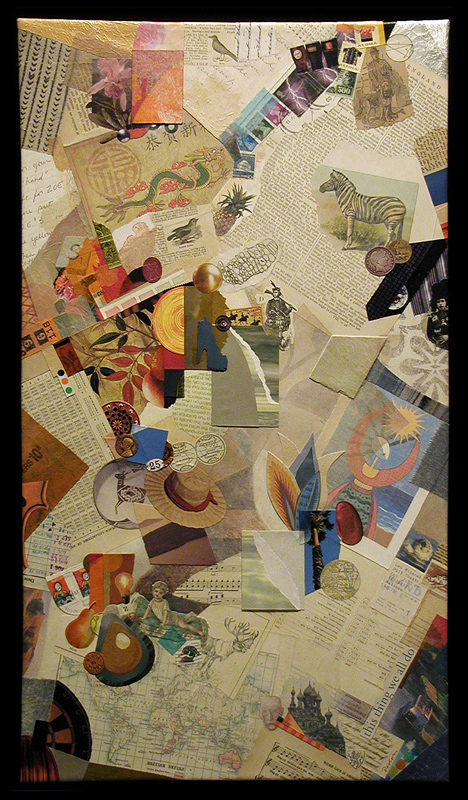
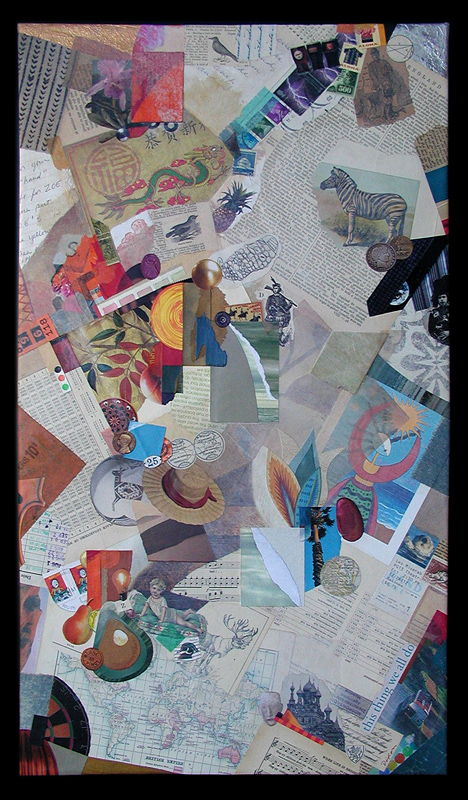
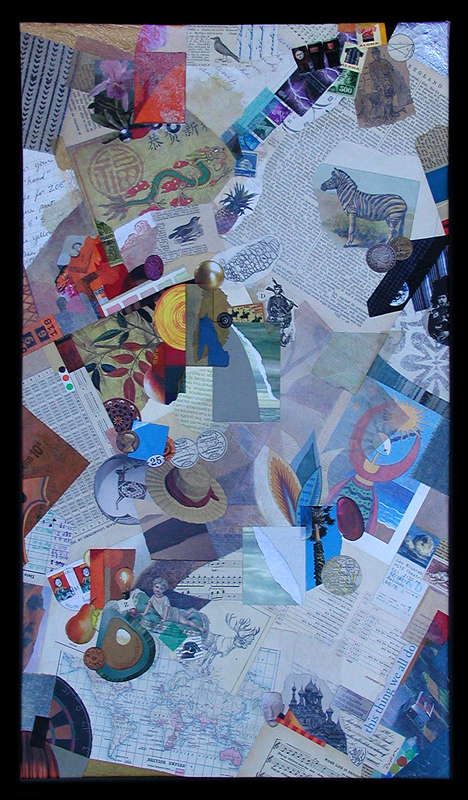
this thing we all do (three different digitals)
collage with combined mediums on canvas by J A Dixon
15.75 x 27.75 inches (22.50 x 34.50 inches, framed)
collection of L and D Simpson
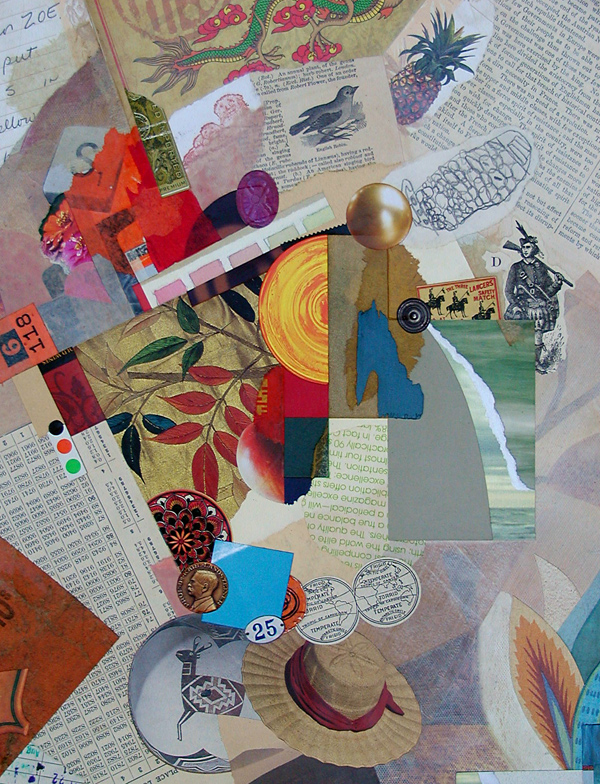
this thing we all do (detail)
collage with combined mediums on canvas by J A Dixon
(photographed and digitally balanced to match original)

