Archive for the ‘Artists/Collage’ Category

Journal Collage  |  First Page

Thursday, February 21st, 2013

“At first I put anything and everything in — phone numbers, appointments, grocery lists, in addition to things related to what I was thinking about for my work. Over the years the contents have become a shade more formal, and much more visual. There’s less of my hand (in the sense of sketches and drawings), more reliance on found material. But I’ve tried to keep the whole thing as loose and freewheeling as possible.”
— John Willenbecher

When I was 21, I had a single conversation with a man named Henry who boarded at the Cincinnati house where I lived. He seemed much older at the time, but I would guess now that he was barely 25. What I took away from that one exchange was Henry’s strong conviction that I should start a journal, as he had done several years before. Heeding his invaluable advice, I kept an active journal close at hand from that point forward. At first, it was just words, because I already had various sketchbooks as a student. Eventually, it became a comprehensive repository for personal notes, musings, doodles, and thumbnail ideas. As time passed, the content took on more of the character of visual exploration, with whole pages devoted to spontaneous collage experiments and studies for what might or might not lead to a finished artwork. I discovered that John Wllenbecher and others were calling their volumes “commonplace books,” a term more strictly applied to a “verbal scrapbook.” For some reason, mine also seemed a bit large for that particular name (sometimes 11 x 14, but most often 8.5 x 11), and so I’ve always continued to think of them as my journals. In combination with the many hundreds of handmade greeting cards I’ve created over the same period of time (nearly 40 years now), these private “chronicles” have served as the primary incubator for my work as a collage artist.
 

Untitled (Library Use Only)
journal collage by J A Dixon
8.5 x 11 inches, not for sale

Star of Abraham

Monday, February 18th, 2013

“However long and varied the background of pasted materials in folk art, none of these developments was considered a major artistic movement. It was the creative artists of the twentieth century, Pablo Picasso and Georges Braque, who applied materials as a new and valid means of expression. With these artists and their work the word ‘collage’ was first applied and became associated with the movement. Thus was born an art form that has become part of the contemporary milieu and, indelibly, a major historical art movement.”
— Dona Z Meilach and Elvie Ten Hoor

My wife and I recently went to see Lincoln, the Spielberg picture with Daniel Day-Lewis in the title role. It got me thinking again about the work I created for the bicentennial of the 16th president’s birth, the celebration of which was a fairly big deal here in his native state. I had made the decision to exploit the bulk of my collected Lincoln images to totally cover a metal star. To produce a collage tribute to the martyred leader with a folk-art approach seemed to me a technique appropriate to the occasion. The “artifact” is still waiting for a home. Happy Presidents Day to all.
 

Star of Abraham
collage artifact by J A Dixon
22 x 22 inches

Happy Happy !

Thursday, February 14th, 2013


Be Mine
collage miniature by J A Dixon

Shadows of Joseph

Monday, February 11th, 2013

“From the beginning he had responded to the avant-garde developments of his time with admirable swiftness and sureness. It is hard to think of another American artist who was receptive to so many different art movements or who managed to win the admiration of everyone from the Surrealists in the 1940s to the Abstract Expressionists in the 1950s to the Pop Artists in the 1960s. Artists who agreed on little else agreed on Cornell.”
—Deborah Solomon

“The central themes of Pop Art were sub-culture, folk cultures, media imagery, new technologies, design, the consumer goods and engineering industries, the inter-relationships between these phenomena and their effect on human beings.”
—Tilman Osterwold

Osterwold’s analysis suggests that traditions, fashions, and even avant-gardist achievements could no longer be the norm after Pop Art, which swept away the boundaries of artistic development with its focus on a “consciously perceived and reflected present-day existence.” Having just finished Deborah Solomon’s biography of Joseph Cornell (Utopia Park: The Life and Work of Joseph Cornell), I am struck by how Cornell anticipated Pop Art with his focus on the appropriated elements of mass culture and his various obsessions with celebrities, while at the same time demonstrating an abiding indifference to the cult of personal fame so typically associated with the movement. Walter Hopps stated that Cornell was “Schwitters’ greatest successor.” Cornell was certainly aware of Schwitters, for he was highly cognizant of nearly everything about the onrushing stream of modern art (in contrast to the misconception that he was some sort of urban hermit), but the precise lineage of artistic influence may never be fully known. Perhaps it was Cornell’s connection with Max Ernst that is a key factor. In my opinion, Ernst was not a giant of 20th-century collage, but did have a vital influence on the genesis of Cornell’s art. It is well recognized that Joseph began and ended his unique body of work with the medium of collage. One of the things that astonishes me is how he could be so attuned to the advancing frontier of present-day art (often staying a step or two ahead of it) and, at the same time, carry such a personal dysfunction that derived from the driving intensity of his inner world. Was that the nature of his genius? At any rate, his strange but amazing ability to synthesize powerful emotional and cultural content by inventing (virtually from scratch) a distilled form of assemblage continues to set the standard for almost everything in the mix of media that has followed in its wake. Hardly a day goes by that I don’t observe an artwork that can be traced directly to his seminal vision. But rarely do I see another artist infuse their juxtapositions with a rich symbolism to compare favorably with his complex associations. Most of the art I see with an obvious Cornellian tone owes more to surrealist automatism or atmospheric illustration than to the intricate blend of embedded meaning and refined intuition that characterized his enduring originality.
 

Knave Child
Kurt Schwitters, 1921
Collage on paper
Sprengel Museum, Hannover.

plate from La Femme 100 Têtes
Max Ernst, 1929
Collage novel
Published Éditions du Carrefour, Paris

Untitled (Schooner)
Joseph Cornell, 1931
Collage on paperboard

Untitled (Girl and Two Columns)
Joseph Cornell, c. 1950
Glass, wood, tempera and printed paper collage

Circe III — Surface and Volume in Nature
Joseph Cornell, c. 1961-66
Collage on masonite

More personal miniatures . . .

Thursday, February 7th, 2013


It Could Have Been You
collage miniature by J A Dixon
collection of M Higgins

Elusive Legibility
collage miniature by J A Dixon
collection of K O’Brien

On To 100
collage miniature by J A Dixon
collection of J Fulton

Defoliata
collage miniature by J A Dixon
collection of E H Simpson

Jocular Assimilation
collage miniature by J A Dixon
collection of D Breidenbach

Sign Up For Another
collage miniature by J A Dixon
collection of S J Montgomery

Personal miniatures

Saturday, February 2nd, 2013

“The dealings with artists, for instance, require great prudence; they are acquainted with all classes of society, and for that very reason dangerous.”
— King Leopold II of Belgium
 

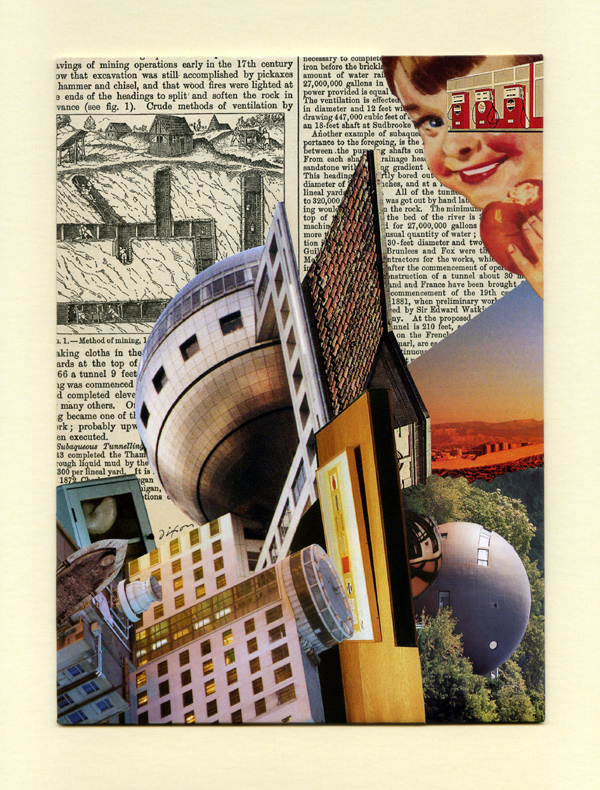
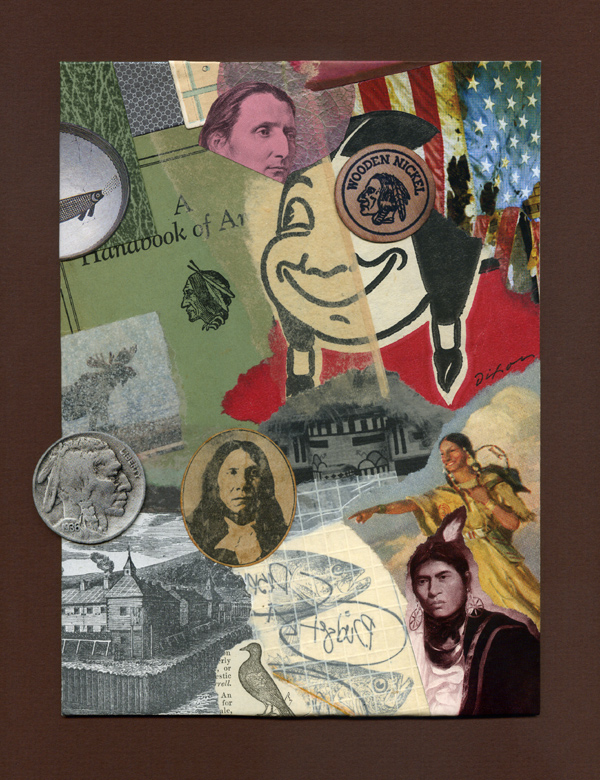
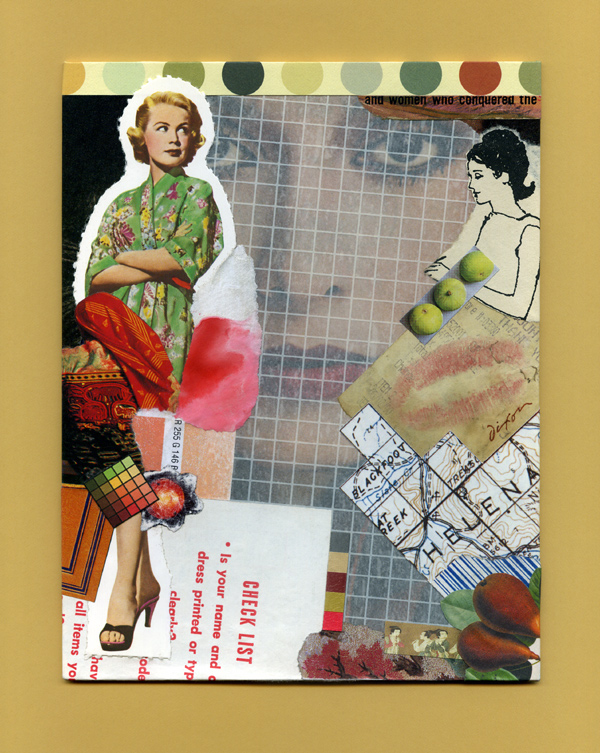
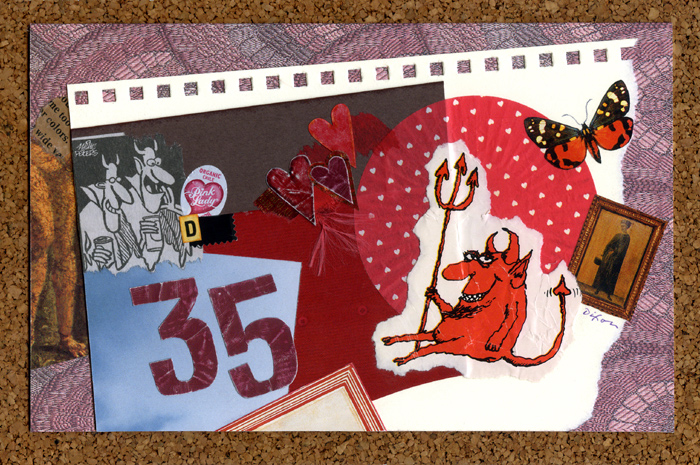
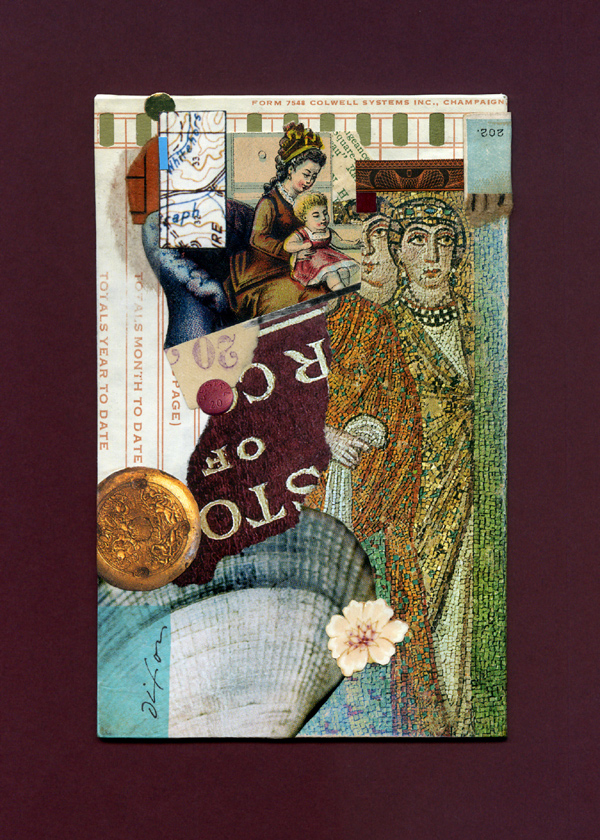
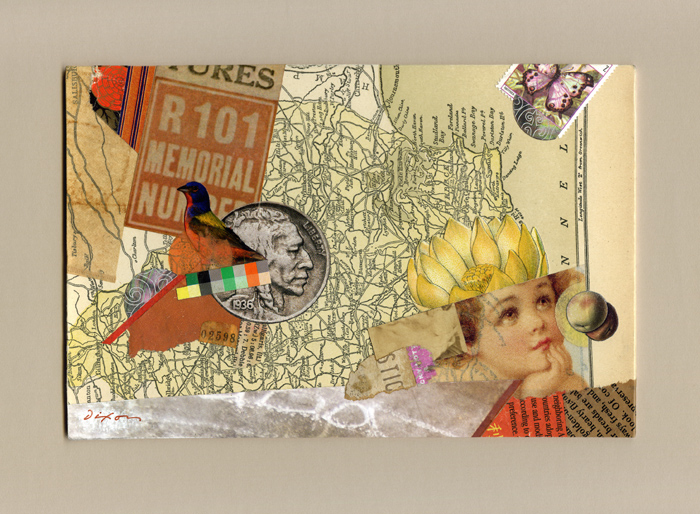
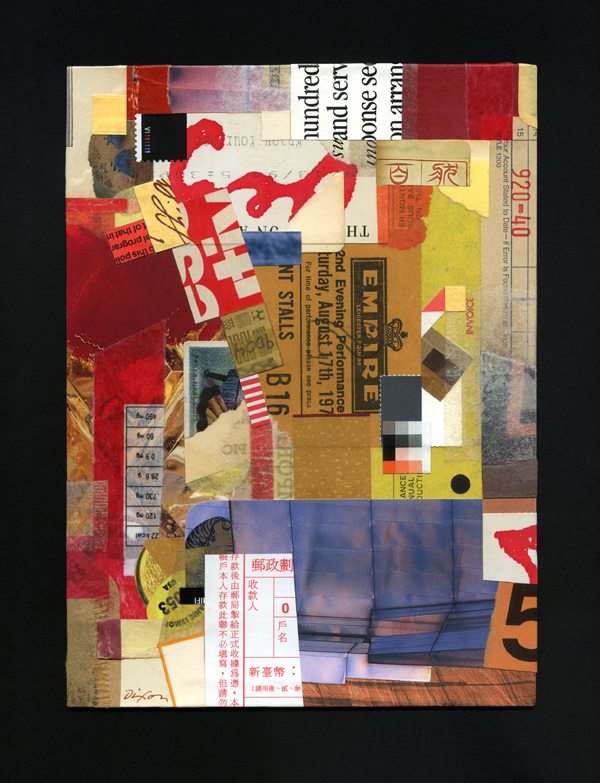
As many artists have found through the ages, there is something uniquely satisfying about creating a small work of art as an expression of fondness for an individual person. Part of the appeal is that one knows it will be accepted unconditionally and without judgment. It can serve as an exercise in unfettered intuition, free from the kinds of meddlesome thoughts and feelings that can accompany the formation of a work for exhibit or sale. This is a good habit to internalize. It keeps one in touch with the heart of creativity, a necessary balance to the practical concerns that come with being an art professional.

I usually begin by deciding whether the miniature will also function as a card, and if it will lean toward the verbal (series alpha), the visual (series omega), or a hybrid of both. Once the basic composition is blocked out with key shapes and color quantities, I allow total spontaneity to overwhelm the process. Ingredients that allude to the world of the recipient merge with conspicuous or camouflaged non-sequitur elements. The outcome is intended to be a close-up viewing experience. The collage miniature can be a perfect format for this sort of intimate rapport.
 

Coast Starlight
collage miniature by J A Dixon
collection of R W Breidenbach

Nurse Kari
collage miniature by J A Dixon
collection of K Oldham

Give Me a Facelift
collage miniature by J A Dixon
collection of R K Hower

Flowers for Mombo
collage miniature by J A Dixon
collection of V E Dixon

Bob’s Orb
collage miniature by J A Dixon
collection of R D Dixon

Presidential Mule Team
collage miniature by J A Dixon
collection of J D Wood

Fortune Collage Project

Wednesday, January 30th, 2013

Here are the rest of the recent experiments from my participation in the Fortune Collage Project. Aside from the strict imposition of vintage magazine scrap, which dictates a particular look not in keeping with my typical eclectic mix of ingredients, the primary realization I gained from this exercise is a greater awareness of how much I rely on a series of closing decisions to fine tune my composition. A speed requirement strips nearly all of that phase from my process. It was interesting to observe the distinct difference between spontaneity and deliberate refinement. Each involves a different kind of intuitive response. 

A

B

C

D

A—   Life with Bobby
B—   Over the Weekend
C—   The Following Presentation
D—   Crocodile Tears

collage miniatures by J A Dixon
7.75 x 4.5 inches
Fortune Collage Project
available for purchase

Daze of Yore

Thursday, January 24th, 2013

“Creativity arises out of the tension between
spontaneity and limitations . . . ”
— Rollo May

If you want to see just how quickly 30 minutes can zip by, try your hand at the Fortune Collage Project. Charles Wilkin currently has a bunch of us speed-pasting his vintage scrap, as we take part in the latest collaborative exercise among facebook friends. It’s important to keep these kinds of involvements under control, but Wilkin has put together a thoughtful ritual that I could not resist. I have a tendency to pride myself on a high level of spontaneity, so occasionally I have to put it to a true test. It can be fun, informative, and more than a bit humbling, too. 

Daze of Yore
collage miniature by J A Dixon
7.75 x 4.5 inches
Fortune Collage Project
available for purchase

Left Field Corner

Tuesday, January 15th, 2013

Degas: “Voilà! I have this great idea for a poem.”
Mallarmé: “Alors mon ami, poems are made out of
words, not ideas.”

It has been said that ingredients make the collage. One could argue that case. But what of the comprehensive whole? Does the effect of the artwork not rely on the compositional relationships and the interest of juxtapositions? Of course. But what could be expressed without the ingredients? What would a painting be without the paint? Do you know a collage artist who does not take special care with the selection of the physical components and does not thoughtfully compile, sort, edit, and re-edit before the process of assembly takes place? Some may emphasize the pictorial or symbolic qualities, while others may focus more on abstract or aesthetic attributes. Many give great attention to the sourcing or provenance, with personal criteria that must be met in service to a sought-after look or personal style. Others zero in on the transitory nature of ingredients, independent of representational aspects, with a keen regard for age, condition, and the sense of impermanence. But the bottom line for all— something a perceptive friend recently pointed out to me— is that each and every ingredient caught the artist’s eye in some significant, personal way, in some manner that gave glimpse to its ultimate visual potential. That was when I realized how most of my ingredients had run a long gauntlet of multiple scrutinies: First it was acquired and saved for some reason. Then it was retrieved from its repository for some reason (often years later). Then it was grouped with other worthy candidates for some reason. And then finally it was used in a work. It found a new purpose for which it was not originally intended, a place where it belonged, when other items were set aside (perhaps to win a role in another collage, or to eventually fall out of favor). It’s hard to disagree with the idea that the culminating gestalt of a collage determines its level of success, the degree to which it becomes more than the sum of its parts. Ah… but how we relish those parts!
 

Left Field Corner ~ J A Dixon

Left Field Corner
collage miniature by J A Dixon
5.5 x 5.5 inches
collection of R K Hower

An exhibition in Durango.

Saturday, January 12th, 2013

My appreciation to Cecil Touchon for including one of my works in a collage exhibition at the Durango Art Center. Cecil has said, in his typically understated manner, “I just grabbed some things off the walls at the archives, with the thought of techniques used as examples for the upcoming workshop, which is sold out already … and I also wanted to show the international nature of the collection.” He often refers to the International Museum of Collage, Assemblage and Construction, but not to his impressive labor as a preservationist and his effort to raise the profile of the medium during its centennial year.

Plate Touchonics ~ J A Dixon

Plate Touchonics
collage on canvas
by J A Dixon
12 x 12 inches
collection of the
Ontological Museum

Diamonds in the Rough ~ details

Wednesday, January 9th, 2013

Collage for me is always an intimate viewing experience. You may find me with spectacles off and nose pressed near to the surface of any example within the medium. The scale of Diamonds in the Rough enhances the contrast between an up-close scrutiny and a step-back regard for the entire effect. With a large piece like this, I also enjoy visually cropping areas to create a series of virtual collage miniatures.
 

This micro view accentuates the ingredient elements, as in a collage miniature.
Visually, larger works are less ingredient centric, but still rely on their qualities.

I think my imagination would never tire of working with diagonals.
What is it about the diamond or the triangle that engages my mind’s eye?

This is one of my favorite areas within the total artwork.
Oddly, the legs and hands resonate with the Tapley drawing in the exhibition.

The composition’s focal center projects from the surrounding forms.
It differs energetically from the outer areas of structural perpendicularity.

To regularly bestow a new purpose on found material . . .
Without fear of contradiction, one could say that I am hooked.

The essence of collage is the contrast of the mundane and sublime.
At any rate, this is often how I perceive it.

WH—WHO’S THERE? (Look closely: Milt Caniff, that’s who.)
Somebody saw this as an homage to Roy, but Kurt used comics first.

A collage can rest divertingly upon layers of symbolic meaning.
Or it can be simply the harmonious resolution of aesthetic factors.

The dynamics of complementarity. (Is that a real word?)
More than one astute eye discovered my warm-cool “horizon.”

Composing with shape, color, contrast, rhythm, dimension.
At times, it need be about nothing more than that.

This image isolates a microcosm of the whole effect.
Are my larger works just a aggregation of collage miniatures?

Thanks for looking. Let me know what you think. Constructive criticism is encouraged at this site. To be honest, the medium of collage needs a bit more of it.