Archive for the ‘Publications’ Category

Collaboration in Collage, part 3

Tuesday, February 24th, 2015

“We suspect that individual practices function more similarly to collective practice than most people imagine. Whether explicitly acknowledged or not, all forms of production are fundamentally based on collaboration in the sense that the artist inevitably draws on the influences and innovations of existing culture. In this sense, we feel that autonomous authorship only exists as cultural mythology.”
Soda Jerk (Berlin-based Australian duo)


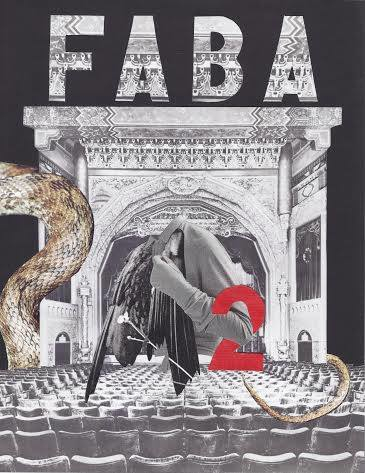
Collaboration is expanding within the medium and taking many forms. Collage artists are teaming their talents to produce publications, for example. FABA Collage Mag (For And About Artists) is preparing to release its second issue.FABA, issue 2 Allan Bealy recently brought together the work of more than two dozen active creators to “Explode the Alphabet” with his Z2A. Each spread features an original solo collage based on the designated letter. Zach Collins takes the idea of synergy another step with a major exposition of how dynamic international collage collaboration has become. Anyone who has tracked the prolific artist could see this coming. We Said Hello and Shook Hands documents the results of his relentless series of virtual “jam sessions” from the past few years. Both publications benefit from the able editing of fellow collage artist Laura Tringali Holmes.
It remains to be seen whether or not we can expect a tide of post-centennial self-publishing, now that evolving technology has opened up new opportunities for collage artists outside the conventional art-book world. In any case, these examples are worthy of attention, as we build our collector libraries during this exhilarating period for collage.
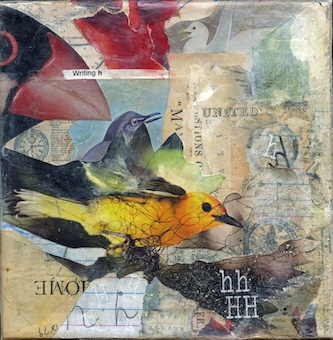
 

H is for Homecoming ~ L T Holmes

H is for Homecoming
collage with mixed media by L T Holmes
8 x 8 inches, beeswax finish
part of Z2A by A Bealy
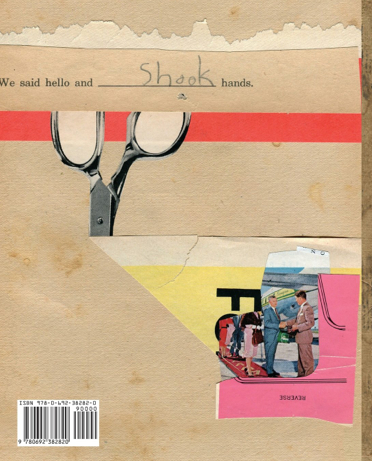
We Said Hello and Shook Hands by Zach Collins (Author, Designer) and Laura Tringali Holmes (Editor)

We Said Hello and Shook Hands
collage collaboration by Z Collins and F Free
back cover of We Said Hello and Shook Hands by Z Collins
Assignment: Mars

Monday, December 22nd, 2014

“I would do ‘John Carter’ again tomorrow. I’m very proud of ‘John Carter.’ Box office doesn’t validate me as a person, or as an actor.”
— Taylor Kitsch

One of the more exciting developments for any artist is the request for original artwork based on an interesting theme. Whether it is for personal or commercial purposes, the medium of collage is ideally suited for commissions, and the process can make use of visual ingredients provided by the client, if the artist sees fit to embed them. It probably goes without saying that the applied arts can be a tricky affair for some fine artists. It is important to sort out the contrasts between meeting customer expectations and following one’s own creative direction. There is also a range of differences among the types of projects that might benefit from a collage assignment, including packaging or label graphics, book cover or editorial illustration, product design, or the straightforward commissioning of a fine-art work. Clear communication up front is always the best approach, and there is nothing wrong with declining a job if client objective and artist satisfaction cannot be fulfilled at the same time.

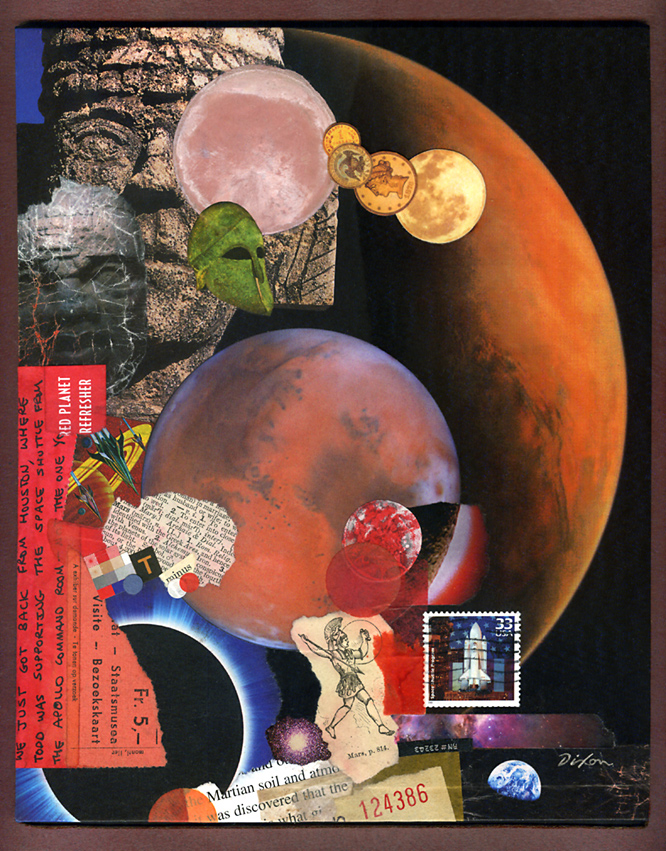
Today’s example was created for the buyer’s presentation as a gift to an engineer closely involved in Martian exploration. When the client described the intended recipient’s passion for the subject, I swallowed hard, but my initial trepidation soon faded as the process took on a life and momentum of its own (as, thankfully, it always does for me). I shall admit, however, that it may take a little time before I replenish my red-planet stash.
 

Dixon_AssignmentMars

Assignment: Mars
collage miniature on panel by J A Dixon
8 x 10 inches
private collection

Thursday, November 27th, 2014


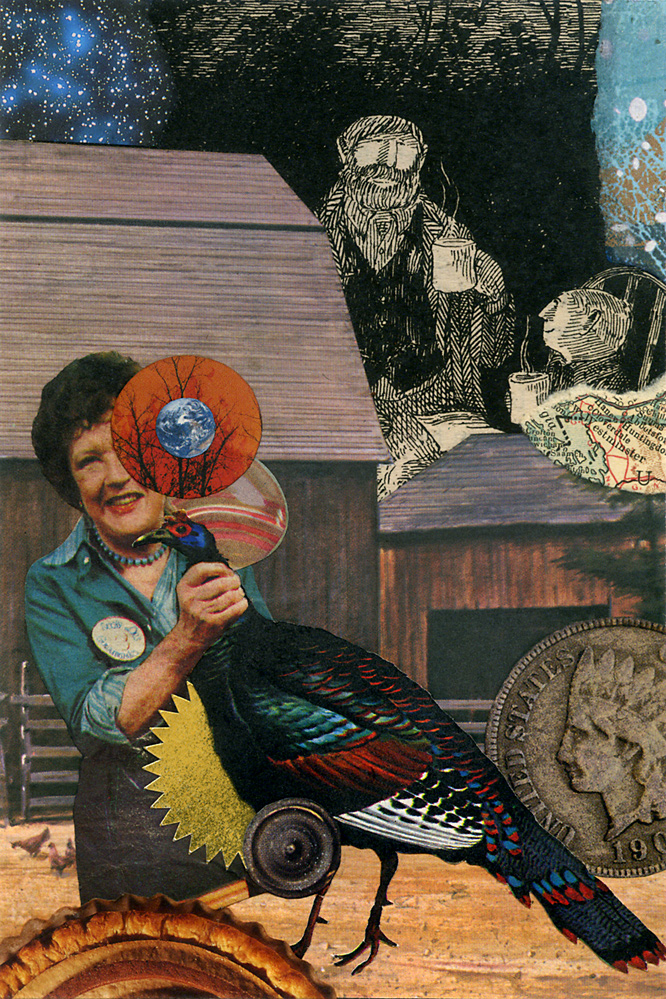
collaborative collage by Michael Tunk and John Andrew Dixon

Happy Thanksgiving
collage collaboration, 4 x 6 inches
start by M Tunk, finish by J A Dixon
from FABA Collage Mag, Issue 1

On collage derivations . . .

Sunday, November 17th, 2013

“I believe that it is better to be receptive to correction than to be satisfied with one’s own imperfection, and to think that one is oh so original!”
— Piet Mondrian

As I mentioned in a welcome statement from over a year ago (and perhaps more recently), I have nothing against digital collage, although I do maintain a bias in favor of conventional (so-called analogue) techniques, especially at this site, but don’t expect me to become “all blogmatic” about the topic, since I have been known to gratefully accept commissions for digital montage and affirm my respect for those who do collage illustration at a high level. The point I want to make today is that, so far, I have not generated much enthusiasm for manipulating or reproducing my “tear and glue” artworks as digital prints or “art merchandise.” Someone recently asked if I sold note-card versions of my miniatures, and I had to admit that “I have never quite gotten around to that.”

There are many reasons, both good and bad, to produce derivations of one’s own work for the marketplace. There are also many reasons, both good and bad, to restrain oneself. I would hope to be open-minded about the subject. Not everyone who enjoys collage can afford to collect originals. In addition, I often get ideas about how to combine separate works into a composite digital design, exploring in the process a distinctive aesthetic resonance that might not be discovered in other ways. I occasionally imagine how one of my miniatures would look as a super-enlargement, or I envision an exhibition of large canvases created from Giclée blow-ups of small works. No doubt, there is an appropriate place for digital technology in the medium, whether on the front- or back-end of the process. The digital image is, of course, the stock in trade of any artist with an active presence on the Internet. That comes with its own set of issues that I plan to cover in my next discussion. Meanwhile, I hope to preserve my emphasis on a traditional methodology and observe how other collage practitioners adopt emerging technology to enhance their fine-art investigations.
 

Microcosmic Moments
compilation of nine miniatures by J A Dixon
proposed digital concept, variable in dimensions

Modular Zowee
composite of collage details by J A Dixon
proposed digital concept, variable in dimensions

Mystery Solved (detail)
super-enlargement of collage detail by J A Dixon
proposed digital concept, variable in dimensions

Mystery Solved (set of four cards)
merchandise with collage details by J A Dixon
proposed digital reproductions, 5.75 x 4.5 inches

Broadband Access
digital montage by J A Dixon
editorial illustration for ACUTA Journal

All Things Collage: Year One

Friday, July 12th, 2013

“Any fool can carry on, but only the wise man knows how to shorten sail.”
— Joseph Conrad

Looking back on a full year as a blogger, many of my initial objectives have been met, but there are even more subjects to tackle in the coming months. Can I find the right balance between words and images, welcoming others to act as better scribes for what is happening in collage and remembering that I would rather be holding a pair of scissors than typing at a keyboard? The exceptional print quarterly out of Canada, Kolaj, has also celebrated its first birthday. 2012 was the perfect year to salute a century of collage as a modern art and also to look around, assessing the current maturity of the practice. I still have much to say about the pioneers and exemplars — Gris, Schwitters, Hausmann, Höch, Cornell, Hamilton, Johnson — for there is much to observe and absorb about their seminal talismans and bodies of work.

It is equally important to evaluate more of the leading and emerging artists now actively producing what may be known as “post-centennial collage,” perhaps the most vital period of cross-pollinated output in the medium’s history. Where to focus next? Those who magnify the traditions of Dada, Surrealism, Fluxus, or Layerism? Dedicated collage abstractionists such as Touchon, Dryden, Romoff, or Gordon? Masters of the outer reaches of a Maximalist/Minimalist spectrum such as Kroll, Reitemeyer, or De Blauwer? I have for some time lamented the lack of a visual-arts phenomenon equivalent to how musicians have traditionally improvised together, but my recent awareness of dynamic collaborations between collage artists is forcing me to change my mind. Is it time for me to take a closer look at the creative fusions instigated by Collins, Holmes, Daughters, or Wilkin?

My, my . . . have we just laid out another year or more of entries? And I have not yet “scraped the working surface” of all the collage artists who make the contemporary scene so exciting. Do I possess the necessary wisdom to tame my ambitions and “shorten sail?” My mind rebels at the idea that I cannot be an artist and a writer, too. I am no scholar, and some art historians would scoff at my correlations, but I cling to the notion that there is a place for insights about our medium that can come only from a person who faces the same challenges as my working peers when confronting a pile of scrap.

One more thought: As the digital age sweeps over the planet, is there also taking place a not-so-quiet backlash against the erosion of manual dexterity? If so, is there a more compelling counter-trend example than the current explosion of tearing, cutting, assembling, transferring, and pasting? And beyond the familiar “analog” technique, what can be said about the deep influence of visual collage on the preponderance of montage in all things sensory — music, performance, film, and media design? This site can become a place where all of this is explored, discussed, shared, and challenged. Much of that is up to you, valued reader. Meanwhile, I shall continue to see, write, and make more art. Stop by again, soon!
 

Every Instinct of My Being Rebels
collage miniature by J A Dixon
7 x 5 inches
 
Purchase this artwork!