Archive for the ‘Movements’ Category
Thursday, August 8th, 2013
Scopophilia, the postcard collage exhibition, has been featuring contributions at its Website. It is always a delight to see new names and fresh approaches to our medium. I must admit that there is much for me to learn about the history and current state of Mail Art, which has always been closely tied to collage, based on the trends set in motion by Ray Johnson and his collaborators.
My thanks to British artist Theo Miller for his ongoing management of the Scopophilia project. Many of us look forward to learning if the volume of submissions will culminate in a physical exhibition.

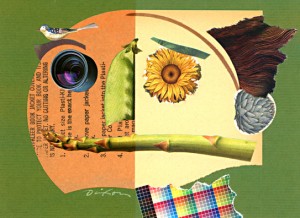
A Tempting Inclination
collage on post card, 6 x 4 inches
by J A Dixon for Scopophilia exhibition
Posted in Exhibitions, J A Dixon, Links, Mail Art, R Johnson | No Comments »
Friday, July 12th, 2013
“Any fool can carry on, but only the wise man knows how to shorten sail.”
— Joseph Conrad
Looking back on a full year as a blogger, many of my initial objectives have been met, but there are even more subjects to tackle in the coming months. Can I find the right balance between words and images, welcoming others to act as better scribes for what is happening in collage and remembering that I would rather be holding a pair of scissors than typing at a keyboard? The exceptional print quarterly out of Canada, Kolaj, has also celebrated its first birthday. 2012 was the perfect year to salute a century of collage as a modern art and also to look around, assessing the current maturity of the practice. I still have much to say about the pioneers and exemplars — Gris, Schwitters, Hausmann, Höch, Cornell, Hamilton, Johnson — for there is much to observe and absorb about their seminal talismans and bodies of work.
It is equally important to evaluate more of the leading and emerging artists now actively producing what may be known as “post-centennial collage,” perhaps the most vital period of cross-pollinated output in the medium’s history. Where to focus next? Those who magnify the traditions of Dada, Surrealism, Fluxus, or Layerism? Dedicated collage abstractionists such as Touchon, Dryden, Romoff, or Gordon? Masters of the outer reaches of a Maximalist/Minimalist spectrum such as Kroll, Reitemeyer, or De Blauwer? I have for some time lamented the lack of a visual-arts phenomenon equivalent to how musicians have traditionally improvised together, but my recent awareness of dynamic collaborations between collage artists is forcing me to change my mind. Is it time for me to take a closer look at the creative fusions instigated by Collins, Holmes, Daughters, or Wilkin?
My, my . . . have we just laid out another year or more of entries? And I have not yet “scraped the working surface” of all the collage artists who make the contemporary scene so exciting. Do I possess the necessary wisdom to tame my ambitions and “shorten sail?” My mind rebels at the idea that I cannot be an artist and a writer, too. I am no scholar, and some art historians would scoff at my correlations, but I cling to the notion that there is a place for insights about our medium that can come only from a person who faces the same challenges as my working peers when confronting a pile of scrap.
One more thought: As the digital age sweeps over the planet, is there also taking place a not-so-quiet backlash against the erosion of manual dexterity? If so, is there a more compelling counter-trend example than the current explosion of tearing, cutting, assembling, transferring, and pasting? And beyond the familiar “analog” technique, what can be said about the deep influence of visual collage on the preponderance of montage in all things sensory — music, performance, film, and media design? This site can become a place where all of this is explored, discussed, shared, and challenged. Much of that is up to you, valued reader. Meanwhile, I shall continue to see, write, and make more art. Stop by again, soon!
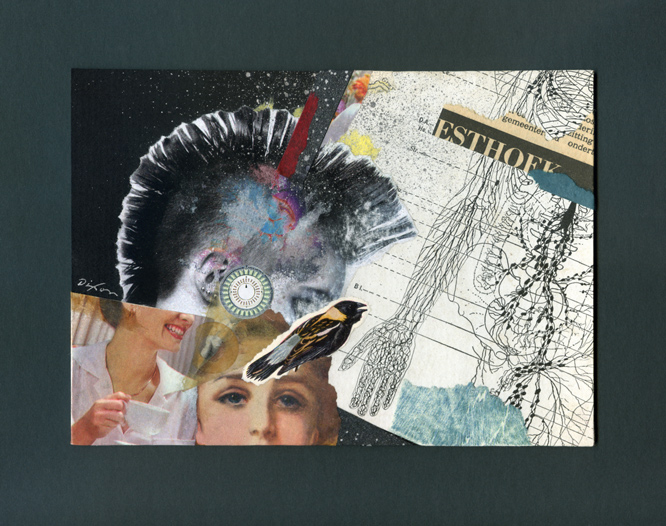
Every Instinct of My Being Rebels
collage miniature by J A Dixon
7 x 5 inches
Purchase this artwork!
Posted in 1) Available!, Artists/Collage, Blog Years, C Touchon, C Wilkin, Collaboration, Collage, D Daughters, Dada, Fluxus, H Höch, H Kroll, I Reitemeyer, Influences, J A Dixon, J Cornell, J Gris, K De Blauwer, K Schwitters, L Romoff, L T Holmes, Layerism, Links, Maximalism/Minimalism, Music, Publications, R Hamilton, R Hausmann, R Johnson, R K Kadour, S Gordon, Surrealism, T Dryden, Z Collins | No Comments »
Sunday, June 30th, 2013
“Transforming nothing into something is something of course, but because it’s a metaphor (let’s say it’s a reflection of life and death), doesn’t mean it’s especially important.”
— Matthew Rose
Is a pizza fundamentally more satisfying than a beer?
Perhaps this question is a peculiar way of following up on my previous post. The subject of maximalism and minimalism in collage is worth continuing, and I readily admit that our topic would benefit more from an interactive discourse than a single voice, but such is the nature of a blog that has yet to gain a participatory following. Nevertheless, I cannot drop the discussion without further remarks and, in particular, some worthy examples of each methodology.
Getting back to the opening query . . . There is nothing more inviting on a hot summer evening than a cold beer after a day of effort. It can immediately lose its appeal if flat or flavorless. A slice of pizza will look much better — steaming, fragrant, and loaded with toppings — but not if it is dry, overdone, or charred underneath. What I am trying to suggest with this oddball reference is the idea that a simple thing or a complex thing is not necessarily better than the other. It is all about how each is presented. And the most meaningful conclusion may be that both are enhanced when the two exist together. Whether you investigate Picasso, Braque, or Schwitters, it is clear that they thought of collage as an extension of painting, and how can one say that maximalism or minimalism in painting takes supremacy over the other? One cannot, of course, and either method is more interesting when the entire scale of approaches to the medium are continually explored (in some cases by the same artist). So, returning to my feeble analogy, we recognize that the combination of “good stuff” determines a synergistic effect. Collage as an art form is more vital today as a result of this diversity of orientation.
Our medium does not exist in a vacuum. Maximalism, minimalism, and everything in between is rooted in the movements of Dada, Surrealism, Constructivism, Expressionism, and Popism. One contemporary collage artist with a keen awareness of these influences is the “American in Paris,” Matthew Rose. He has created masterful works at multiple points in the spectrum of complexity, and a few examples appear below. In future entries, we shall feature other artists who probe minimalism and maximalism in collage.
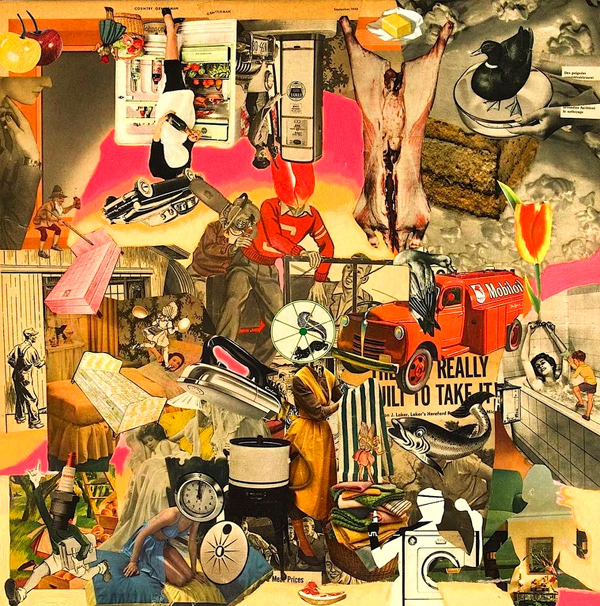
The End Of The World
Matthew Rose, 2008
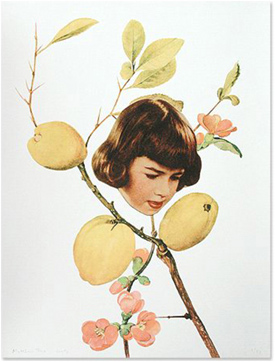
Immaculate Perception
Matthew Rose, 2010
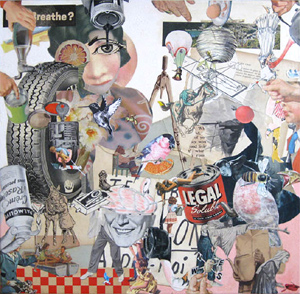
Breathless
Matthew Rose, 2010
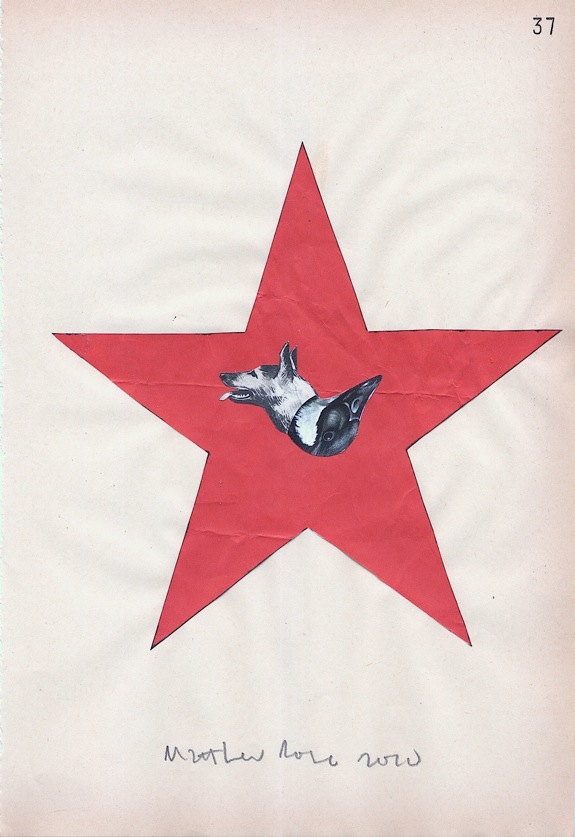
China Star
Matthew Rose, 2010
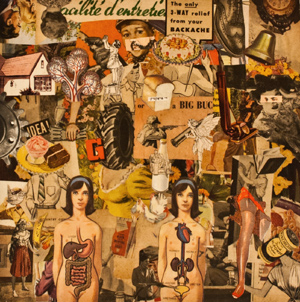
Experience
Matthew Rose, (date unknown)
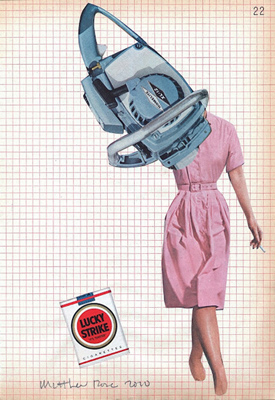
Lucky Strike
Matthew Rose, 2010
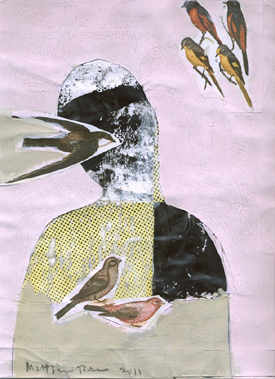
Self Portrait
Matthew Rose, 2011
Posted in Collage, Combined Mediums, Constructivism, Dada, Expressionism, G Braque, Influences, K Schwitters, Links, M Rose, Maximalism/Minimalism, Methodology, P Picasso, Pop Art, Portraits, Surrealism | No Comments »
Monday, February 18th, 2013
“However long and varied the background of pasted materials in folk art, none of these developments was considered a major artistic movement. It was the creative artists of the twentieth century, Pablo Picasso and Georges Braque, who applied materials as a new and valid means of expression. With these artists and their work the word ‘collage’ was first applied and became associated with the movement. Thus was born an art form that has become part of the contemporary milieu and, indelibly, a major historical art movement.”
— Dona Z Meilach and Elvie Ten Hoor
My wife and I recently went to see Lincoln, the Spielberg picture with Daniel Day-Lewis in the title role. It got me thinking again about the work I created for the bicentennial of the 16th president’s birth, the celebration of which was a fairly big deal here in his native state. I had made the decision to exploit the bulk of my collected Lincoln images to totally cover a metal star. To produce a collage tribute to the martyred leader with a folk-art approach seemed to me a technique appropriate to the occasion. The “artifact” is still waiting for a home. Happy Presidents Day to all.
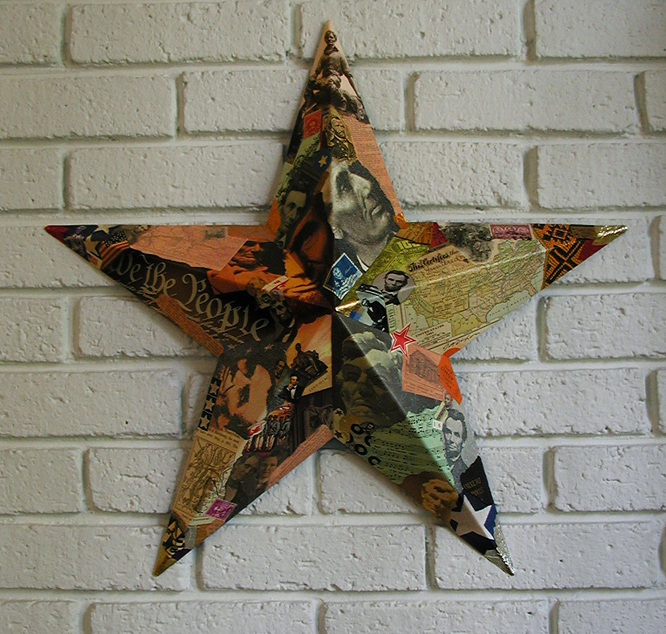
Star of Abraham
collage artifact by J A Dixon
22 x 22 inches
Posted in 1) Available!, Artifacts, Folk Art, G Braque, Holidays, J A Dixon, Morgue, P Picasso, Technique | 1 Comment »
Monday, February 11th, 2013
“From the beginning he had responded to the avant-garde developments of his time with admirable swiftness and sureness. It is hard to think of another American artist who was receptive to so many different art movements or who managed to win the admiration of everyone from the Surrealists in the 1940s to the Abstract Expressionists in the 1950s to the Pop Artists in the 1960s. Artists who agreed on little else agreed on Cornell.”
—Deborah Solomon
“The central themes of Pop Art were sub-culture, folk cultures, media imagery, new technologies, design, the consumer goods and engineering industries, the inter-relationships between these phenomena and their effect on human beings.”
—Tilman Osterwold
Osterwold’s analysis suggests that traditions, fashions, and even avant-gardist achievements could no longer be the norm after Pop Art, which swept away the boundaries of artistic development with its focus on a “consciously perceived and reflected present-day existence.” Having just finished Deborah Solomon’s biography of Joseph Cornell (Utopia Park: The Life and Work of Joseph Cornell), I am struck by how Cornell anticipated Pop Art with his focus on the appropriated elements of mass culture and his various obsessions with celebrities, while at the same time demonstrating an abiding indifference to the cult of personal fame so typically associated with the movement. Walter Hopps stated that Cornell was “Schwitters’ greatest successor.” Cornell was certainly aware of Schwitters, for he was highly cognizant of nearly everything about the onrushing stream of modern art (in contrast to the misconception that he was some sort of urban hermit), but the precise lineage of artistic influence may never be fully known. Perhaps it was Cornell’s connection with Max Ernst that is a key factor. In my opinion, Ernst was not a giant of 20th-century collage, but did have a vital influence on the genesis of Cornell’s art. It is well recognized that Joseph began and ended his unique body of work with the medium of collage. One of the things that astonishes me is how he could be so attuned to the advancing frontier of present-day art (often staying a step or two ahead of it) and, at the same time, carry such a personal dysfunction that derived from the driving intensity of his inner world. Was that the nature of his genius? At any rate, his strange but amazing ability to synthesize powerful emotional and cultural content by inventing (virtually from scratch) a distilled form of assemblage continues to set the standard for almost everything in the mix of media that has followed in its wake. Hardly a day goes by that I don’t observe an artwork that can be traced directly to his seminal vision. But rarely do I see another artist infuse their juxtapositions with a rich symbolism to compare favorably with his complex associations. Most of the art I see with an obvious Cornellian tone owes more to surrealist automatism or atmospheric illustration than to the intricate blend of embedded meaning and refined intuition that characterized his enduring originality.
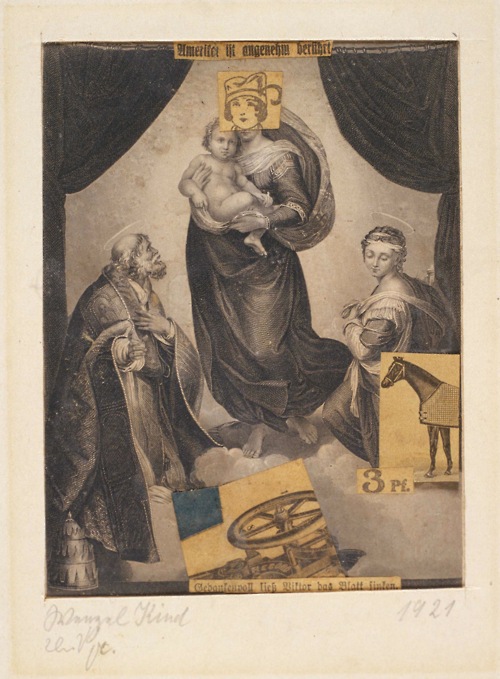
Knave Child
Kurt Schwitters, 1921
Collage on paper
Sprengel Museum, Hannover.
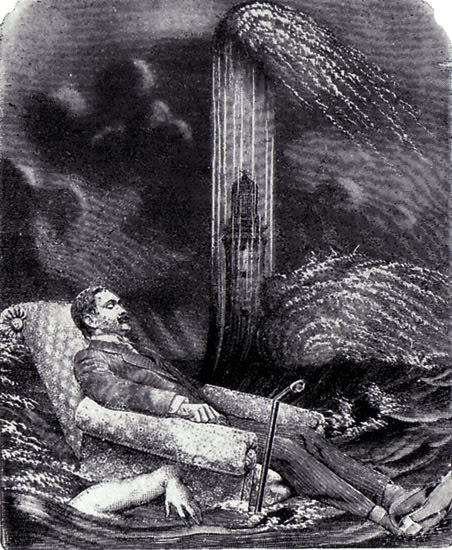
plate from La Femme 100 Têtes
Max Ernst, 1929
Collage novel
Published Éditions du Carrefour, Paris
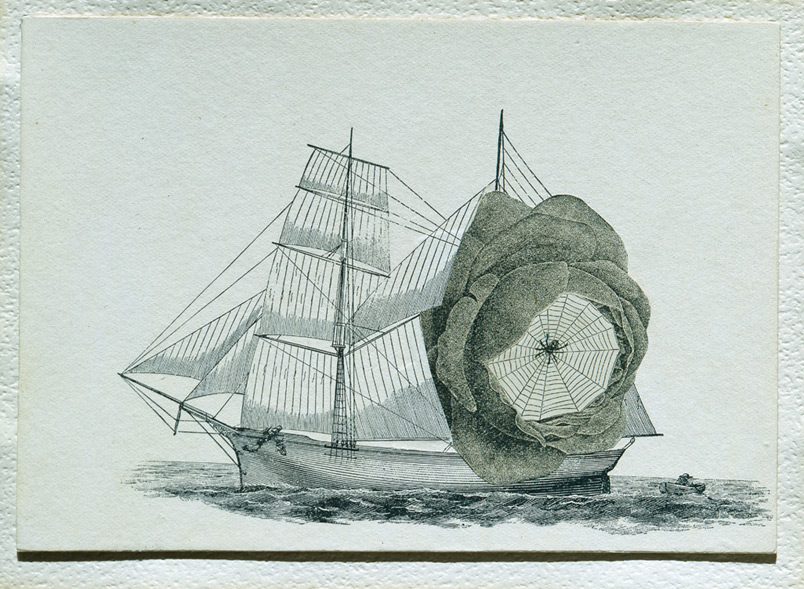
Untitled (Schooner)
Joseph Cornell, 1931
Collage on paperboard
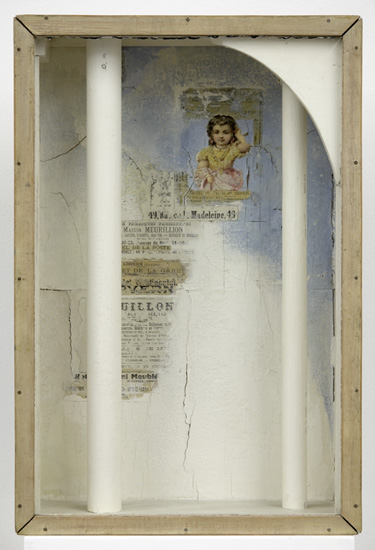
Untitled (Girl and Two Columns)
Joseph Cornell, c. 1950
Glass, wood, tempera and printed paper collage
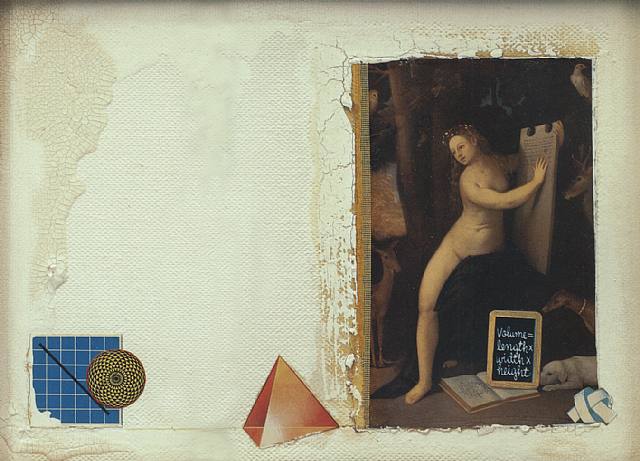
Circe III — Surface and Volume in Nature
Joseph Cornell, c. 1961-66
Collage on masonite
Posted in Assemblage, Collage, Dada, Expressionism, Illustration, Influences, Ingredients, J Cornell, K Schwitters, Links, M Ernst, Pop Art, Surrealism, Symbolism | No Comments »
Saturday, September 29th, 2012
“To say that Kurt Schwitters was an amazingly versatile artist and anticipated much is such an absurd understatement that the remark is almost Dada.”
—Walter Hopps
“And so you will understand why we have had enough of Dada. The mirror that indignantly rejects your worthy countenance, that in mirroring it banishes it, such a mirror does not love you, it is in love with the very opposite.”
—Kurt Schwitters
To perpetually imitate KS is to be as unlike him as one could conceive. He was always pushing forward into the untried. But it is not for every artist to cross a boundary into the unknown. Some of us might be better suited to settling the frontier. There may be some among us more appropriately equipped to continue investigating the discoveries of a pioneering original— by sharing these visual concepts with a broader audience, by weaving them into a greater tapestry of the visual landscape, and, with a bit of luck, by finding a way to fuse our unique perspective with what has been handed off to us, in order to express new ideas that further cultivate a valuation of the past.
I am not an expert on Dada or the relationship of Schwitters with the phenomenon. I am always learning more. I just know that he was never fully accepted by the movement at its peak, and that he was compelled to articulate his own vision of Merz. Perhaps much of it relates to Fascist oppression and the resulting geographic disruption, but I’ve always believed there was more to it than that. More important to me is an ongoing effort to unravel the underlying differences. A certain veneration for painting, design, and the aesthetics of beauty probably set KS apart from some of his rejectionist or surrealist contemporaries, but that is what gives his creations a unique, seminal power for me and for others. His perseverance in the face of daunting circumstances and a professed goal of “creating relationships, preferably between all things in the world” fly in the face of a nihilist orientation. Although I remain awed by surrealism in collage, and I am as tickled by irreverent juxtapositions as the next guy, there is an inherent pessimism or metaphysical anarchy in the “art of weirdness” that never seems to resonate with my deepest creative urge. I cannot say that I fully understand that, or that I am not occasionally moved to place a fish head on a reclining nude or mask a face with a front-loading washer. Is it even productive for me to engage in such self-analysis? Or, is it important only to submit to the most undeniable inner motivations when in the studio, sorting through another pile of visual fragments that await an intuitive response?

Unconditional Surrender
collage artifact by J A Dixon
collection of Nancy and Charles Martindale
Posted in Artifacts, Collage, Dada, Influences, J A Dixon, K Schwitters, Merz, Surrealism | No Comments »
Sunday, September 23rd, 2012

“The language of Merz now finds acceptance, and today there is scarcely an artist working with materials other than paint who does not refer to Schwitters in some way.”
—Gwendolen Webster
“I could see no reason why used tram tickets, bits of driftwood, buttons, and old junk from attics and rubbish heaps should not serve well as materials for paintings; they suited the purpose just as well as factory-made paints.”
—Kurt Schwitters
Last November I had the good fortune to find myself close enough to Berkeley, California to attend Kurt Schwitters: Color and Collage, the first U.S. museum exhibition in 25 years to focus exclusively on his towering work. I was able to spend as much time as I wanted (at the Berkeley Art Museum & Pacific Film Archive), studying about 80 examples of his collage and assemblage. It was an experience that is almost impossible for me to describe. I suppose that I should at least try.
KS has been a powerful influence on my personal artistic journey, for good or ill. When I first learned of this exhibition, it seemed beyond my Kentucky reach, but circumstances conspired to place me in the Bay Area on the day after Thanksgiving. During the trip west, I began to greatly anticipate what I knew would constitute more than a singular research event for me. It felt like a pilgrimage, or a potential culmination of sorts, that might “release” me in some meaningful way. My notion could not have been more off target. Hours of arms-length appreciation and up-close inspection served only to solidify my bond with the German innovator. Seeing masterpiece after masterpiece would crystallize a deep awareness that one need not ever shy away from drawing water from the well of this man’s insights, any more than a musician might hold at a distance Wagner, Stravinsky, or Ellington. Should I be concerned a critic may judge my works as derivative of his? Should a mathematician fear being described as an imitator of Einstein? Should a naturalist worry that others might say, “He thinks too much like Darwin”?
The works were superbly organized in a space that allowed for the full range of observation. The guiding concept of the exhibition was the idea that the artist always considered himself a painter. As Clare Elliott writes, “His practices of painting and collage were so intertwined that it is often difficult to determine if paint was applied to paper before or after it was pasted onto the surface, or mixed into the paste itself.” I doubt if KS, a trained painter, made any distinction. We must remind ourselves that there was no clear sense of collage as a separate medium, in the way we understand it today. It was more about his drive to radically expand the choices involved in how one creates a painting to include any material from the surrounding environment of mundane existence.
The rooms were dotted with descriptive panels that presented some of the most incisive remarks I had ever read about Schwitters. Sadly, the catalog edited by Isabel Schulz had already sold out. (Now available for $200 from Amazon, it was being offered for $40 when the show opened.) On top of it all, I did an inordinate amount of note taking and dared to strike up conversations with strangers viewing the show— something I recall never having done before at a museum. Needless to say at this point, it was a pinnacle experience for me. I finally understood that to entertain the hope of moving beyond an artistic influence of this magnitude, I needed to internalize it as fully as possible to discover my own points of departure. I needed to understand how Merz was fundamentally different than Dada, how KS became a revolutionary without being a rejectionist, and how strongly he must have believed in his initiating a spirit of unification that would encompass artistic methods and approaches not even “invented” yet.
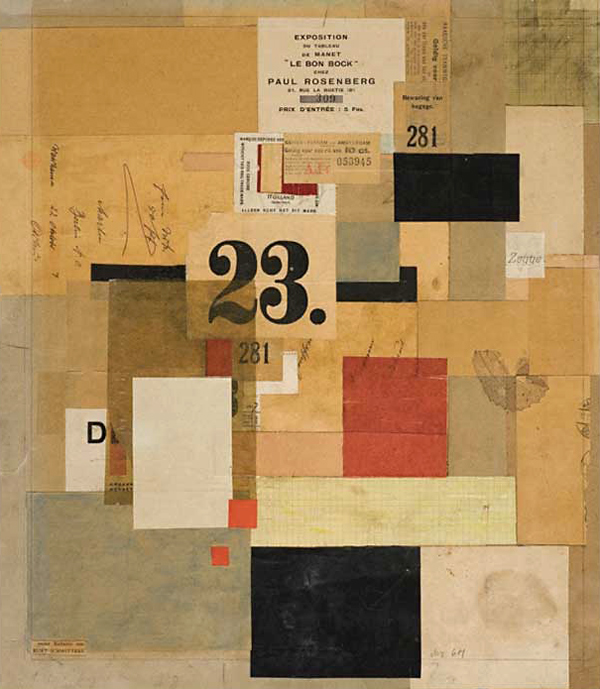
Mz 601
collage by Kurt Schwitters, 1923
paint and paper on cardboard
15 x 17 inches, Sprengel Museum, Hanover
Posted in Assemblage, Collage, D Ellington, Dada, Exhibitions, Influences, Ingredients, J A Dixon, K Schwitters, Methodology, Music | No Comments »
Saturday, August 25th, 2012
I’m keen on art history to quench a dry spell. Here’s my suggestion to a collage artist in a slump.
• Browse modern art movements that have influenced collage: cubism, dada, constructivism, expressionism, surrealism, pop art.
• Relax and study the seminal masters of the medium: Cornell, Paolozzi, Höch, Hausmann, Schwitters.
• Then go to your “morgue” of images, textures, ephemera, and found material: group various ingredients into piles, responding quickly, intuitively, and without conscious thought for composition or symbolic associations.
• Before you know it, you’ll have more ideas and embryonic projects than you can immediately deal with. React first to the ones that won’t be denied. With a bit of luck, a new series will emerge.
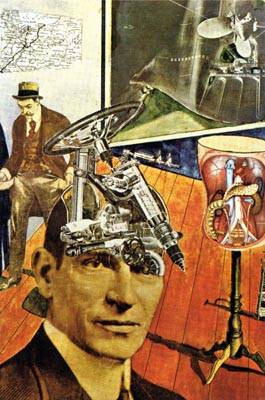
Tatlin at Home
by Raoul Hausmann
1920
Posted in Constructivism, Cubism, Dada, E Paolozzi, Expressionism, H Höch, Influences, Ingredients, J Cornell, K Schwitters, Methodology, Pop Art, R Hausmann, Surrealism | No Comments »
Wednesday, August 22nd, 2012
“Ray didn’t talk about it, he just did it. That’s why you don’t find art magazines lying around quoting the art philosophy of Ray Johnson.”
—Toby Spiselman
Ray Johnson, the original “most famous unknown artist in the world,” produced his A Book About Death during the years 1963 to 1965. The pages were randomly mailed and offered for sale. Complete copies were compiled by a rare few. Johnson was a significant bridge between the groundbreaking work of Schwitters, the sensibilities of Cornell, and the emergence of what would become the most widely recognizable features of Pop Art. He was highly influential in the Mail Art, Installation Art, and Performance Art movements, as well as late 20th-century neo-Dadaist trends. Paris-based Matthew Rose has actively aroused a worldwide interest and vitality that perpetuates the legacy of A Book About Death, including a 2010 incarnation (in which I made a small contribution). The full history can be studied at this site.

ABAD 2010
collage miniature by J A Dixon
6 x 4 inches, not for sale
Posted in Collage, Dada, Exhibitions, Influences, J A Dixon, J Cornell, K Schwitters, Links, M Rose, Pop Art, R Johnson | No Comments »
Saturday, August 18th, 2012
“Art is the greatest risk of all because when you’re making something, you’re constantly asking yourself what the hell you’re doing.”
—James Rosenquist
The century-long history of collage casts a deep shadow into the creative present and beyond. It is startling to realize that even Pop Art has been around over half that time. There aren’t many things that haven’t already been tried, or many effects that stake their ground removed from Dada, Surrealism, Constructivism, or one of the other movements influenced thereby. A collage artist must respect and acknowledge the past with a clear mind, internalize it as a part of the intuitive process, and follow a personal investigation anchored on risk. It’s not easy to successfully defy expectations, whether one’s own or the anticipated response, but everything else is practicing etudes or mere fabrication for the marketplace.

Marty’s Borggrrrl
collage miniature by J A Dixon
collection of J M Strock, Jr
Posted in Collage, Constructivism, Dada, J A Dixon, Pop Art, Surrealism | No Comments »
Saturday, July 21st, 2012
Friday, July 21, 2012
Today is as good a time as any for a public launch of this site. A hearty welcome to all. My sincere thanks to all the great folks at Xorph.com for their kind assistance.
My main purpose here, I have no problem admitting, is to showcase my work as a collage artist. That’s the selfish part. I would hope that it also becomes a point of reference for others who create or appreciate the medium. I make no claim as an authority. My only expertise is doing what I do, based on 40+ years of observation, creative investigation, and hands-on experience. And may the emphasis be on “hands.” I have nothing at all against digital collage —far from it— but this space will be devoted to the art and craftsmanship of 20th-century-mode, tear-and-glue, up-close-and-analogue collage — the 100-year-old approach that results in a singular, physical artifact.
If you happen to like this spot, please pay a return visit frequently, and let me know what you think. Visual art is a collaborative activity, no matter what some may say. I’ll expound more on that at another time. Begin today with a long paragraph that serves as my “statement.”
After a full century, people may continue to debate whether collage as a technique was “invented” by Georges Braque or Pablo Picasso, but in my considered view, the seminal genius of the medium was Kurt Schwitters, perhaps the first modern artist to fully master the process. I hold the opinion that relatively few aesthetic traditions emerged from early-20th-century collage experiments without the inherent sensibilities of Dada or Surrealism, and I find it endlessly fascinating to probe toward the heart of creative spontaneity while unraveling the ever-present contrasts of beauty versus non-beauty, optimism versus pessimism, and art versus anti-art. In addition to being intrigued by such mindful intuition, I remain awestruck by the capacity to create extrinsic value from everyday material that has virtually no intrinsic worth. By aesthetic sensitivity and creative ingenuity, anything that has been discarded can be infused with meaning or be brought into a contributory connection with our daily awareness. Thus, the core relationship between found material and the art of collage transmits a unifying principle. When the remnants of ordinary living are physically re-purposed to inevitably resolve their unique compositional harmony, the underlying link between visual form and symbolic communication is revealed. When the literal characteristics of the ingredient elements are successfully transcended, a culminating artifact offers the potential for a shared experience with each participating observer. I am convinced that the resulting totality of emotional impressions and layered associations derive more from a deeper artistic intent than from conscious decision making. As in most improvisational activity, there is ample opportunity for surprise, amusement, mystery, intrigue, discovery, and joy.
Posted in Collage, Cubism, Dada, G Braque, Influences, J A Dixon, J Cornell, K Schwitters, Methodology, P Picasso, Surrealism, Symbolism | No Comments »