Archive for the ‘Links’ Category
Tuesday, June 18th, 2013
“Not what we give, but what we share,
For the gift without the giver is bare.”
— James Russell Lowell
My thanks to fellow collage artist, Kathleen O’Brien, who kindly bestowed on me a delightful trove of vintage poultry. By all appearances, the various hens, roosters, ducks, and geese were scissored from multiple sources many years ago, often less than expertly, and compiled for some anticipated project. Why this collection was passed along or sold, with an original intent abandoned, can never be known, but my friend felt that the ingredients were more suited to my artistic activity than hers, so now I am the fortunate steward of a silent menagerie. Hope Kroll, the “paper surgeon,” could undoubtedly exploit the entire mass of images in one fell swoop, but I am more likely to apply them in a trickle. Here is the first collage that benefits from the acquisition:
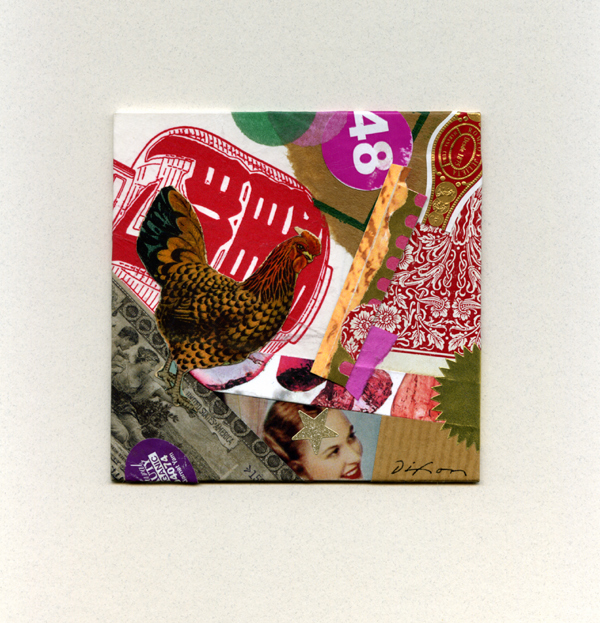
A Chicken Involved
collage miniature by J A Dixon
4 x 4 inches
collection of R Gilpin
Posted in H Kroll, Ingredients, J A Dixon, K O’Brien, Links | No Comments »
Tuesday, May 14th, 2013
“Giving is an energy that not only helps others but creates even more for the person who is doing the giving. This is a natural law that is true regardless of whether the person who is giving wants or even realizes what is occurring. Any success you have is despite your lack of giving, not because of it. The universe knows what it is doing. Everything you give away will return. With interest!”
— Richard Carlson
Once every two years, I contribute a work to our local arts scholarship fundraising effort. As a fine artist, I limit my charitable involvement to a single event out of numerous worthwhile causes. Creatives have to be very discerning about this type of thing, because, as others have pointed out, organizations have an insatiable appetite for donations of art and the phenomenon is out of control. It is up to each individual to find the proper balance of self-interest and generosity. My suggestion: keep it small, infrequent, and close to home.
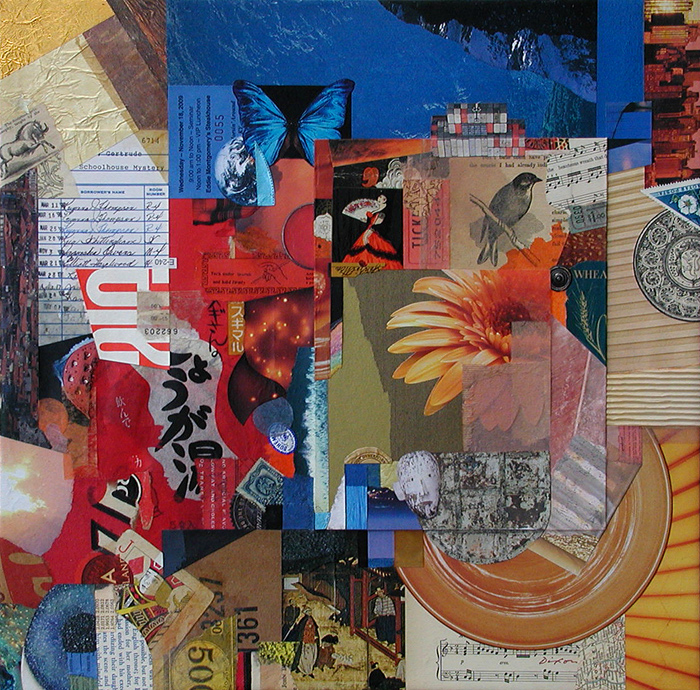
Mystery Solved
collage on canvas by J A Dixon
16 x 16 inches, collection of J Morgan
Posted in Fundraising, J A Dixon, Larger Works, Links, Priorities | No Comments »
Tuesday, April 16th, 2013
The primary reason that I look forward with great anticipation to this Friday’s LexArts Hop is because Kathleen O’Brien has a new solo exhibition. The opening reception for Realms of Wonder at the M.S.Rezny Studio & Gallery is from 5 to 8 pm, and it is certain to be one of the highlights of the evening. It was no surprise when a local Marketing Maven recently exposed herself as a Kathleen O’Brien “groupie,” and I suspect that there are far more than two of us. It’s not at all baffling to find oneself totally captivated by her visionary art.
Kathleen’s artwork clearly grows out of how she thoughtfully observes and attunes with the world of nature. It also literally contains and preserves natural ingredients. But in contrast to collage that maintains its focus on formal or intellectual juxtapositions, Kathleen’s art always nudges one toward a deeper sense of wholeness and the inner complexity of our balanced existence as both organic and spiritual beings. Without question, she has made a personal commitment to creating art as a mystical practice, and, on a communal level, to providing nature-inspired beauty as a source of healing in a fractured world. With the strong presence of these intangible dimensions, Kathleen’s art is always esoteric, and yet she manages to make the work accessible to all with her choice of subject matter and allegiance to traditional drawing. At the same time, she can delight the eye of a fellow artist with her methodology, aesthetic choices, and pictorial skill. I’m not ashamed to admit that much of Kathleen’s symbolic virtuosity is beyond my ken, but I appreciate that it’s all in play at the intuitive level. Being near the prolific output of her creative life is simply uplifting, and that’s because all the facets of her art —whether conscious or subliminal— unify as a total perception to nourish the mind, heart, and soul.
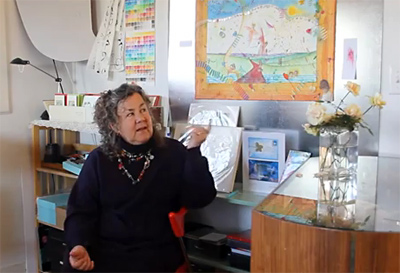
Here is a video of Kathleen in the studio discussing her art.
Find out more about the artist at her website or blog.
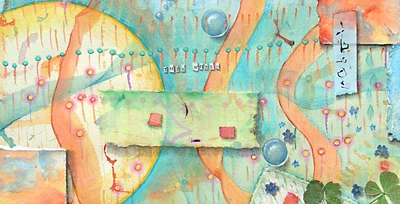
3 Worlds (detail, This World)
mixed-media collage, © Kathleen O’Brien
22 x 15 inches
Posted in Collage, Combined Mediums, Exhibitions, Influences, Ingredients, K O’Brien, Links, Methodology | 1 Comment »
Thursday, February 28th, 2013
“The unshakable rule is that you don’t have a really good idea until you combine two little ideas. That is why you scratch for little ideas. Without the little ideas, there are no big ideas.”
— Twyla Tharp
For a number of years, the month of March has held a special distinction for me as an artist. It all began in 2006 as a month-long experiment in focused awareness and evolved into an annual exercise to discover, refine, and internalize creative habits. Tomorrow morning the practice will commence again as I produce and post a collage miniature each day for the duration of the month. Of course, this is not a new idea. When it comes to doing this sort of thing online, most of us who concentrate in the medium will immediately think of Randel Plowman, the artist, author, curator, and blogger, who holds the A Collage A Day web domain. His successful publication, The Collage Workbook, brought heightened attention to the art form during its centennial year. Another individual who has made the online commitment is Portuguese artist Dilar Pereira, who maintains the Daily Collage Project. But when it comes to the ritual itself, who can hold a candle to the late John Evans? The New York artist created a daily collage for 37 years (except for a single day when he was too ill). Now that’s what I call an exercise!
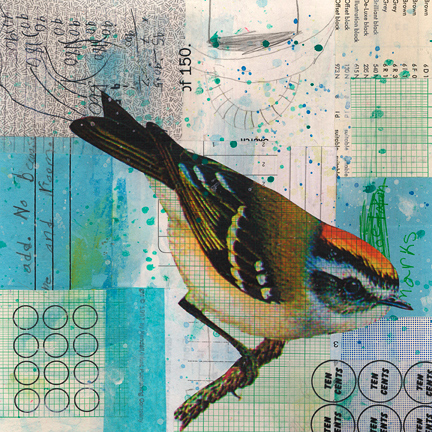
Color Chart
collage on paper by Randel Plowman
8 x 8 inches
A Collage A Day
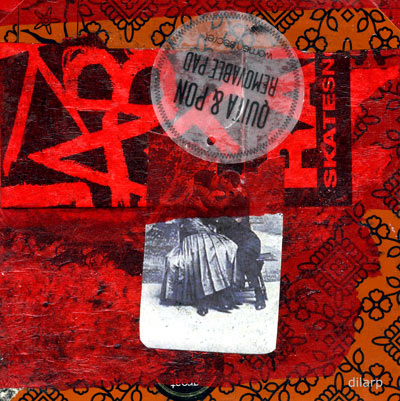
O Beijo
collage on canvas by Dilar Pereira
13 x 13 centimeters
Daily Collage Project
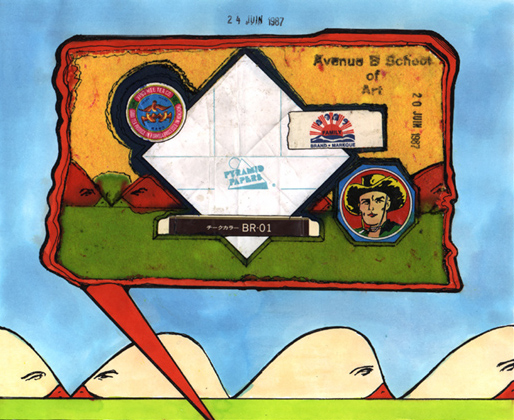
6-24-87
collage and watercolor on paper by John Evans
12 x 9 inches
Posted in Collage, D Pereira, Experiments, J Evans, Links, March Exercise, R Plowman, T Tharp | No Comments »
Monday, February 11th, 2013
“From the beginning he had responded to the avant-garde developments of his time with admirable swiftness and sureness. It is hard to think of another American artist who was receptive to so many different art movements or who managed to win the admiration of everyone from the Surrealists in the 1940s to the Abstract Expressionists in the 1950s to the Pop Artists in the 1960s. Artists who agreed on little else agreed on Cornell.”
—Deborah Solomon
“The central themes of Pop Art were sub-culture, folk cultures, media imagery, new technologies, design, the consumer goods and engineering industries, the inter-relationships between these phenomena and their effect on human beings.”
—Tilman Osterwold
Osterwold’s analysis suggests that traditions, fashions, and even avant-gardist achievements could no longer be the norm after Pop Art, which swept away the boundaries of artistic development with its focus on a “consciously perceived and reflected present-day existence.” Having just finished Deborah Solomon’s biography of Joseph Cornell (Utopia Park: The Life and Work of Joseph Cornell), I am struck by how Cornell anticipated Pop Art with his focus on the appropriated elements of mass culture and his various obsessions with celebrities, while at the same time demonstrating an abiding indifference to the cult of personal fame so typically associated with the movement. Walter Hopps stated that Cornell was “Schwitters’ greatest successor.” Cornell was certainly aware of Schwitters, for he was highly cognizant of nearly everything about the onrushing stream of modern art (in contrast to the misconception that he was some sort of urban hermit), but the precise lineage of artistic influence may never be fully known. Perhaps it was Cornell’s connection with Max Ernst that is a key factor. In my opinion, Ernst was not a giant of 20th-century collage, but did have a vital influence on the genesis of Cornell’s art. It is well recognized that Joseph began and ended his unique body of work with the medium of collage. One of the things that astonishes me is how he could be so attuned to the advancing frontier of present-day art (often staying a step or two ahead of it) and, at the same time, carry such a personal dysfunction that derived from the driving intensity of his inner world. Was that the nature of his genius? At any rate, his strange but amazing ability to synthesize powerful emotional and cultural content by inventing (virtually from scratch) a distilled form of assemblage continues to set the standard for almost everything in the mix of media that has followed in its wake. Hardly a day goes by that I don’t observe an artwork that can be traced directly to his seminal vision. But rarely do I see another artist infuse their juxtapositions with a rich symbolism to compare favorably with his complex associations. Most of the art I see with an obvious Cornellian tone owes more to surrealist automatism or atmospheric illustration than to the intricate blend of embedded meaning and refined intuition that characterized his enduring originality.
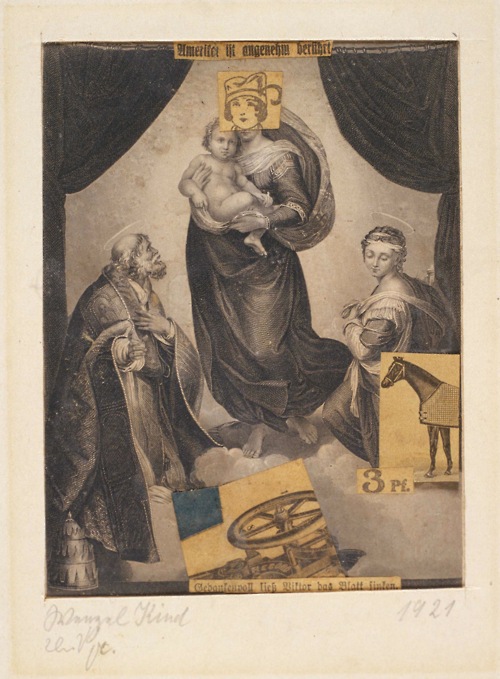
Knave Child
Kurt Schwitters, 1921
Collage on paper
Sprengel Museum, Hannover.
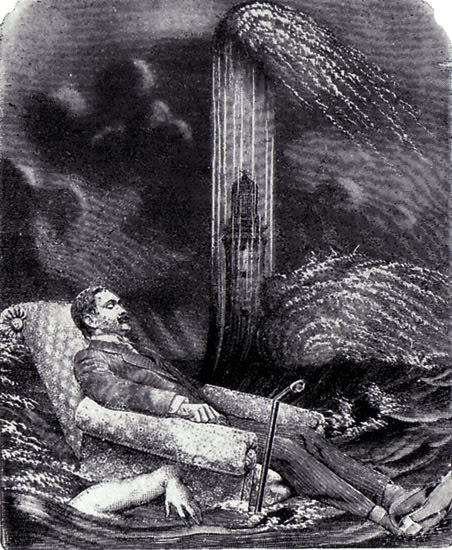
plate from La Femme 100 Têtes
Max Ernst, 1929
Collage novel
Published Éditions du Carrefour, Paris
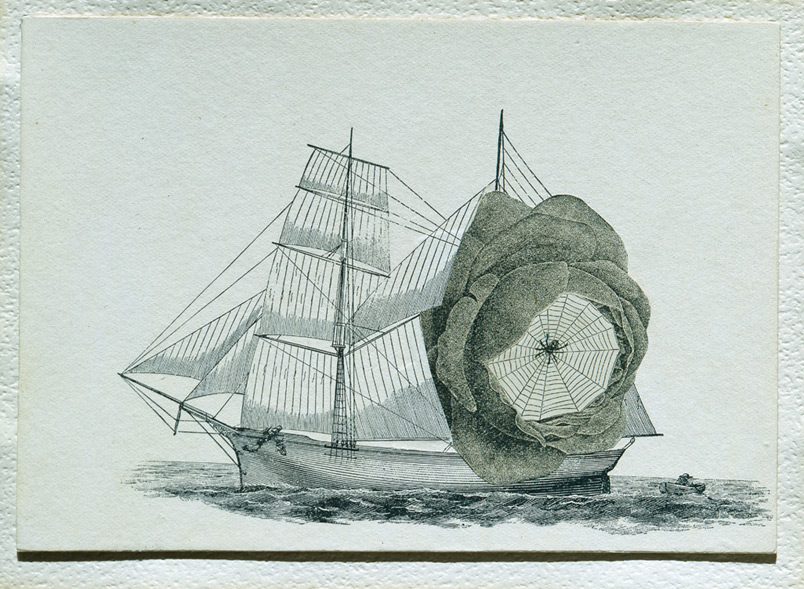
Untitled (Schooner)
Joseph Cornell, 1931
Collage on paperboard
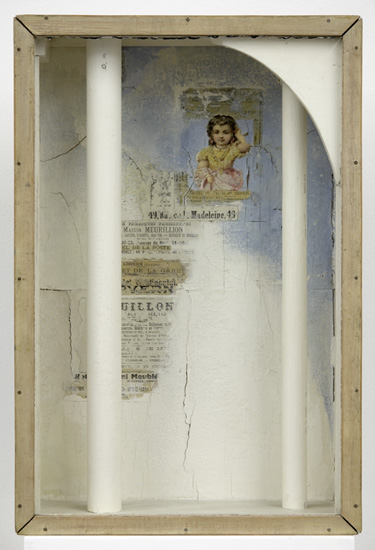
Untitled (Girl and Two Columns)
Joseph Cornell, c. 1950
Glass, wood, tempera and printed paper collage
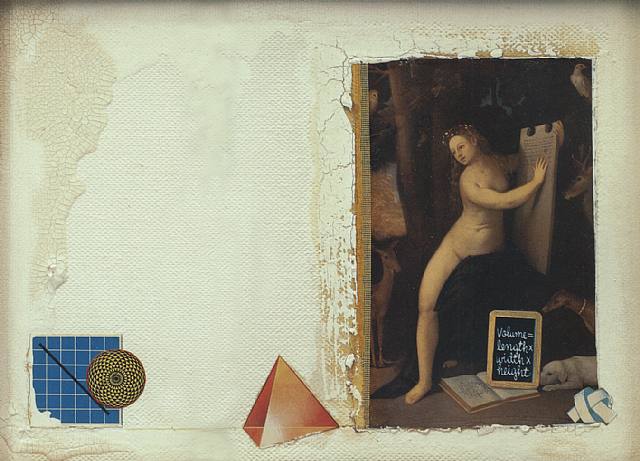
Circe III — Surface and Volume in Nature
Joseph Cornell, c. 1961-66
Collage on masonite
Posted in Assemblage, Collage, Dada, Expressionism, Illustration, Influences, Ingredients, J Cornell, K Schwitters, Links, M Ernst, Pop Art, Surrealism, Symbolism | No Comments »
Saturday, January 12th, 2013
My appreciation to Cecil Touchon for including one of my works in a collage exhibition at the Durango Art Center. Cecil has said, in his typically understated manner, “I just grabbed some things off the walls at the archives, with the thought of techniques used as examples for the upcoming workshop, which is sold out already … and I also wanted to show the international nature of the collection.” He often refers to the International Museum of Collage, Assemblage and Construction, but not to his impressive labor as a preservationist and his effort to raise the profile of the medium during its centennial year.
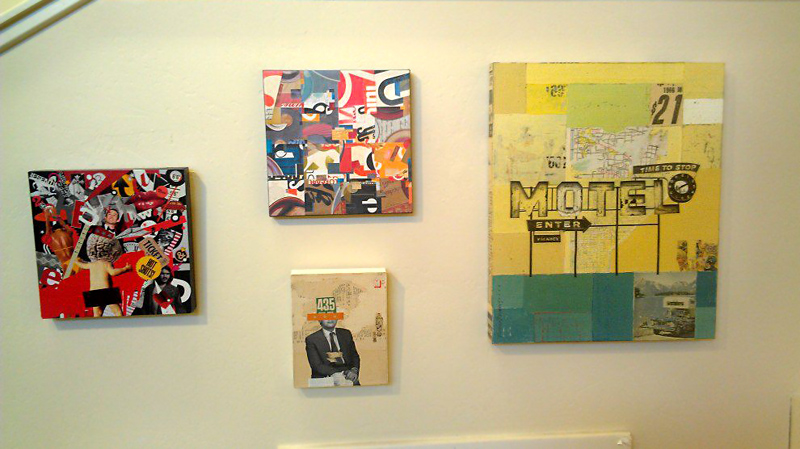
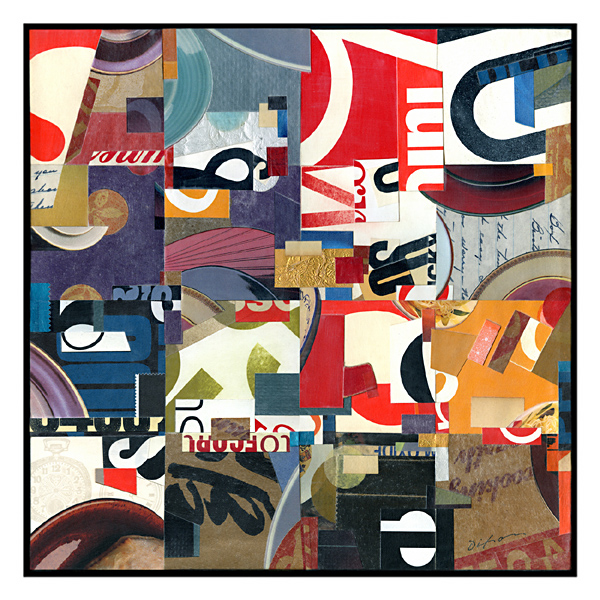
Plate Touchonics
collage on canvas
by J A Dixon
12 x 12 inches
collection of the
Ontological Museum
Posted in C Touchon, Collage, Exhibitions, J A Dixon, J Lambeth, K Rizk, Links, Museums, R Mars | No Comments »
Saturday, January 5th, 2013
“What makes a painting meaningful is the spectacle of the ordinary content living together with the equally important life of the picture plane and the unity of the whole surface.”
— Gillian Pederson Krag
It pleases me to say that my most recent large-scale artwork will be on display and available for purchase as part of an invitational exhibition now hanging in my hometown.
NEW YEAR NEW ART ~ Community Arts Center, Danville, Kentucky
January 2 to 26, 2013 ~ Reception: January 10, 6–8 pm
The invitation to participate is an honor for two reasons. It is always good for one to know that local people appreciate collage, especially the more esoteric kind. Even more humbling is to be included among some truly outstanding Kentucky artists, such as Sheldon Tapley, Helene Steene, Kathleen O’Brien, and Marianna McDonald. I’m looking forward to the reception this Thursday. Mayor Steven Connelly of nearby Berea will speak on the powerful effect the arts can have on local economies. According to Programming Director Brandon Long, the intention is to showcase “fresh, new art that has the kind of excitement and energy of artists who know their work will go on display.” Many of the diverse works were created specifically for the exhibition, and that includes mine. Everything accepted had to have been executed since September.
Diamonds in the Rough is a composite of panels and stretchers. It is my latest effort to free collage from behind glass and approach the medium in a manner similar to the painted surface that stands on its own. I also departed from my typical rectilinear format, yet sought to maintain the type of perpendicularity that I frequently exploit for a unified structure. As usual, the color balance of found material plays a vital role in my overall composition. The lineage of the collage miniature is strong here. In fact, nearly everything I do to produce a major work comes from what I have learned from the small-format approach. This recognition is not meant in any way to devalue the miniature. I would hope that you have come to know my penchant well enough by now to appreciate that.
The next entry will include some detail crops and perhaps a few remarks about the process, too.
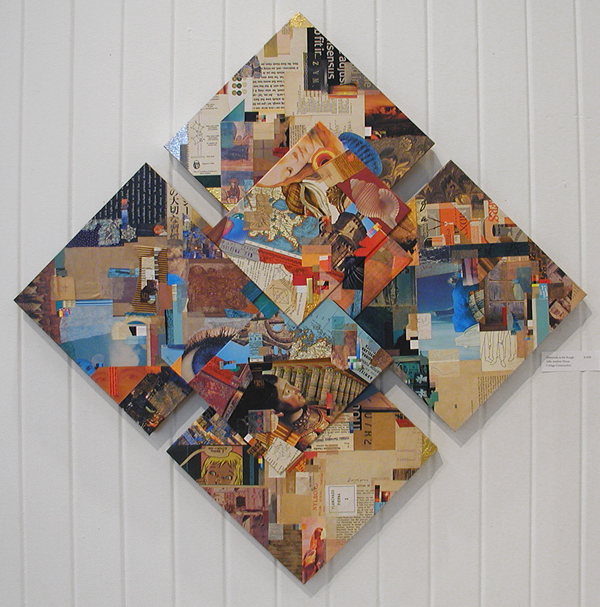
Diamonds in the Rough
collage construction by J A Dixon
36 x 36 inches
available for purchase
Posted in 1) Available!, Collage, Exhibitions, J A Dixon, K O’Brien, Larger Works, Links, New Year New Art, S Tapley | No Comments »
Tuesday, January 1st, 2013
”Every man should be born again on the first day of January. Start with a fresh page. Take up one hole more in the buckle if necessary, or let down one, according to circumstances; but on the first day of January let every man gird himself once more, with his face to the front, and take no interest in the things that were and are past.”
— Henry Ward Beecher
“Finish each day and be done with it. You have done what you could. Some blunders and absurdities no doubt crept in; forget them as soon as you can. Tomorrow is a new day; begin it well and serenely and with too high a spirit to be encumbered with your old nonsense.”
— Ralph Waldo Emerson (thanks to four corners design)
It is interesting to see the contrasts inherent in various discussions about setting New Year’s resolutions. I think that most people who make them keep the practice to themselves, and the ones who do not are prompted to explain why, often coming from a position that seems cynical or overly critical to me. To be fair, some are simply being practical when they question the efficacy. For those who go out of their way to sow seeds of disdain for the customary list: it’s not about now long it stays viable, or about the resulting success rate, or whether it retains meaning in a culture where overt self-improvement carries a tinge of “fuddy-duddy-ness.” For me it’s about one’s mindset at the cyclical cusp. Is it not just “the thought that counts.” The thought becomes a renewal of self-belief, expressed in multiple line-items of striving. It requires introspection, evaluation, discernment, and commitment— hardly fashionable, to be sure. As an artist, I know that resolutions have worked for me at some level, just as they have for other aspects of my personal discipline (the effort to stop smoking, quit refined sweeteners, or get into marathon condition all began with a New Year’s Day pledge). The bad rap on resolutions probably has a lot to do with the familiar failure to abstain, and that’s understandable, given the nature of human behavior. For the most part, the average person underestimates the value of failure as a stepping stone to achievement. Some of the best insight I’ve read on the subject has been written and shared by choreographer Twyla Tharp. For a creative individual, positive resolutions can be an aid to tackling new challenges. Perhaps it is better to attempt a new ritual of focusing on priorities rather than resolving to banish procrastination, for example. Detrimental patterns can more effectively be overcome if one replaces them with beneficial habits. If a promise to oneself on January the First will help, I’m all for it.

Majestic Fetch
collage miniature by J A Dixon
6 x 6 inches
• S O L D
Posted in 1) Available!, Holidays, Influences, J A Dixon, Links, Priorities, T Tharp | No Comments »
Friday, December 28th, 2012
“Whatever an artist’s personal feelings are, as soon as an artist fills a certain area on the canvas or circumscribes it, he becomes historical. He acts from or upon other artists.”
— Willem De Kooning
“You can never see too many things in a work of art. Itself, the work is a means for discovering what is already within us. The true work of art is more than its creator; it is always beyond him; soon it enters another orbit not his, because the artist changes, he dies, while the work lives in others.”
— Michel Seuphor
As I look back on six months of producing this site, I recognize that there are probably only a handful of people who currently pay a visit. To those of you who do, please accept a sincere tip of the hat. I hope that you find my periodic entries to be stimuli worthy of your time. Perhaps 2013 will bring a wider audience.
Collage is a distinctively collaborative medium, at times directly, but always indirectly. We are continuously interacting with those responsible for the ingredients we value enough to incorporate into a work. They might include one of the finest masters of the brush, an outstanding photographer, a bull-pen illustrator, an obscure commercial artist, or an anonymous shipping-carton keyliner. All that matters is this: Each has in some way caught hold of our eye, mind, or heart. Each has become an influence and unwitting contributor. For reasons not entirely clear, some of us attempt to have a more active effect on the state of our art by regularly making words, too. Allow me to bring a few stimulating blogs to your attention, if you haven’t already discovered them—
matthew rose studio
kathleen o’brien studio
a collage a day
daily collage project
with scissors by hand
paper with a past
every day should be a red letter day
lynn whipple’s blog
janice mcdonald collage art studio
four corners design
the altered page
collage clearinghouse
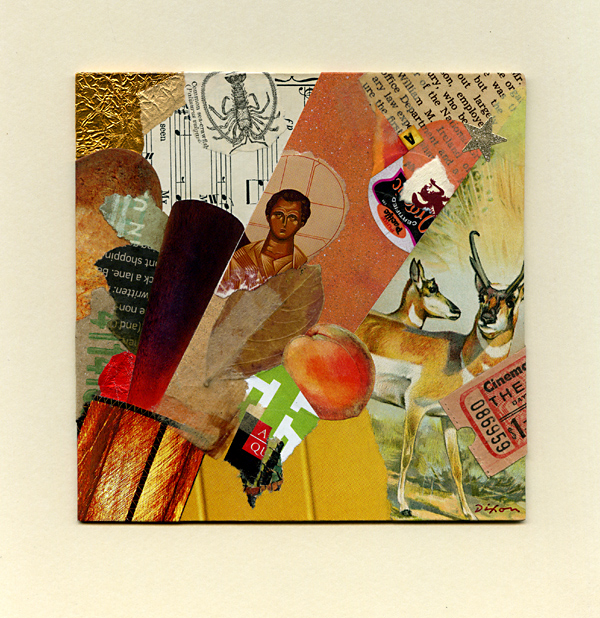
By Heaven’s Good Grace
collage miniature by J A Dixon
5 x 5 inches
Purchase this artwork!
Posted in 1) Available!, Artists/Collage, Collage, Influences, Ingredients, J A Dixon, K O’Brien, L T Holmes, Links, M Rose, R Plowman | 1 Comment »
Friday, September 7th, 2012
“Though he was not connected with any political party, his art was regularly vilified as a threat to traditional German values, while he himself was denounced as ‘unpatriotic’ or, just as often, insane. Yet Schwitters thrived on public opposition, and from 1919 to 1923 he created a succession of Merz pictures which are now seen as his greatest contribution to twentieth century art. These pictures carry an inner tension that derives from the sensitive juxtaposition of abstraction and realism, aesthetics and rubbish, art and life, and their innate dynamism is one of the characteristics of Merz.”
— Gwendolen Webster
Today’s featured collage, inspired by some of the superlative work being done by my friends during this centennial year for the medium, is a bit larger than my typical miniature. To produce an “artifact,” I began with the cover of a ruined book, and before long I realized I had a strictly nonrepresentational composition on my hands. Created spontaneously at a close viewing distance, it wasn’t until I stepped back after completion that it brought to mind the kind of image one might view from the window of an upper story, looking across an urban landscape, with light and shadow playing off facades and roof lines. The way in which the mind attempts to unravel layers of symbolic meaning from the purely abstract is endlessly intriguing to me.
Those of us who create art within this particular genre are indebted to the increasingly exalted legacy of Kurt Schwitters and his original conception of Merz. I often think about how we have been liberated to explore the inexhaustible potential of this approach and to disclose our aesthetic vision within the accepted playground of modern art. Never forget that the man who fully defined this visual language for us did so at genuine risk to his personal freedom and safety. We may not always describe our works as a tribute to the enduring idea of Merz, but that is precisely what they are. Schwitters said, “Merz means creating relationships, preferably between all things in the world.” One fine aspect of that is the new connections and friendships that grow out of mutual interest in collage during its one-hundredth year. Check out the online galleries of Launa D Romoff, Teri Dryden, Scott Gordon, and Joan Schulze. You may agree with me that these artists are among today’s “Heirs to KS.” I hope to discover many more and to share their creative output at this site. Please stop by again soon.
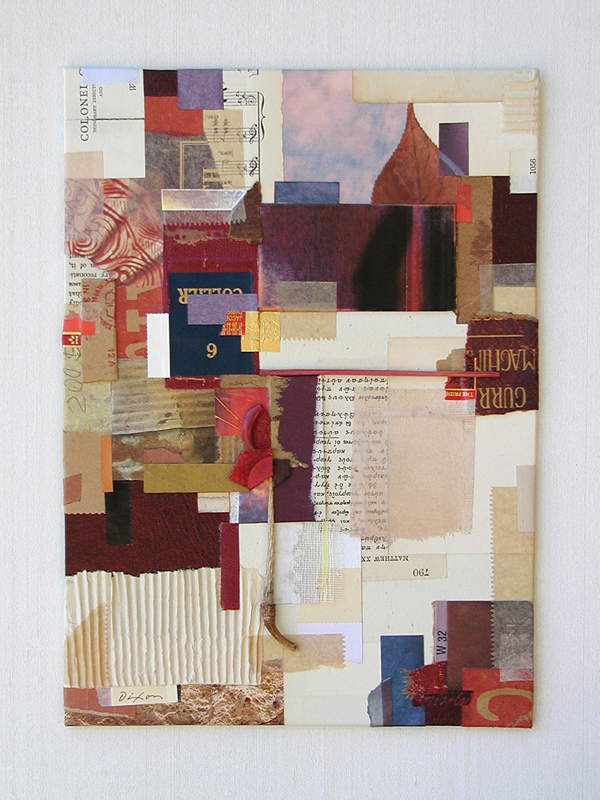
Structural Integrity
collage artifact by J A Dixon
8 x 10.5 inches
• S O L D
Posted in Abstraction, Artifacts, Collage, Influences, J A Dixon, J Schulze, K Schwitters, L Romoff, Links, Merz, S Gordon, T Dryden | 4 Comments »
Wednesday, August 22nd, 2012
“Ray didn’t talk about it, he just did it. That’s why you don’t find art magazines lying around quoting the art philosophy of Ray Johnson.”
—Toby Spiselman
Ray Johnson, the original “most famous unknown artist in the world,” produced his A Book About Death during the years 1963 to 1965. The pages were randomly mailed and offered for sale. Complete copies were compiled by a rare few. Johnson was a significant bridge between the groundbreaking work of Schwitters, the sensibilities of Cornell, and the emergence of what would become the most widely recognizable features of Pop Art. He was highly influential in the Mail Art, Installation Art, and Performance Art movements, as well as late 20th-century neo-Dadaist trends. Paris-based Matthew Rose has actively aroused a worldwide interest and vitality that perpetuates the legacy of A Book About Death, including a 2010 incarnation (in which I made a small contribution). The full history can be studied at this site.

ABAD 2010
collage miniature by J A Dixon
6 x 4 inches, not for sale
Posted in Collage, Dada, Exhibitions, Influences, J A Dixon, J Cornell, K Schwitters, Links, M Rose, Pop Art, R Johnson | No Comments »