Archive for the ‘Journal’ Category

Beyond “vacation art” . . .

Saturday, November 30th, 2013

“I have been producing collages for nearly fifty-five years, many of the early ones were done during long flights or in the waiting areas at airports.”
— Richard Meier

This season of the year finds many artists visiting family and friends. My spending time as a traveler without the suppletory activity of creating art makes for a less than satisfying experience. Visiting new places or returning to familiar haunts is noticably deficient if not combined with sketching or assembling ingredients for a collage experiment. Of course, we all need to relax now and then, sharing time with people who mean the most to us, but many of us also recognize a price to pay whenever the creative urge is asked to take a back seat for any length of time. What better opportunity than a change of environment to infuse our investigations with a fresh dose of spontaneity?

The sabbatical is a time-honored tradition for creative people, which brings to mind Cecil Touchon’s remarkable Paris Papers. But in contrast to this kind of planned artistic get-away, there is also much to be gained by a custom of fusing the influences of short-term travel with an ongoing artistic process. This makes me think of the highly publicized collage artwork of American architect Richard Meier. I saw something years ago which suggested the collage-making proclivity that runs parallel to his professional practice developed from the found material he acquired crisscrossing continents as an in-demand designer, and that many of the early works were created on airliners. I remember being impressed with his wooden case, crafted to accommodate several square working surfaces plus the modest number of accourtrements a collage artist requires to do one’s thing. No doubt his days of transporting blades and scissors on aircraft are part of the past. The status of being a celebrated architect has provided Meier ample “rare” opportunities to showcase examples of his collage. Whether or not the eventual significance of his work within the medium will prove commensurate with the attention it has already received remains a matter of opinion (like nearly everything in the art world).
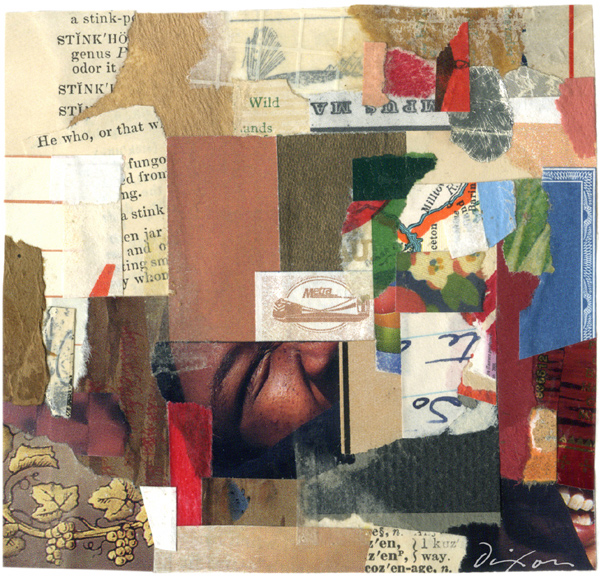
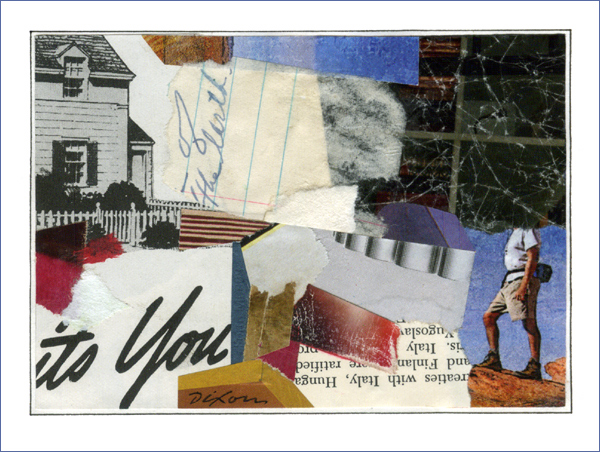
Two years ago, I had the privilege to view a milestone exhibition of Kurt Schwitters originals at the Berkeley Art Museum. During my stay in Northern California, a brother-in-law was kind enough to let me set up a makeshift work area in his home office so that I could capture as collage experiments the flow of new stimuli. Please allow me to share two of those artworks for the first time:
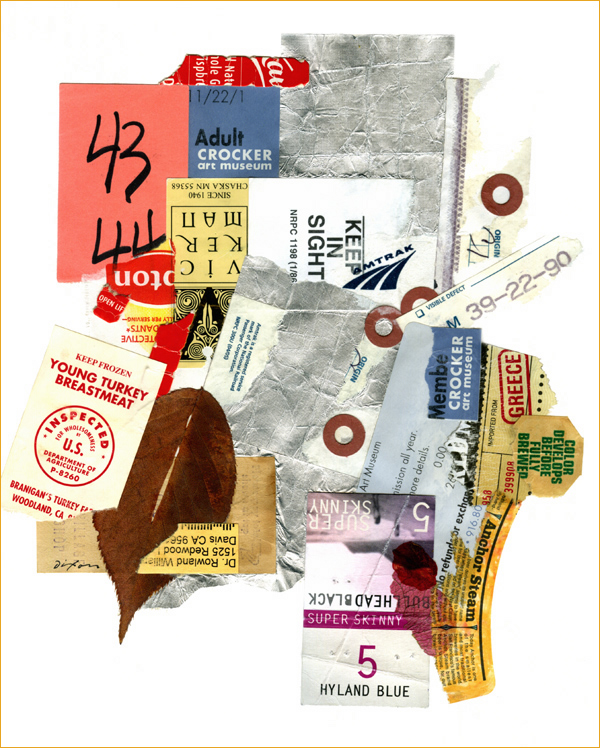
 

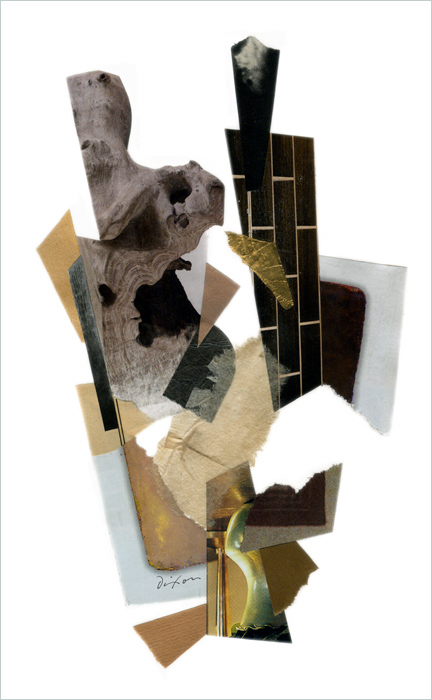
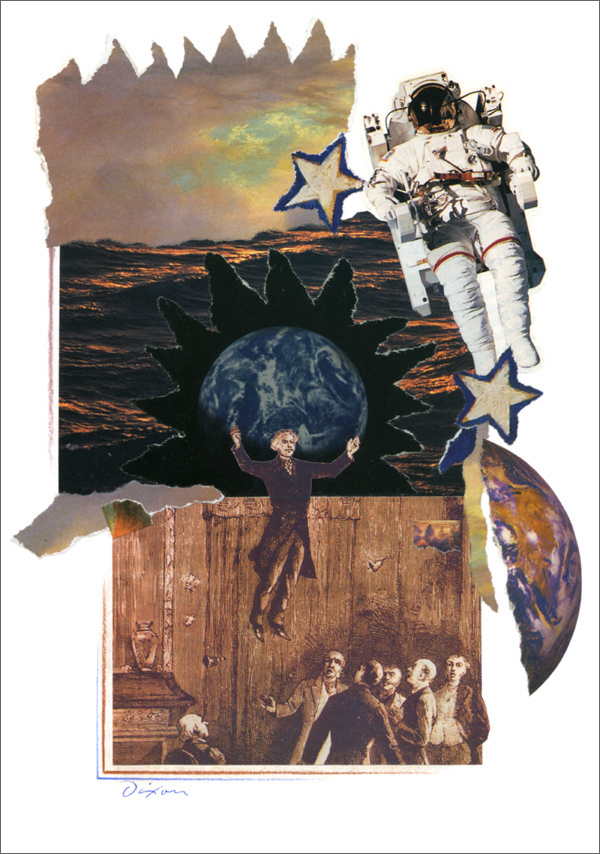
Untitled (Back to California, part one)
collage experiment by J A Dixon
8 x 9.5 inches, not for sale
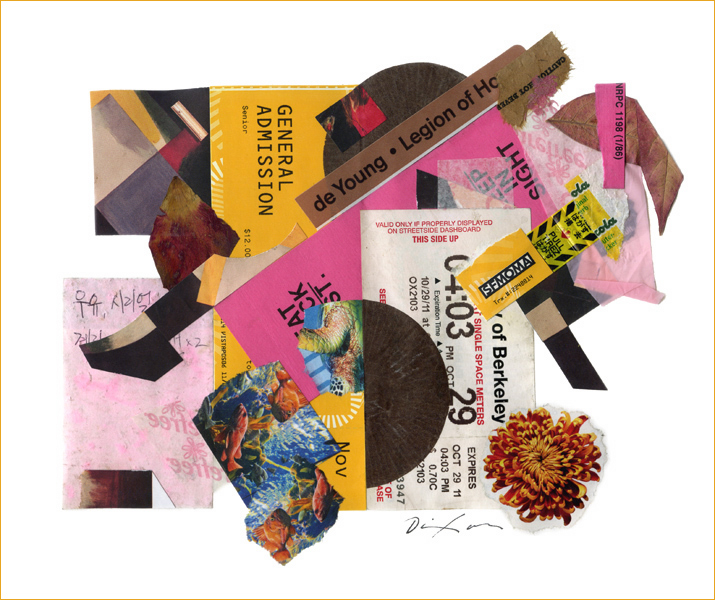
Untitled (Back to California, part two)
collage experiment by J A Dixon
8.5 x 7.5 inches, not for sale
More collage experiments . . .

Tuesday, October 29th, 2013

“All the works of man have their origin in creative fantasy.”
— Carl Jung

Anyone who thinks that everything about collage is known is probably stuck in a dull place. Continuous experimentation is vital, whether or not we divulge or share the products of our investigation, and constructive self-criticism is essential, if one is to avoid the pitfall of “artistic comfort.”
 

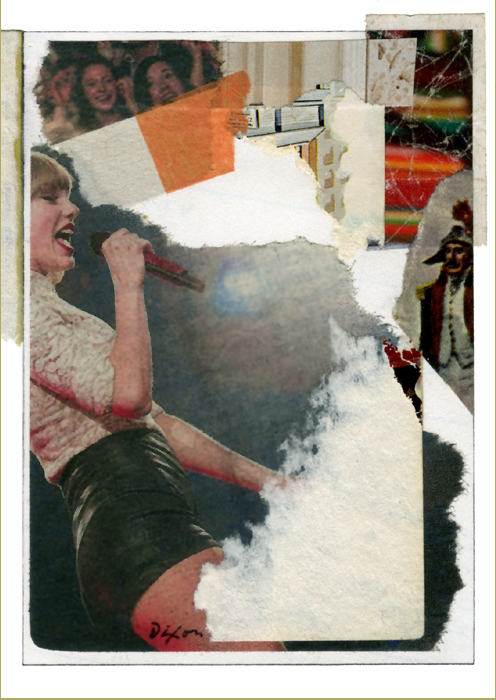
Untitled (kaleidoscope)
collage experiment by J A Dixon
4 x 3.75 inches, not for sale

its You
collage experiment by J A Dixon
4.375 x 3 inches, not for sale

Reign Glorious
collage experiment by J A Dixon
3.25 x 4.5 inches, not for sale

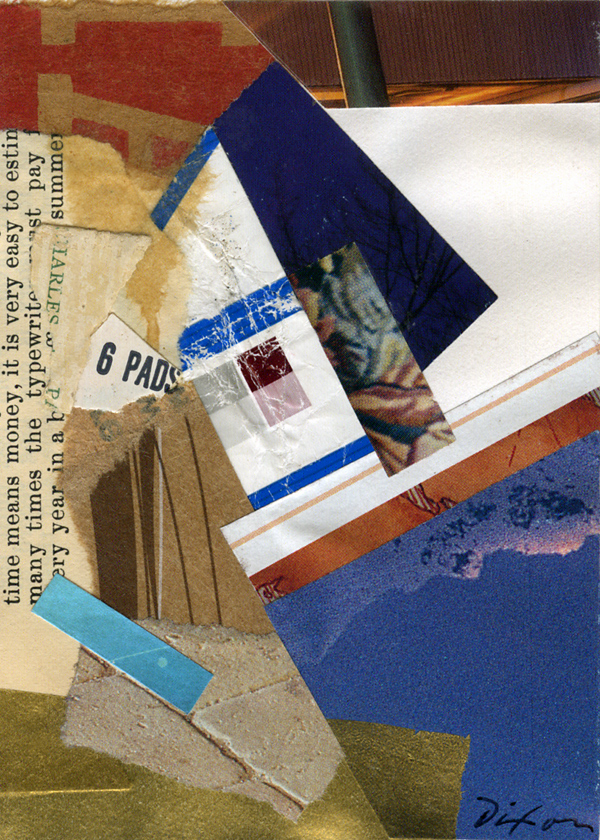
6 Pads Of Time
collage experiment by J A Dixon
3 x 4.25 inches, not for sale

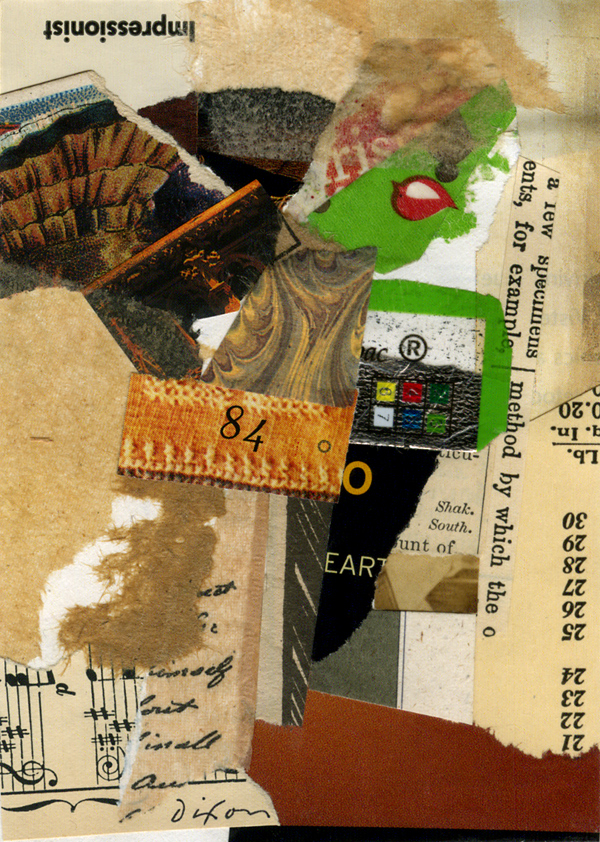
84 Tonal Impressions
collage experiment by J A Dixon
3 x 4.25 inches, not for sale

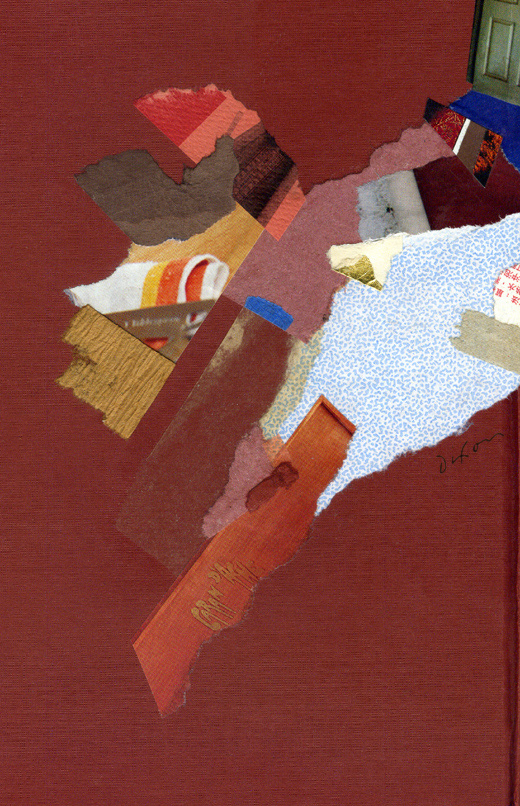
Untitled (overlook)
collage experiment by J A Dixon
5 x 7.75 inches, not for sale

Never stop scratching

Sunday, October 20th, 2013

“The true method of knowledge is experiment.”
— William Blake

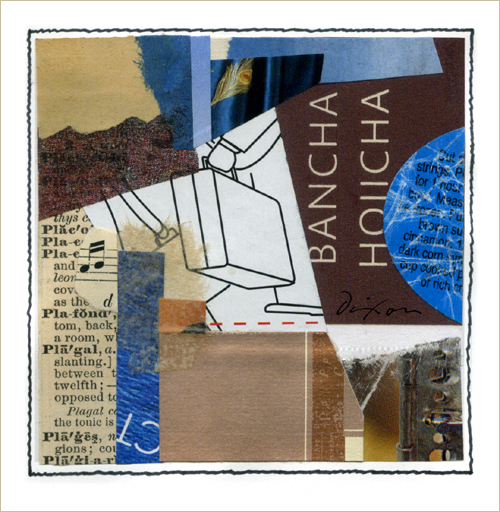
Conducting intuitive experiments with eventual disclosure in mind may defeat their purpose at some level, but it can be beneficial at times to share the creative process that leads to new works. Nevertheless, the primary purpose of experimentation is to remove oneself from the context of producing something to be held up for evaluation by others. To investigate. To explore. To defy one’s own expectations.
 

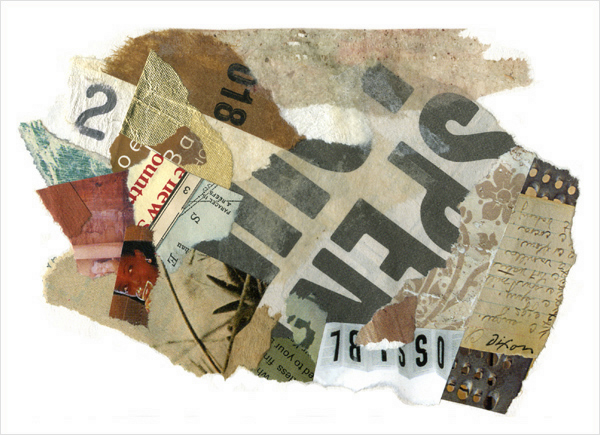
Untitled (shards)
collage experiment by J A Dixon
4.5 x 7.5 inches, not for sale
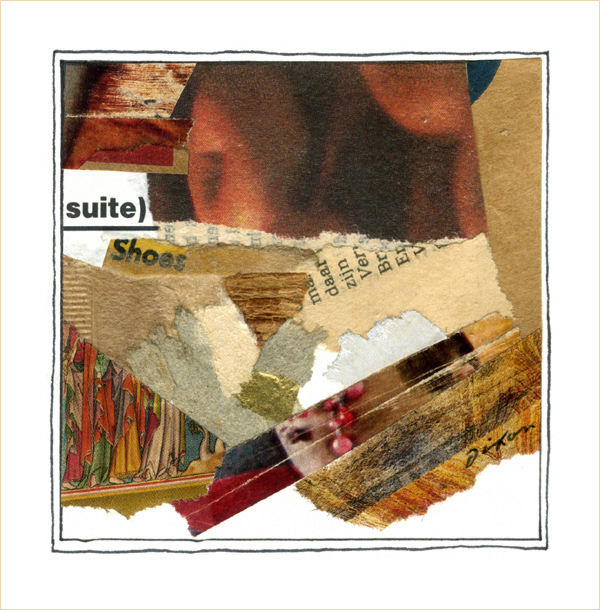
suite)Shoes
collage experiment by J A Dixon
3.25 x 3.25 inches, not for sale

Untitled (la vie moderne)
collage experiment by J A Dixon
5 x 3.625 inches, not for sale

The New Number Two
collage experiment by J A Dixon
5.5 x 3.75 inches, not for sale

Morning Bancha
collage experiment by J A Dixon
3 x 3 inches, not for sale

Journal Collage  |  Sixth Page

Tuesday, February 26th, 2013

“There are thoughts always abroad in the air which it takes more wit to avoid than to hit upon.”
— Oliver Wendell Holmes

“Practice what you know, and it will help to make clear what now you do not know.”
— Rembrandt van Rijn

To identify and penetrate the emerging idea, the evasive key, the potential solution. To isolate and discard the ordinary notion, the well-worn effect, the visual cliché. Both are the beneficial fruits of keeping a journal of sketches and studies.
 

Untitled (Sam’s Outlook)
journal collage by J A Dixon
8.5 x 11 inches, not for sale

Journal Collage  |  Fifth Page

Monday, February 25th, 2013

“Time consecrates and what is gray with age becomes religion.”
— Friedrich Schiller

The collage artworks of Kurt Schwitters possess a “vintage” appearance to our eye, but it is essential to keep in mind that his “Merz” ingredients were predominantly gleaned from a concurrent environment. It was Joseph Cornell, via the influence of Max Ernst and others, who consciously selected antique images to reinforce the romance and melancholy of feelings past. Apparently, a significant number of active collage artists limit their resources to vintage found material. Don’t get me wrong; I love this work. The immediate “retro effect” can be quite compelling. It would take a stronger soul than mine to dismiss the inherent dignity that comes with the marvelous scrap from an outdated encyclopaedia or the now-funky gravitas of post-war, mass-market magazines. However, from my perspective, a vital element of contemporary collage is the incorporation of present-day material and the recycling of twenty-first century detritus. I find it even more interesting to see vintage ingredients effectively juxtaposed with the ephemera of our own time. Nevertheless, every serious artist has a set of aesthetic considerations, genre goals, and process parameters that mold decisions. Due respect should be extended to the overall objectives that each collage artist brings to this exceptionally diverse media.
 

Untitled (Just Another Prophesy)
journal collage by J A Dixon
8.5 x 11 inches, not for sale

Journal Collage  |  Fourth Page

Sunday, February 24th, 2013

“The least of things with a meaning is worth more than the greatest of things without it.”
— Carl Gustav Jung

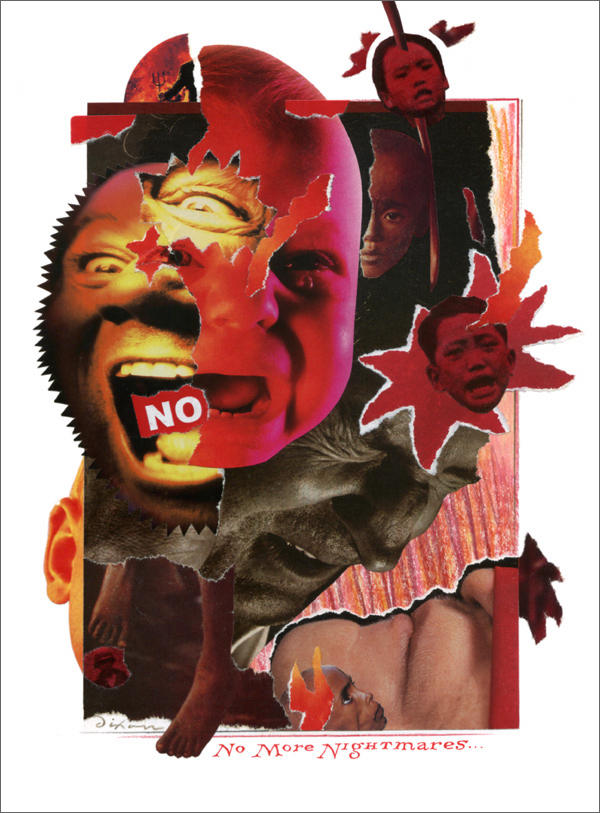
For me, the purpose of a journal collage is to explore whatever imagery or theme that spontaneously occurs, free from other motivating intentions (including the dubious blog post such as this).

What can one say when something bubbles up from the level of the unconscious? Perhaps it is best to not say anything at all.
 

Untitled (No More Nightmares)
journal collage by J A Dixon
8.5 x 11 inches, not for sale

Journal Collage  |  Third Page

Saturday, February 23rd, 2013

“Who is not attracted by bright and pleasant children?”
— Epictetus

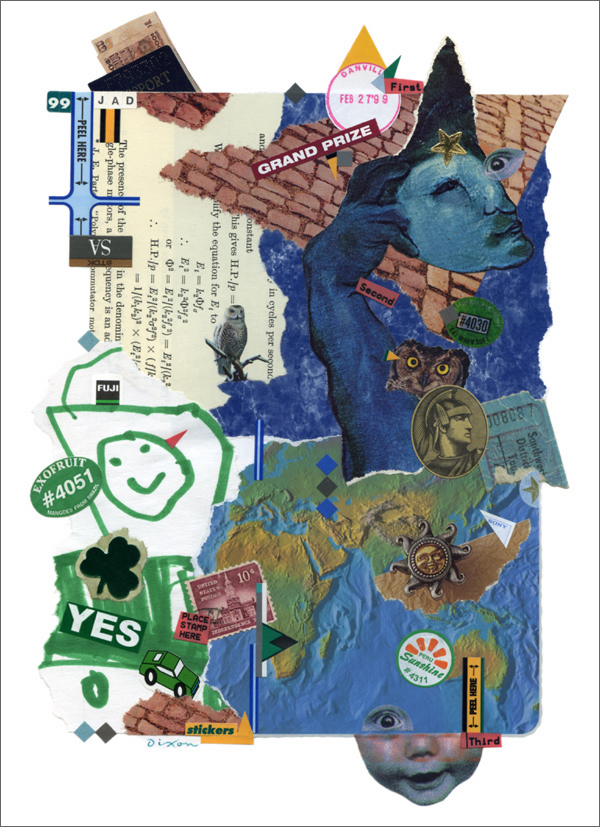
Since that long-ago day when the first artist was unable to resist adding one more cherub to a painting, it has been tough to refrain from including the infant as visual ingredient. This is no less true as collage enters its second century. I hereby salute all those who can restrain themselves from affixing the occasional baby head into a composition.
 

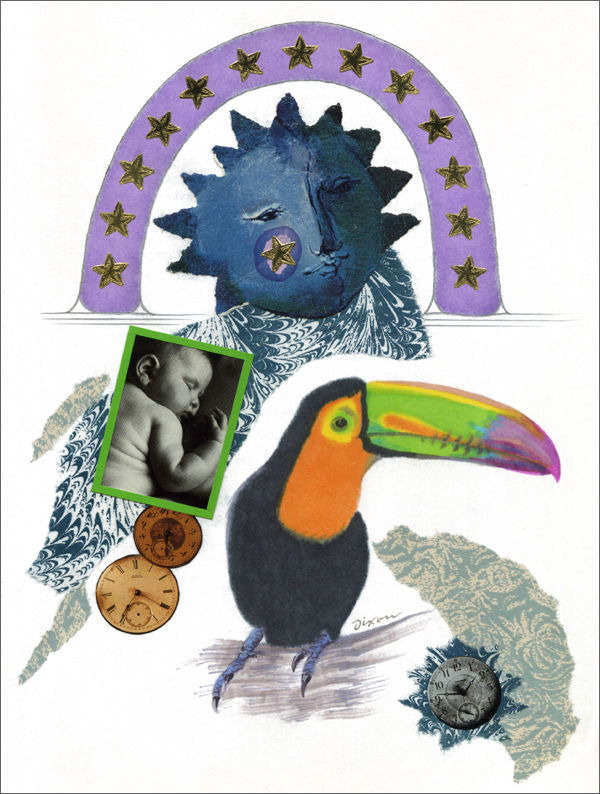
Untitled (Listen Here, Baby)
journal collage by J A Dixon
8.5 x 11 inches, not for sale

Journal Collage  |  Second Page

Friday, February 22nd, 2013

“No man is matriculated to the art of life till he has been well tempted.”
— George Eliot

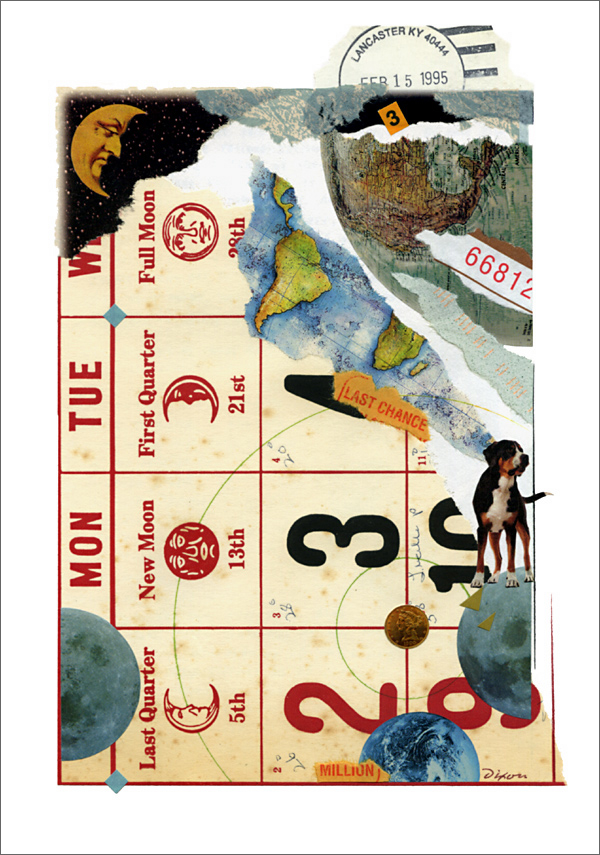
There are certain ingredient images that always, when added to a collage, have a significant impact on the overall effect. A perpetual temptation to the artist, they comprise an intriguing class of their own: the eyeball, the doll head, the handgun, the female breast, the dog. Can you think of others that qualify?
 

Untitled (Canis Luna)
journal collage by J A Dixon
8.5 x 11 inches, not for sale

Journal Collage  |  First Page

Thursday, February 21st, 2013

“At first I put anything and everything in — phone numbers, appointments, grocery lists, in addition to things related to what I was thinking about for my work. Over the years the contents have become a shade more formal, and much more visual. There’s less of my hand (in the sense of sketches and drawings), more reliance on found material. But I’ve tried to keep the whole thing as loose and freewheeling as possible.”
— John Willenbecher

When I was 21, I had a single conversation with a man named Henry who boarded at the Cincinnati house where I lived. He seemed much older at the time, but I would guess now that he was barely 25. What I took away from that one exchange was Henry’s strong conviction that I should start a journal, as he had done several years before. Heeding his invaluable advice, I kept an active journal close at hand from that point forward. At first, it was just words, because I already had various sketchbooks as a student. Eventually, it became a comprehensive repository for personal notes, musings, doodles, and thumbnail ideas. As time passed, the content took on more of the character of visual exploration, with whole pages devoted to spontaneous collage experiments and studies for what might or might not lead to a finished artwork. I discovered that John Wllenbecher and others were calling their volumes “commonplace books,” a term more strictly applied to a “verbal scrapbook.” For some reason, mine also seemed a bit large for that particular name (sometimes 11 x 14, but most often 8.5 x 11), and so I’ve always continued to think of them as my journals. In combination with the many hundreds of handmade greeting cards I’ve created over the same period of time (nearly 40 years now), these private “chronicles” have served as the primary incubator for my work as a collage artist.
 

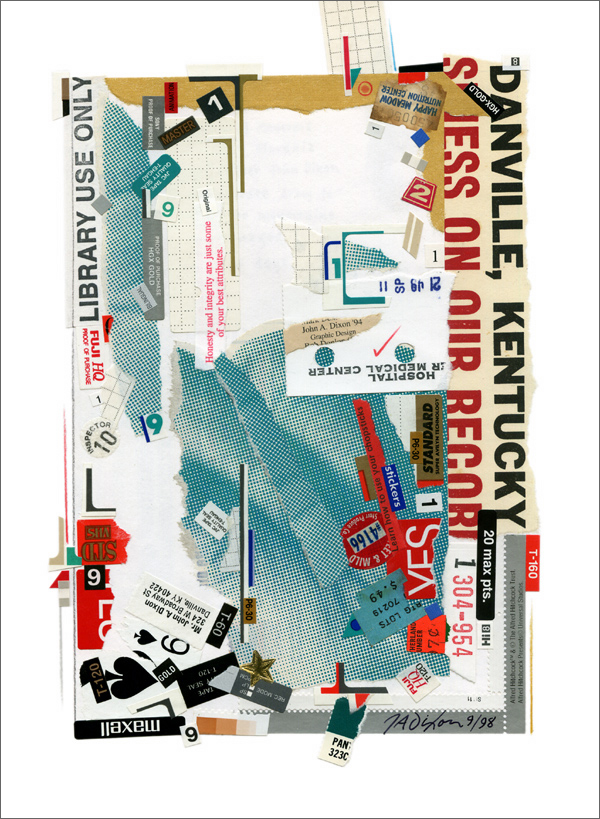
Untitled (Library Use Only)
journal collage by J A Dixon
8.5 x 11 inches, not for sale