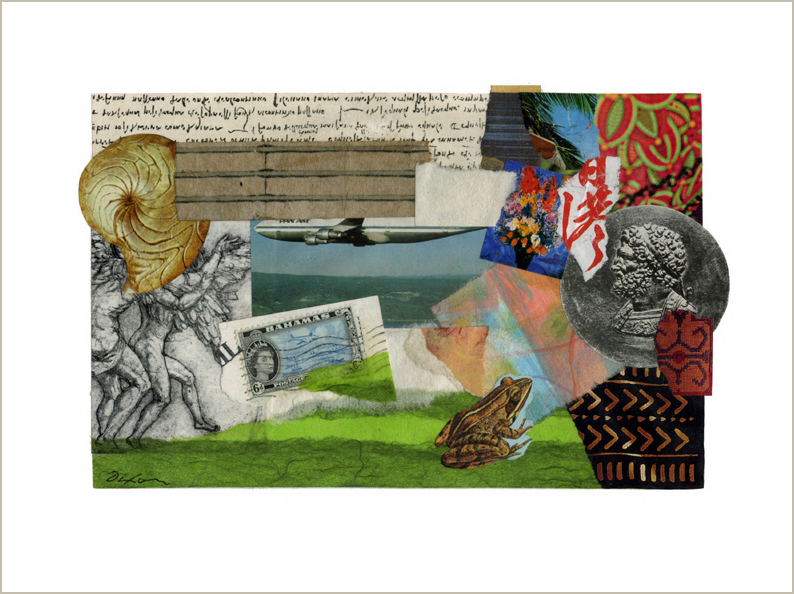
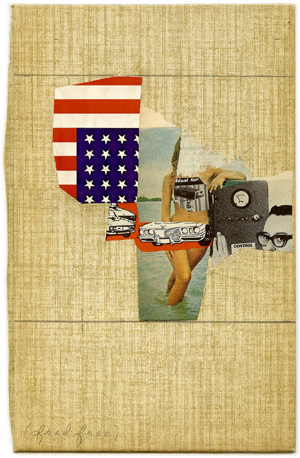
Untitled (Alexander)
collage experiment by J A Dixon
1 of 2 within 90-minute constraint
8 x 5.25 inches, not for sale
ingredients by Kathleen O’Brien
Untitled (Alexander)
collage experiment by J A Dixon
1 of 2 within 90-minute constraint
8 x 5.25 inches, not for sale
ingredients by Kathleen O’Brien
“If you want to get better at something, you have to do the reps. Dreams work the same way. You don’t get to pick and choose a life of home-run moments. You get to swing the bat, a lot. Some of them are going to connect; some of them won’t. But each one takes you one step closer to awesome.”
— Jon Acuff
I have crossed the halfway point in my March Exercise. Yesterday, I went to the plate one more time and met the ongoing challenge of creating a harmonious balance of counterpoise in a collage. For me, it is one of the most important factors that determine whether or not a composition is merely an active “stew” of ingredients. As I added another miniature to my Bibelot Series, I completed the exercise of using journal experiments to concentrate on a particular set of design principles — the visual support for any ideas at play in the artwork. Perhaps I should have made this parameter more clear at the beginning of the month, and explained the history of the annual regimen. One comment maker on Facebook asked me if I have been creating daily college entries for nine years. Any earlier concern I had about the potential for misinterpretation proved valid. A blogsite should not cause confusion for those kind enough to pay a visit. On the other hand, more and more people ask questions before spending enough time to comprehend a fuller picture of things. Nevertheless, I am always willing to interact with my guests and answer any inquiries. I have a great passion for working in this medium, but this online destination is meant for the observer (and remember: I have a thick skin, too!).
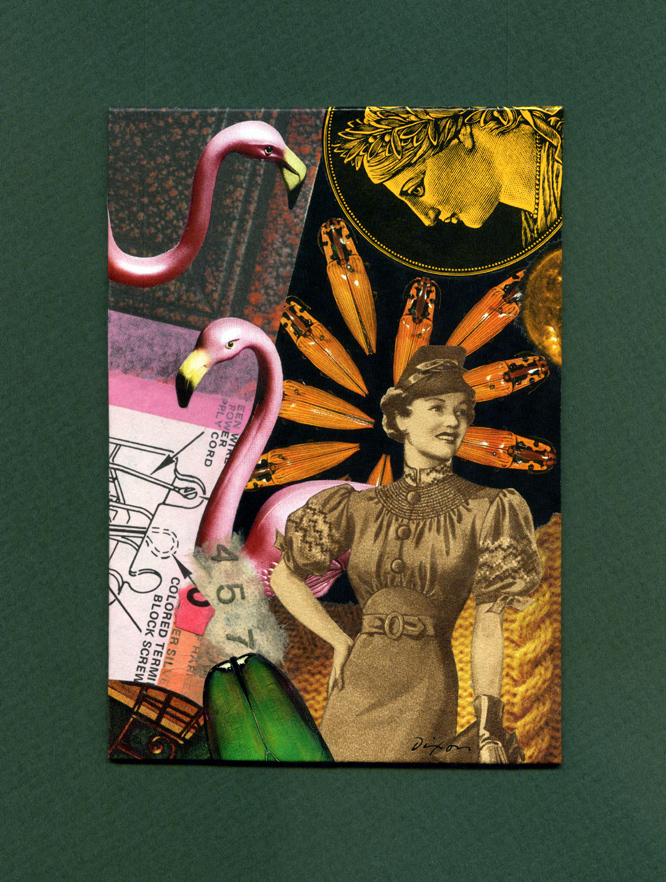
In Pomp Arrayed
collage miniature by J A Dixon
4 x 5.75 inches
on consignment
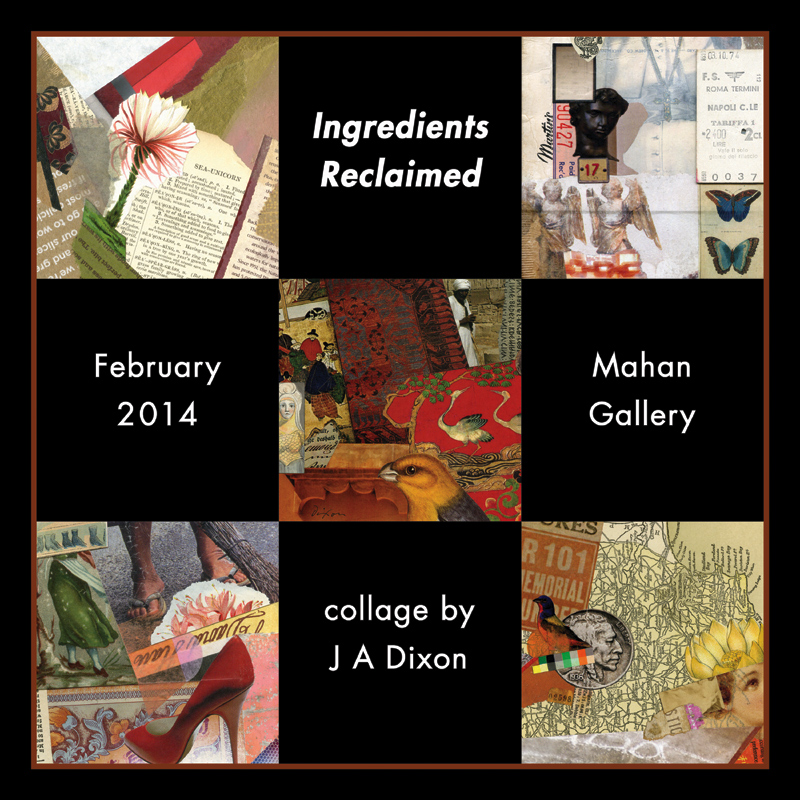
February 3–28, 2014
Ingredients Reclaimed
Boyle County Public Library
Danville, Kentucky
“. . . the completion of a work is only ever an abandonment, a halt that can always be regarded as fortuitous in an evolution that might have been continued.”
— Paul Valéry
Whether one thinks of the anonymous medieval monk embellishing a pre-existing manuscript, of Leonardo da Vinci working on the surface of his older painting, or of George Lucas making alterations to the original Star Wars trilogy, there is a long and sometimes controversial history of “refining” creative works already accepted as finished. I remember reading about Asian masters who thought nothing of making additions to artworks created in earlier eras. Apparently some art historians believe that halos were added to religious masterpieces much later. Duchamp did not draw those whiskers on the actual Mona Lisa, but he might have, had he been able to get away with it. What has all this to do with collage? Perhaps our entire genre came into being with the essential hunch that worthwhile art could result from revising something in contrast to its original purpose or frame of reference.
There is a wide spectrum to consider, if the subject under discussion is “altered art.” We might be talking about anchoring the concept for a collage on a singular appropriated image or transforming a mundane object into a new work of art. (L T Holmes recently shared a multi-part, personal tour of her Don’t Get Jittery On Me.) Or we might be referring to the simple idea of returning to a work already deemed complete and “writing a final chapter” to improve it. Think long enough about this topic and you may ask yourself whether any artwork is ever really done. Going back to Leonardo and Lucas for a moment, both turn up from time to time in attributions that suggest they also may have altered a version of the Valéry quotation more pithy than the poet most likely ever expressed.
“A poem is never finished, only abandoned.” — Paul Valéry
“Art is never finished, only abandoned.” — Leonardo da Vinci
“A movie is never finished, only abandoned.” — George Lucas
Forgive me if all of this undue rambling merely serves as an opportunity to highlight two “finished” collage artworks that I recently chose to revisit. Both examples also illustrate the complications of visually comparing two images created with different digital devices. After writing about a corresponding issue last week, I have since discovered S Caswell-Pearce’s related words from an April entry at paper with a past. My images for Rhapsody with Fever Chills demonstrate the same scanner/camera differential, although the scan of the new version is a better rendition of the artwork’s strong complementary effects. (This piece is currently on display with the “Seeing Red” exhibit in the McKinney Conference Center at Kentucky’s Constitution Square Historic Site.) The digital documentation of a revised Broken Qualifications, having shared the original version previously at this site, became a bit more challenging the second time around, given the addition of three-dimensional ingredients. At any rate, neither piece had ever felt fully resolved, although I had no specific plans to “reopen the case” until I made a broader reassessment of my inventory. Did I enhance them, ruin them, or just squander my time? You be the judge.
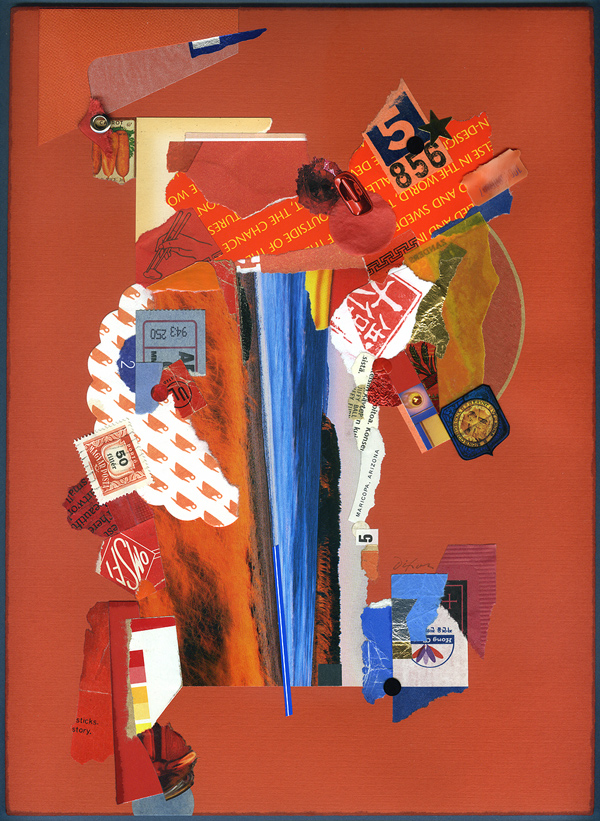
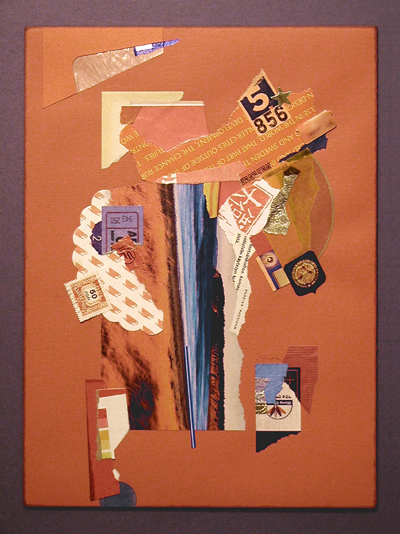
Rhapsody with Fever Chills
collage on paper by J A Dixon
7.5 x 10 inches, available for purchase
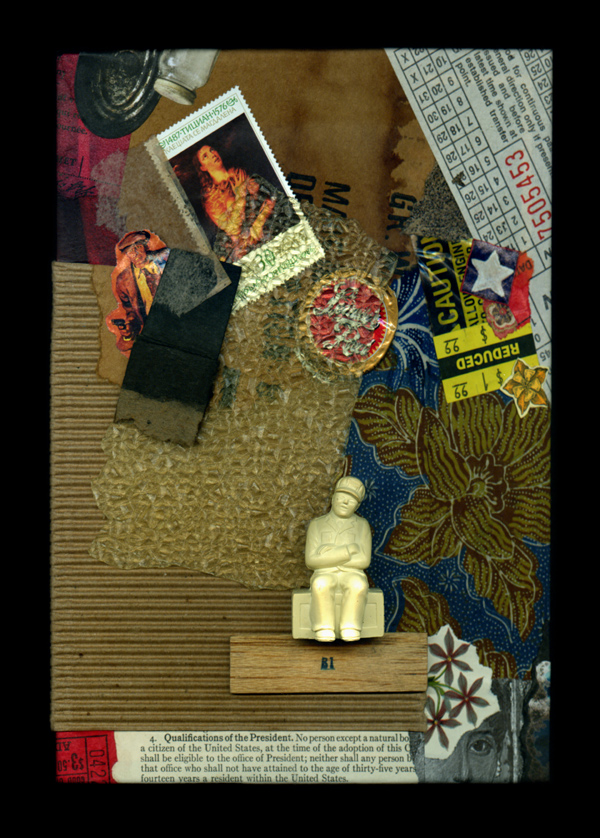
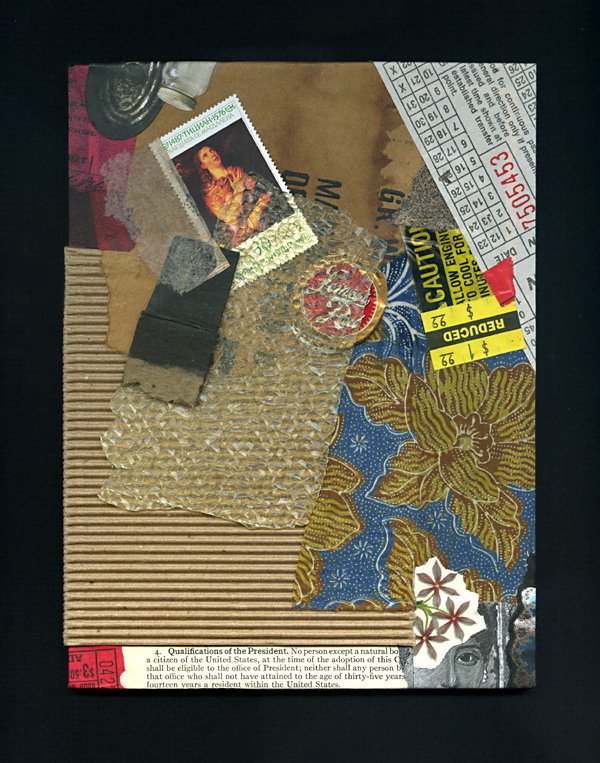
Broken Qualifications
collage/assemblage by J A Dixon
6 x 8 inches, available for purchase
In response to an assertion that his environmental works are impossible to visually document—
James Turrell: “Well, someone has to make up for all the work that photographs better than it is.”
Mr. Turrell’s recent quip brings to the forefront a distinct feature of representing or documenting one’s artwork. Does it really look like the image being included with a call for entries, posted at an online marketplace, or shared on a social network? Of course, the photographing of artwork to enhance its appeal did not begin with digital devices or the World Wide Web. Most of us are familiar with the curator’s disclaimer that reserves their right to reject artwork which arrives substantially different than visually represented when proposed. Even non-artists know how easy it is to boost the contrast or color saturation of a digital image. Setting apart from our discussion works that are essentially digital from the outset, it is important for anyone working in the medium of traditional collage to squarely meet this challenge: How do we properly interpret the visual experience of seeing our artwork firsthand?
Needless to say, faithfully photographing or scanning conventional artwork is something that professionals face every day, but how can it ever be an exact science? What is the “true” appearance of anything? As the three examples below demonstrate, one of my recent collage artworks photographed differently under three different lighting conditions, before it was delivered. The more neutral version is closer to how it might “typically” appear, but perhaps the most faithful rendition would be an image made in the setting for which the piece was commissioned, under the unique lighting conditions of that particular environment, and then subsequently balanced for a reasonable match to the naked eye.
I review nearly a hundred collage artworks a day, as my eye passes over numerous online displays each week. What percentage of these creations actually look like the corresponding digital image? We all know what it’s like to see something and think, “I wonder if it really looks like that.” On the other hand, we also know what it’s like to scan a piece and think, “Wow. That looks better than I expected.”
All that any of us can do is establish a level of integrity about representing work to others. For those who routinely cheat or push an ethical boundary? Rest assured; the habit will eventually come back to haunt their studios.
And now, a few words about today’s collage example. I must first express my appreciation to Lee and David Simpson for the commission that resulted in this thing we all do, a mixed media and collage artwork on canvas. To infuse the composition with images that represent aspects of significance to their lives, this piece was personalized by using the clients’ own artifacts and memorabilia, as well as additional ingredients carefully selected from my morgue. Creating works with special meaning to those for which they were intended has always been some of the most fulfilling time I have spent as an artist.
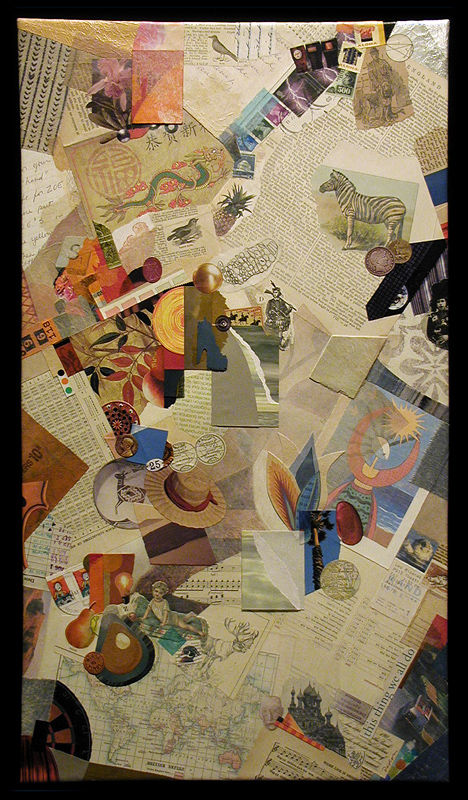
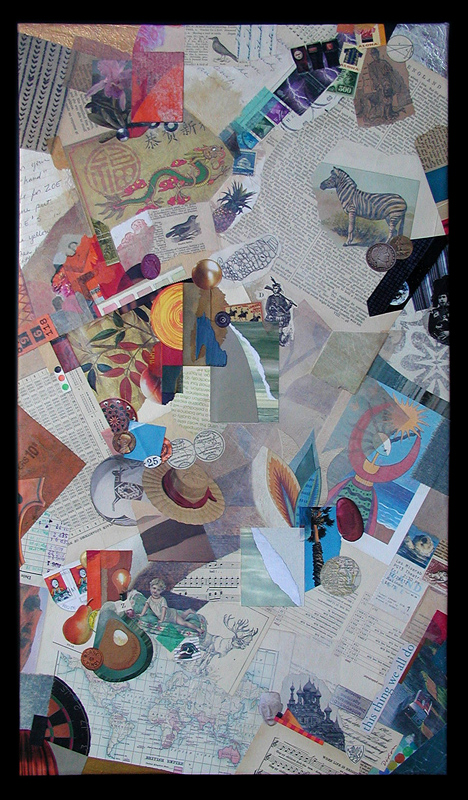
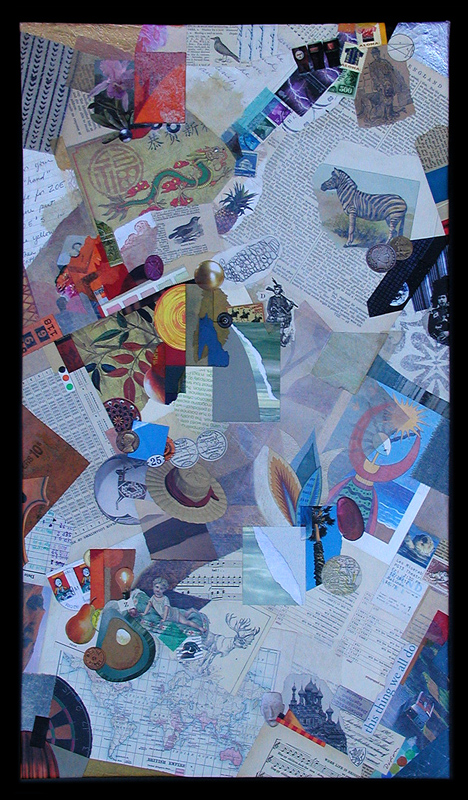
this thing we all do (three different digitals)
collage with combined mediums on canvas by J A Dixon
15.75 x 27.75 inches (22.50 x 34.50 inches, framed)
collection of L and D Simpson
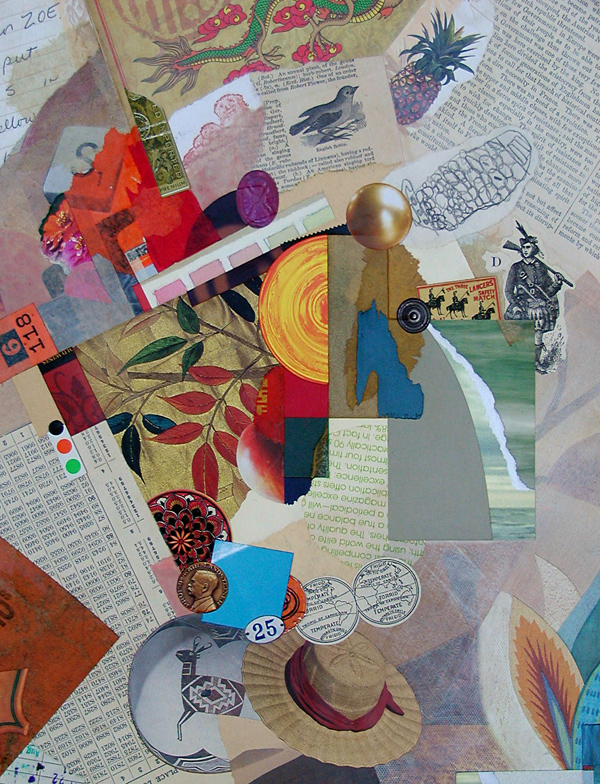
this thing we all do (detail)
collage with combined mediums on canvas by J A Dixon
(photographed and digitally balanced to match original)
A recent series of intensive collage investigations undertaken by Cecil Touchon while abroad — resulting in The Paris Papers — are more than worthy of our careful study. One of the medium’s most assiduous practitioners, Mr. Touchon clearly earned a well-deserved break after his significant contributions to the Collage Centennial, and yet it is no surprise for me to learn that he would combine it with such a Herculean self-assignment. We are all the beneficiaries.
p s ~ He also let everyone know the good news that he quit smoking during his month-long adventure hanging out with collaborator Matthew Rose. Amazing.
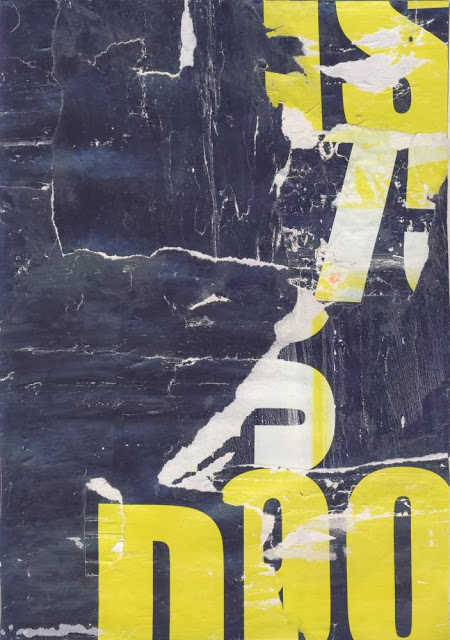
Fusion Series #3384
collage on paper by Cecil Touchon
made with bits of paper from Parisian street posters
8 x 12 inches, 2013
“There has been an increased attention on collaborative practice in the arts in recent times with a perceived increase in artists working in groups or partnerships. For many other artistic enterprises, collaboration is the norm. Musicians form together into ensembles and bands; actors, writers and directors necessarily work in companies; and dancers, choreographers and musicians work in companies too, or in troupes. But for the visual arts the history of collaboration is less dominant, but perhaps, on the rise.”
— Kent Wilson, from the Central Highlands ArtsAtlas
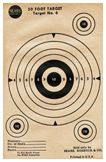 The Target Practice Project is certainly taking on a life of its own. L T Holmes has established a new blogsite and yesterday she kindly featured me as a “guest blogger.” Thank you, Laura, for your generous spirit.
Several of my entries over the past weeks have illustrated thematic collaborations. How many other kinds are there at play in the contemporary collage scene? Please indulge me as I continue to count the ways.
There have been remarkable long-term projects such as Liz Cohn’s Playing with a Full Deck. The playing card format seems to be a perpetual stimulus to interesting collaborations in collage. And then there is always the creative teamwork that simply results from a meeting of improvisational minds. One artist will originate a piece and a partner will complete it. Sometimes the process works in both directions at once. In other cases, a collaborator will select ingredients in order that a fellow “chef” may prepare a delicious “entrée.” Zach Collins has devoted much of a Tumblr site to his prolific joint ventures. Musta Fior is internationally known for his many visual co-conspiracies. Below are representative products of collaboration in the medium that have recently caught the eye of The Collage Miniaturist.
Long have I been convinced that musicians had it all over visual artists when it came to the collaborative urge, but countless exponents of contemporary collage are helping to revise that perception. Ladies and gentlemen, keep jammin’ away!
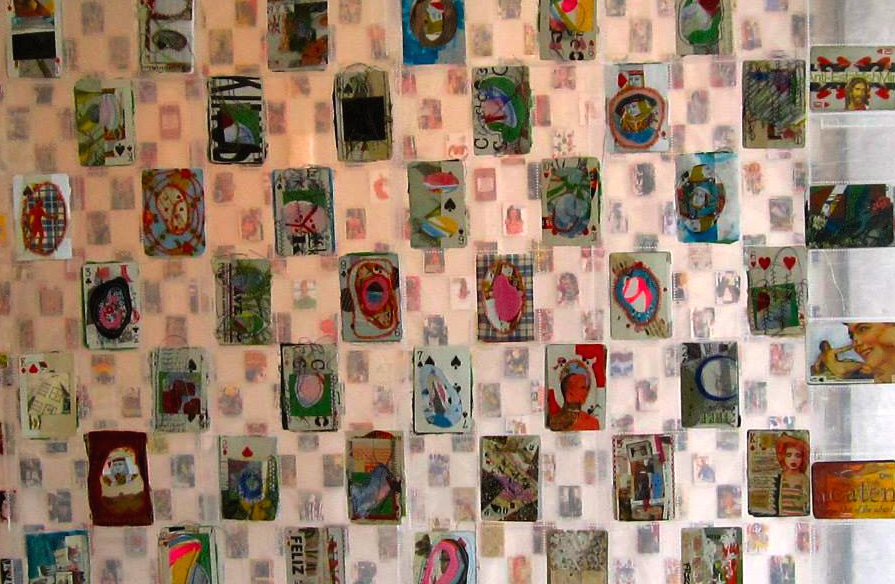
“Playing with a Full Deck” exhibit
altered playing card collaborations
Gallery 6 PDX, 2013
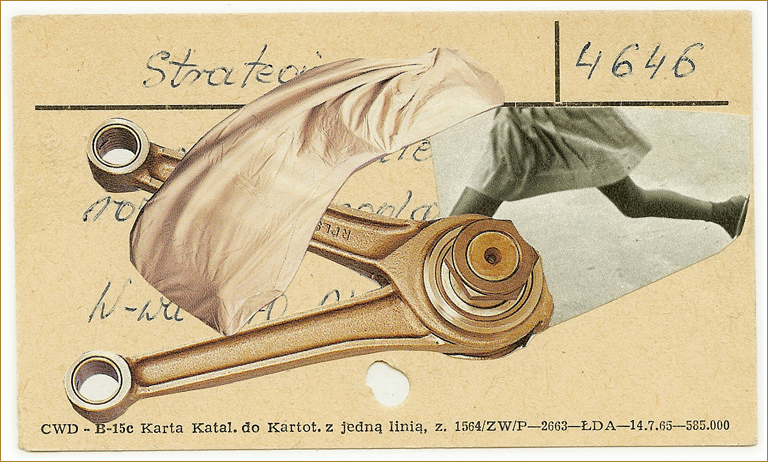
4646
collage collaboration
F Free + J Gall, date unknown
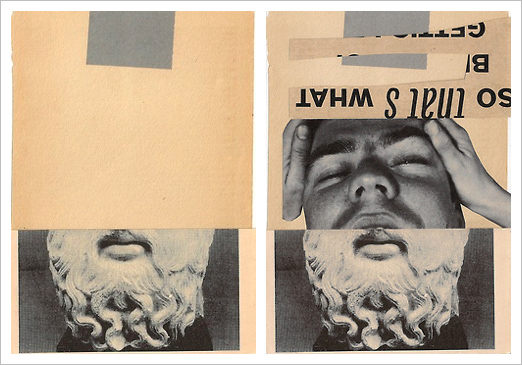
(start and finish, title unknown)
collage collaboration
start by A Bealy, finish by Z Collins, 2013
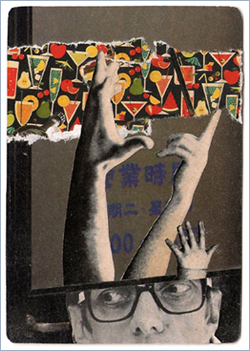
(title unknown)
altered playing card collaboration
start by G Stadler, finish by Z Collins, 2013
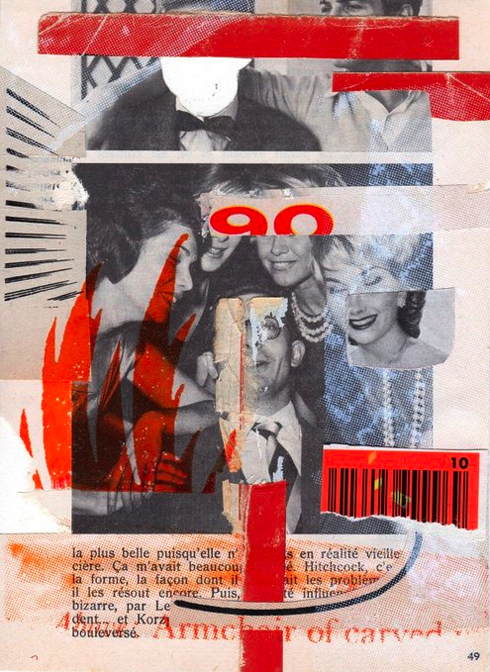
deception
collage collaboration
(©2013 Flore Kunst/Aaron Beebe)
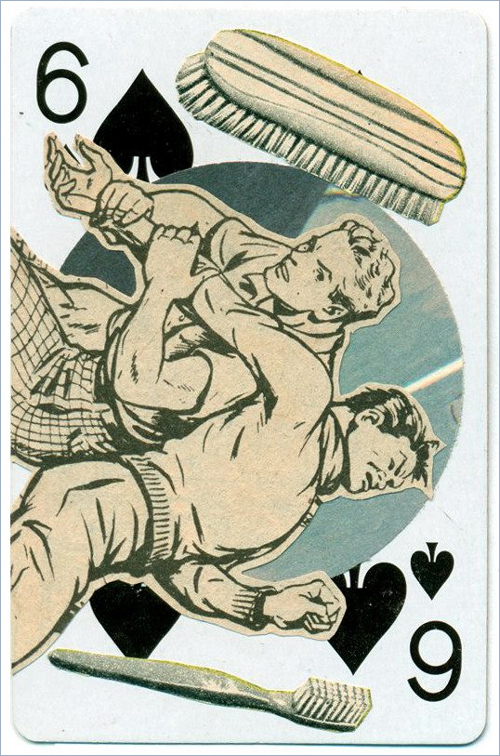
Cute commando 5
altered playing card collaboration
(©2013 Flore Kunst/Musta Fior)
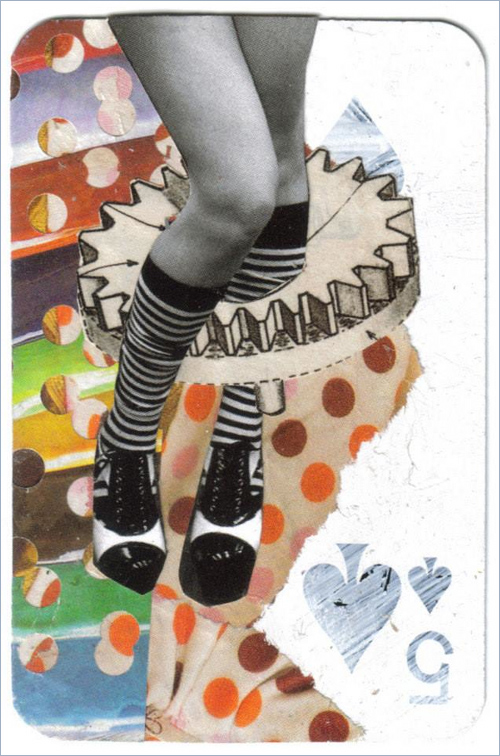
(title unknown)
altered playing card collaboration
M Fior + + L J Miller-Giera, 2013
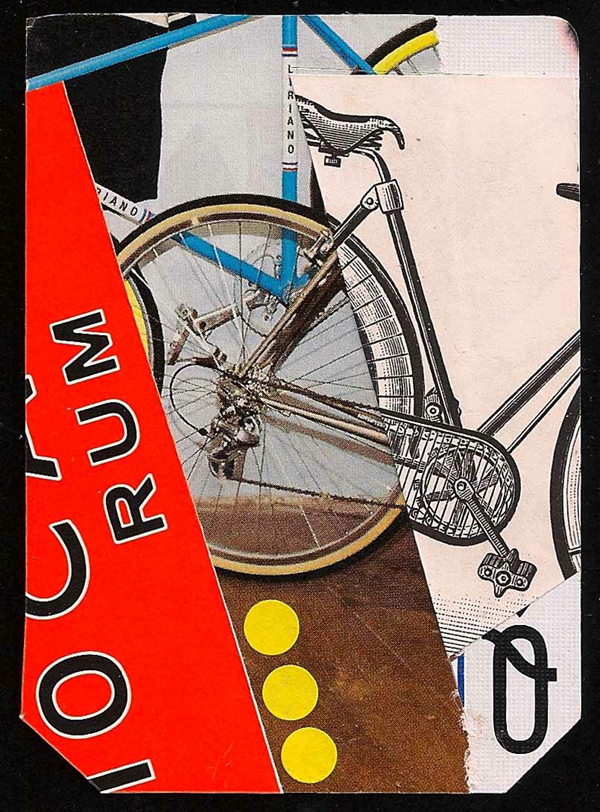
Ragbrai
altered playing card collaboration
T Tollefson + L J Miller-Giera, 2013
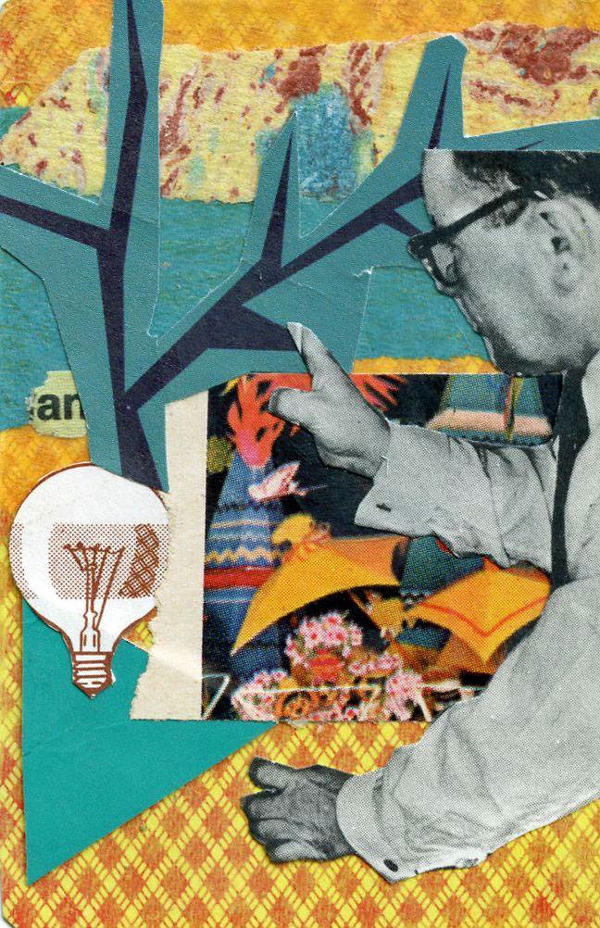
A Dreadful Idea
altered playing card collaboration
L T Holmes + C Chocron, 2013
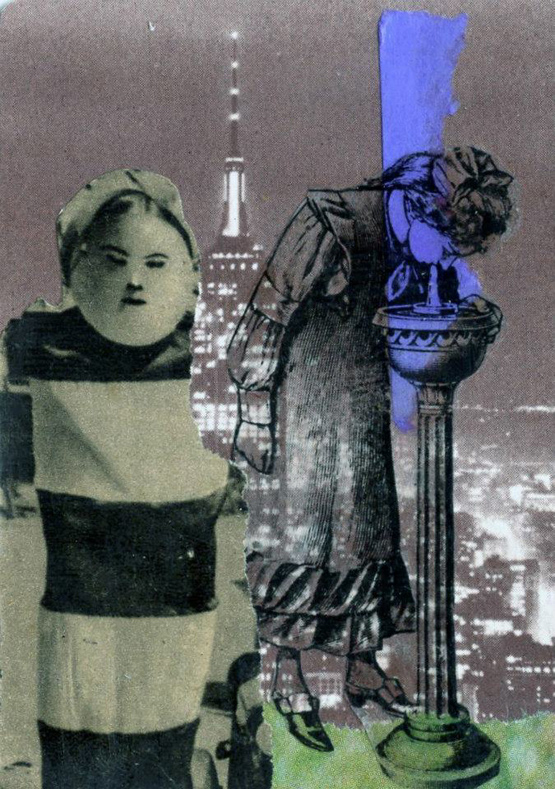
Bigger Than That
altered playing card collaboration
T R Flowers + L T Holmes, 2013
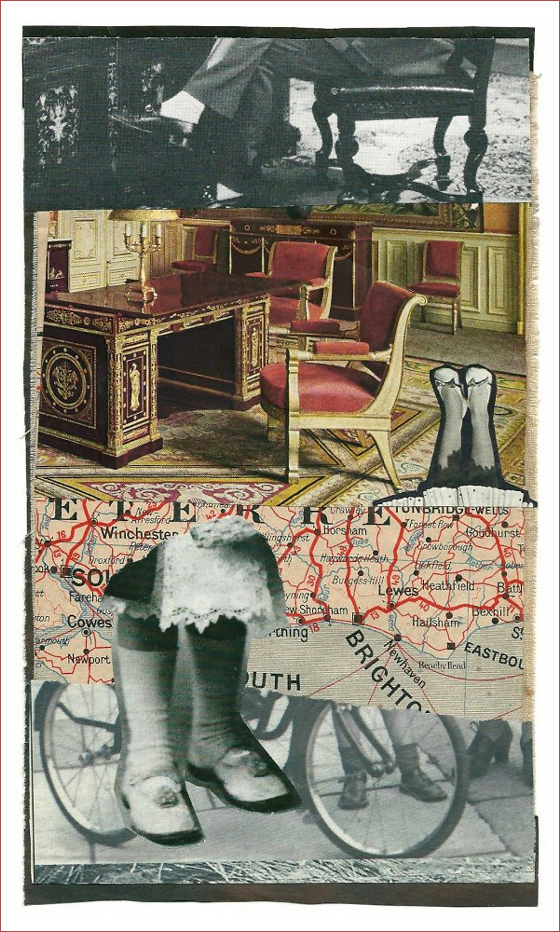
Channel Crossing
collage collaboration
start by J Ratouin-Lefèvre, finish by D Daughters, 2013
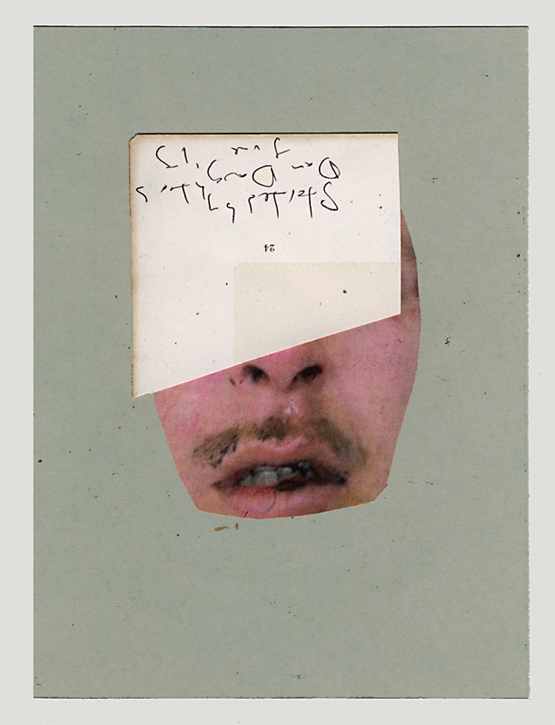
24.2
collage collaboration
D Daughters + I Reitemeyer, 2013
“But now I had these targets, and something grand in me wanted to make the two divergent threads — one of my artwork, one of my father — intertwine.”
— Laura Tringali Holmes
An increasingly engaging form of collaboration in collage is the coming together of a diverse group to explore the shared concept. In my last post we looked at an example in which the participants artistically exploited an image or thematic suggestion. Today we feature a remarkable project launched by L T Holmes that makes use of nearly identical vintage paper targets she has magnanimously provided to those taking part. Anyone reading this is urged to investigate her recent blog entry that offers an affecting backstory for the “Target Practice” initiative.
As this outstanding series takes shape, I cannot help but think of the Merz painting, “Hitler Gang,” and how KS (as usual) was just a bit ahead of us. If he thought a target was a cool collage ingredient nearly 70 years ago, I am, for one, quite content to continue digging the ground he broke. At least we are not fearing for our personal safety, thank heaven.
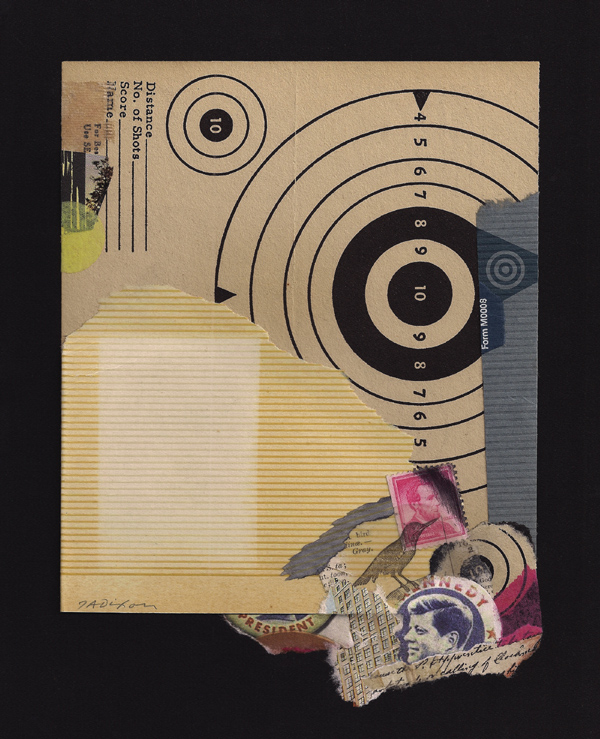
Friday, 1963
collage miniature by J A Dixon
vintage target from L T Holmes
6 x 7 inches
Purchase this artwork!
“I’m not an art reviewer, nor am I a psychiatrist, but I’ve often thought that Katrien De Blauwer’s special talent is her ability to speak to and for the collective unconscious of human emotions.”
— Laura Tringali Holmes
I regularly walk to a nearby college natatorium to swim laps. To my periodic astonishment, I will get an idea for a collage while staring at the bottom of a pool. My mind apparently stays cluttered with images of unused ingredients, and I suppose they demand to be composed, even when I am absent from my studio. As I travel to and from the destination, no scrap of litter escapes my attention (an occupational practice for many collage artists). Recently, when I discovered a wadded-up candy or bubble-gum wrapper that looked to me like a tiny, mashed bird (or was it a disfigured fleur-de-lis?), I knew I had to find a place for it, but I preferred that it not get lost in a “maximalist” design. So I encouraged myself to produce a collage with a minimal of elements. This is not my typical style, but I visually partake daily of numerous examples by peers who excel at this technique, if one can call it that. Thankfully, a bit of their approach may have rubbed off. Laura Tringali Holmes has taken it another step by accepting the challenge of creating a collage under the influence of a particular fellow artist. Laura often leans in the direction of maximalism, as do I, and her skillful homage to Katrien De Blauwer, a master of minimalism, is worth a visit to her site. As you may know, I am keen on the cross-fertilization of solid influences. I am not ashamed to say that both of these collage artists are among my favorite sources of rich visual pollen. Watch for a profile of each in future entries here.
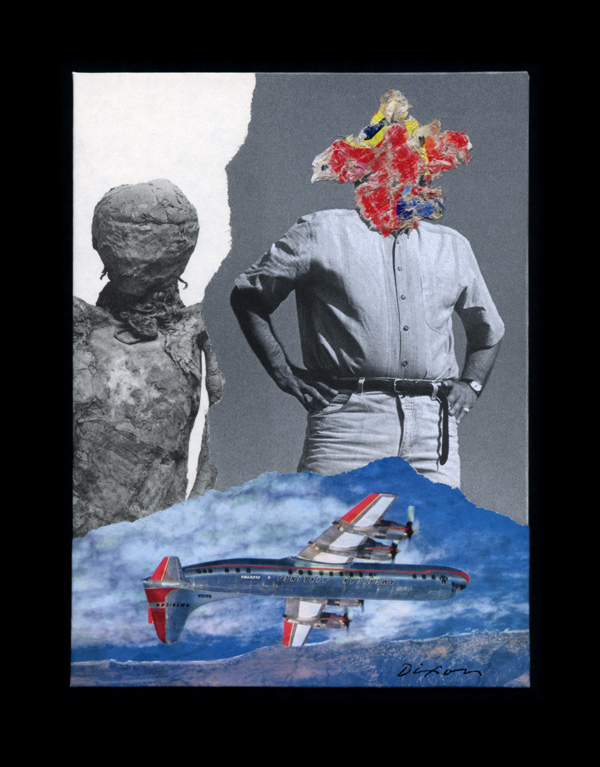
Fear of Failure
collage miniature by J A Dixon
4.75 x 6.375 inches
Purchase this artwork!
“My scraps rarely get thrown away and are often the main inspiration for getting started on a piece.”
— Fred Free
Slowly open your eyes to find yourself in an oddly familiar space that is part tool & die shop, Zen garden, and hi-fi showroom. Mom is there in her polka-dot apron, and somewhere in the next room, The Adventures of Jonny Quest has gone to commercial break. It may well be a surreal warp in quantum time, but, more than likely, it is the distinctive world of a Fred Free collage.
I cannot say if Fred Free uses his given name or a pseudonym, but it has never really mattered to me. He is one of the most actively intriguing artists working in the medium today. His superb compositions often look more minimalist than they actually are, offering delightful complexities that blend a clearly restrained interplay of vintage ingredients and street rubbish with moods that fluctuate between reverence for lost motifs, wry humor, and a mild disenchantment with 21st-century culture. While cohering to a recognizably defined vision, FF skillfully explores the spectrum of minimalism to maximalism in collage. In spite of a “yesteryear” oeuvre, he makes adept use of online platforms and social networks, while also effectively promoting visual cross-pollination at Tumblr by “endorsing” other artists with his Variety Showcase.
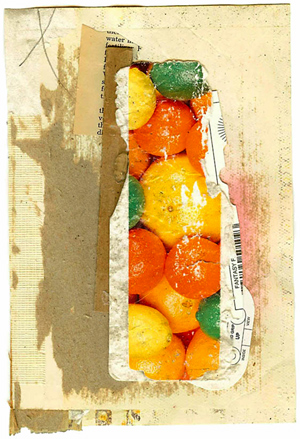
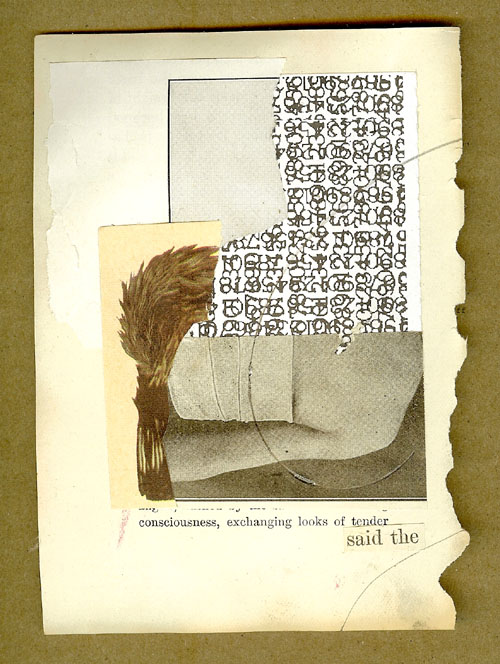
fantasy f
Fred Free, 2005
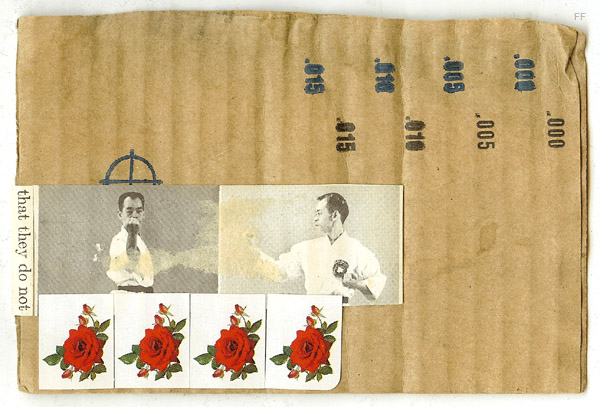
to pay
Fred Free, 2007
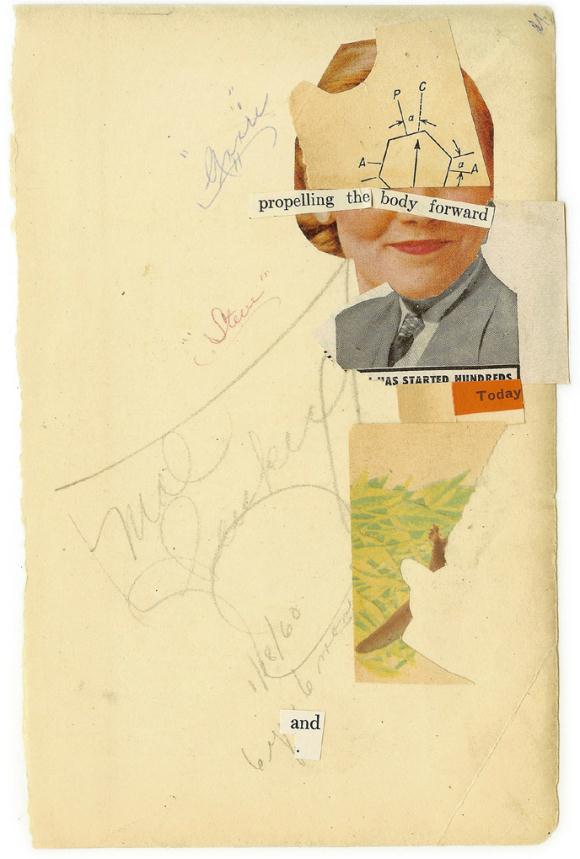
conceal
Fred Free, 2008
digging for the foundations on
Fred Free, 2011
activities
Fred Free, (date unknown)
7413
Fred Free, 2013
“Less is not necessarily more.”
— Milton Glaser
A profusion of collage artwork has recently come to my attention that makes use of only two or three elements. When this type of minimalist approach is successful, the result can be quite arresting to the eye and mind. More often than not, it looks uninteresting or unfinished to me. It may come as no surprise that I am more of a maximalist, preferring to build a layering of ingredients that transcends the intrinsic quality of the found material. I suppose that I have been more influenced by Schwitters than Cornell. Although there is nothing inherently unappealing to me about “sparsity,” admiring those who employ the methodology with skill, I have found myself pulled toward “density’ for the past few years. Some artists may think that if one hasn’t achieved a solution with fewer than a dozen parts, the essence of the piece has escaped. I appreciate that viewpoint, and respect those who consistently meet the challenge of limitation. For me, the working surface calls out for more, until a balance of “visual polyphony” takes form, and the dynamic aspects of color, shape, composition, and symbolic communication have resolved themselves as a distinctive, unified whole.

Fallen Body
collage artifact by J A Dixon
7.5 x 10.5 inches
available for purchase