Archive for the ‘Collage’ Category

Precursors have precursors

Tuesday, August 21st, 2018

“We do not analyze works of art because we want to imitate them or because we distrust them.”
— Paul Klee
 

The other day the world learned about an unpublished Ernest Hemingway short story. If there had not been a Mark Twain first, would literature know Hemingway’s writings at all? Could there have been an Isaac Asimov, Stan Lee, or Gene Wolfe without a Verne or Burroughs? The J.K. Rowling body of work without an Austen or Tolkien? Similarly, all of today’s rock music can be linked to direct influences — to bands such as Ramones, Led Zeppelin or the Beatles, which, of course, had their own precursors. Would jazz exist in its current form without the innovations of Armstrong and all those who inspired him? Imagine a contemporary musician saying, “I really haven’t paid attention to any music that was recorded before I started to play.” And yet, not infrequently, collage artists will boast that they have little use for art history (all the breakthroughs of bygone creators who dug the swimming pools in which they now frolic).

It is argued that modern artists were the first to decide that visual art would be about art, rather than subject matter. Nonsense. Art has always been about art, because it always has been structured on prior foundations. The idea that any artist can burst on the scene as an original is absurd. Nobody who comes out of early childhood with any level of awareness has not built an inventory of perceptions — countless images from the culture around them. Each of these individual influences involved creative activity based on another bank of stimuli, and so forth, back to the first proto-human who picked up a piece of charcoal to make interesting marks on a stone (and was probably knocked on the head by another who judged the action as irrelevant to group survival).

Perhaps I have belabored my point. Perhaps it is a point that anyone who reads this would not need emphasized in the first place. Isn’t it obvious to us that no art form is more about all these churning influences from untold visual decision makers — painters, printers, illustrators, photographers, designers — than the medium of collage itself? So, let us all continue to study the collage artworks of the explorers who came before us, to trace the direct lineage of their concepts and techniques, to recognize that valuable inheritance in the work of our peers, as well as in the composition taking shape on the surface before us, and then, fully informed, to push confidently into the second century of collage.
 

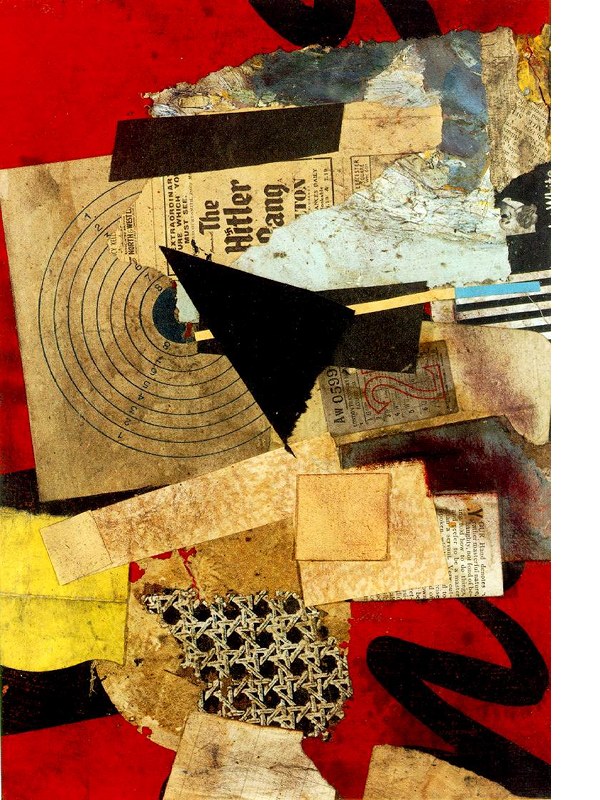
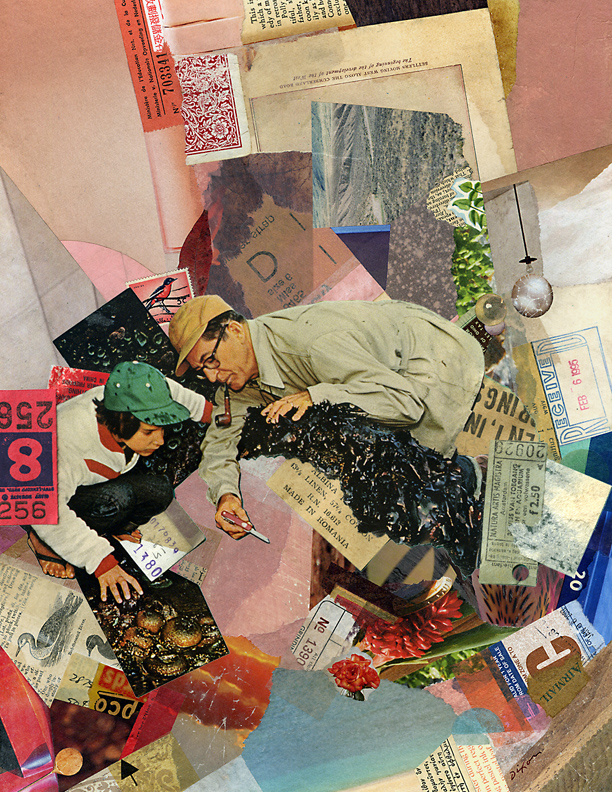
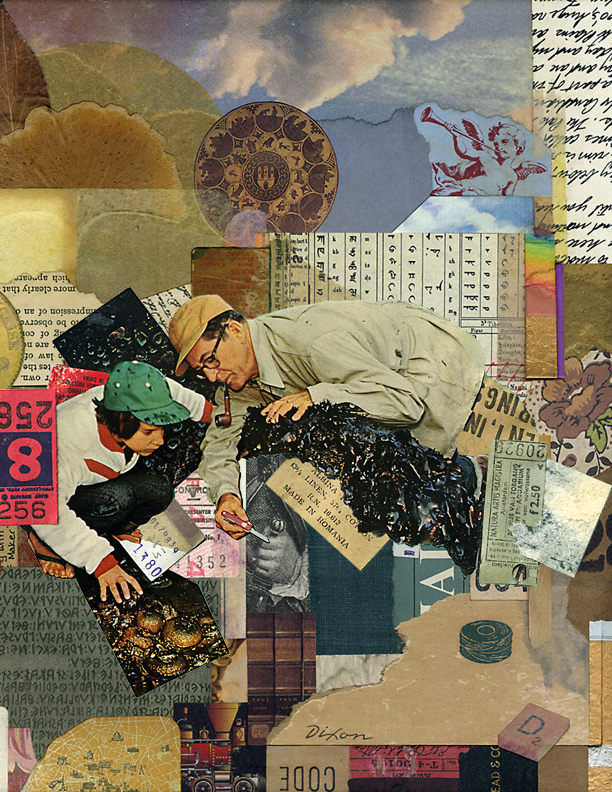
Tranquil Ode (to Merz) ~ collage homage by John Andrew Dixon ~ Danville, Kentucky ~ Kentucky Crafted Mixed Media Artist

Tranquil Ode (to Merz)
collage homage by J A Dixon
9.5 x 11.875 inches
 
Purchase this artwork.

All Are Dispossessed

Saturday, July 21st, 2018

 
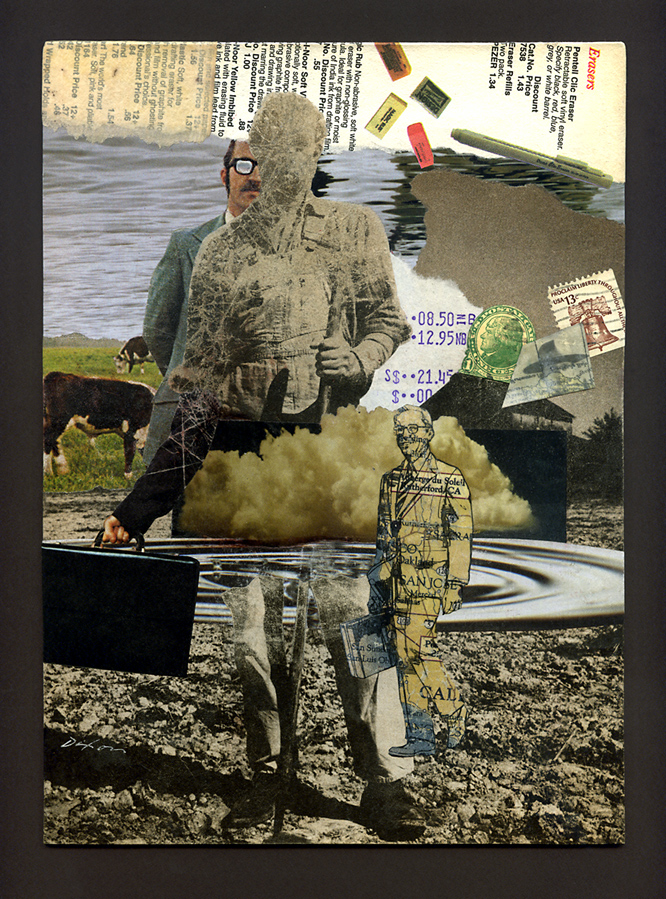
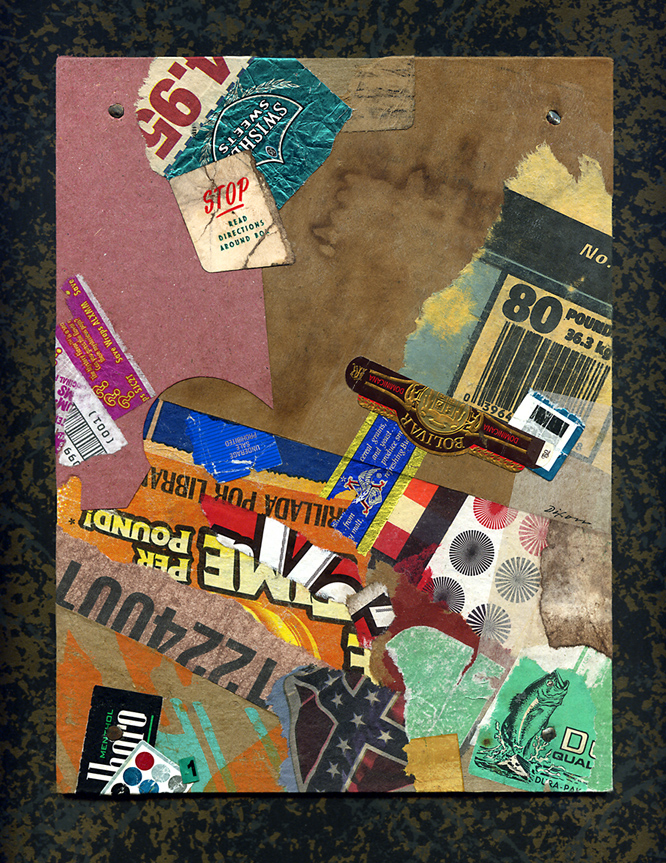
All Are Dispossessed ~ J A Dixon

All Are Dispossessed
collage miniature on book cover by J A Dixon
7 x 9 inches
 
Purchase this artwork.

Governor’s Derby Exhibit, 2018

Thursday, May 17th, 2018

My 3D collage from last summer, Star of Commonwealth, is currently on display as part of the Governor’s Derby Exhibit titled Reflections of the Commonwealth. It is an honor to have my artwork chosen and, reportedly, positioned near the door to the Governor’s offices. Yes, it’s a cool thing, if I do say so myself. The Kentucky-themed piece was created as part of the 225th birthday celebration for our Bluegrass State. I have yet to replenish my stash (hint, hint, wink, wink) that would enable me to do another similar artwork. The annual initiative coordinated by the Kentucky Arts Council is on view in Frankfort at the Capitol Rotunda through June 4th.
 
detail from ‘Star of Commonwealth’ ~ collage construction by John Andrew Dixon, Danville, Kentucky

Star of Commonwealth (detail)
mixed-media collage construction by J A Dixon
22 x 21 x 6 inches
available for purchase

The Governor’s Derby Celebration, 2018

Sunday, May 6th, 2018

“The Kentucky Derby is a time-honored tradition, and so, too, is our celebration of work by Kentucky artists.”
— Kentucky First Lady Glenna Bevin
 

It was a privilege to be among sixteen Kentucky artists selected to exhibit and sell their work during the Governor’s Derby Celebration yesterday on the lawn of the Old State Capitol in Frankfort. It was my first opportunity to participate in something limited to adjudicated members of the Kentucky Arts Council’s Kentucky Crafted program. The day started with such miserable weather that I wondered if anyone would show up, but I was surprised at how many came and enjoyed themselves at the rain-or-shine event. Kentuckians really do support everything with a connection to the Derby! In the spirit of all things horse, I created four collage improvisations with equine scrap. Please let me know what you think!


(clockwise from top)
Horseplay with Photo Finish – (buy now)
Horseplay with Pink Silks – (buy now)
Horseplay with Palomino Stare – (buy now)
Horseplay with Hunter Seat – (buy now)

four collage miniatures by J A Dixon
5.5 x 7.75 inches each

(below) the artist at the Old Capitol grounds
in Frankfort with his Kentucky Crafted display

 
JAD with a visitor to his Derby Celebration display at the Old Capitol grounds in Frankfort, Kentucky


Triple Play

Monday, April 30th, 2018

“Friendship is a manifestation of God’s love for you, expressed through your friends, who constitute the richest possessions a human being can have.”
— Paramhansa Yogananda
 

As I have probably emphasized too many times in this format, one of the most enjoyable forms of collage artwork is the personal montage, which begins with a sort of meditation on a particular friend or family member and evolves with an array of ingredients driven by a unique set of preferences and associations. Over the years, in many ways, it has provided me an instructive path to a fuller expression of the medium, and I shall never miss opportunities to continue such a rewarding practice.
 
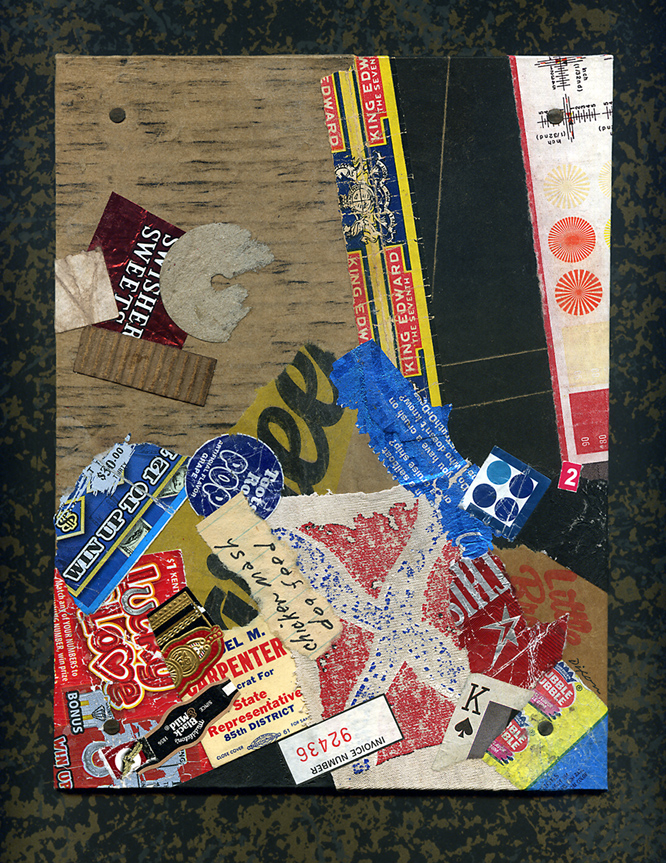
Triple Play ~ J A Dixon

Triple Play
collage miniature by J A Dixon
7.75 x 10.25 inches
collection of S P Vagedes

Mr. Kraler’s Distress

Monday, April 23rd, 2018

“I don’t think of all the misery, but of the beauty that still remains.”
— Anne Frank
 

It has been a distinct pleasure to perform in the company of some accomplished dramatic artists. I felt like a novice throughout our local production of The Diary of Anne Frank. There were times when the angst of my character, Mr. Kraler, spilled over into my off-stage being. So, naturally, I fell back on my own art and made a collage miniature as a creative catharsis. After a bit of sadness when the Secret Annex set was struck, I found myself eager to spend more time in the studio.
 
Mr. Kraler’s Distress ~ collage miniature by John Andrew Dixon ~ Danville, Kentucky

Mr. Kraler’s Distress
collage miniature by J A Dixon
8.25 x 9.375 inches
collection of the artist

Mouse in the House

Saturday, March 31st, 2018

“You can’t really make ideas, create ideas. You know, all ideas are the same. They just wander by. If your house has mice, you never know when they’re going to show up, or how, or in which room. and great ideas are the same. They’re like mice. Just a mouse. A mouse in the house. And you step on its tail and you go, ‘Hold it, buddy.’”
— Jerry Seinfeld
 

Ideas will suggest ingredients, but, as often as not, ingredients will spark ideas. Actually, I prefer the latter. In discussing the groundbreaking Merz pictures of Schwitters, curator Isabel Schulz asserts that his materials “surrender their original function … but not all semantic meaning.” Those meanings can generate layers of additional meaning when ingredients combine in synergy. Before long, if the exterminator is not on site, the house is happily full of mice.
 
Mouse in the House ~ collage miniature by John Andrew Dixon ~ Danville, Kentucky ~ Kentucky Crafted Mixed Media Artist

Mouse in the House
collage miniature by J A Dixon
4.75 x 5.5 inches
 
Purchase this artwork.

The “Collagesmith” as Artisan

Saturday, March 24th, 2018

“Even in the absence of inspiration and talent, I think that through sheer craft you can actually create extremely good work, all the time, reliably. Great work is something else. I think for great work you also need a lot of luck. You can only aspire to really good work. The great work either happens or it doesn’t.”
— Christoph Niemann
 

Sloppy collage artwork has never held much appeal for me. Individuals might define “sloppy” differently, so I’ll rephrase that. I have always found well-crafted collage artwork to be the most appealing. In practice, I have aspired to the highest level of artisanship to which I am capable. According to my peculiar notions, the very nature of collage as a “mash-up” of visual ingredients suggests that one resist all the inherent temptations to condone careless techniques. To do anything less is a disservice to the medium, and strikes me as being a bit lazy.

I have been at this long enough to contrast current activity with a study of my “early” work. I perceive it now as more crisp and aligned with my long stint as a designer and illustrator. I remain proud of craftsmanship that continues to challenge my present hand skills. Like everyone who sticks around, I have moved relentlessly toward a period of life when manual dexterity and vision are unlikely to improve. At any rate, clean, precise work is more about attitude and personal commitment than it is about facility. Lately, on the other hand, I have sought a more organic, less contrived look — the impression that a piece is naturally the way it should be, rather than appear too obviously composed and belabored. As I work, I try not to permit the goal of a somewhat softer and cohesive whole to suggest a relaxation of craft. In fact, I have gradually introduced steps in the process that demand extra time and attention: sanding the reverse side of ingredients for adhesive-saturated compression and eliminating white edges on printed scrap to enhance a seamless effect. I combine that with ample burnishing and some hair-dryer prep before curing time under weight, followed by multiple light-touch coats of matte sealant. I would rather be thinking about practical methodology or a musical playlist than what is literally evolving on the surface before me, allowing that to be as intuitive as possible.

And perhaps (just maybe), Lady Luck will smile.
 
Cosmic Crucifixion ~ J A Dixon

Cosmic Crucifixion
mixed-media collage by J A Dixon
2006, 16 x 16 inches
available for purchase
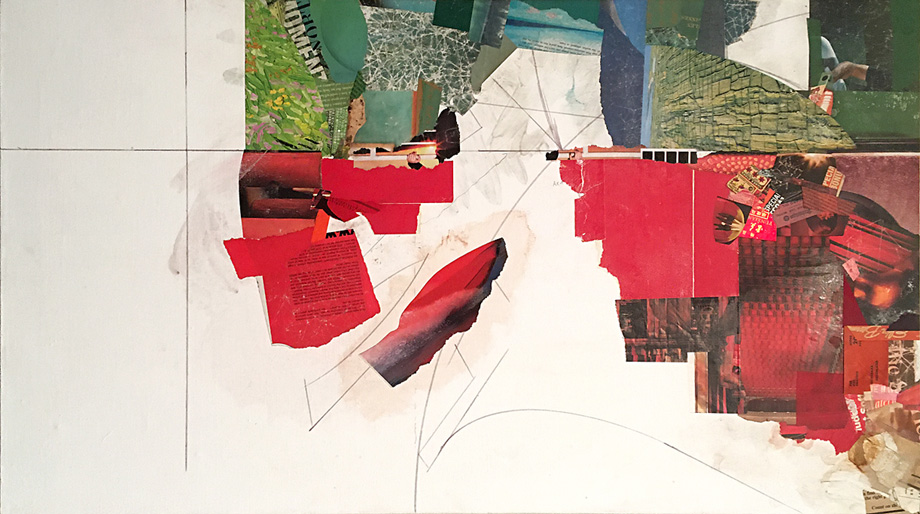
Abstraction in Collage

Saturday, March 10th, 2018

“In the ’20s, dadaist Kurt Schwitters collected bits of detritus such as cigar bands and bus tickets and used them in collages. They were shocking then but with the passage of time have taken on the aura of classics: vibrantly colored and harmonious arrangements of abstract forms and only incidentally assemblages of junk.”
— John Ashbery
 

About a hundred years ago, a handful of Europeans had set out to invent what we now know as the medium of collage. Nearly all of them were painters. From the beginning, collage was rooted in modern art concepts that were emerging at the same time — the fundamentals of abstraction. Thus, the evolution of abstraction and collage in the 20th century are entwined, and remain so in a burst of contemporary activity in this post-centennial period. Next year will mark a full century of Merz. Artists working in collage abstraction carry the “creative code” of Kurt Schwitters and his seminal innovations. But, allow me to pause here and point out something that has become increasingly obvious: conventional art history was woefully male centered. Intentionally or not, the discipline would downplay or ignore many exceptional women artists, and that includes collage antecedents which were largely the domain of females, especially in the domestic or folk arts. For example, an interesting feature at moowon.com highlights the forgotten art of Chinese textile collage. from his Cockatoo Series ~ an homage to Juan Gris by J CornellPicasso lifted visual ideas from tribal cultures. Cornell borrowed techniques tied directly to Victorian crafts. We understand that now. Modern art did not spring fully formed from the brow of Zeus like the armored goddess Athena. Fast forward to 2018. Many of the most accomplished and widely recognized collage artists of today are women. And the best part is that we know about them.

Melinda Tidwell is one of the dedicated abstractionists in collage that I enjoy following. She has a solid and very articulate designer “upstairs” guiding each decision, but her regard for the unexpected is a strong part of her intuition. Last summer, she published a two-part discussion of “order versus disorder” at her blogsite. It features abstractions by Lance Letscher and is well worth checking out.

Please indulge me as I share examples of collage abstraction from artists who continue to favorably capture my eye. Some of them range into mixed media in a way that remains very much collage. Others are strictly “painting with paper.”

Merz is alive and well in the 21st century, my friends.
 

(title unknown)
abstract collage by L Letscher

(title unknown)
abstract collage by M Tidwell

11zc18
abstract collage by Z Collins

Elysburg IV
abstract collage by C Chapman

Ellington
abstract collage by D McKenna

Osmosis 3
abstract collage by C Emeleus

Antoinette
abstract collage by W Strempler

Music
abstract collage by S Kraft

from her series, BALANCE
abstract collage by S A Herman

Day 18 of 40
abstract collage by C Neubauer

Red Cottage — from her series, SENSE OF PLACE
abstract collage by P A Turner

(title unknown)
abstract collage by J C Martin

Reap ~ G Cooper

Reap
abstract collage by G Cooper

Cognitives and Conclusions
abstract collage by S Ringler

Dynamic Stability ~ J A Dixon

Dynamic Stability
abstract collage by J A Dixon
 
Purchase this artwork.

Haus of Categories

Monday, January 22nd, 2018

“As an art of its time, collage art — its imagery, its techniques, its attitude — speaks to our confrontation with a fractured multifarious image of the world in an age of information overload. The activities of sifting, sorting, organizing and prioritizing has become the basis and the goal of artistic activity in this hummingbird era of ADHD”
— Cecil Touchon

“A light bulb in the socket is worth two in the pocket.”
— Bill Wolf
 

Categorization is integral to the practice of collage. It is part and parcel of the ongoing acquisition, storage, and retrieval of compositional ingredients. I doubt if there is a dedicated collage artist out there who does not possess a particular method of processing the studio material that results in a work of art. We do relish the hunt, and, to some degree, we enjoy accumulation for its own sake, but, more than that, we like to be able to find our stuff when we want to use it.

Not long ago, Allan Bealy brought an article about the library of Vito Acconci to my attention. Like many artists, I devised a method of classification early in life and refined it over the years, and I found benefits in developing a “morgue” according to my own “creative code” rather than adopting a predetermined system. In whatever way we catalog it, we must be able to access the ingredients we need without impeding a flow of intuitive spontaneity. My studio repository began as a few “youthful” files of tear sheets that simply caught my eye as catalytic images. With the demands of professionalism, it grew into an illustrator’s resource that spared me many a trip to the public library. It mushroomed over time and finally evolved into a collage artist’s stash, with many subdivisions (such as antiquity, language, creatures, environments, attire, icons, themes, botanicals, patterns, vintage, surreal, and cosmic).

Individualized categories also help me to organize self-perceptions of what I make, even if these “sets” or “series” make limited sense to others. Although crafting personal greeting cards continues at a significantly reduced rate, I can now look back on the life-long activity as a key practice in my transition from applied to fine arts. It has had a strong influence on how I codify work that typically begins with intuition and ultimately ends with inclusion within some sort of idiosyncratic classification.

Please examine seven images recently created for my outgoing cards (with their designated categories). Some are considered hybrids (for lack of a better term). Those with an interest can find more at The Collage Miniaturist with this link and its associated archive.

Long live John’s Haus of Cards!

collage greeting card by John’s Haus of Cards!

BodoMason
collage greeting card by J A Dixon
series Omega/Pi hybrid, collection of W Bates

collage greeting card by John’s Haus of Cards!

Eagle Nest Goddess
collage greeting card by J A Dixon
series Pi, collection of J Hellyer

collage greeting card by John’s Haus of Cards!

Existunt
collage greeting card by J A Dixon
series Omega, collection of R W Breidenbach

collage greeting card by John’s Haus of Cards!

G is for Gray
collage greeting card by J A Dixon
series Omega/Pi hybrid, collection of G Zeitz

collage greeting card by John’s Haus of Cards!

Nurse Saw It
collage greeting card by J A Dixon
series Pi, collection of R K Hower

collage greeting card by John’s Haus of Cards!

IcogNeato
collage greeting card by J A Dixon
series Omega, collection of J M Hoover

collage greeting card by John’s Haus of Cards!

O Lovely Perch
collage greeting card by J A Dixon
series Omega, collection of W W Barefoot

Wetland

Monday, January 15th, 2018

“When you take risks you learn that there will be times when you succeed and there will be times when you fail, and both are equally important.”
— Ellen DeGeneres
 

Although it was created in the studio, my new collage landscape titled ‘Wetland’ benefits from a summer of plein-air activity. My “painting in papers” outside has opened a rewarding area of investigation for my work as a collage artist. I’m pleased to share this piece with the art-viewing community at my first invitational exhibition of the year, the annual New Year New Art show at our Community Arts Center, just a biscuit toss from my home base in downtown Danville, Kentucky. This event has been a fortifying tradition for regional artists, because we can complete our year of work at a risk-taking level, and still know that the result will get a prominent public display. An artist working outside a metropolitan center could not ask for greater support from a local institution.

Based on an excellent photograph by a longtime pal, this artwork was created as an entry for a contemporary landscape show, but the juror rejected it for unknown reasons. I kept it handy for a pair of upcoming open studio events (my participation in the Central Kentucky ARTTOUR and Gallery Hop Stop). Plenty of praise ensued, but nobody took it home, so I decided to make additional refinements, leading up to the deadline for the January exhibition. A full makeover was unnecessary, as the in-process image above indicates. However, I was not entirely pleased with the vegetation at the waterline, above the dark shadow that spans the composition. In this case, less was not more. Additional ‘foliage’ was needed. I also thought that the lower right corner was too abstract. The desired sense of realism would profit from a more detailed foreground. Late-season ironweed, a favorite of mine, seemed a suitable choice. That led intuitively to a few closing decisions in the sky reflection and distant terrain. stash of premium paper samplesNearly all of the ingredients were infused with wheat paste and pressed firmly onto the evolving surface with polymer gel. After thorough drying, selected areas were lightly sanded and the total surface evenly daubed with a flat sealant.

It is very satisfying to work with a palette of elegant papers, and I am fortunate to have them. Some of you may remember (especially those with a background connected in some way to the graphic arts) the pre-internet days of a more diversified paper industry. Numerous mills and distributors slugged it out in a highly competitive market. Inkjet printing was still on the horizon and multi-color offset printing was expensive. Printing on colored stock was a cost-effective way to get more color into published material. Paper producers went out of their way to demonstrate creative ways to use colored paper and many of us who specified paper for printing projects were lavished with promotional samples. Decades later, I still have a stash from that era, and I rely on it now for my plein-air miniatures and studio landscapes. A piece such as ‘Wetland’ puts this hoard to good use; it would not look the same with scrapbook or construction paper. The richness of premium papers manufactured for fine printing were accented with fragments of dulled foil, tissue, scraps of found packaging, and fragments of typography. After all, it’s meant to be a collage artwork!

The opening reception for NYNA is this Friday evening, 5 to 8 pm. Perhaps I shall see you there to discuss ‘Wetland’ in person.
 
Wetland ~ collage landscape by John Andrew Dixon, Danville, Kentucky

Wetland
collage landscape by J A Dixon
21.25 x 19.25 inches
on structured panel, framed

•  S O L D