Archive for the ‘Artists/Collage’ Category

Not So Big

Monday, August 3rd, 2015

“Shadow boxes become poetic theater or settings wherein are metamorphosed the elements of a childhood pastime.”
— Joseph Cornell
 

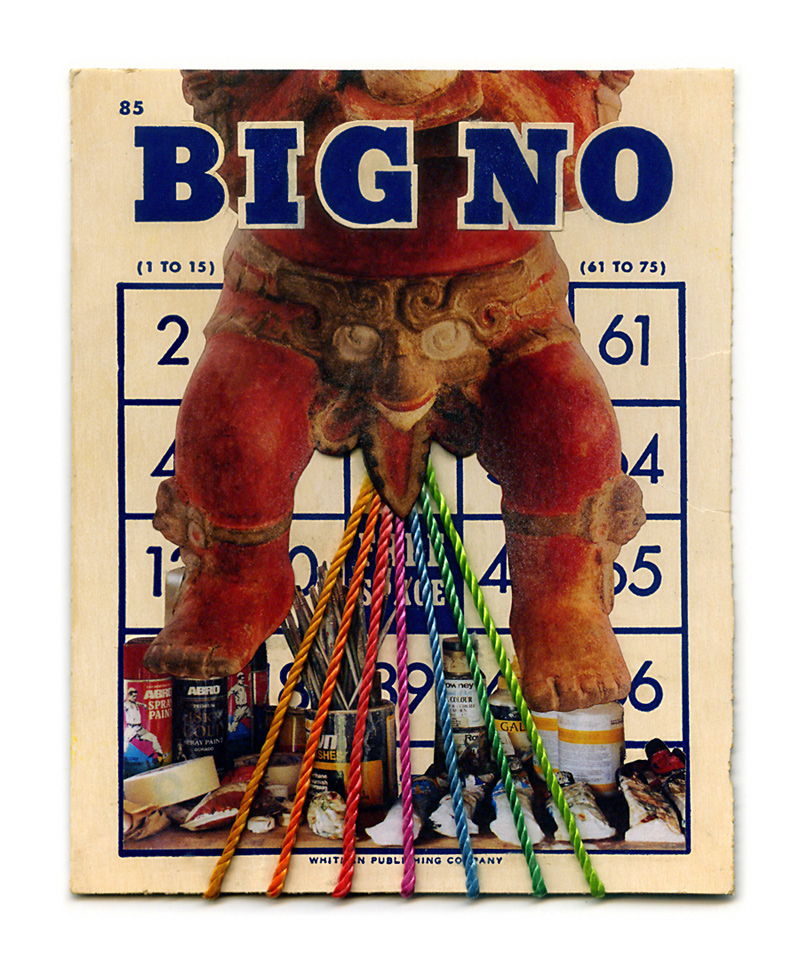
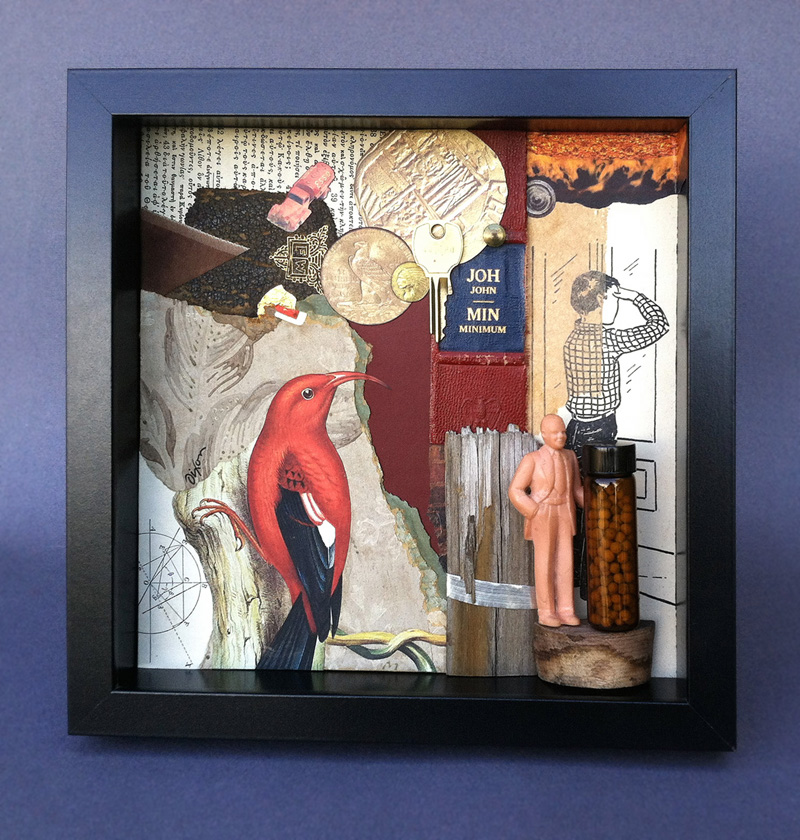
The creations of Joseph Cornell are small, and remained so throughout his unusual life as an artist, even as many of his contemporaries responded to the fashion of producing ever larger works. For me, a salute to this influential American seemed like the fitting approach when I decided to enter notBIG(3), an annual juried exhibition devoted to small art. I am pleased to have had a piece accepted to this show, which hangs from 8/11 to 9/11 at Lexington’s M S Rezny Studio/Gallery.

The “poetic theater” of little shadow boxes is not an isolated medium in collage/assemblage. To consider one’s activity in this comprehensive oeuvre as anything but an homage to Cornell would be an act of mild self-delusion. His singular, enduring presence overarching the genre must be acknowledged. There was a concern that my taking this approach with the notBIG(3) entry might appear to the juror as too derivative, but I pushed ahead with the “sincere flattery” of my plan. I had failed to crack this competition in its previous calls to artists, and I had hopes that the third time would be a charm for me. In addition, I wanted to assemble a range of ingredients outside my norm, including metal, wood, organic material, glass vials, and vinyl dimestore figures.

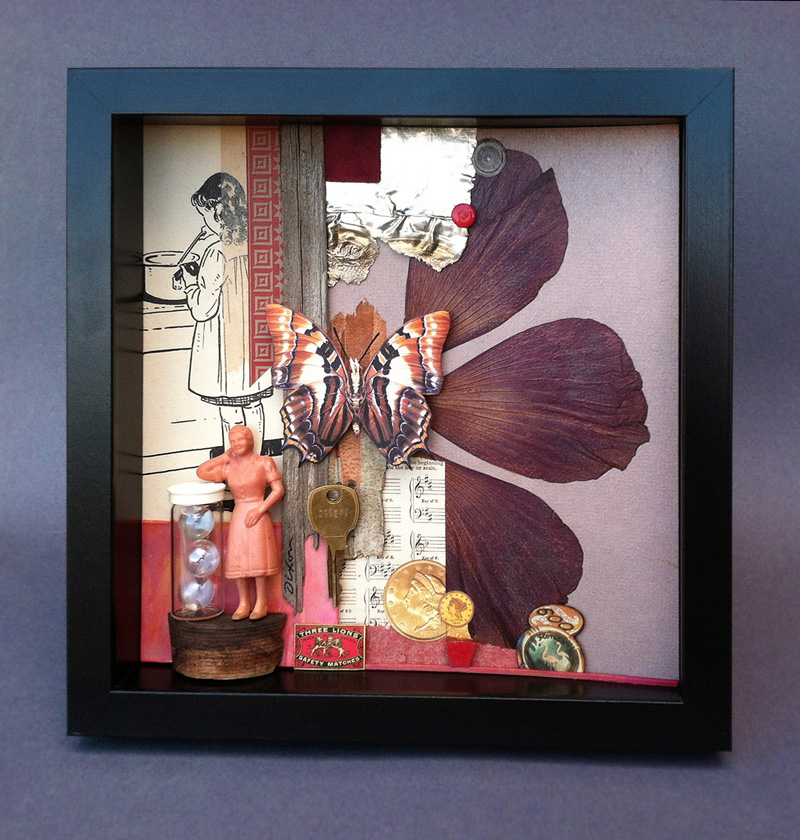
I created and entered two works as a pair — Histopia and Hertopia — a dual allusion to Utopia Parkway and its significance to the art history of the 20th century. It was not possible to enter both as a combined entry because the dimensions would have exceeded the size limitation of 12 x 12 inches. Only the first shadow box was selected. I was delighted to learn of my getting in the show, but it came with a small serving of disappointment, knowing that the gender balance of my overall idea would be lost with the “boy scene” presented to viewers by itself. It is something I can accept. Out of 380 works submitted, the 45 artists who make up the exhibition have a single artwork included. At any rate, this is what blogsites are for. Both pieces can be viewed together, and I have the opportunity to explain the whole thing to anyone kind enough to read this far. I also anticipate that many of you will be able to visit what appears to be shaping up as a strong exhibition. The opening reception is Friday evening, August 14th, 5 to 8 pm.
 

Histopia ~ collage/assemblage in shadow box frame by John Andrew Dixon

Histopia
collage/assemblage in shadow-box frame by J A Dixon
10 x 10 x 1.75 inches, available for purchase

Hertopia ~ collage/assemblage in shadow box frame by John Andrew Dixon

Hertopia
collage/assemblage in shadow-box frame by J A Dixon
10 x 10 x 1.75 inches, available for purchase

All Things Collage: Year Three

Monday, July 27th, 2015

Jamie Wyeth said, “You have to love a medium to work in it.” I have developed such an enthusiasm for collage that I also have been writing about it for three years at this blogsite. Miniatures are at the heart of what I enjoy doing most. The remarks accumulating here center on my recognition that what I can bring to the practice evolves from an ongoing investigation of the small format. When I do create larger pieces, I would hope that they are informed by my study of tiny, intimate visual relationships. Increasingly, I am embedding the miniature collage into these sized-up artworks, exploring the contrasts of scale and persuading the observer to step in very close — to interact with the ingredients at the artist’s viewing distance.

Over the coming year, I plan to profile other collage artists who exalt the small, and to highlight some of the “categories” of collage that recently have sparked my interest.

What’s in store?
• Merz-meisters: the dedicated aestheticians
• Endurance of the surreal face in collage
• The exemplars of erotic minimalism
• Die-hard collaborators gone wild
And, of course, much more . . .

When I used to put too much on my plate at meal time, my “Mombo” would say, “Your eyes are bigger than your stomach.” Perhaps there is an analogy to piling up my wish list for future entries, and I probably have made a few promises to readers that so far I have not kept. I shall do my best, and remind myself during year four that it’s not what one says about art that matters most.
 

Nancy Gene Armstrong
Who else recalls that nostalgia can be so surreal?

Laura Tringali Holmes
A diversity of approach — her singular sensibility.

Allan Bealy
This provocative soloist is a relentless collaborator.

Katrien De Blauwer
If you ever figure out how she does it, let me know.

Matthew Rose
He seriously does not take himself seriously. Seriously.

to Chicago from Kentucky . . .

Monday, July 20th, 2015

“When the end of the world comes, I want to be in Kentucky because it’s always 20 years behind the times.”
— commonly attributed to Mark Twain

One of the best things about Kentucky is that everyone here is where they want to be, except for the usual quantity of young folks looking to escape to some other place where the grass is greener, but doesn’t everybody know that Kentucky has the greenest grass, even if somebody long ago decided that we’re supposed to call it blue?

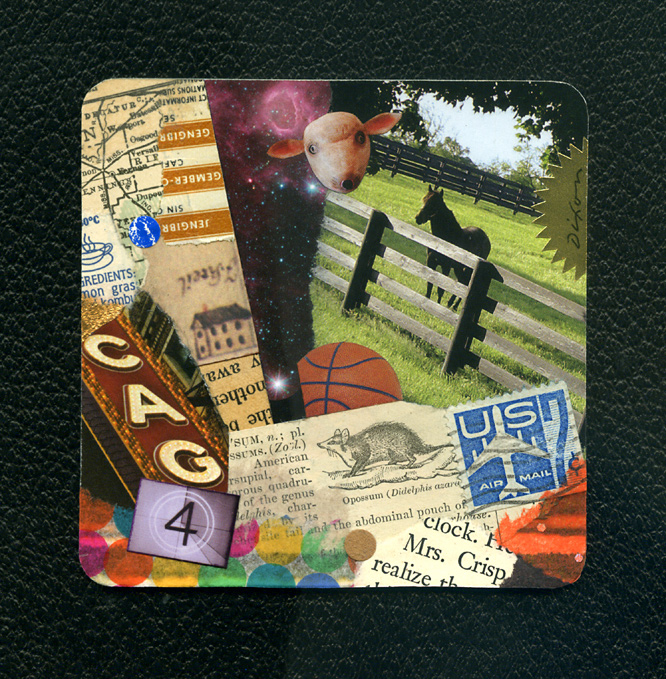
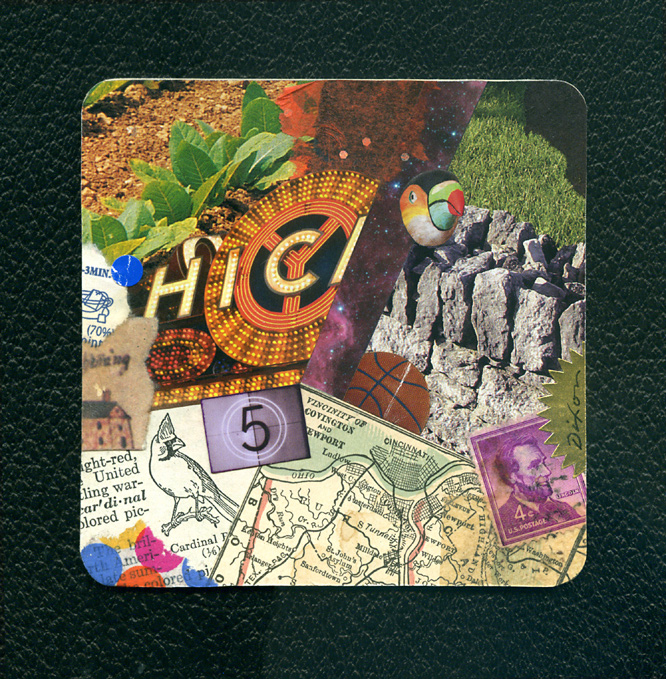
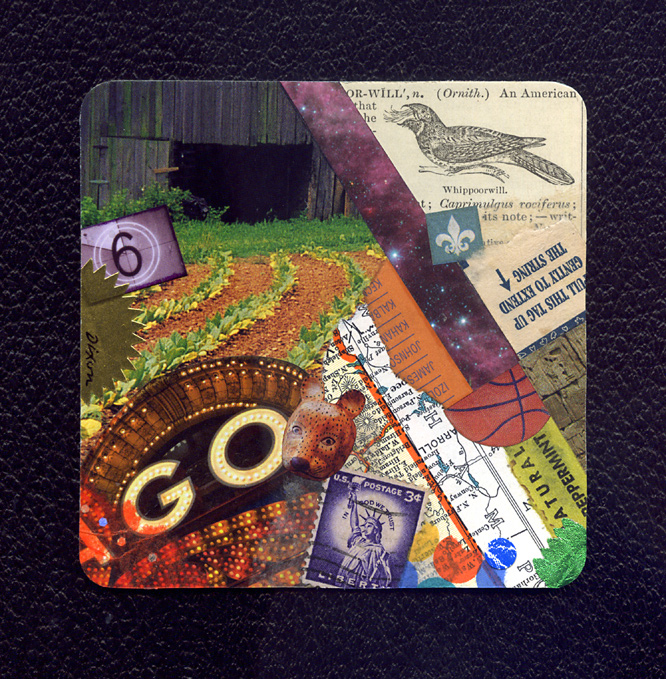
I like to tip my hat to Ted Tollefson for turning me on to the new enjoyment of creating collage miniatures on beverage coasters. When I discovered a stash of Pepsi’s Super Bowl XLVI coasters, I knew I had to put some of them to good use. Not long after, one of my best pals commissioned a triplet of versions as gifts to friends in Chicago, and the small series featured below was the result.
 

Dixon_KY(4)

KY(4)
collage on Super Bowl XLVI coaster by J A Dixon
4 x 4 inches, collection of L Gels

Dixon_KY(5)

KY(5)
collage on Super Bowl XLVI coaster by J A Dixon
4 x 4 inches, collection of J Straus

Dixon_KY(6)

KY(6)
collage on Super Bowl XLVI coaster by J A Dixon
4 x 4 inches, collection of G K Straus

selecting details . .

Thursday, July 16th, 2015

“We do have repeated patterns that arise, in differing ways for different people, every time we create. But how do you get excited by the downturns and turn this into a positive experience?”
— Lyne Marshall

After I finish a larger artwork and its temporary or permanent disposition is settled, I have this tendency to focus on the perceived flaws, the missed opportunities, or that appealing ingredient “left on the cutting room floor.” Diverting my observation to the areas that I prefer, I crop into the design, looking for interesting sub-compositions. I tell myself that I should create spin-off prints or note cards based of a series of details — it must be my built-in bias toward the miniature. In almost every case, I put market-driven notions aside and begin something new. Objective scrutiny usually becomes a catalyst to the creative process. The cycle continues.
 

detail from Selective Fusion ~ John Andrew Dixon


detail from Selective Fusion ~ John Andrew Dixon

two details from Selective Fusion
collage on structured panel by J A Dixon

Selective Fusion

Monday, July 13th, 2015

“Schwitters subjected his bits of flotsam to an organizing principle resembling the vertical scaffolding of Analytic Cubism, thus transforming the diverse components into formal elements.”
— Nancy Spector

Color and composition may be the most common denominators of all visual art. Collage, by its nature, relies on a combination of separate, often disparate elements, and those two fundamentals generally play a more prominent role in the finished effect, but that does not make collage essentially a category of abstraction. A minimalist concept built on a provocative juxtaposition or image insertion can be a predominantly figurative or representational approach, even if symbolic or surreal ideas are introduced. On the other hand, collage artworks rooted in the seminal innovations of Kurt Schwitters pay primary tribute to a tradition of abstraction now more than a century old. Of course, the medium had other early pioneers, but it is difficult to imagine the trajectory that collage might have taken without his towering influence. Personally, I have no qualms about continuing to respectfully mine the rich vein of creative ore he helped to expose. Whether it proves to be a nonrenewable resource has yet to be shown.
 

Selective Fusion ~ John Andrew Dixon, collage artist

Selective Fusion
collage on structured panel by J A Dixon
13.375 x 11.75 inches
not for sale

Haus of Cards!

Monday, July 6th, 2015

“Youth is happy because it has the ability to see beauty. Anyone who keeps the ability to see beauty never grows old.”
— Franz Kafka

How can one ever exhaust the potential of combining creative spontaneity with affection for another on a special occasion? Wishing another well is a powerful catalyst for plucking a bit of beauty from material that would otherwise be trashed or recycled. Why not re-purpose it? One less store-bought greeting card is no tragedy.
 

collage greeting card by John’s Haus of Cards!

collage greeting card by J A Dixon
collection of L E Dixon

collage greeting card by John’s Haus of Cards!

collage greeting card by J A Dixon
collection of F Breidenbach

collage greeting card by John’s Haus of Cards!

collage greeting card by J A Dixon
collection of C Dixon

collage greeting card by John’s Haus of Cards!

collage greeting card by J A Dixon
collection of K Sluga

collage greeting card by John’s Haus of Cards!

collage greeting card by J A Dixon
collection of J L Dixon

another “trip collage” exercise

Monday, June 29th, 2015

“The absence of limitations is the enemy of art.”
– Orson Welles

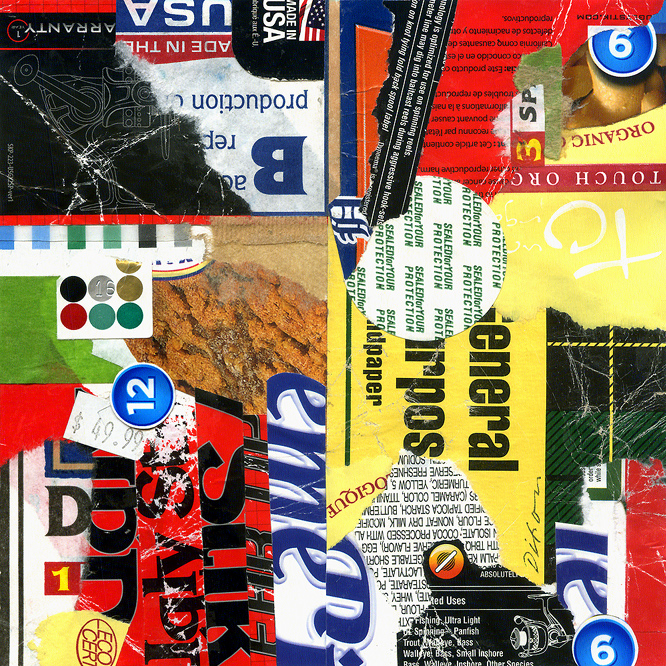
Here is another journal experiment based on ingredient constraints. It has a more abstract emphasis, in contrast to the previous example. There are numerous ways to impose this instructive limitation. Some collage artists have been known to create a composition restricted to the random scraps found on their work surface. Others make it into collaborative play, swapping an envelope of ingredients within which to work. A speed requirement will reveal more aspects of creative decision making and give rise to other insights. Paradoxically, there is no limit to how limitations can unlock the freedom of artistic expression.
 

journal experiment ~ John Andrew Dixon

results of a “trip collage” exercise
journal experiment by J A Dixon
7.25 x 5.25 inches

It’s a trip collage, man . . .

Monday, June 22nd, 2015

“It is the limitation of means that determines style, gives rise to new forms and makes creativity possible.”
– Georges Braque

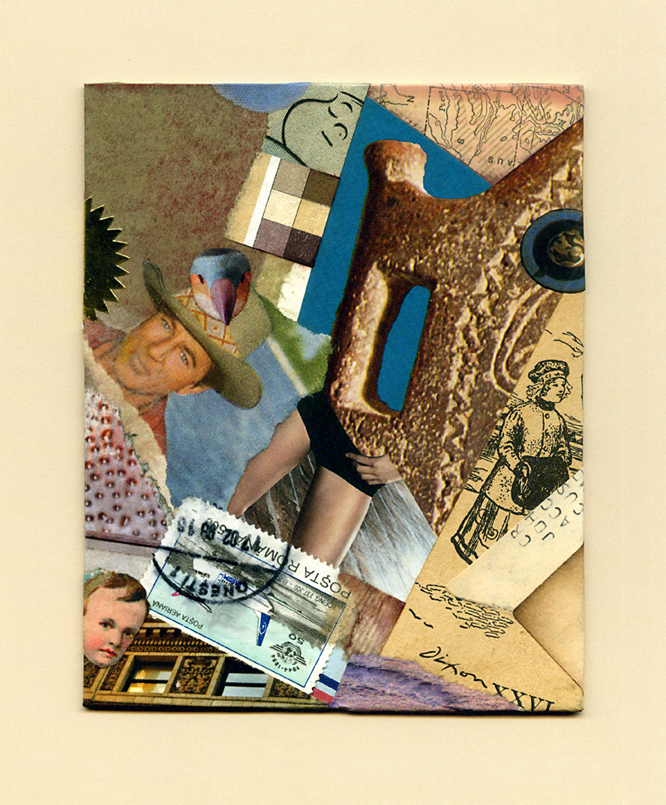
From the first decision an artist makes when confronting a blank format, available options are eliminated. As contradictory as it may sound, writers, designers, musicians, dancers, visual artists — all of us find fertile ground in restriction. Working within limitations, self-imposed or otherwise, is always at the heart of the creative process. One of my preferred journal experiments is a variation I call the “trip collage.” Mind you, this has absolutely nothing to do with psychotropic escapades. However, I do periodically “expand my consciousness” of the medium with an exercise based on limited ingredients. When on holiday or outside the studio, I produce a small collage only with the elements immediately available at hand. Litter, junk mail, discarded packaging, or the detritus of a particular environment will become the instruments of a miniature orchestration. Even within this constraint, choices about what to use and what to ignore will govern the approach, and the interesting relationship between spontaneity and intuitive judgment can be observed.
 

Journal experiment ~ John Andrew Dixon

results of a “trip collage” exercise
journal experiment by J A Dixon
5.5 x 6.75 inches

more leaps . . .

Monday, June 15th, 2015

“Different themes inevitably require different methods of expression. This does not imply either evolution or progress; it is a matter of following the idea one wants to express and the way in which one wants to express it.”
— Pablo Picasso

The quick sale of Rhetorical Leap was among several factors that would cause me to create a slightly larger piece with similar themes. It was an interesting experience on multiple levels. I had the opportunity to revisit my original intuitive process in a more rational way. It is not for me to judge the relative “success” of either work. I prefer to focus on what it was like to make the journey a second time. Personally, I find the effort to recapture nearly any aspect of life to be a hit-or-miss proposition. For every time one scores the same enjoyment or sense of fulfillment, there is another that falls short of expectations. For this reason, I tend to resist variations on a theme or a defined series when approaching collage artwork. At any rate, that is my tendency, although the practice retains a special appeal that I have no reason to resist. Ideally, one’s entire body of work might be seen by others as an extended series of thematic variations. It is only natural for most observers to put emphasis on the end products, rather than the more obscure goings-on that make up the creative process.
 

detail from Rhetorical Leap ~ John Andrew Dixon  detail from Leap of Faith ~ John Andrew Dixon

left: Rhetorical Leap (detail)
right: Leap of Faith (detail)
two collage artworks on canvas by J A Dixon

Leap of Faith

Monday, June 8th, 2015

 
Leap of Faith ~ John Andrew Dixon ~ The Collage Miniaturist ~ Danville, Kentucky, USA

Leap of Faith
collage on canvas by J A Dixon
11 x 14 inches

•  S O L D

Contemplation Ajar ~ details

Monday, June 1st, 2015

“It’s the little details that are vital. Little things make big things happen.”
— John Wooden

One of my favorite things to do with an image of a collage is to explore alternative compositions by cropping. We can never stop training the eye. Visual ingredients are always elements in context and their character can change with different design relationships. The more we do this, the more a sense of balance and spatial harmony are internalized. As a bonus, any ideas that emerge can become the basis for new investigations.
 

square crop ~ detail from Contemplation Ajar ~ John Andrew Dixon ~ The Collage Miniaturist


square crop ~ detail from Contemplation Ajar ~ John Andrew Dixon ~ The Collage Miniaturist


square crop ~ detail from Contemplation Ajar ~ John Andrew Dixon ~ The Collage Miniaturist


square crop ~ detail from Contemplation Ajar ~ John Andrew Dixon ~ The Collage Miniaturist

four squares from Contemplation Ajar
collage on structured panel by J A Dixon
collection of J Wood