Archive for the ‘Music’ Category

All Things Collage: Year One

Friday, July 12th, 2013

“Any fool can carry on, but only the wise man knows how to shorten sail.”
— Joseph Conrad

Looking back on a full year as a blogger, many of my initial objectives have been met, but there are even more subjects to tackle in the coming months. Can I find the right balance between words and images, welcoming others to act as better scribes for what is happening in collage and remembering that I would rather be holding a pair of scissors than typing at a keyboard? The exceptional print quarterly out of Canada, Kolaj, has also celebrated its first birthday. 2012 was the perfect year to salute a century of collage as a modern art and also to look around, assessing the current maturity of the practice. I still have much to say about the pioneers and exemplars — Gris, Schwitters, Hausmann, Höch, Cornell, Hamilton, Johnson — for there is much to observe and absorb about their seminal talismans and bodies of work.

It is equally important to evaluate more of the leading and emerging artists now actively producing what may be known as “post-centennial collage,” perhaps the most vital period of cross-pollinated output in the medium’s history. Where to focus next? Those who magnify the traditions of Dada, Surrealism, Fluxus, or Layerism? Dedicated collage abstractionists such as Touchon, Dryden, Romoff, or Gordon? Masters of the outer reaches of a Maximalist/Minimalist spectrum such as Kroll, Reitemeyer, or De Blauwer? I have for some time lamented the lack of a visual-arts phenomenon equivalent to how musicians have traditionally improvised together, but my recent awareness of dynamic collaborations between collage artists is forcing me to change my mind. Is it time for me to take a closer look at the creative fusions instigated by Collins, Holmes, Daughters, or Wilkin?

My, my . . . have we just laid out another year or more of entries? And I have not yet “scraped the working surface” of all the collage artists who make the contemporary scene so exciting. Do I possess the necessary wisdom to tame my ambitions and “shorten sail?” My mind rebels at the idea that I cannot be an artist and a writer, too. I am no scholar, and some art historians would scoff at my correlations, but I cling to the notion that there is a place for insights about our medium that can come only from a person who faces the same challenges as my working peers when confronting a pile of scrap.

One more thought: As the digital age sweeps over the planet, is there also taking place a not-so-quiet backlash against the erosion of manual dexterity? If so, is there a more compelling counter-trend example than the current explosion of tearing, cutting, assembling, transferring, and pasting? And beyond the familiar “analog” technique, what can be said about the deep influence of visual collage on the preponderance of montage in all things sensory — music, performance, film, and media design? This site can become a place where all of this is explored, discussed, shared, and challenged. Much of that is up to you, valued reader. Meanwhile, I shall continue to see, write, and make more art. Stop by again, soon!
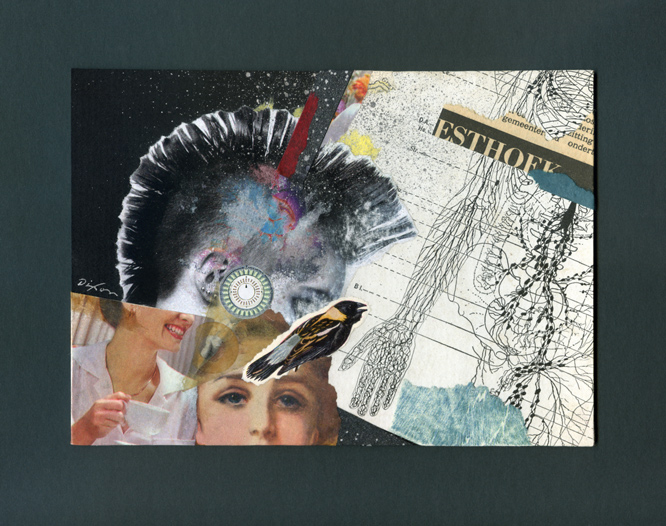
 

Every Instinct of My Being Rebels
collage miniature by J A Dixon
7 x 5 inches
 
Purchase this artwork!
Safe from importance and finality

Wednesday, October 17th, 2012

“Success is the sum of small efforts, repeated day in and day out.”
— Robert Collier

“Sometimes when I consider what tremendous consequences come from little things … I am tempted to think … there are no little things.”
— Ralph Waldo Emerson

As much as I realize how vital it is to study and experiment without preconceived visual notions or tangential aims, it is a rare thing for me to produce a collage without some underlying motivation, whether it be an eventual offer to sell or a simple desire to display the work through social networks or a site such as this. It is, however, important to devise, apart from distracting intentions, some ongoing method of keeping one’s rhythm of composing material for its own sake, in order to reveal and sustain a process of pure discovery. It is not as though some artists are better at this than others. I see it more as a matter of momentum.

Perhaps musicians are more attuned to this, although it is always foolhardy to generalize. They seem to possess an innate understanding of and appreciation for distinct activities— creating, practicing, jamming, performing —that derive from a more collaborative tradition than the visual arts. I admire artists who don’t have to trick themselves into engaging in strictly private, personally unique investigations. To develop and internalize this kind of work ethic— to be able to honestly tell oneself that nobody ever needs to see the product, that it never needs to be held up to evaluation or approval —is one of the most valuable qualities an artist can achieve. This involves resisting the desire to immediately display our incremental output. It means creating a framework we can use for real exploration, and, in the words of John Willenbecher, “try things out, put things down safe from importance and finality.” There is often a fine line between true worth and mere preciousness. Artists who have refined their creative process know the difference.
 

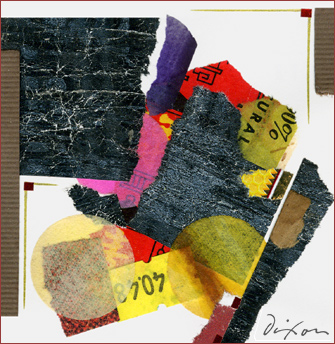
Blog Jam by J A Dixon

Blog Jam
collage miniature by J A Dixon
3 x 3 inches, not for sale

Kurt Schwitters: Color and Collage

Sunday, September 23rd, 2012


“The language of Merz now finds acceptance, and today there is scarcely an artist working with materials other than paint who does not refer to Schwitters in some way.”
—Gwendolen Webster

“I could see no reason why used tram tickets, bits of driftwood, buttons, and old junk from attics and rubbish heaps should not serve well as materials for paintings; they suited the purpose just as well as factory-made paints.”
—Kurt Schwitters

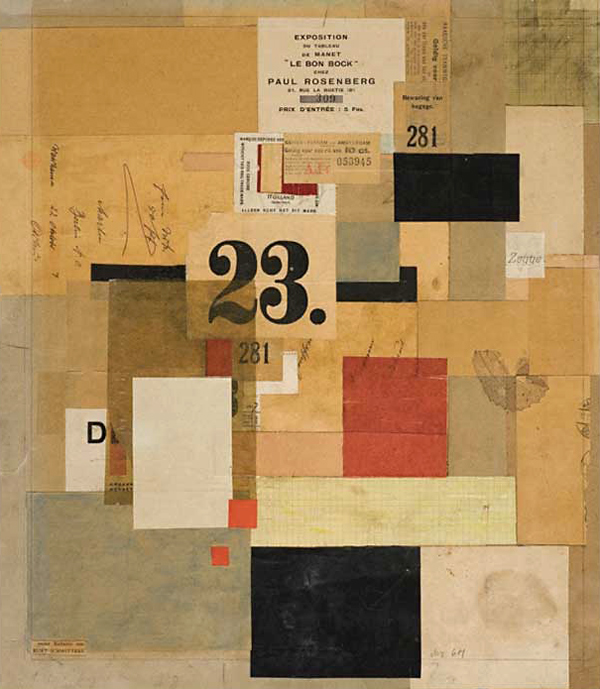
Last November I had the good fortune to find myself close enough to Berkeley, California to attend Kurt Schwitters: Color and Collage, the first U.S. museum exhibition in 25 years to focus exclusively on his towering work. I was able to spend as much time as I wanted (at the Berkeley Art Museum & Pacific Film Archive), studying about 80 examples of his collage and assemblage. It was an experience that is almost impossible for me to describe. I suppose that I should at least try.K S, date unknown

KS has been a powerful influence on my personal artistic journey, for good or ill. When I first learned of this exhibition, it seemed beyond my Kentucky reach, but circumstances conspired to place me in the Bay Area on the day after Thanksgiving. During the trip west, I began to greatly anticipate what I knew would constitute more than a singular research event for me. It felt like a pilgrimage, or a potential culmination of sorts, that might “release” me in some meaningful way. My notion could not have been more off target. Hours of arms-length appreciation and up-close inspection served only to solidify my bond with the German innovator. Seeing masterpiece after masterpiece would crystallize a deep awareness that one need not ever shy away from drawing water from the well of this man’s insights, any more than a musician might hold at a distance Wagner, Stravinsky, or Ellington. Should I be concerned a critic may judge my works as derivative of his? Should a mathematician fear being described as an imitator of Einstein? Should a naturalist worry that others might say, “He thinks too much like Darwin”?

The works were superbly organized in a space that allowed for the full range of observation. The guiding concept of the exhibition was the idea that the artist always considered himself a painter. As Clare Elliott writes, “His practices of painting and collage were so intertwined that it is often difficult to determine if paint was applied to paper before or after it was pasted onto the surface, or mixed into the paste itself.” I doubt if KS, a trained painter, made any distinction. We must remind ourselves that there was no clear sense of collage as a separate medium, in the way we understand it today. It was more about his drive to radically expand the choices involved in how one creates a painting to include any material from the surrounding environment of mundane existence.

The rooms were dotted with descriptive panels that presented some of the most incisive remarks I had ever read about Schwitters. Sadly, the catalog edited by Isabel Schulz had already sold out. (Now available for $200 from Amazon, it was being offered for $40 when the show opened.) On top of it all, I did an inordinate amount of note taking and dared to strike up conversations with strangers viewing the show— something I recall never having done before at a museum. Needless to say at this point, it was a pinnacle experience for me. I finally understood that to entertain the hope of moving beyond an artistic influence of this magnitude, I needed to internalize it as fully as possible to discover my own points of departure. I needed to understand how Merz was fundamentally different than Dada, how KS became a revolutionary without being a rejectionist, and how strongly he must have believed in his initiating a spirit of unification that would encompass artistic methods and approaches not even “invented” yet.


Mz 601 by Kurt Schwitters

Mz 601
collage by Kurt Schwitters, 1923
paint and paper on cardboard
15 x 17 inches, Sprengel Museum, Hanover