I’ve come too far to believe that politicians can actually solve problems. Elections are about a periodic effort to calibrate the degree to which they inevitably fuck things up.
America swings like a pendulum do . . .
November 3rd, 2010Owie-ow! Ow!
October 16th, 2010You know that fleshy web at the base of a thumb? Don’t let that overlap the edge of a paint can when you whale away with a hammer to close the can.
Of course, the saving grace is realizing that I can never injure my good hand when I periodically foul up with a hammer.
I’m such a genius after the fact . . .
Well, excuse me . . .
October 11th, 2010While at the World Equestrian Games, a
lady gave me a dirty look when I tried to
invite her interest in my art and design . . .
as she walked through THE BLOODY TRADE SHOW!

Sir Ben . . .
September 29th, 2010I highly recommend this Kingsley “trifecta” for your viewing pleasure:
1) House of Sand and Fog with Jennifer Connelly
2) Elegy with Penélope Cruz
3) You Kill Me with Téa Leoni
Oldenday XIII
August 27th, 2010Teachers and school boards should embrace comic books and graphic novels as a “gateway” literature, helping children transition towards more complex narratives and helping boys catch up with girls in reading achievement, according to a new study.
—Giuseppe Valiante, Postmedia News
I was thinking it might be about time to add another entry about “The Legend” to this neglected series, but then Joan passed along a link from the Vancouver Sun that forced me to ask a question: Were comics a key aspect of my own progress toward literacy?
It’s gettin’ kinda hazy, but I recall being heavily into the Hardy Boys as a pre-teen, and comic books were a treat, like the Saturday morning “Treasure Chest.” (Remember Chuck White, or This Godless Communism?“) As readers, we used to add little summary cards to our handmade “books pocket” —until junior high years and the move to Tipp City, and then the comics craze struck with a vengeance. We even managed to scrounge funds for subscriptions! (Jimmy Olsen? What were we thinking?) I recall few youthful activities as pleasurable as absconding with an “80-Page Giant” of Bob Kane Batman stories after school (on a day that I’d made a midday trip to “Jointer’s” lunch counter). DC reigned supreme, but we still liked Casper, Wendy, and Hot Stuff, too. We couldn’t get our fill, so we hunkered down with Superman whenever we made a visit to Pam and Lottie’s. “Superman Red and Superman Blue” was the pinnacle experience. Sadly, for me, everything was downhill from there. And when someone let that litter of kittens make a stink of our comics box, the era came to a ignominious close. I moved on to Edgar Rice Burroughs, Jules Verne, and Raphael Sabatini.
Should I be marked down as a statistic?
It’s a strike . . .
July 31st, 2010 If you look closely, that’s the Graybeard Prospector doing a jig around the campsite with his Medicine Woman, cackling, “Paydirt! Paydirt!” Who thought that an old shaft, long thought to be played out, would cough up a hefty nugget when it was least expected? As soon as all the Dosey Doe-ing winds down, it will be time to commence toting sacks of ore into town. And it’s fair to say that the big strike couldn’t have come at a better time.
“Yee-hah!”
Then you know it’s Pure Hollywood ~
June 27th, 2010• Bullets that penetrate human bodies never shatter bones, cause severe shock, or sever a major blood vessel, except if fired from small-caliber weapons toward bad guys at a great distance, in which case the result is sudden and certain death.
• When the protagonist notices any tool or object in the vicinity (at times it’s only necessary for the audience to see it), surely he or she will use it within minutes to survive a near-death crisis.
• At the moment of climax, a villain never fails to indulge the need for a soliloquy or dramatic pause, giving our hero enough time to avert what could have been a curt, straightforward confirmation of inevitable death.
Step aside, Daniel Craig . . .
May 2nd, 2010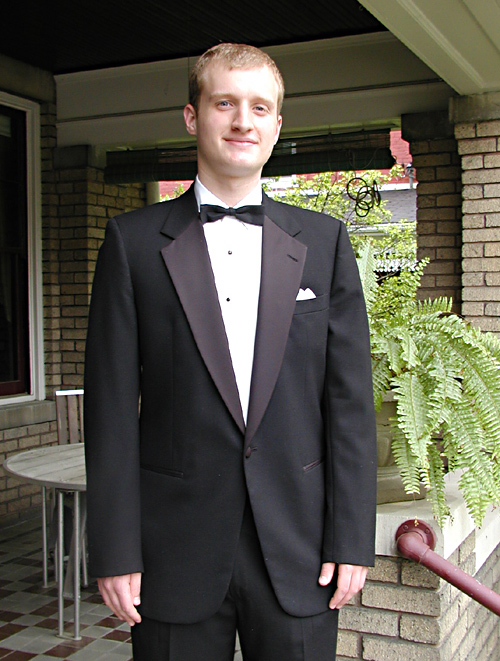
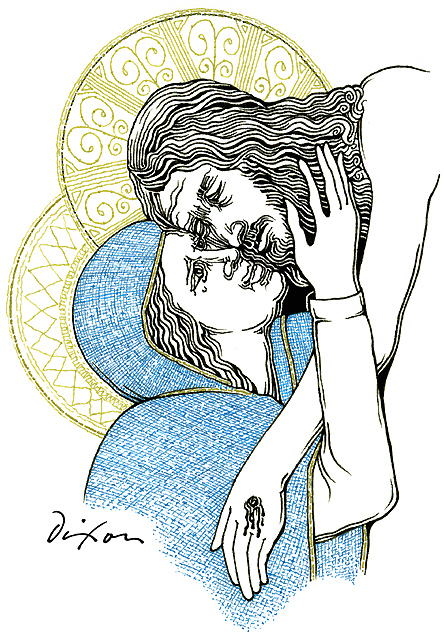
It’s oh-vah!
March 31st, 2010March Exercise V —day thirty-one— Finis.
Today’s sight bite— Dana —c-l-i-c-k— on her feet again!
Previously on M-Ex— Victory! (3/31/07)
Tomorrow— Walie turns twelve . . .

Rooftop revelation
March 30th, 2010March Exercise V —day thirty— Dana was still down for the count, as I spent most of my day with the roofing crew. I tore off the deteriorating veneer which covered the exterior of the front dormer and discovered original stucco matching the Tudor-style gables. It was a pleasant discovery that took the edge off a somewhat stressful day. After today, I know what to expect as the dudes move from the garage to the Town House. This work should provide a significant visual transformation.
Today’s sight bite— Don’t bend over. No. NO! —c-l-i-c-k— a roofer’s major crevasse that makes any plumber look like a lightweight.
Previously on M-Ex— An illustration and an excavation. (3/30/09)
Tomorrow— A try for thirty miles on two wheels . . .

Advance ~ decline
March 29th, 2010March Exercise V —day twenty-nine— I had my eleventh session at the eye center with a substitute therapist, and she gave me a “Brock String,” a simple but powerful tool for binocular training that improves accommodative (focusing) and vergence (aiming) skills. Dana was gone most of the day on an EKU campus visit with Marty. When they returned, he was excited to report that he liked the school and would do everything he could to get enrolled for the fall term. Dana, who hadn’t been feeling particularly well over the weekend, took a turn for the worse after too much outdoor exposure while touring the facilities.
Today’s sight bite— Bold shapes of red, white, and black —c-l-i-c-k— as symbolic abstractions challenge my perceptions.
Previously on M-Ex— At the home stretch, I get good news. (3/29/07)
Tomorrow— The roofing crew is due at the Town House . . .

Inward seeding
March 28th, 2010March Exercise V —day twenty-eight— The early group ride was rained out, so my morning moved at a slower pace than I was expecting. I began to get the sense that the regimen had lost its momentum. This impression soon gave way to a more accurate assessment. So many of the desired habits of thought and focus have been internalized to the point that I no longer sustain the perception of an imposed discipline. This is a good development. It was never about a progression of time, was it? I’m prepared to think that I’ve reached a successful conclusion to the exercise a few days ahead of schedule, but why not make the most of the month’s remainder?
Today’s sight bite— Black soil under an overcast sky —c-l-i-c-k— sprinkled with grass seed until the fork hoe has its say.
Previously on M-Ex— A bad habit can die a hard death. (3/28/06)
Tomorrow— More vision therapy . . .

Life lived
March 27th, 2010March Exercise V —day twenty-seven— Nothing could feel finer than the cool air under a warm sun, deep in conversation with my grandson, applying the seasonal mindset to some scheduled yard work. Yesterday I paused in my town walk to chat with the nurseryman from Harrodsburg who provided the library’s new landscaping. We shared our pleasure at the coming of spring, and I silently contemplated how fortunate he was to spend most of his time out of doors. Today I savored a few hours in his lifestyle and then logged a 16-miler on Hakkoch in the late light. It’s a wonder to be part of everything coming fully alive again, and this realization proves that all my fathers still exist within me.
Today’s sight bite— Tulip shoots, lilac buds, and jonquil brigades —c-l-i-c-k— March is going out like a lamb!
Previously on M-Ex— Endeavor to persevere . . . (3/27/07)
Tomorrow— More than one Sunday can possibly accommodate . . .

Impecunious periphery
March 26th, 2010March Exercise V —day twenty-six— While spending hours alone in the studio, there’s probably nothing better than the framework of a March discipline to put things into perspective, because the backdrop of inexorable dependencies are certain to impinge upon the solitude of the day, and, eventually, they do. One can’t help but imagine another type of life, but that’s a pointless distraction. This is my ship, and, with the Creator’s guidance, I shall sail her as best I can.
Today’s sight bite— Globules of amber, blue-violet, and magenta —c-l-i-c-k— as late sunlight projects a pattern of Time Zippy against the rotunda’s white interior.
Previously on M-Ex— Uncle Joe’s final ordeal is at hand. (3/26/06)
Tomorrow— A spring weekend begins!
Nagging thumbkin
March 25th, 2010March Exercise V —day twenty-five— I continued to have difficulty with my “phantom thumb” exercise, so I called Mary Ellen to consult. She told me to just set it aside for now and not to fret about it. I suddenly realized how many other things I’d allowed myself to make an object of daily worry, pondering the connection between stress and vision problems. It seemed a good time to walk over to the Community Art Center with Dana and tour the dinosaur exhibit. We saw Nathan M and he offered to provide us the list of economic development conferees. Later, I sipped a cold Leinenkugel and watched the Wildcats secure their spot in the “elite 8.”
Today’s sight bite— Phosphorescent streaks and random geometric perfections —c-l-i-c-k— convincing me that exotic minerals are more fascinating to my current imagination than extinct reptiles.
Previously on M-Ex— It’s a madhouse! (3/25/07)
Tomorrow— Flying solo in the studio . . .

Fixed mundanity
March 24th, 2010March Exercise V —day twenty-four— I was burnt toast after my 22-miler tonight, making me painfully conscious of my sedentary occupation. But it’s March, when my bicycle legs are rudely punished until I can take 30 miles in stride, with a couple of knobs thrown in for good measure.
Today’s sight bite— Was that the familiar green and brown bag? —c-l-i-c-k— In the ditch? There’s another one! —c-l-i-c-k— My package design for livestock feed appearing as a huge item of roadside litter reminds me that I have chosen to spend much of my life creating trivial ephemera.
Previously on M-Ex— Conservation of energy—more secrets are revealed through focused awareness. (3/24/06)
Tomorrow— Dinosaurs!

Inestimable vacuum
March 23rd, 2010March Exercise V —day twenty-three— Sometimes a book will accidentally get shoved behind the others on a shelf, and that’s what happened to my copy of “High Performance Health” by John Yiamouyiannis. Thinking it was long lost, I discovered it was only hidden. After a bit of skimming, it didn’t take me much time to remember that he’d outlined one of the best, most practical anti-cancer regimens I’d ever read. Ironically, “Dr. Y” died of cancer in 2000, and he was about my age. I’d lost touch with him in the 90s and, needless to say, I was stunned at the news of his demise. I can only conclude that he became so tirelessly devoted to his crusade that he neglected his own program. The other possibility is that he was covertly murdered, which wouldn’t be impossible for me to comprehend, given the powerful enemies he made over decades of bitter lawsuits and uncompromising activism. I can’t help but wonder what he’d think of the sweeping federal legislation just signed.
Today’s sight bite— The initial shock of the garish turf —c-l-i-c-k— as I first set my eyes on Centre’s all-synthetic football surface.
Previously on M-Ex— The Muse comes through for me. (3/23/06)
Tomorrow— Local cyclists gather for a group ride…

Elusive calm
March 22nd, 2010March Exercise V —day twenty-two— After my tenth round of vision therapy, the balance of the day felt like a refutation of the popular fallacy called “multitasking.” I had little tolerance for more than one activity, train of thought, or sensory stimulus at a time. I accept that one is responsible for one’s own serenity, but there are times when I think that peace and quiet are the scarcest commodities. Tonight is one of those times, after having found a kindred spirit in the author of this remarkable blog. Two years ago she posted a picture of a Minnesota scene identical to the one I viewed from the Bluegrass Parkway this morning.
Today’s sight bite— Twin silos against an amber-pink burst of luminosity —c-l-i-c-k— as day breaks over a landscape carved by the Kentucky River.
Previously on M-Ex— March is for going a little bit “kook.” (3/22/07)
Tomorrow— Executing fleet graphics for a client…

Advancing alone
March 21st, 2010March Exercise V —day twenty-one— After Dana fixed Marty and me a delicious pancake breakfast, I set out on Hakkoch for my first bike workout of the year. Near the edge of town I stopped at Jay and Glenda’s for a surprise inspection before heading out to Chrisman Lane, one of my favorite riding roads. I was thinking about the recent death of Winston and that Walie was the only Yorkie remaining in the Clan. She’ll turn twelve on April Fool’s Day. I rode about 15.5 miles and was ready to arrive home. I’ve got some serious work to do if I hope to complete a 100-miler in May. Joan and Mombo stopped by as part of their ongoing mattress research. I heard Joan tell Walie she knew what it felt like to be a widow.
Today’s scent bite— The glorious agricultural stench of a spreader’s output —s-n-i-f-f— with pastoral recollections of Studebakers, Browns, and Silknetters all rolled into one.
Previously on M-Ex— This is about as heavily into the experiment as one can get. (3/21/06)
Tomorrow— Pedal to the metal…

Favorable exposure
March 20th, 2010March Exercise V —day twenty— I now have my foot in the door at the Kentucky Artisan Center, thanks to a good friend. Decision makers there chose to purchase three of my wood engravings for the upcoming “Black and White” exhibition. This is a very good sign, because I would’ve been thrilled if they’d taken a few merely on consignment. Dana and I traveled to Berea today to deliver the prints and see the facility for the first time. We spent a bit more time downtown at a couple galleries, but we got so hungry we found ourselves heading north to Lexington for a celebratory dining experience. Even though we ran smack into the Wildcats game-viewing crowd and had to endure an inordinately long wait for our meals, it was a satisfying finish to a most uplifting day.
Today’s sight bite— Squares of assembled stone in a multiple of subtle hues —c-l-i-c-k— provide a captivating visual stimulus as memorable as the sensory overload of artistic creations.
Previously on M-Ex— The Graybeard is confounded. (3/20/07)
Tomorrow— First bike ride of the year…

Beyond sorrow
March 19th, 2010March Exercise V —day nineteen— We finally “pulled the trigger” and hired a roofer, ending years of distress that stemmed from our inability to afford the kind of roof we truly wanted. Someday, perhaps, this bungalow will once again wear a clay tile roof, as it did in the 1920s, but, sadly, we won’t be the ones to provide it. We can’t even swing the metal simulation, so we’ll do the best thing we can— restore the original terracotta color with a premium asphalt shingle. We’re tired of the indecision and just can’t attempt another rainy season with buckets throughout the attic. It’s time to press on.
Today’s sight bite— Low shafts of morning light —c-l-i-c-k— as they wrap around the ancient maple’s gnarled bark.
Previously on M-Ex— Our favorite hoops-gril finishes her high school career. (3/19/09)
Tomorrow— Our first visit to the Kentucky Artisan Center…
