Archive for the ‘Creativity’ Category
Thursday, December 29th, 2005
Days of mixed emotions as the year draws to a close…
I’m really excited about the wise, practical advice I’m getting from Twyla Tharp’s “The Creative Habit,” the best book on creativity I’ve ever discovered. Anyone who is remotely artistic or has even a modest hope of harnessing their creative abilities should read this book. I wish I’d read it 30 years ago—a silly thought, since she wrote it in 2003. That she’s been able to synthesize from her life experience such a down-to-earth approach is another form of genius beyond her greatness as a dancer/choreographer. Her counsel is so effective that I’m already getting noticeable results, and I’m only half way through the book.
In a previous entry I mentioned Paula, the state employee who was coordinating the KBBC when I joined the Commission at the end of the summer. I learned today that the cancer has advanced to the final stage and her family was gathering nearby to keep the vigil. My one long talk with Paula took place on what might have been the most exhilarating day of the year for me. She was very nice and very professional, believing she was making a routine follow-up call to introduce herself and offer her help within the Transportation Cabinet. I was totally lost, and it became clear soon enough that I wasn’t yet aware of the Governor’s appointment. We ended up having an amusing conversation after we put the awkward moment of embarrassment behind us. I looked forward to getting to know her and hardly imagined never speaking to her again. I don’t need to go into the memories from a year ago that this news brings to the surface. I just hate to be reminded that another family is facing a new year with the same tide of overwhelming sadness.
With the observance of her 15th birthday, my niece Hayley is on the brink of success as an athlete. She’s put in some hard work as a youngster, but is now poised to commence her career as an outstanding high school ballplayer. I watched her carry her team to a two-point tournament game victory yesterday as a freshman, and I can vividly see the potential, although I’m not knowledgeable enough to analyze her situation in detail. I’ll leave that to others. I just know how happy I am for her and how much I wish her well. A relaxed self-confidence is beginning to blossom, plus the capacity to turn on “the means,” when necessary. A good combination that will improve with more playing time, which she’s certain to get after a performance like her 14-point, 9-rebound effort last night. You got it, Belle— go tear ’em up tonight!
Bruce has improved enough for probable release by the weekend. He’s still experiencing enough dramatic flux in his body temperature, blood pressure, and pulse rate to keep everyone on edge about his prognosis for 2006. It took our friend Nathan two years to recover some level of normalcy in his bout with pancreatitis, presumably a worse case than Bruce’s, and that included multiple surgeries. This gives me reason to have the long-term outlook for a positive outcome, to resist the tendency to fret about the periodic fluctuations, and to recognize that the Father has a purpose for this man that none of us can begin to imagine. It will just take time. Lots of it.
So… I’m juggling joy, sadness, hope, and fear right now, but behind that veneer of emotional energy is a core of Divine Love. I’m grateful that I grew up swimming in a lake of pure love. Not indulgence or sympathy or favoritism or the milk of human kindness. Love. The real thing. And I realize now that it’s the Presence of God in my life, and I’ve since learned how many others have struggled to adulthood without it. That is surely my greatest gift. Not my talents, or my excellent health, or my “good joss,” but the certainty of always knowing I am deeply loved, and it enables me to touch the Heart of Christ—if I remember to pay attention. If I relax, avoid the panic, and float in that vast life-giving ocean—an inner and outer home that’s always been there and always will be.
Posted in Creativity, Family, Gratitude, Nonfiction, Personalities, Priorities, Public Service, Sport | Comments Closed
Sunday, November 20th, 2005
I left Danville too late, so most of the steam was out of the “Hop” by the time I hit the streets of the city. The wine boxes were empty and the finger food looked too picked over. The crowds of hipsters had clearly shifted their collective focus to discussing whatever late-night enticements lay in store for them after the galleries closed.
I was there to see art while I could; it was worth the trip.
• Jeff Rogers is always up to something new and interesting.
• D.B. Westerfield, a prospective Layerist, has switched from ceramics to multi-media canvases, and I like her smaller collages—bright, loose, and full of gaity. I was going to add, “just like the artist,” but how would I know? (I shouldn’t be so rude. I just met her and she’s a very sweet person.)
• Going from the Ann Tower Gallery to the poster art show
at the ArtsPlace building was moving from the sublime to the ridiculous, but that’s what this event is all about (and I liked discovering the work of Mark Daly).
I’m glad I had the impulse to drive up. I was alone and there wasn’t anything else I felt like doing on a Friday night. I saw a few pieces that inspired me, but nothing I encountered in Lexington compares with Sheldon‘s exhibit at the Community Arts Center, only a block from our studio.
Posted in Art, Community, Creativity, Personalities, Studio | Comments Closed
Saturday, November 19th, 2005
— I reconfigured the screen saver on the Mac G4 Mini to display a sequence of abstractions by Kurt Schwitters. I can’t say why, but, as far as motivating me to make art, nothing of late has been more inspirational to me than the rule-shattering creations of this early 20-century master. One could say he basically invented the medium we know as collage (he certainly was the first to perfect it), and it won’t hurt if I can subconsciously absorb a wee bit of his genius. Did KK really go to Newcastle? My God, that’s the repository of the Schwitters “Merzbarn,” one of the most genuinely innovative artistic concepts of the last hundred years! I may never get to see it myself… Go back there, Caitlan; it’s in the Hatton Gallery at the University of Newcastle!
— Don’t know any details, but it seems as though conditions are imploding at the school where my sister Joan has worked for many years. I feel bad for her because I think I know what she’s going through. Dana and I still refer to the “Golden Age” at Wright State University Communications (where we first met) before that department went into a nose dive. Things were never the same. Some of our coworkers saw it coming early and escaped most of the madness. Dana and I saw the handwriting on the wall before many in our group, but we still had to endure six months of collapse until we made the leap and started our partnership and studio. Several of our friends tried to make the best of it and had to experience a lot of nastiness before what was left of our creative “dream team” had been totally dismantled. A few of us from those years started our own companies and continued to work with each other sporadically, and we keep in touch as friends to this day. Since then I’ve learned that good working relationships and situations can rarely be sustained indefinitely. Everything always changes. Undesirable situations can improve, but, unfortunately, great situations inevitably decline, or even crash and burn. There’s been quite an ebb and flow in our clientele since those days (26 years ago). It’s not that existing relationships will sour, but it’s more often a matter of the natural, dynamic flux in any organization’s personnel equation. Never underestimate the wake of change that can occur when outstanding people move on with their lives. It can cause a “brief, shining moment” to fade into personal mythology. The silver lining for me—I still have my “partner in all things” and my Clan, and that’s as close to permanent as I’ll ever know.
— Today Dana told me that Bruce had a bad night, but pulled through without having to go back to the hospital. He gets into vicious cycles of fever, nausea, low red cell count, weakness, low blood pressure, and then sometimes passes out when he tries to stand up, if he has the energy to move at all. I don’t know the actual sequence of it, but he manages to will himself forward, or he relies on his mother or Pam for the encouragement to ride it out when this happens. It apparently has something to do with dialysis, or the lingering infections, or another factor I’m not aware of. He told Dana this past week how much he wants to feel good again, and that he’s not giving up. Dana will stay with him until he improves enough that she can turn her role over to someone else. Until then, she must be there while Pam is at work. Meanwhile, I continue at the home-front and make my effort to get work, be productive, juggle the volunteer commitments that have a momentum I can’t control, and resist the kind of distractions I’ve always invited to avoid facing—right now—the full emotional impact of bearing life’s load (for example, making overly long blog entries).
V & S
Posted in Art, Blogging, Business, Caitlan, Creativity, Dana, Family, Friends, Home, Joan, Personalities, Priorities, Studio | Comments Closed
Monday, November 14th, 2005
I broke away from the Knobs so as not to miss a meeting at Kathleen‘s about the Society of Layerists in Multi–Media (SLMM). I recently joined as an associate member and hope to boost my involvement with the organization as they gear up for a major gathering in Lexington during the autumn of 2006. My goal is to complete enough larger collage pieces by next summer to submit an application for full membership to the Society’s jury. It’s my hope to qualify to participate in the exhibitions connected with the month-long series of art events.
It was a very pleasant, interesting gathering of artists who share a similar orientation to their work, including a few friends from Danville, but mostly a group of people I’d never met. We each had an opportunity to introduce ourselves, show some examples of our work, and talk about our approach. I got to explain how the hundreds of greeting cards I’ve made over the years as a creative contrast to the needs of my commercial practice has enabled me to develop a miniaturist style that I yearn to apply to larger concepts. I told them that, although the aesthetics of my spontaneous compositions are rooted in early 20th-century design and modern art (like the masterful Merz experiments of Kurt Schwitters), I reject the nihilism and pessimism of Dada, and that my process and intent is more in keeping with the uplifting, holistic principles of Layerism.
Posted in Art, Community, Creativity, Friends, Personalities | Comments Closed
Thursday, October 6th, 2005
Experiencing Mark O’Connor last night was the kind of transporting event I needed. Any of the other individuals who appeared with him onstage—Bryan Sutton, Howard Alden, Jon Burr, Roberta Gambarini—could have easily carried the evening on their own. The musical originality and virtuosity was riveting. I love wind instruments, but it’s totally amazing what fingers can do when lips don’t have to keep up.
Posted in Creativity, Music, Personalities | Comments Closed
Friday, September 9th, 2005
I don’t believe I understood to what extent an online discussion could break through to a new level of interactive dynamism until I had the opportunity to partake of this sweet nectar.
Posted in Brendan, Creativity | Comments Closed
Friday, August 19th, 2005
Brendan set up a nice Web-based device for further development of our pirate concepts… better ration myself on that one. Makes me realize I could easily take a two-week vacation and devote it entirely to filling up a similar site with ideas from “The Legend.”
Posted in Brendan, Creativity, Pirates, Time | Comments Closed
Thursday, August 11th, 2005
I’ve already mentioned that “Pirate Revenge” is done and ready for tomorrow night’s premiere. The family has previously seen a rough cut that’s pretty crude (home VCR edit with no sound track). On the surface, there’s nothing profound or meaningful to be found, because the “Houseboat Trilogy” has always been about indulging ourselves with a bit of silly entertainment for some good laughs and a few inside jokes. The original film was silent 8mm, shot in sequence during a 1971 lake vacation. It was short, violent, and very funny. The second part came 17 years later, when we celebrated Mombo and Dadbo’s 40th anniversary at Dale Hollow Lake. We’d made the shift to VHS by then, but it was also a spontaneous, in-camera effort, with some miserably poor post-production to spice it up. Now the characters from “Pirate Waters” had names and a context, so “Pirate Isle” was an instant classic within the Clan.
It looked like the next installment was going to be another of my many unfinished projects. I’d decided to shoot it more like a typical movie—get a lot of takes “in the can,” and then put it all together later. Seemed like a good idea at the time, but I didn’t have any capability beyond splicing clips from the raw Hi-8 footage to a home VHS deck. We recorded that master tape during a long weekend outing to Lake Cumberland in 1993. Brendan and I shot some filler months later, but basically nothing happened for nearly twelve years to bring the series to a conclusion.
But now, in the words of Petey the Pirate Urchin, “Everything’s changed,” because Seth rolled up his sleeves to reconstruct the entire production from scratch as a labor of love, adding his own natural sense of pacing and story coherence. The result goes way beyond my original vision for what was never meant to be more than another goofy contribution to the family archives, and I say that because the clean production quality of the Casablanca editing system at WREB lends an odd credibility to the composed footage. For me, this achieves two things. It provides a more satisfying entertainment experience rooted in our unique camraderie and shared humor, but, beyond that, it captures in one collaborative creation a intensely pleasurable look at the many raw talents and “playtime personalities” of the participants—the acting skills of Brendan in early formation, the not inconsiderable ability of his mother to craft a powerful characterization with minimal screen time, the hilarious histrionics of Jeanne, Susan, James, Jeffrey, Jerome, and others, the touching scenes of my parents together (demonstrating the typical respect they had for our endeavors by playing their roles straight), but perhaps more than anything, Seth’s embryonic media capability, which no one should fail to admire at his stage of the game.
Speaking only for myself, I think this oddball creation should be preserved and treasured forever.
Posted in Brendan, Creativity, Dadbo, Family, Mombo, Movies, Pirates, Playtime, Technology | Comments Closed
Tuesday, August 9th, 2005
Walie wanted to play with toys all day. APS replaced our crashed hard drive with an even bigger one. I had a 150-yard PR time in the pool during my midday workout. The American economy continues to grow. I solved the cascading style sheets problem in the preliminary Website for Kentucky Trust Company. Dana had an informative talk with a local man who recovered from a case of pancreatitis worse than what Bruce has. Seth helped me put the finishing touches on “Pirate Revenge,” the final segment of my goofy “Houseboat Trilogy” (originated as a teen not much older than he). Discovery landed safely and the astronauts held a press conference. Josh had another night’s sleep at the Blue Bank Farm.
Posted in Creativity, Current Events, Dana, Exercise, Family, Mombo, Movies, Pets, Pirates, Space, Studio, Technology, Television | Comments Closed
Monday, August 8th, 2005
Working on the family movie has been fun, and I’ll be somewhat sad to see it finished. I don’t think I can imagine a young person taking a project more seriously than Seth is taking the completion of “Pirate Revenge.” I can tell that it’s a bit painful for him to watch me insert gags and “camp it up” (in the old Dixon manner of my generation), and when we talked about continuing to tweak it, I shared the George Lucas quote, “No film is ever finished, only abandoned.” Seth thought that was depressing. Marty, who came along to work with us one night, wanted to know if I saw the essence of the piece as drama or comedy. I said, “If anyone can tell, then Seth and I have failed.”
Posted in Creativity, Family, Marty, Movies, Personalities, Pirates | Comments Closed
Thursday, August 4th, 2005
We’ve all seen some bizarre content on the Web, but one has to admit that this page is pretty strange…
Posted in Creativity, Technology | Comments Closed
Tuesday, August 2nd, 2005
I’m trying to figure out how to say something about Andrew’s new film without spoiling it for someone who wasn’t at the Kentucky Theater opening last Friday night. It’s a clever twist on the typical love triangle and has many fine moments. I have enough experience with film/videography to know how much work goes into finishing a project like this, so I have to tip my hat to anyone who puts that much energy into a movie with no budget. I can’t wait for the day when someone gives Andrew the time, dollars, and support to do his best work. I know it will happen because this lad has more persistence than almost any other creative person I’ve ever known. He’ll be successful because he’ll never quit trying. I recall the only time I ever heard my friend Danny talk in public about being an actor, and there were a lot of young people present wanting to know how to break into “the industry.” He told them not to wait for somebody else to hand over an opportunity, but to just get a camera and start creating. I don’t believe Andrew was there that night to hear the advice, but that’s exactly what he’s been doing for as long as I’ve known him. He’s a talented, good-looking young man, but it’s his focused will to make it happen on his own that will be the key to his eventual “discovery.”
Posted in Creativity, Friends, Movies | Comments Closed
Saturday, July 9th, 2005
Seth and I put in a rigorous session with Lady Casablanca and learned a few hard lessons in our first team effort to produce a final cut of “Pirate Revenge.” When we were no longer laughing at our funniest scenes, we knew it was time to call it a night.
Posted in Creativity, Family, Movies, Pirates, Technology | Comments Closed
Saturday, June 25th, 2005
My family was never far from my mind during the seven months I lived in Europe during 1974. (In fact, I so turned off a pretty Flemish girlfriend by admitting I missed my family that she dumped me within hours for a Belgian doofus named Bruno.) One way I could feel connected to my brothers was to think about “The Legend,” and it was easy to be inspired, surrounded as I was by all the fascinating history of feudal conflicts, life on the manor, warring political factions, imperialistic ventures, and Napoleonic exploits. I was constantly encountering the art, architecture, accouterments, and weapons of the general time period we’d chosen to frame our imaginary world of swashbucklers and tyrants. When my brother James sent me a letter mentioning Hedda Keeh, one of our beloved characters (a native of the Western Plaines and Peace Chief of his nation), I plunged into the creation of a comprehensive map and sent it home along with our most ambitious document to date—a long letter from Joncules Dix to his half-brother Jimcus (otherwise known as Chaims-Dan, or Man-With-Flying-Feet, from his years among the outcast monks of Chap). Before long, the nonlinear structure of our narrative was firmly rooted in the idea of producing documents and artifacts that revealed only a portion of the totality, which would then lead to further discussion, attempts at integration, and ongoing creativity (often using dioramas built with the very type of plastic figures that influenced our imagination from the beginning). It became a perfect organizing principle—not original to us, I suspect—and reinforced the historicity of our approach, removing it forever from a strictly oral realm. An explosion of development followed, with numerous drawings, carvings, models, and written fragments. Spinning yarns within “The Legend” has never been the same since.
Olden…
Posted in Art, Creativity, Family, History, James, Pirates, Playtime | Comments Closed
Friday, June 3rd, 2005
By adolescence, our collection of evolving characters and plot-lines had detached itself from playtime notions or other childhood limitations. We made an effort to shed not only elements of fantasy, but anything out of conformity to the “historical accuracy” of our invented world—the land of “The Pirates.” We used the term in its broadest sense. The band of half-brothers central to our story were not the classic “Howard Pyle types,” but true corsairs from the standpoint of their disregard for societal constraints or prevailing authority. Their adventurous conduct was governed by a common code of mutual survival and respect for each other’s keen abilities. That our story had no fixed beginning or end was well accepted by us all, and we felt free to add new personalities, ethnicities, and anecdotes, as long as they seemed to fit within a narrative continuum that was constantly pushing forward and backward in time. Revisions in service to coherence would pass muster and shape the new legacy. It’s hard to describe the shared excitement and the satisfaction of knowing that we could never be bored if we were together, because the joy of adding to our open-ended chronicles was just a collective daydream away. A mere suggestion could trigger a new layer of creative integration. I’m not sure when it happened, but we started to document a few things here and there, and before long it was apparent that there was no end to the depth and richness of the mosaic. I can’t say it was clear to us at the time that it would prove to be a lifelong pursuit, but we did appreciate its staying power and understood that it was certain to continuously improve. It’s no surprise to any imaginative individual that youth is often fertile ground for an enduring artistic vision. I just recently listened to Ron Howard explain that the premise of how he’d create his motion picture about the Great Depression derived from ideas he had in high school. By the time the oldest of us were settled into college life, we had quite a head of steam with our own story project, but we didn’t anticipate the explosion of development that was about to take place in “The Legend.”
Olden…
Posted in Creativity, Family, Fiction, Movies, Personalities, Pirates, Time | Comments Closed
Friday, June 3rd, 2005
When Brendan spoke of “building a narrative out of noncontiguous events,” it was as if he was talking about the tapestry of stories that my brothers and I have been weaving all our lives. Stories… they’ve been part of my creative identity from the beginning. Wanting to tell them was as natural as drawing. First it was with chalk and blackboard (my artistic genesis), and then it expanded to comic strips, “scrips,” and my early childhood writings (the Summer family’s life on a farm and the adventures of Gordon Antent, leader of shipwrecked souls). But whatever artesian well of infatuation might emerge and run its course, there was always a distinct narrative world that continued to evolve at the pace of my maturing regard for the human condition, and there was never any doubt about the fact that this was a story project that was meant to endure. As is typical with any creative momentum that has an origin in early life, it’s difficult to define how naive concepts gain an inertia that survive childhood play. And it was always a collaborative enterprise from the start, involving a sibling give-and-take of ideas that would find enough consensus to mold the stories and character profiles in a semi-permanent fashion, until the next burst of development. It all grew out of an activity that, for us, was a powerfully stimulative pastime—playing with little plastic men. Current hobbyists and collectors would refer to them as “playset figures.” The next generation would know them as “action figures.” But most families like ours wouldn’t expend limited resources for the elaborate playsets on the market, with their carefully planned and crafted groups of figures, buildings, props, and accessories (few would dispute that the Marx Toy Company was the high-water mark in the genre). We fit into the merchandising strata at a level called “dimestore toys,” cheap, simple bags of men (rarely women) with few if any accouterments. We envied the friends and cousins who had Marx
playsets (WWII Battleground, Blue and Gray, Fort Apache, Alamo, Ben-hur, and TV spin-offs like Davy Crockett, Gunsmoke, Wagon Train, and The Rifleman), but we could make do. We had imagination to spare and we had each other, but most of all, it really wasn’t about the toys. It was about the dramatic stories, and the heroic personalities, and the exotic homelands, and the interactivity of brotherly minds, and the continuity of our boyhood traditions, and ultimately… the fascinating nonlinearity of it all.
Olden…
Posted in Brendan, Creativity, Family, Movies, Playtime, Television | Comments Closed
Thursday, June 2nd, 2005
Something Brendan said yesterday really got me fixated on a line of thought. For some reason I don’t consider myself a writer (perhaps a diarist or “journal-ist” at best), and yet telling stories has been a part of my imaginative side for as long as I can remember— whether illustrative, oral, or written. The Iliad and Odyssey of Homer may have been the first nonlinear story, but I didn’t read Homer (just the condensed juvenile versions) until long after my brothers and I had begun to create a rich oral/written tradition that’s almost 50 years old now. It’s nonlinear nature is one of its strongest suits. It’s been called various things over the years, but now we generally refer to it as “The Legend.” If I keep thinking about this I’ll have the ingredients for another Oldenday segment.
Posted in Blogging, Brendan, Creativity, Fiction | Comments Closed
Thursday, May 12th, 2005
The word “miracle” keeps coming up in my conversations with others
about Bruce, and appropriately so, but I can’t help but think that such
profound intersections of the physical and the divine may not be as
extraordinary as we often believe, nor as rare as the term implies.
Perhaps they’re just the proving of the Universal Law, and are meant to be
the rule, rather than the exception. Haven’t the sages, prophets, and
Christed Ones told us as much since the beginning of recorded time?
And yet it appears that I only participate fully in this
“creative equation” when traumatic circumstances shatter my
daily mode.
Tonight I was part of The Salvation Army’s annual appreciation
dinner and had the opportunity to hear a talk by Commissioner Fred
Ruth, who recently retired as the organization‘s representative to the
United Nations. From New York to London to Eastern Europe to
Russia to Indonesia to New Guinea to North Korea, this dedicated
officer has literally served around the globe and witnessed countless
examples of the Light of God intervening on behalf of those in need,
but only when an individual’s heart, head, and hand are in the right place
at the right time with the right intent, positioning oneself in service
to His eternal Law.
Miracle? Until we come up with a better term—and it’s time we do—the word will have to suffice.
Posted in Community, Creativity, Family, Personalities, Prayer | Comments Closed
Friday, May 6th, 2005
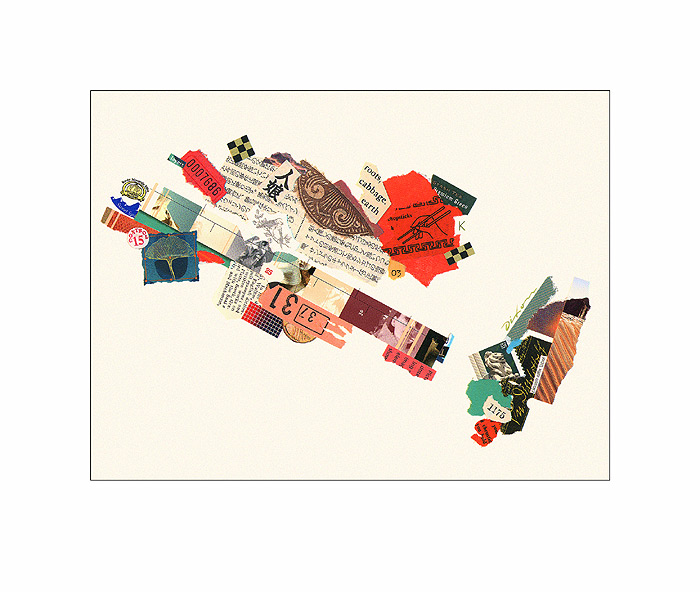
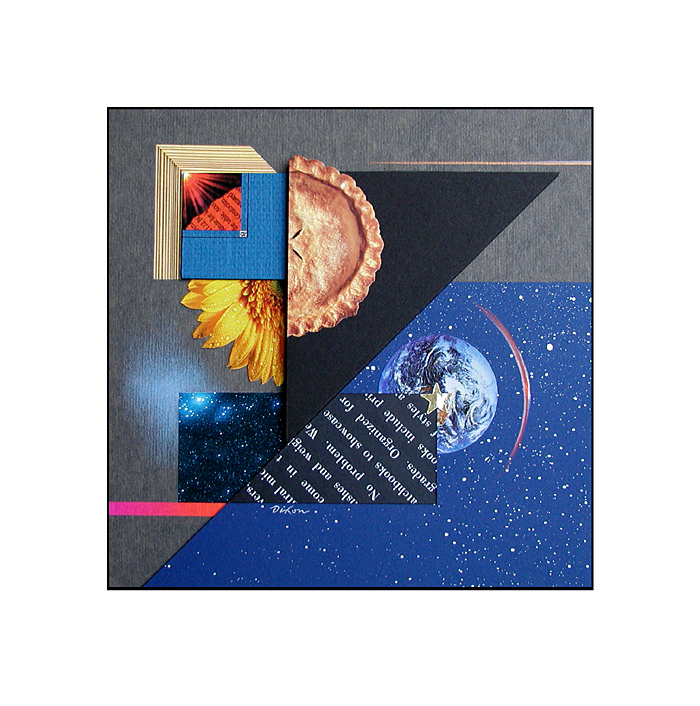
There’s a pattern that presents itself when I create one of my collage artworks, and it can be described something like this— As a concept gradually takes shape over a period of days, individual components are selected by contrast of color, size, and aesthetic associations, often involving the assembly of miniature configurations that will function as units. The formal compositional phase is then executed with intuitive dispatch within a concentrated block of time. After at least one night’s sleep, the third and final step is one of refinement, when the design is finessed with the placement of smaller elements to anchor the proper visual balance. Tonight I completed “act two” of the piece I’m donating to the Art-full Raffle (sponsored by the Arts Commission of Danville/Boyle County next week to raise funds for local arts scholarships).
Posted in Art, Community, Creativity, Time | Comments Closed
Saturday, April 30th, 2005
While out at midday on a five-miler, I was imagining what would happen if I took a collage miniature and enlarged it to gallery size after subjecting it to a mezzo-tone or stochastic conversion. I must have at least a dozen images that lend themselves to this graphic treatment, but when I consider time, materials and framing, I don’t see how I could finance it, not to mention the lack of anyone asking me to prepare such a large exhibition. I’d better start with just one and test the waters.
Posted in Art, Creativity, Exercise | Comments Closed
Thursday, April 28th, 2005
Precisely three years ago, Marty and I spent much of our day documenting and dismantling my 50th birthday “Haus of Cards” retrospective exhibition. At the time I thought it might be the high point of my card-making activity, and I was probably right. After a peak of 309 hand-made cards in 1999, I created 166 in both 2000 and 2001, bumped it back up to 189 the year of my Danville show, but saw the total fall to 105 by the close of 2004. So far this year I’ve made 22, a far cry from those productive years, when I might top 50 or 60 cards by Brendan’s birthday.
Posted in Brendan, Creativity, Marty, Priorities, Time | Comments Closed
Wednesday, April 20th, 2005
When I was a preteen, Dadbo brought home a carload of aerospace magazines from work. Did I cut out all the cool pictures of rockets and supersonic aircraft? No… I cut out and saved the marketing symbols and corporate trademarks. I can’t explain it, but I always had an affinity for letters and graphics (the GE emblem on the refrigerator intrigued the heck out of me), but I had no clear comprehension of either the fine or applied arts, any sense of the distinction, or what an artist actually did for a living, other than maybe draw cartoons, paint signs, or think up a few crazy advertising ideas like Darren Stevens. My junior high art teacher had worked as a commercial artist before switching to art education. She didn’t actually instruct me in any specific graphic arts techniques, but I did gain one valuable thing from her—she made sure I understood that commercial art was a viable aspiration for a talented person. But there was something else between the lines, as though it was our secret, this notion that commercial art wasn’t exactly noble, that it wasn’t real art. Hmmm, so what was real art? Didn’t have a clue. Norman Rockwell? For petesake I didn’t even realize who Bob Clampett and Ralph Bakshi were poking fun at when they created a cartoon character called Go Man Van Gogh (the wild beatnik artist on “Beany“). I just knew that I was fascinated by comics and advertising art and loved to study lettering and draw words as pictures. I remember painting the word “ICE” with watercolors, adding the archetypical mounds of snow and ice-cycles around the letters. It was almost a right of passage. Weird, eh? I had four different art teachers in four years of high school. I hate to be unkind but each one of them was worthless. I had talent, so there was no reason to spend time with me. It was more important to babysit the goof-offs who took art as a “cake” elective. No wonder I sent off for the Famous Artists home test. I don’t think I even realized how desperate I’d become. What others might have viewed as crass merchandising was a Godsend for me. The individual attention I got from instructors in far-off Connecticut was something I’d never experienced before. And even though the course introduced me to both the fine and applied arts, there was something about commercial art that made me feel at home. When I saw the classes offered by UC I didn’t get the same electricity from reading about figure drawing, painting, or printmaking like I did from discovering that I could take design fundamentals, typographics, photography and film/animation. I was pumped! I wanted to go to college so bad I turned cocky and couldn’t wait to blow my hometown and head for the big city…
Olden…
Posted in Art, Creativity, Dadbo, Education, Letters, Personalities, Television | Comments Closed