Category: Pulverbatch

Quill & Scroll

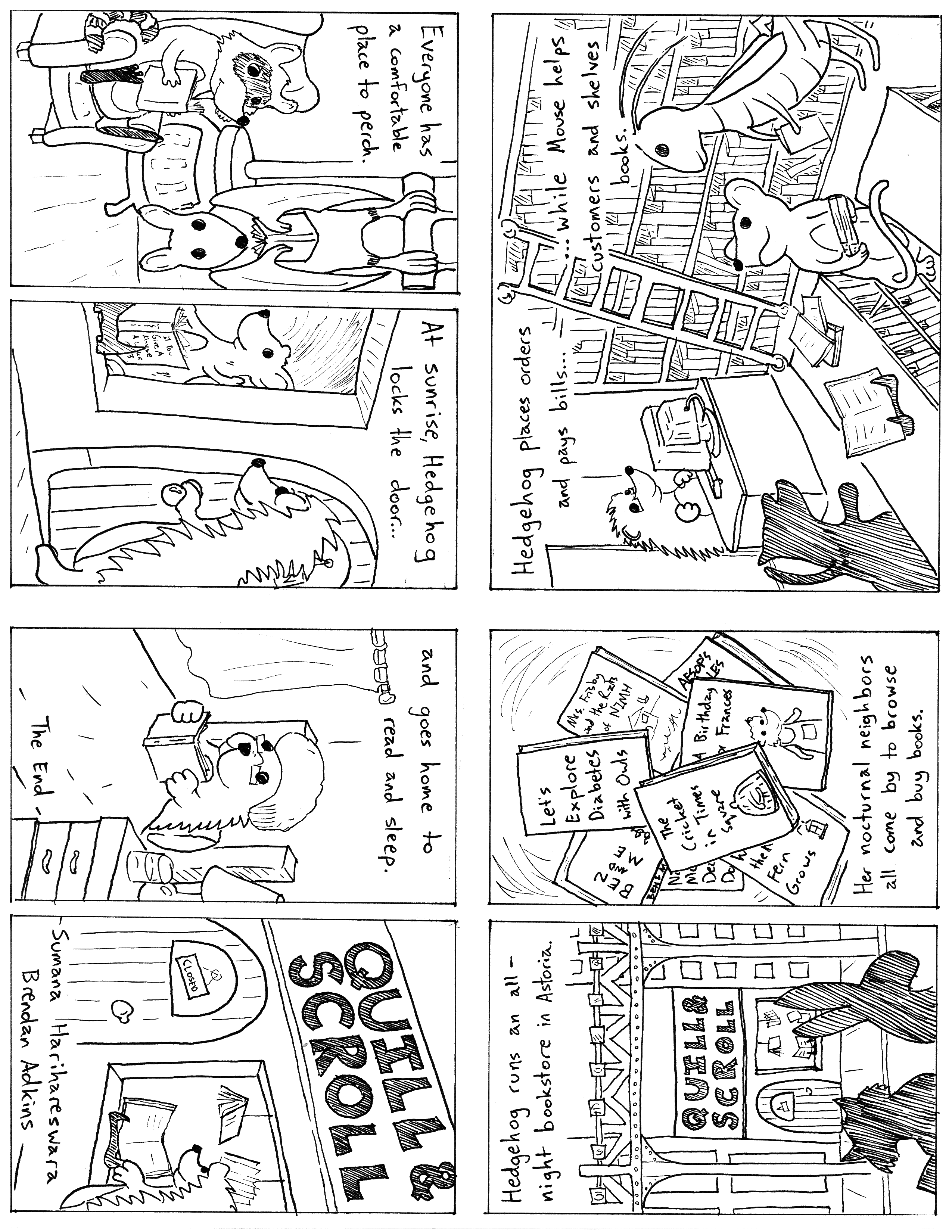
In December my friend Sumana came to visit me. I have a longer entry to write about her, but I want to publish this one first. One night as we were hanging out at my house, she asked if we could make something together. So we got out pencils and paper and we did!

What we made was zine, a sort of companion piece to a zine she worked on with a different friend about animals who run bookstores in the Bay area. This one is about an all-night animal bookstore in Astoria. Sumana wrote it and I drew the pictures, and—I must emphasize this—it is completely adorable.

You can download it and print it out yourself if you would like to. It’s in the “8-sided zine with one cut” format, no tape or staples necessary. Here is the Quill & Scroll PDF and another PDF with no margin, which may make for easier printing. And here it is as an image.

Quill & Scroll

This work is released under a Creative Commons Attribution 4.0 license.

By now all this is past the point of relevance

But it needs to get written down anyway. On Saturday morning, September 7th, I woke up feeling grumpy about the way nerds had treated my friend Elizabeth and made the following series of ill-advised tweets.

If you see the numbers under those widgets you can see that they became the most far-reaching things I have ever written. I did not plan for that. They were tossed off, poorly thought out, and not particularly intended to stand in the record. This took a while to dawn on me, and when it did, I considered deleting them. I chose not to mostly because it wouldn’t undo anything, and because I should be held to account for my words.

I failed as an ally and a writer in several ways by writing what I did. The most significant and glaring is that I didn’t ask Elizabeth before posting them. That’s enormous. She and I had talked privately about the abuse she was getting, so it was on my mind, and I am so used to violent misogyny being directed at women who point out flaws in popular culture that I failed to consider her public stance about it. But even if she had discussed the hate more openly, I still should have asked. At the very least I should have reconsidered using her twitter handle, which made it even easier for a new wave of garbage to find her.

Also, as several people have pointed out, those three tweets are not exactly an iron syllogism. Elizabeth wrote a strongly worded post taking a strong stance against PAX; all I did was briefly express disappointment. I still think someone with a feminine name and icon would have received more abuse than I did for that tweet, but I certainly am not doing the kind of work Elizabeth does, and should not have tried to accord myself her stature.

There are other things about my phrasing with which one might well take issue, but those two are the most basic and important: I didn’t show my friend the respect she deserves. I can’t undo that, but the least I can do is point out for other people who want to be allies where I went wrong. I hope this helps someone else avoid a similar mistake in the future, especially if that someone is me.

As for the original matter of the controversy, I’ve been wrestling with it, but the simplest way to put it is that I take a version of Elizabeth’s view. I’m not going to PAX in 2014, I’m definitely not volunteering there, and I won’t be back unless and until they demonstrate change from the top down. It won’t be enough for PAX to come up to the standard of games conventions; from here on they’ll have to be twice as good as everyone else to make me consider attending.

I have dear friends in and around the Penny Arcade organization, many of whom work tirelessly to create safe space, and I’m not going to spurn you or your work for being involved with PAX. But I will say that attending any conference without a clear, detailed, rigorously enforced harassment policy is a bad idea. PAX rose to that standard in 2012, but when internal pressure from the volunteer corps relented this year, they failed again. That alone is a valid reason to stay away.

Some people can’t do that. PAX is a big part of how money works in games, and if the choice is between taking a stance and making your rent this year, I don’t have the moral authority to stand in judgment. I hope you’ve got other avenues for promotion too, though. I won’t see you there.

This isn’t even counting BAX, which would technically make this year’s begin in fucking February

There’s this thing called con season. It is mostly called that by people who make and sell things at conventions, which are warm-weather phenomena, beginning in March of each year and winding down in the autumn. I don’t currently sell things, but I find myself talking about it anyway, because con season has been the dictator of my travel plans for several years running.

There’s Gamestorm twenty minutes north of me, in Vancouver, Washington, and then there’s a local house-sized gathering called Nemocon in May. June sometimes has a Fabricated Realities in Olympia and always (I hope) has Go Play Northwest in Seattle. This year, for the first time, I am flying to Indianapolis to go to the nerd-gathering granddaddy, Gen Con. (It’s hard to explain exactly why I’m going in much the same way that it is hard to explain why Indianapolis holds a convention named for Lake Geneva, Wisconsin.) And then there’s PAX in September, and Geek Girl Con the month after that, unless I go to Indiecade too–and then at last we rest. Until it starts again.

It’s kind of grueling. I’m going to have to cut back in 2014: I want to travel more outside the US, and save money, and this shit devours that budget. But what do I cut? The answer would be easier if “what” didn’t so easily swap out for “whom.”

There are a lot of variations on the con circuit: some people do tech conferences, some people do sci-fi cons, some people do cultural gatherings or music festivals or films and documentaries. All these gatherings have a rationale for getting lots of people together at a specific time and place, but over time, I suspect, the rationale becomes just that. I used to go to gaming conventions to play as many games as I could fit into a weekend. Now I play games at gaming conventions because that’s what my friends are doing.

Weddings, funerals and cons. You don’t get together just to do the thing, you get together because the thing you do is the way to concentrate as many of these far-flung people as you can. Many of the people I love are locative: available in a specific place at at specific time and then too quickly dispersed. Jackson and Avery and Joe and PH and Matthew and Chris and Elizabeth and John and Shannon and Paul and Tony and Daniel and Twyla and Andi and Ryan and Lily and Will and Lisa and everyone I’m forgetting and everyone I have yet to meet. We only get so many rounds of this, in the warm season of our lives, and it’s hard to think about missing any of them.

Sandbank Diner

For my 10,000th tweet I created the monster called RealBrendan. When I noticed that I was approaching 15,000, I wanted to do something along the same lines, if possibly a bit less splashy and horrifying. I’d been playing around with the “real name” field on my Twitter profile, disturbing a lot of people by changing it to Dank Nerd Basin (an all-too-accurate anagram of Brendan Adkins). When I went to visit New York last weekend—a great trip I should really write up here as well—Leonard, who was also graciously hosting me, helped me unlock this particular weird joke.

I’ve crowdsourced my name. If you mention @BrendanAdkins in a tweet, and if there are 20 or fewer characters in that tweet (ignoring URLs and usernames), and if those characters contain a B, R, E, D, A and two Ns, the new bot will pick it up and set my “real name” to that. It checks in ten times an hour, and it takes the most recent valid submission.

A lot of people were doing full anagrams or superset-anagrams yesterday, which were delightful—And Snark In Bed, Nard Skin Benda, Danken d-brains, Kind Banner Ads, BADSKINNY DICKKISSER—but you don’t have to work “Adkins” into it at all if you don’t want to. As of this writing, it’s “Brendan poops?!?” and I encourage you to make it anything else as soon as possible. (THANKS, ANNE.)

Peer to Peer

I worked for the Centre College IT department during my senior year. It was 2002. BitTorrent hadn’t reached critical mass yet, and the filescape was fragmented: finding music or software cracks meant risking your boot sector on Kazaa or Limewire or eMule, and I spent weeks cleaning malware off the computers of those who tried. Even so, I knew I had it easy. Just a couple years beforehand, IT had been dealing with Napster.

I had been part of the problem myself, then. Music is so ubiquitous now, from so many services, that it’s hard to remember when it only came in physical form. I only brought a couple dozen CDs with me to college; they, and what my friends would loan me, were all the music I could listen to. Then I downloaded this piece of software, and—while the network creaked and shuddered—my Dell became a boundless playground.

There was so much weird stuff out there, and so many obscene delights: old TV themes, rap skits, Prince B-sides, that wildly misattributed cover of “Gin and Juice.” Oh, also every song I’d ever wanted. Before the advent of decent portable MP3 players, we burned teetering stacks of sharpied CDs, or stuffed them into fat binders; we blew out car stereos and hijacked theater sound boards. Most people go through some kind of music epiphany in college, but I’ll never be able to separate my own from the opening floodgates of P2P distribution. It couldn’t last.

The courts didn’t really kill Napster: money did. I’m afraid for Twitter.

Twitter has to start making money. They’ve decided to make money via advertising. Faruk Ateş can explain why that’s a bad idea, both in selling one’s users and in stifling innovation. I wish I could just pay Twitter to let me keep posting from my third-party client and stop serving ads.

Yet I regret intensely paying to join app.net. Everything I love about Twitter comes from the fact that it’s free, anonymous, open and inclusive: my broke friends won’t be on app.net, nor will the horse books or identity thieves or psychotropic stumble-spelling genius joke poets. But will they be on Twitter? Or will Twitter fuck this up and immolate itself by cash?

It’s mindlessly easy to get music now: free if you want it, fast if you pay. But there’s no playground. The weird is dead. I have no doubt that we will retain the ability to type out 140-character sentences in any number of places for some time to come, and I know that the (vast, vast) bulk of those sentences are throwaways. But some of them are the best sentences we have yet made in English, and they can only exist in the atmosphere of Twitter, the alacrity and transience and irony and fierce, fleeting joy.

Right now, I can carry 281 people I love in my pocket, and pull them up whenever I need to learn something new. Twitter is how I talk to the world. I know this isn’t entirely healthy, but intoxication rarely is. For the second time in my life, I’m high on sharing, and I don’t want it to end.
The time, the distance and the price

This post contains spoilers for Constellation Games up through chapter 30, but it’s not really a Constellation Games post; it’s about Starslip, and contains spoilers for its ending.

I’ve connected the work of Kris Straub and Leonard Richardson before, and not just because they both wrote serialized stories that trade heavily on the importance of artwork in space, calling things into being with poetry, and a pure-thought immortal hivemind end-stage of all life protected by a group of mortals. I could do that thing where I try to assert that they both take place in the same fictional universe, but I’m not going to, in part because the idea of hopping around between infinite possible universes is kind of the point of Starslip.

But I do think they have one thing in common, across all of those:

The One True Pairing phenomenon is real, but it’s a curse. Any two parties so affected are the Keymaster and Gatekeeper of a door that opens into stark, existential horror.”

“Wherever there is a Memnon Vanderbeam and a Princess Jovia, the former seeks the latter. And they never get together. It just. Doesn’t. Happen.

The last Starslip is bittersweet, and a lovely conclusion to a long story. The subtext of the whole conclusion arc, though, is incredibly dark. Out of all infinity, there is exactly one timeline in which Vanderbeam saves Jovia, and he has to make enormous sacrifices to do so, including his own life. The comics we saw in Starslip depict that timeline, but what happens to them in the uncountable others? Uh, this kind of thing.

That’s what I think Jenny and Ariel understand when they kiss. Ariel sees the horror, the mind-destroying vastness of possibility in which they will always be apart. Jenny sees the hilarious impossibility that maybe this is the right timeline, and Copernicus is wrong, and they are the center of the universe after all.

I think that at the beginning, Starslip’s daily punchlines masked the weight it carried in its core, but it carried it all the same. The impact of that weight landing, seven years on, was incredible. It deserves assessment, and I hope to be able to give it some as it restarts its run from the beginning as (!) a syndicated comic. Re-read Starshift Crisis.

Story Hacks: Tenth in a Series

Did you know that when you describe something in terms of a color, you are also describing it in terms of symbolically? It’s true! Here are the many things that colors can represent in fiction.

  • Black: awesome death stuff, bad people, sex workers
  • Red: blood, bad people, sex workers
  • White: non-sex-workers (don’t overdo this)

That’s all! You can go home now.

Today’s Hack in a Nutshell: WHAT other colors

Story Hacks: Ninth in a Series

Bear with me, because this S is about to get C, but there are times when—by sheer demographic necessity, or just to be different—you may want to write about a female protagonist. “What?” I hear you say. “But then how will I make my readers care about anything that happens to her?” I know it seems impossible! But there is a simple solution to this problem: Sexism.

It seems hilarious now, but in the misty past of yore, Sexists ruled the land and would frequently make girls feel bad for not being as good as men. To subtly indicate that this controversy will be your subject matter, have a man smack your protagonist on purpose in her butt area, then join his friends for a group smirk over cigarettes. I bet your spunky chick blows her hair out of her face and looks mad to show that she didn’t like it! This is classic Sexisy, one of the three unforgivable narrative sins. (The other two are kicking a dog and saying the “f-word”) (“fat”)

Now that we know who the bad guys are—the Sexisms—and who the good guy is—the girl—have her secretly practice being just as good as a man at something only men are good at. She wants to show everyone what she can do, of course, but how can she? She has too many female emotions!

Fortunately she will meet her savior: a bad boy with a good man inside him, who can learn that women are people too once she beats him at archery or boxing or whatever. Then, when the evil sexist goes crazy but not exactly because of our heroine because she’s really not a troublemaker, she and her new boyfriend can team up to defeat the metaphor once and for all! Now your audience has learned that females can solve almost all their problems, with help from men. No more sexistry ever! GIRL POWER!

Did I mention that she should be super hot but in a kind of tomboy-y way? That’s important.

For bonus points, make the villain a mean lady, to show that really the whole problem is chick-on-chick violence. Now that you’ve solved sex, you can do the same thing with racism! Instead of a heroine, just substitute a hero who is not white, then whoops I am being thrown from a moving car at freeway speed

Today’s Hack in a Nutshell: UNGH thudthudthudthud thud thud scraaaaape, CRACK

whoooshhh

whoooshhh
whoooshhh

N-player co-op

This is a Constellation Games post. Spoilers for the chapters that have already gone out to subscribers.

From late in Chapter 14:

“I don’t need to learn English,” said Ashley through her chopped-up resampled vocalizer. “The translator is a benefit embraced by the median person and shunned only by snobs who want to show off their own erudition and enlightened attitudes.”

“Wow, I guess you feel pretty strongly about it?”

“That translation went on a lot longer than it should have,” said Ashley. “That was four words in Purchtrin. I don’t know what happened.”

A couple paragraphs earlier Ashley mentions that the idle work she’s doing when Ariel shows up is “part of the History of Life overlay.” This is a subtle thing, and easy to miss amid what Leonard calls “the Gift of the Magi-esque farce about the English lessons.” When some subset of the Constellation wants to achieve something, they form a loose asynchronous working group called a fluid overlay. Where does Ashley work? In some fluid overlays. Where did Ashley’s translator come from? A fluid overlay.

The overlays aren’t an allegory, but they are a device Leonard uses to comment on leaderless organization in real life, inspired (I suspect) by his career in open-source software. Of course, the last six months have seen another set of nonviolent, leaderless organizations leap into prominence to remind us that scarcity-based power structures fuck everybody. Remember back in the commentary for Chapter 3?

“You’ve seen the anarchists in Austin. They couldn’t hold a city park.” is one of those lines that shifts connotation dramatically between the time you write it and the time it’s published.

Whether you take the correspondence as timeliness or startling prediction, the popular criticisms of Occupy reveal the flaws in the overlay idea, which the Constellation presents as a sort of labor utopia. In Chapter 13, Ariel found flyers from the Raw Materials overlay begging humans for their garbage in Human Ring, where there were… almost no humans. The Constellation can do miracles, but sometimes those miracles lack direction.

Just as often, the overlays lack accountability. In Chapter 9, Ariel tried to find somebody to thank for the English-language CDBOEGOACC; when he asked who was in charge of creating it, Curic’s response was “that’s not a real question.” So who snuck that rant about language snobbery into Ashley’s translator? Here, have an achievement graph with ten million nodes.

The translation is a throwaway gag, but it’s also foreshadowing. Sometimes overlays work at cross purposes. Sometimes they’re hard to track down. The other foreshadow in Chapter 14 is the first appearance (and disappearance) of, yes, the long-promised shipping container. Curic’s part of the Constellation Shipping overlay, yet he or she is asking a human for ideas about where it might have gone.

In doing so, Curic presents a neat alien mirror to Krakowski and Fowler at the BEA. All of them are now using this unemployed video-game blogger from Austin as an asset, overtly or otherwise. How desperate do you have to be to turn to Ariel for intelligence? We’ll find out!