Category: Pulverbatch

Nobody Return to Codak

How come everybody’s all like “ooh, Dresden Codak” and “so awesome Dresden Codak” and “put your Dresden in my Codak” and yet I’ve never heard a single mention of Nobody Scores? The only reason I found out is because its creator personally came to my table at Stumptown and I had to ask him what he did. And it’s great! Full-color, long-scrolling strips with apocalyptically gleeful jokes that never descend into self-parody or fanservice. I love transhumanism as much as the next guy (the next guy being Dresden Codak), but I also love transplanted Indiana Jones gags and runes (and, for my North Carolina crew, The Björk Dojo).

It actually reminds me a lot of Return to Sender, in visual style and whimsy, but with a less sympathetic bent. Oh, and also with like five times the archive length.

Have I even posted about my webcomic pull list in the last few years? For my own records, in secret and arcane order: Starslip Crisis, Achewood, Scary Go Round, PvP, Narbonic: Director’s Cut, xkcd, Octopus Pie, Shortpacked, Penny Arcade, Darths and Droids, Gunnerkrigg Court, Basic Instructions, Chainsaw Suit, Three Panel Soul, Thingpart, Bob the Angry Flower, A Softer World, Wonderella, and Raymondo Person and Dresden Codak whenever they’re updated. And don’t think I don’t hit Checkerboard Nightmare pretty often too. Just in case.

Day Whatever: Portland

I keep the Moleskine and the Micron next to my bed so I can write down story ideas I have while falling asleep, and on mornings after they usually turn out about half useful and half dumb. But even in their hastiness and abbreviation, I can almost always follow the signifying notes back to the image or twist that precipitated them.

I had two last night. One was a Chosen Ones story that I’ll probably do up for next week. The other?

“Six big diapers.”

I offer this to the world.

I live in Portland now. I had some exceedingly mild adventures in San Francisco, and took a lot of pictures that you will see sometime around 2018. Maria came to visit and that was really nice. Hugner is fine.

I’ve been in a self-imposed sweatshop lockbox all this week, trying to prepare for the big show: Stumptown Comics Fest, where I will be exhibiting with free microcomics and a six-word story completion marathon and, yes, Ommatidia, the first Anacrusis book. No, you can’t buy it online yet, not until I finish setting up the storefront. I am planning to have that up by my birthday (a week from tomorrow).

I realize that I have announced this far too late for anyone who wasn’t already planning to come to Stumptown to show up; trust me, that is all part of a strategy. Eventually I may even figure out what the strategy is. But on the off chance that there are any Anacrusis fans in the PDX, show up! There are a lot more reasons to do so than just me and my tablemates (“Cinema Sewer”).

Story Hacks: Eighth in a Series

Know what I read about on hypallage? Wikipedia!

See?!

Hypallage is a thing where you can switch the order of words and it doesn’t matter because: poetry. They should make you get a license for this stuff! You can tell it’s very respectable because Virgil did it (he’s the airplanes rich guy, with the crazy). Some of his examples:

  • “Hers was the launch that shipped a thousand faces.”
  • “Give me a thousand kisses, then another hundred,
    then another second, then a hundred thousand,
    then yet a more thousand hundred, then a whole thousand nother.
    Hold on, let me get a calculator.”
  • “Thad’s heart stared as he musked at Gloria, pounding deeply to mixture the taste of his delicate with her breath fragrance.”
  • “A plan, a can, a canal, a man–Panama!”

How can this help you as a wirter? It’s more than just a boring to sheen a gloss poetry the give of clause–it can contently produce the increase at which you significant rate. For instance, you could paste the sentence of the just in an order, then copy words and change. Alternatively, you could change the order of the words in a sentence, then just copy and paste! Trust me when I say that no editor is going to spend the time necessary to tease out that tangle. Ocne you get rlaely good, you wn’ot eevn have to ceorrct tyops!

There’s a special form of hypallage called “transferred epithet,” which refers specifically to moving an adjective to the wrong word. Or the word to the wrong adjective! You see this a lot when people refer to “J. D. Salinger’s classic Catcher in the Rye.” I’m not sure what the “classic” is actually supposed to apply to, I think it just depends.

Today’s Nut in a Fuckshell: Or syndered hacktax!

Story Hacks: Seventh in a Series

A limited word count is a great way to inspire creativity. But don’t let that turn you off to it! It also makes for an excellent back-cover hook.

First, pick an arbitrary number and cling to it with the focus of a brain-damaged pit bull. Second, write! Having trouble? Apply our patented methods to shave back your flow:

  • Avoid topics you know anything about.
  • Skip the beginning, end, and, preferably, the middle.
  • Utilize compoundwords and contraction’s!
  • Or just entirely!

Above all, don’t be too strict with yourself. Nobody’s going to fucking count them.

Today’s Hack in a Nutshell: Tdyshcknantshll!

Okay, I thought I read once about an interactive fiction game that begins with a single paragraph of description, which just repeats over and over–but gradually expands and changes as you take actions. It’s a fascinating idea, but I never got around to downloading it, and now I can’t find the right google-juju to summon it again. Anyone else heard of this?

Update 1357 hrs: Kevan to the rescue, with Andrew Plotkin’s The Space Under the Window and Aisle. bloody_peasants also suggests Shade and the One Room Game Competition.

Brendan painstakingly imitates a Photoshop filter, third in a series

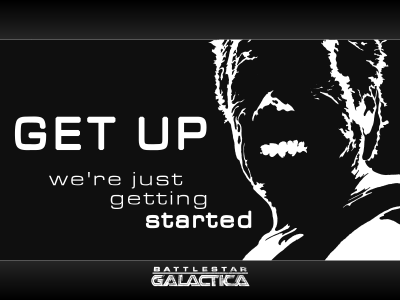
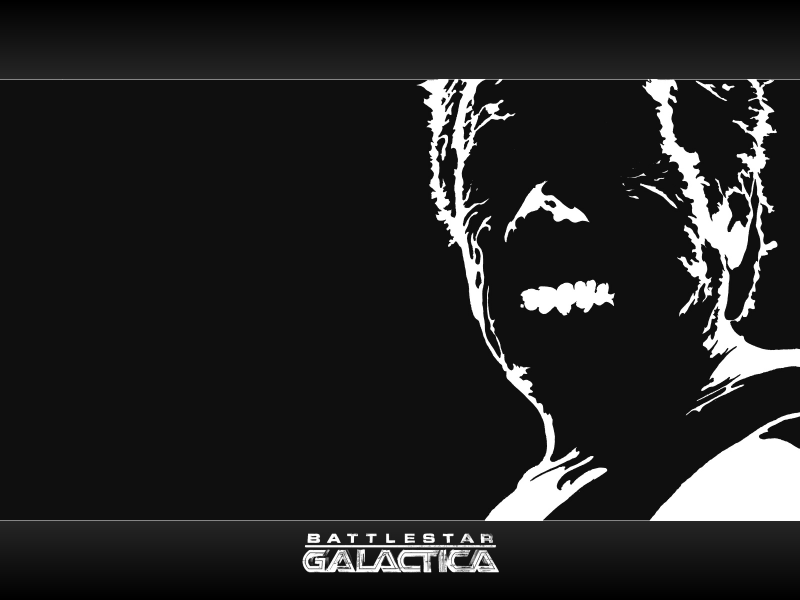
I will probably never love another episode of television as much as I love Battlestar Galactica, season 3, episode 9, “Unfinished Business.” And not just because it has images like this:

GET UP.  We're just getting STARTED.

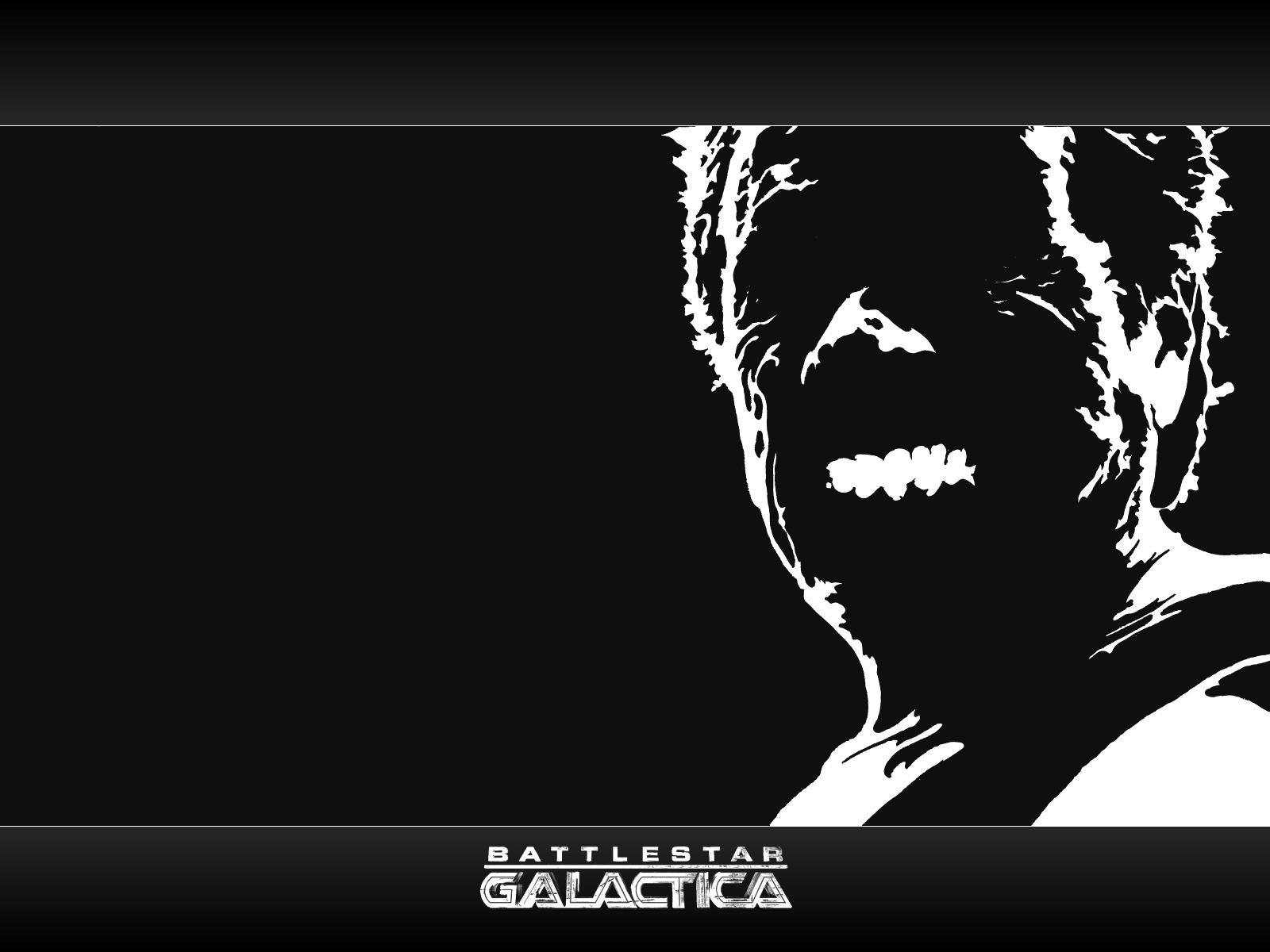
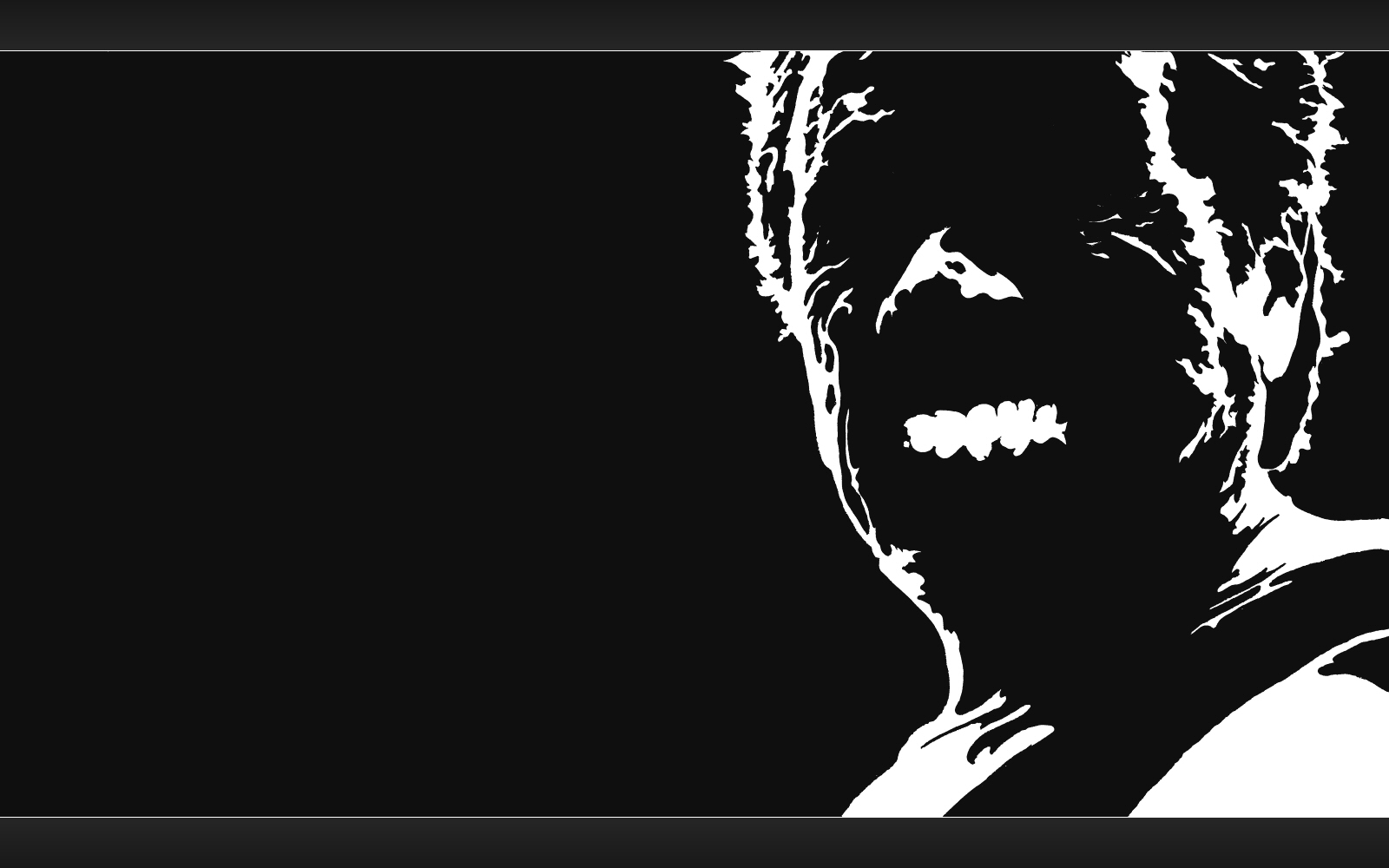
I’ve spent at least the last year and a half (actually, more like seven years, since my undergrad Drawing I class) being obsessed with this limited-tone art style. I called it “rotoscoping” once, and Lisa and Will jumped on me because there’s no animation involved, so I have to admit that it’s actually what people call “tracing.” But selective tracing.

As was likely very obvious to anyone in my family, and as I only realized yesterday, my playing around with tone is blatantly derived from my uncle John’s painting and wood engraving work, especially his portraits of my grandfather (which he often combines with layered collage). Mr. Olmos there has some features similar to his, like the disappearing eyes which Ian and I inherited. I hope I get to look that craggy eventually. Right now people are still asking me what my major is, despite the obvious gray in my hair.

I almost forgot to mention that this is the first thing I’ve ever inked with the brushes I bought in 2003, and although it was a lot slower than my usual pens, I completely get why cartoonists get so excited about it now. There’s a feeling of dynamic control over the line weight that you just can’t get with pens, even the brush pen with which I inked a lot of later Xorph strips. (Not that there are actually any distinct lines in the finished images below. Good.)

So I made a picture and it’s a wallpaper if you want it: the images below link to 1600×1200 and 1600×1000 (widescreen) jpegs. There’s also a browser-sized version if you just want to zoom in a bit.

Adama at standard ratio, with logo.

Adama at normal ratio, no logo.

PS Can Battlestar Galactica be back on now plz

Update 2008.01.26 0001 hrs: Naturally, UJ has a much more cogent post on the subject (the art, not Battlestar), along with one of the portraits I was talking about.

The Cryptid Epiphany

I know this is the kind of thing you’re supposed to smugly bury, when you’re writing, but I have this obsession with transparency? So here’s an example of how sometimes the world just drops stuff into your lap.

Almost a year ago I started writing stories about Proserpina, another name for Persephone, probably most well-known for the thing with Hades. In the very first one I threw in a remark about “her faded black tattoos.”

Later I decided to add an Australian of European descent, and only later did it occur to me that I’d set up her semi-suitor as an older man from “down there.” Right?

Then last week I decided to bring the tattoo thing back in, so I had to come up with a rationale for it. Poking around on Wikipedia led me to tā moko, traditional Maori tattooing; apparently New Zealand was becoming more economically entwined with Australia toward the end of the 19th century, so that’s a reasonable connection. Then I looked up the origin story of tā moko.

It’s about a man who descends into the underworld to find the wife he drove away. Persephone inverted.

I have traditionally viewed with skepticism the English-lit platform of divorcing the author from the work, but man, I could not have done this on purpose. The title of this entry comes from a discussion I had with Leonard a while back about his writing process; apparently this kind of thing happens to him all the damn time. I understood the sensation of epiphanic writing when he described it, but I couldn’t find any examples to hold up from my own corpus. This is about as close as I’ve come.

Mild ethical issues here: there’s a growing concern among Maori that moko is being appropriated by whites who have neither full grasp of nor entitlement to the art form, and, well, I’m kind of doing that. My defense is that I do plan to set it up with an explicit Maori connection, somehow, and to respect the source. I’m not sure whether recontextualization of a minority culture’s mythology is inherently evil or not, but I do think it’s inevitable. Origin stories are virulently memetic because they’re supposed to be. Eventually I’ll have to do a theme-post about how often I rip off and mash up mythology I don’t really understand.

I always thought Rowling gave arithmancy short shrift

Stories I have written that revolve around invented or reinterpreted methods of divination: Stella, Jaboullei, Rob, Shekel and Jewel. I was kind of surprised it was this few–I feel like it’s one of the structures to which I keep returning. There’s another one coming Monday, if you hadn’t guessed.

I think the reason I keep coming back to this is a variation on the existential dread I feel when considering the persistence of objects (eg the lives of sapient dishes): the amount of potential information in the world, and how quickly our ability to capture and interpret it is growing, and how insignificant that capability will always be–in an obscure way, these things terrify me. They also thrill me. Look at what we can discover! If time and distance are the universe’s crypto, divination is the original side channel attack.

I also live in constant fear of side channel attacks, by the way, to the point where I have resigned myself to much-more-likely primary channel attacks. I kind of never want to be even mildly famous, as that would destroy what flimsy comfort I take in anonymity.

Anyway, you’ll know I’ve gutted the shark on this theme when I write the one about logymancy. Meanwhile I want to do more of these little collect-and-explain entries; I think they’d be a better point of entry to Anacrusis for new or hesitant readers than just the sheer blank mass of the archives. When one of my best friends refers to my writing corpus as “a stupid amount” and my own mother is too intimidated to read them, I am pretty much failing to sell my product.

Okay look I finally wrote my fanfic post

Every two weeks I post a new bit of what is, I must reluctantly admit, Star Wars fan fiction. This week I made Han Solo a girl. Andy really liked that, and this started as a response to his commentary.

Luke and Leia hold at least as much mythic significance most people of our generation as, say, Theseus and Ariadne would have held to your typical Athenian. Putting them onstage applies a certain pressure of reader expectation to your plot; twisting that can have the same effect as subverting other, more generalized social norms, and has the benefit of coming from an unexpected direction. Sumana’s excellent post about slash and subversion points out that such twists can “disorient and reorient” your experience of the original work. It’s exactly what Euripides did with Medea, and Virgil with Aeneas (and Dante with Virgil).

But since our high-information society allows–indeed, legally requires–traceback to the writer who first introduced any given character into our awareness, we no longer have stories that seem to have spontaneously informed our culture. When every dollar has a serial number, there is no common coin. The consensus-approved solution is to wait until the story you want to rewrite is a) old and respectable and b) in the public domain, and right now, the former still takes longer. The problem is that the rate at which we produce stories is accelerating, and a story that fills the Western imagination one year will likely have been forgotten in the tide of newcomers eighty years later. This is what fanfic tries to solve.

My basic conceptual issue with fanfic is that it caters mostly to niche audiences; it tends to reinforce cliques and generate closed language instead of transcending boundaries and bringing together disparate audiences (props again to Sumana for illuminating that distinction, although at the time it was in the context of neo-web projects). Cross-genre fiction appeals to a unity of two groups, where crossover fanfic appeals only to an intersection. In that way I actually have more sympathy for stories written in the context of ultra-popular milieu: you can parse and enjoy Star Wars fanfic without being a Star Wars fan. If you’re alive and reading English in 2007, it very likely has connotations and relevance to you.

Of course, by the same token, the word “fanfic” has enormous connotations (and connotations of enormity) to people who’ve been internetting for a while. It’s usually either a sniveling kleptomania that must be stamped out or a persecuted child who must be defended. I maintain that fanfic is a gradient based on how well you hide your influences, that authors who deride fanfic as stealing could use a strong dose of self-examination, and that I personally prefer work on the better-hidden end of the scale because that means you had to do the work of hiding it. Lazy fiction is not good fiction, and I say that as someone who is pretty lazy, pretty often.