My brother graduated! From college! CONGRATULATIONS, IAN!
Category: Family
Obligatory reflection
Thanks for everybody who called, wrote or commented to send me birthday wishes, and to all the people who showed up at my partylike entity. You’re all great! And I am made happy by material possessions: DC gave me more of the awesome restricted-access Actors Theatre notebooks, and Maria gave me about a jillion books and DVDs and an ice cream cake and apparently something else that hasn’t arrived yet, and Lisa gave me–exclamation marks!–my first-ever illustrated story! (Of Fortado.)
Despite my inexplicable knee-jerk belief of the past several months that I’ve been 26, I’m 24. Tonight I sent off the third-to-last thing I have to do to graduate. Almost done.
It doesn’t honestly feel like I’ve lived in Louisville that long. I feel so much more competent now, in so many areas, than I did two years ago: working with humans, writing code, writing, traveling, using public transportation, applying the principles of aikido to solve nonphysical conflicts–all the things I want to spend my whole life doing.
Also, I think this is the year my brain starts dying!
Pookie
He was a canine Houdini, absolutely brilliant at escaping whatever fences, gates or other barriers we could set up to keep him safe. He was brick-stupid about everything else: glass doors, bigger dogs, cars. Those two things in combination don’t make for a long life expectancy; it’s kind of surprising that he lived to be eleven.
Pookie was always nominally my dog, although Ian took care of him more often, and after we moved out he was really my mom’s. She found him, Friday afternoon, on the wrong side of the fence around Kelly Ridge. There wasn’t any real evidence of what exactly happened. Could have been a car, or another dog, or some unknown medical problem.
He was a shih tzu, the kind you see like little furry hovercraft on shows: glossy, legless, gliding. Pookie never looked like that. His fur was short, tangled and dirty; he smelled like a dog. He lived outdoors, and always seemed satisfied with that.
After Mom sold the house, Pookie spent much more time with Joe and his giant antisocial dog, Greg Brown, out on the ridge. I don’t know how Greg and Pookie first behaved around each other, but by the time I saw them together they were inseparable. Pookie was already nine, but he acted like a dog finally growing up: his body got thicker and more muscular, and he seemed more reserved, less goofy. Greg never let anyone he didn’t trust near his protege.
When he was wet he looked like a rat, but when his hair was just the right length he looked like those Chinese statues of lions. I’ve never met anyone more confident, or more trusting, or who spent his entire life in such a happy mood.

Nobody in the church actually calls it “the last rites,” you know, although nobody had any doubt what it was when the Pope received it. The sacrament is most commonly called the Anointing of the Sick, and it’s performed in many cases of serious illness that incur the danger of death, not just terminal conditions. It’s a ritual of enlightenment, comfort and cleansing, not a funeral rite. My father received his Anointing while he could still walk and feed himself.
Maria brought it to my attention some time ago that I tend to assume everybody knows the story of my family in the early part of the last decade, when in fact I know a lot of you only through the interweb, and I’ve never actually written it up here. I’m correcting that omission today. I’m not entirely sure about all these dates, but I’ll change them if I’m wrong.
When his time in the service ended, he earned a technical degree in engineering at DeVry University. He and my mom were married in August of 1975, and they moved to Georgetown, Kentucky, in 1978. I was born in May of 1981, my brother Ian in October of 1982, and my sister Caitlan in August of 1984.
The house we lived in was called Ivangrad, pronounced like a Russian city (although everybody called my dad “Wayne”). It was a big old place with an ancient well on one side, lots of stovepipes and no working chimneys. It was falling apart when they bought it; my extended family rebuilt it from the inside out before and during my childhood. Some of my earliest visual memories are of heat shimmering off the paint strippers held by my uncles and aunts, and of watching my toy cars disappear as Ben McBrayer and I dropped them between the studs where the drywall was missing.
In 1987, my dad was diagnosed with non-Hodgkin’s lymphoma. He pursued several avenues of treatment, including both traditional and holistic medicine. I think it was also around this time that he became a vegetarian. I don’t remember a time when I wasn’t aware that Dad was sick, nor do I remember any particular disambiguation on the subject, so I assume that my parents told me from the start what was happening–not that I, at six, had any solid grasp on the concept of metastatic cancer.
We moved to Richmond in the fall of 1989, in part because it meant a shorter commute to Dad’s job at the Lexington-Bluegrass Army Depot, in part because it was also a shorter trip to the hospital where he was undergoing outpatient chemotherapy, and in part because my parents wanted a newer home where my allergies to dust and mold wouldn’t be as much of a problem. The new house was called Two Trees. It was the only house with any trees at all in our subdivision–a huge, beautiful sycamore and a smaller catalpa.
Dad joined the RCIA program at St. Mark parish not long after we moved, and was confirmed Catholic at the Easter Vigil mass in 1990 (he’d already been attending Mass for years). He received his Anointing of the Sick near the end of 1992, on his feet, at the university’s Newman Center in Richmond–none of us can remember why it was there instead of at St. Mark, but we’re sure of that.
He entered St. Joseph hospital in Lexington as an inpatient in January of 1993, where his condition steadily declined. He’d been bald for some time by that point, but his facial hair was growing back, which seemed to bother him. He wasn’t allowed to shave, of course; the chemo kept his red cell count very low, so any nick would have been dangerous. He had my grandfather sneak him an electric razor, so he could surprise us with a smooth face. It worked, but his skin was so tender that he cut himself anyway.
He lost the ability to feed himself, and to speak clearly. He was always hot and thirsty. There was a cup of chipped ice next to his bed, and when I came in to sit with him I’d feed him from it with a plastic spoon. My mother taught me how to let it melt a little first. One chip at a time, she’d tell me. Be careful. Go slow.
It’s little surprise to anyone, I think, how much my siblings and I hate the smell of hospitals.
My father is very large in all my memories. He was quiet, and spoke most often with his great strong hands, which knew perfectly how to hold tools and keyboards and children. It must have been heavy irony to see me, small even for eleven, feeding him with a spoon he couldn’t lift anymore. I wasn’t conscious of it.
Dad died on February 17, 1993. Other than the normal blankness, I don’t remember any strong symptoms of denial, though I certainly made my share of mental bargains. My sister, more classically, spent some time after his death believing that Dad was a heroic covert agent, undercover and far away, on secret missions. She was eight. It’s not hard to guess that she’s always been a person of tremendous faith.
I’ve only ever had three dreams about him that I remember: one in high school, one in college, and one a couple of months ago. The first two times I was suspicious of him, untrusting; I knew he was an impostor.
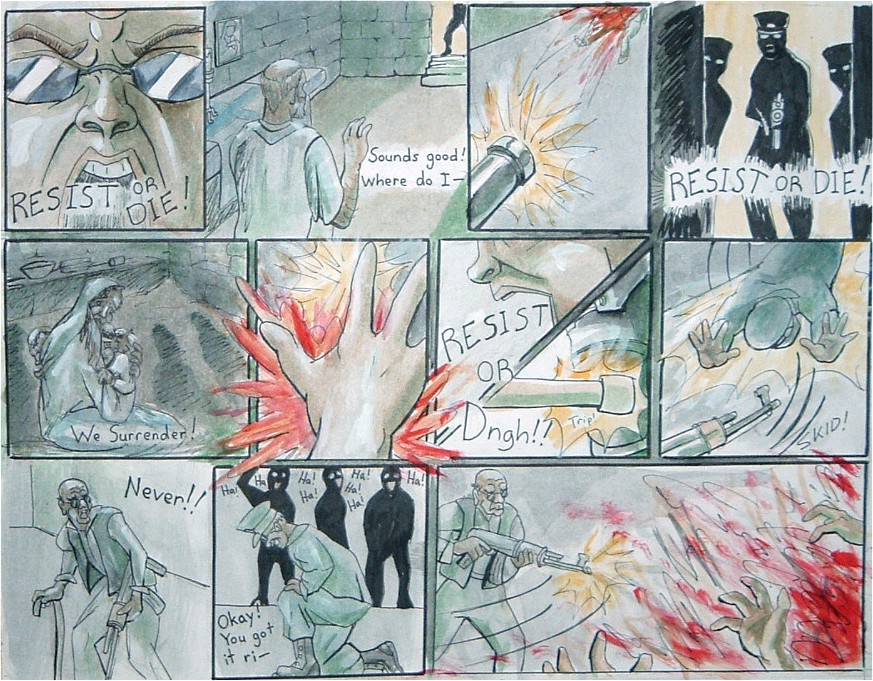
I had a comic-book biography of the John Paul II when I was younger. Its most affecting part was its description of his life during and after the second World War. He had a great deal of contact with the Jewish community-turned-ghetto in Krakow, and he worked with underground resistance to the German occupation.
Hitler wanted badly to eliminate the literate and cultural power of Krakow. He failed. I didn’t understand the symbolism of this image when I read the biography, and I’m sure now that it’s not literal. It’s remained with me anyway: Karol Wojtyla, postulant priest, stealing into a bombed-out library to pull books from the rubble. Covert. A hero.
I’m glad to say that Bruce’s condition is improving. My uncle John is closer to the situation and has more info, so I’ll direct you to his journal instead of just repeating his entries.
My cousin Bruce is critically ill in a hospital in Indianapolis. He’s had a transplanted kidney for the last seven years, and things have often been a little rough with it, but this time a viral infection in his pancreas seems to have caused it to fail entirely. The last I heard, things were improving slightly for him–they reduced some of the swelling and fluid buildup, but he’s still on oxygen and morphine. I hope things continue to improve.
Bruce lived with my family for a while, when I was in middle school and he was taking classes at EKU. He brought with him a huge and nearly comprehensive collection of first edition AD&D resource books, miniatures and modules, not to mention games like Paranoia and Gamma World. When he moved out, he left them to me. It was a huge and valuable gift, magnified by who I was (and am). I still have every piece of it.
He went to dialysis at the time, of course, and had for years, and would until 1998. I wonder what it was like when he went in for the last time. He showed me the scar tissue that had built up on his arm from the treatments, once, and the image has never left me.
I still call it an answering machine
In case you’ve tried to call me in the last couple of days, or will be trying again tomorrow or the day after, sorry. My mom came to visit and accidentally stole my phone; each of ours is currently in US Postal Service transit back to its owner.
I still have the best answering machine message ever, though. Maybe you should call just to listen to it.
John and Jon
I finally convinced one of my relatives to get a blog! My uncle John, about whom I’ve written before, has already started things off on the right foot with a post about how bad for you blogging can be. I wholly support this!
I’m hosting somebody else’s blog now! This makes me really excited!
Well, actually I host two: Jon, King of Former Roommates, started his songwriting journal back in December and then forgot about it. You’re fired, Brasfield! Hand over your badge!
I should go ahead and make the co-opted Crummy Standing Offer here: If you are part of my family (and this includes more than just my relatives) and you want a place to keep a journal, I will gladly host you.
In addition to Caitlan’s car, which (after its acrobatics last Wednesday) is totalled, Ian’s car is now a danger to drive; he’ll probably have to sell it for parts. Regarding Mom’s van, the mechanic told her to keep driving it for what time it had left, then leave it wherever it broke down.
Jon and Amanda, on their way to Tennessee for Christmas, skidded on ice and ran head-on into a truck. They’re okay, but the car is gone, and Amanda’s collarbone is broken.
It has been a bad December for cars, and for my family; but I am shaken by how much worse it could have been.
A year ago I was writing about the earthquake in Bam. I thought an earthquake death toll of around 50,000 was the worst I’d see in my lifetime. I was wrong, of course.
Update 2330 hrs: And my grandparents flipped their truck on ice on their way to Florida for Christmas. They are also miraculously okay, and also currently without transportation.