Category: Digital Neighbors

“I won’t find out all the ingredients till I’m dead.”

My friend Sumana is pretty spry for a retired newspaper columnist. For years she was MC Masala, syndicated in several papers all over the SF Bay, even after she had left it for the other side of the country. I loved the column and read every installment, and I was delighted to see that she recently resurrected its archives on her personal site, nearly a decade after she began that phase of her career. (As befits her growing skillset and shifting direction, she wrote the CMS for it herself!)

From the beginning, the column showed off her skill (and taste) in comedy, cosmopolitan interest in religion, and clever use of parables from both ancient texts and her own life. I still use this aphorism about books and sandwiches to remind myself how to engage with people at social gatherings. I stole quite a few ideas for tiny stories from her, sometimes immediately, sometimes much later; she delivered insights about the nature of attachment that would influence me for years to come.

Over its run, she let her readers in on landmarks in her life in a friendly, almost conspiratorial way: her move from San Francisco to New York, the concurrent shift from one career to another, her wedding—and even personal connections to events on a larger scale, like the end of glasnost.

She was way ahead of the curve, of course, on relaxing vice laws and marriage equality. She showed up early to the fight against manspreading (and manxiety). She preceded me in getting over Aaron Sorkin, and I took way, way too long to come around to her Brian K. Vaughn fandom. And she made some predictions about herself that were wrong in amazing ways: she does, in fact, now give many thousands of dollars to charity, and one branch of her current unpaid public service uses skills she is still developing, and increasing all the time.

Reading back through these, I felt smug and flattered all over again that I got to make a subtle appearance here and there.

Her final column makes me well up with feeling. I first started following Sumana’s blog sometime in 2001, so right now it falls around the halfway mark in the timeline of our friendship. It’s only gained more meaning to me since the first time I read it—I’d never even listened to the Mountain Goats back then!* To this day, she posts regular entries stuffed with insights and links to explore, whereas I didn’t write a damn thing here for all of 2014. I am so fortunate that I was able to make a connection with her back then, and to have followed her with aspiration ever since.

It’s been almost nine years, Sumana; where are you from now?

I shouted, “Congratulations!” She responded, fist raised, “Perseverance!”

Quill & Scroll

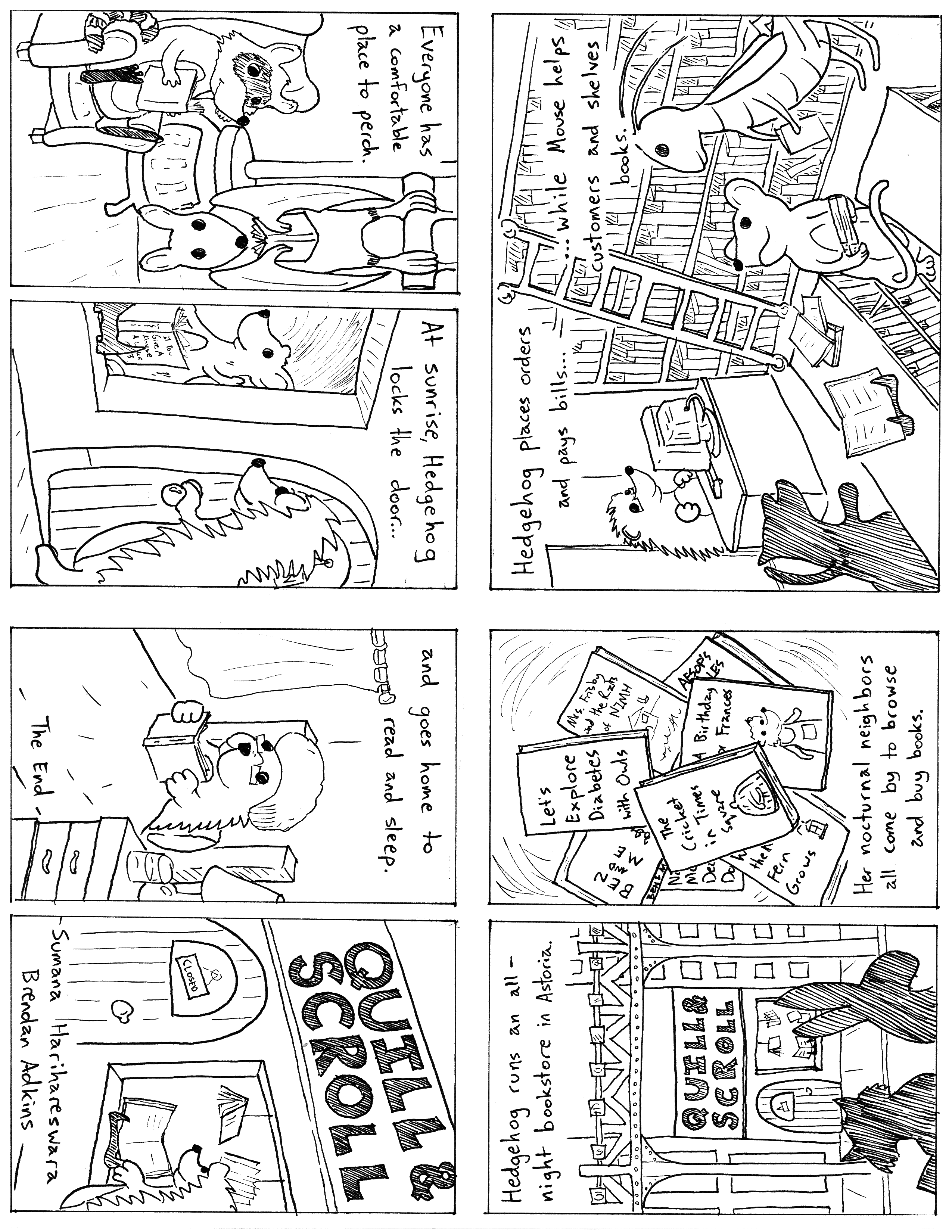
In December my friend Sumana came to visit me. I have a longer entry to write about her, but I want to publish this one first. One night as we were hanging out at my house, she asked if we could make something together. So we got out pencils and paper and we did!

What we made was zine, a sort of companion piece to a zine she worked on with a different friend about animals who run bookstores in the Bay area. This one is about an all-night animal bookstore in Astoria. Sumana wrote it and I drew the pictures, and—I must emphasize this—it is completely adorable.

You can download it and print it out yourself if you would like to. It’s in the “8-sided zine with one cut” format, no tape or staples necessary. Here is the Quill & Scroll PDF and another PDF with no margin, which may make for easier printing. And here it is as an image.

Quill & Scroll

This work is released under a Creative Commons Attribution 4.0 license.

Sandbank Diner

For my 10,000th tweet I created the monster called RealBrendan. When I noticed that I was approaching 15,000, I wanted to do something along the same lines, if possibly a bit less splashy and horrifying. I’d been playing around with the “real name” field on my Twitter profile, disturbing a lot of people by changing it to Dank Nerd Basin (an all-too-accurate anagram of Brendan Adkins). When I went to visit New York last weekend—a great trip I should really write up here as well—Leonard, who was also graciously hosting me, helped me unlock this particular weird joke.

I’ve crowdsourced my name. If you mention @BrendanAdkins in a tweet, and if there are 20 or fewer characters in that tweet (ignoring URLs and usernames), and if those characters contain a B, R, E, D, A and two Ns, the new bot will pick it up and set my “real name” to that. It checks in ten times an hour, and it takes the most recent valid submission.

A lot of people were doing full anagrams or superset-anagrams yesterday, which were delightful—And Snark In Bed, Nard Skin Benda, Danken d-brains, Kind Banner Ads, BADSKINNY DICKKISSER—but you don’t have to work “Adkins” into it at all if you don’t want to. As of this writing, it’s “Brendan poops?!?” and I encourage you to make it anything else as soon as possible. (THANKS, ANNE.)

Valence

This is probably my last Constellation Games post. Spoilers up through chapter 32, and hints about the ending.

Back in the mid-20 chapters, Ariel misdiagnoses Curic with ambivalence, a feared mental condition among the Farang… of ninety million years ago, and not exactly a concern to the unimaginably advanced Farang of the present day. Curic does not suffer from ambivalence, even if her crossselves operated at cross purposes. The sneaky thing about this is that of course Ariel was mistaken, he was taking medical advice from the late Cretaceous. The sneakier thing is that Curic doesn’t suffer from it, but everybody else does.

Somn is ambivalent about her whole place on the contact mission; she wasn’t expecting to find lifeforms, much less anyone she’d have to learn to talk to. She certainly wasn’t expecting her husband to hare off to another planet while she’s trying to hatch their kids. Jenny can’t decide whether she wants to make art or money, nuke Ariel or sleep in his bed. That’s the same Ariel who told one woman he loved her while he left the planet to chase another, and who’s trying to live in outer space and his old house from Texas at the same time. Bai’s ambivalence is stark: he goes to enormous effort to make his imaginary girlfriend a real person, and absolutely cannot handle it when his imaginary girlfriend starts acting like a real person. And said girlfriend herself…

Man, Dana. Because Constellation Games is written by Ariel, most of the narrative is about him feeling hard done by, but he’s got nothing on her. Smoke spins her off by jamming an Alien behavior model onto a mashup of ancient Farang cultural knowledge, a pubescent video game and Bai’s phone app save file. That save file is something to be reckoned with, actually—remember how she was driving the plot before she was even sapient?—but that’s still a pretty messy starting point from which to approximate human behavior. Add the fact that she’s an indentured servant: she gets paid for her translation work (and starts her job while two days old), but she has to live in a piece of paper in Bai’s pocket. No wonder she tried to dissolve Crispy Duck the second she was asked for business advice. Being able to multitask on phone calls isn’t the same as the freedom to leave.

That is, she can’t leave until Ariel fires her and Bai dumps her. Dana is left without a purpose or a friend, as the only being of her kind in existence, and she can’t even masturbate (the other half of her raison d’ĂȘtre) to feel better. That’s the kind of situation that induces suicidal depression in humans.

So how does this tie into ambivalence? Dana is a child of Smoke, and therefore fractal. She’s made of minds all the way down. Ariel’s interview with Her is the closest he sees to what’s going on inside Dana all the time: a mass of individuals adding up to something greater, with a collective voice but a lot of conflict underneath. Which Dana was the one placing that first phone call to Ariel, and which was the one simultaneously having sex with Bai? Which one tried to get them both to enter into a polyamorous relationship, and which one clearly sabotaged the whole thing? When she finally gets Ariel to agree to have sex with her on Ring City, she claims she has to hang up for a second. Which Dana calls back? Which Dana, in a subjective eternity of despair and loneliness, found the will to move forward?

Dana may not even know the answer. Constellation Games is a book about trying to deal with the strange loops in your head, all the minds that are bound to you: your crossselves. Both halves of Curic were trained from birth to deal with the person who lives in their body while they sleep, the Other that neither will ever truly meet. The other characters don’t get that training, and the best they can do is emulate the little plastic board that came with the Brain Embryo. You write down a message in a marker you can’t erase, and you hope the rest of you will see.

The time, the distance and the price

This post contains spoilers for Constellation Games up through chapter 30, but it’s not really a Constellation Games post; it’s about Starslip, and contains spoilers for its ending.

I’ve connected the work of Kris Straub and Leonard Richardson before, and not just because they both wrote serialized stories that trade heavily on the importance of artwork in space, calling things into being with poetry, and a pure-thought immortal hivemind end-stage of all life protected by a group of mortals. I could do that thing where I try to assert that they both take place in the same fictional universe, but I’m not going to, in part because the idea of hopping around between infinite possible universes is kind of the point of Starslip.

But I do think they have one thing in common, across all of those:

The One True Pairing phenomenon is real, but it’s a curse. Any two parties so affected are the Keymaster and Gatekeeper of a door that opens into stark, existential horror.”

“Wherever there is a Memnon Vanderbeam and a Princess Jovia, the former seeks the latter. And they never get together. It just. Doesn’t. Happen.

The last Starslip is bittersweet, and a lovely conclusion to a long story. The subtext of the whole conclusion arc, though, is incredibly dark. Out of all infinity, there is exactly one timeline in which Vanderbeam saves Jovia, and he has to make enormous sacrifices to do so, including his own life. The comics we saw in Starslip depict that timeline, but what happens to them in the uncountable others? Uh, this kind of thing.

That’s what I think Jenny and Ariel understand when they kiss. Ariel sees the horror, the mind-destroying vastness of possibility in which they will always be apart. Jenny sees the hilarious impossibility that maybe this is the right timeline, and Copernicus is wrong, and they are the center of the universe after all.

I think that at the beginning, Starslip’s daily punchlines masked the weight it carried in its core, but it carried it all the same. The impact of that weight landing, seven years on, was incredible. It deserves assessment, and I hope to be able to give it some as it restarts its run from the beginning as (!) a syndicated comic. Re-read Starshift Crisis.

Hacking xoJane

Important Technology People have been calling RSS a dead technology for a couple years now, but I read more content via feed than ever—292 subscriptions in Google Reader, at the moment. But because my use case doesn’t get as much wheelgrease as it used to, a lot of sites will just throw one sitewide megafeed into their <head> tag and call it done, rather than allowing users to subscribe to substreams. They do this even when their site software supports subfeeds just fine!

Take a blogazine like xoJane. It’s produced by women, and the writing there is smart and honest and very funny. I was introduced to it when my twitter idol Julieanne Smolinski became a contributing editor. But while I knew I wanted to read all her columns, the only autosubscribable feed on her author page is the firehose of ALL xoJane content. That would overrun my Reader, and it would be a pain to sort out Ms. Smolinski’s posts, which are the guaranteed gold I’m after.

Fortunately, for certain values of “fortunately,” xoJane is built on Drupal, which some geek decided should let you subscribe to anything anywhere forever. To get a feed of a given author’s content there, you can construct a URL like this:

http://www.xojane.com/rss?author=Firstname%20Lastname&title=Firstname’s%20Posts

And then paste that into the “subscribe” box in whatever reader you use. For instance, here’s a Julieanne Smolinski feed, and here’s one for Kate C, whom I have recently discovered is also great.

Update 2012-08-07: WELP, xoJane broke their individual author feeds. The next-best solution, I suppose, is to follow Kate and Julieanne on their high-quality social media.

Greenland

This is a Constellation Games post. Spoilers up through like chapter 23, I think. And a little one from later than that.

Friends, Greenland is a place where souls go to dry out
It is a vast and terrifying place of ice fields and tundra

—Andrew Bird, “Dear Old Greenland”

It’s a giant ice sheet punctuated with muddy volcanoes, it plunges into darkness for months at a time, and it has a deliberately deceptive name that imputes verdant happiness to a vast, empty, terrifying desert of cold. It’s a pretty good metaphor for divorce.

I thought the Greenland Treaty got mentioned pretty often in Part Two, but I just went digging around in the archives and I am wrong—it’s introduced only through one line of Leonard’s patented sidelong exposition in chapter 17, and not really elaborated on, except that it allows for exit and entry visas again and that it gets signed right after Ariel’s difficult meeting with Her. Leonard did give the game away a bit in his chapter 17 commentary by connecting Ariel’s flirtation with Tammy to the Constellation’s offering more technology to Earth. The exchange and the treaty represent a slight warming of relations between the UN and the Constellation after the whole “stealing Antarctica” incident, but things are still a bit chilly. Both sides are hurt and pissed, and the one who really suffers is the kid.

Ariel ends up with one room (a spartan thing without any of his clothes or toys) and one group of friends who live near the cool parent, and another back on Mother Earth, who gets full custody. He pouts about it, then throws himself into a project, up until the Constellation sneaks through a port to kidnap him for a frightening but exhilarating night of bugs and friends reunited and sexual pair bonding.

Then the BEA shows up to literally break his home.

For people born in the twenty or so years before I was, the gradual introduction of no-fault divorce throughout the US was a shattering redefinition of how families worked and failed and recombined. For people born in the twenty or so years after me, like Ariel, it became almost a passage rite: if you didn’t expect it to happen to your parents, you knew that it was at least a possibility for your friends’. Ariel’s parents are still together and happy, actually—probably a spoiler!—so to put him through an equivalent amount of emotional damage requires something at a planetary scale.

There’s this big, dark, horrible cold thing trying to destroy him, but Ariel’s just trying to make a video game about growing up. It’s actually an adaptation of a foreign game, commonly referred to as a port.

“You know how you make a port?” said Fowler. “You have to use a black hole as a lathe.”

Exit Ariel

This is a very brief Constellation Games post. Spoilers for the chapters that have already gone out to subscribers.

In chapter 16 Save the Humans finds a vector after all, and the consequences of following it cut humanity off from space indefinitely. Ariel’s reaction is to get sad-drunk on the Internet and write about video games. The more he’s learned about Af be Hui’s career as a game designer, the more insight he’s gained into what first contact can do to a civilization, and that’s the focus of his big despairing game review. Don’t ignore the opening paragraph, though, because there’s a sneaky connection hidden in it. From July 28:

Can a video game be a work of art? Eggheads have been asking this question for twenty years, even though the answer is obviously “yes”. We live in a world in which any random shit can be art. Think of anything bad to say about video games and there’s something worse that everyone agrees is art. Torture-wince movies are art. Commercials are art. A fire extinguisher is art, if a designated artist designates it as art.

From The Tempest, Act II, Scene 1:

Ariel: My master through his art foresees the danger
That you, his friend, are in; and sends me forth—
For else his project dies—to keep them living.

JUST SAYIN’. I know this seems trivial, but the deeper we get into the book, the more the archaic use of “art” for “magic” resonates. Get ready for Part II!

Enter Ariel

This is a Constellation Games post. Spoilers for the chapters that have already gone out to subscribers.

Let’s talk about Shakespeare.

Prospero:‘Tis time
I should inform thee farther. Lend thy hand
And pluck my magic garment from me.

There aren’t a lot of books that would give me an excuse to apply that line to a spacesuit. Of course, it isn’t Prospero laying aside his garments in chapter 15: it’s Ariel, the spirit of air, the one who traverses easily among the widely scattered groups of characters. The one who has power but no agency. The magician’s slave.

In the postcolonial-theory take on The Tempest, Prospero is the European colonist, while Caliban and Ariel are indigenous people who take sharply different strategies to deal with his arrival. Ariel, even more so in this book than in the play, is the classic collaborationist: even after hearing that a strong faction within the Constellation wants to shrug and head home to let humanity smother itself, he believes they showed up to do good. Why? In part because they gave him a Brain Embryo, which is, um, a collection of shiny beads. From chapter 2:

“This isn’t an alien invasion. They’re friendly. You think they’re pretending to be nice so they can eat us?”

“Intentions don’t matter,” said the hippie. “Read your history. Any time there’s a first contact, the contactees end up dead.”

As with most historical collaboration, the strategy goes great for Ariel in the short term (video games! trip to the moon! sex with an astronaut!) and poorly in the very-slightly-less-short term. The BEA is using his hard-won knowledge to promote a paranoid agenda. The Save the Humans overlay is having trouble finding a vector. When Curic takes him to her storm-tossed island to start revealing secrets, it’s not a coincidence that he ends up pressed flat to the ground.

Prospero: What torment I did find thee in. Thy groans
Did make the wolves howl, and penetrate the breasts
Of ever-angry bears.

Curic found Ariel on the Internet, and this is about as good a description of blogging as I’ve ever read. Here’s an interesting thing, though: none of the sections in chapter 15 are blog entries. They’re all described as “Real Life, July 2X,” yet they have distinct asides to an audience.

I think this has happened before in the book, but never quite so directly as “Shit. Shit. Shit. Okay.” This, more than the talking rat, is to me the strongest hint that Ariel is in fact a narrator and not just the star of some found-verbiage documentary. He’s organizing and presenting things to you, and he might be doing it selectively, just as he did when he was scrambling to find an Ip Shkoy game that would balance Ultimate DIY Lift-Off. He’s indentured and trying to earn his freedom; he’s a collaborator, and collaboration comes with an agenda. Why should he trust you, dear reader?

“I’m sorry,” I said. “It just feels like we fundamentally don’t understand each other. It really worries me.”

“Are you talking about us and the Constellation?” said Krakowski. “Or you and me?”

N-player co-op

This is a Constellation Games post. Spoilers for the chapters that have already gone out to subscribers.

From late in Chapter 14:

“I don’t need to learn English,” said Ashley through her chopped-up resampled vocalizer. “The translator is a benefit embraced by the median person and shunned only by snobs who want to show off their own erudition and enlightened attitudes.”

“Wow, I guess you feel pretty strongly about it?”

“That translation went on a lot longer than it should have,” said Ashley. “That was four words in Purchtrin. I don’t know what happened.”

A couple paragraphs earlier Ashley mentions that the idle work she’s doing when Ariel shows up is “part of the History of Life overlay.” This is a subtle thing, and easy to miss amid what Leonard calls “the Gift of the Magi-esque farce about the English lessons.” When some subset of the Constellation wants to achieve something, they form a loose asynchronous working group called a fluid overlay. Where does Ashley work? In some fluid overlays. Where did Ashley’s translator come from? A fluid overlay.

The overlays aren’t an allegory, but they are a device Leonard uses to comment on leaderless organization in real life, inspired (I suspect) by his career in open-source software. Of course, the last six months have seen another set of nonviolent, leaderless organizations leap into prominence to remind us that scarcity-based power structures fuck everybody. Remember back in the commentary for Chapter 3?

“You’ve seen the anarchists in Austin. They couldn’t hold a city park.” is one of those lines that shifts connotation dramatically between the time you write it and the time it’s published.

Whether you take the correspondence as timeliness or startling prediction, the popular criticisms of Occupy reveal the flaws in the overlay idea, which the Constellation presents as a sort of labor utopia. In Chapter 13, Ariel found flyers from the Raw Materials overlay begging humans for their garbage in Human Ring, where there were… almost no humans. The Constellation can do miracles, but sometimes those miracles lack direction.

Just as often, the overlays lack accountability. In Chapter 9, Ariel tried to find somebody to thank for the English-language CDBOEGOACC; when he asked who was in charge of creating it, Curic’s response was “that’s not a real question.” So who snuck that rant about language snobbery into Ashley’s translator? Here, have an achievement graph with ten million nodes.

The translation is a throwaway gag, but it’s also foreshadowing. Sometimes overlays work at cross purposes. Sometimes they’re hard to track down. The other foreshadow in Chapter 14 is the first appearance (and disappearance) of, yes, the long-promised shipping container. Curic’s part of the Constellation Shipping overlay, yet he or she is asking a human for ideas about where it might have gone.

In doing so, Curic presents a neat alien mirror to Krakowski and Fowler at the BEA. All of them are now using this unemployed video-game blogger from Austin as an asset, overtly or otherwise. How desperate do you have to be to turn to Ariel for intelligence? We’ll find out!