Category: Books

“I walk with you, please,” he says, drawing even with her and smiling, as if delighted to offer her this favor. “My name is Voytek Biroshak.”

“Call me Ishmael,” she says, walking on.

“A girl’s name?” Eager and doglike beside her. Some species of weird nerd innocence that somehow she accepts.

“No. It’s Cayce.”

“Case?”

The standard criticism of William Gibson is that he’s spent twenty years writing the same story. Fair enough. But now I’m finally getting around to Pattern Recognition and remembering that I don’t care; the reason I go back to his books is their startling immunity to scansion.

I imitate the voices of a number of writers, particularly Margaret Atwood, Douglas Adams, Ellen Raskin, Rebecca Borgstrom and Neil Gaiman. I can get away with it most of the time (well, maybe not Borgstrom), but at a higher level, the whole desire to write microfiction is an attempt to shadow Gibson. I try to achieve, for a hundred words, the density he maintains for hundreds of pages.

That story Gibson keeps writing–the one about transcendence through technology–usually fails the Zafris test: its climax involves some nebulous achievement on a computer. Even if it is stereotypical, though, he always avoids making it trite. Orwell said never to use things in ways you’ve seen before. Gibson, appropriately, always finds his own uses for things.
It occurred to me last night that yes, they must be getting ready to make a The Dark is Rising movie, and sure enough. Aside from the two attached names so far, I’m concerned that Ian McKellen already appears to be doing three movies next year. That doesn’t leave a lot of spare time, and come on, can you even conceive of anyone else playing Merriman?

Baudrillard would actually get a kick out of this whole thing

The phrase “Christ of the Barricades” popped into my head this evening and won’t leave. I knew I didn’t invent it, but my usual sources for cultural context nearly failed me–Maria hadn’t heard it, nor had Wikipedia, and Google gave me only one result. That result led me to historian Frank Paul Bowman, who wrote a book in French called Le Christ des barricades in 1987. Yes, in French, and no, it doesn’t appear to be available in translation.

Putting the phrase in French and applying it to 1789-1848 (the book’s subtitle) certainly places it in context, but that only makes me want to read more. Unfortunately, I know from painful experience that academic texts with intriguing titles end up being, too often, boring and labored with odd extended rants about Disneyland. Also I don’t know French. So I’ll probably never read Le Christ des barricades.

But that’s what we have participatory media for, I suppose. What does “Christ of the Barricades” mean to you? In 101 words?

It is fun to make pictures

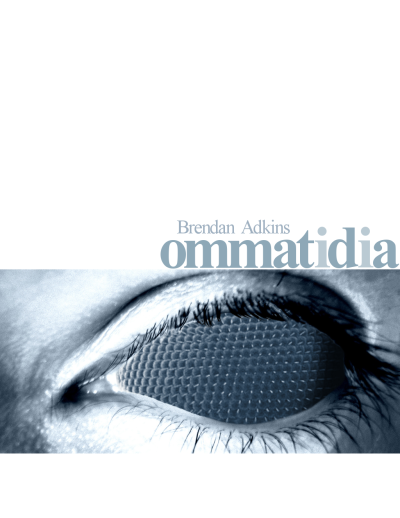
Third monochrome image post in a row! This one actually serves a purpose: it’s a very rough (and lazily photoshopped) mockup of what I have in mind for the cover of the Anacrusis book.

Brendan Adkins:  Ommatidia

Image credits: the human eye came from a really nice BY-SA macro shot called fóvea, and the bug eye from a BY-ND shot called drosoph. The latter makes me unhappy, because I’m clearly deriving from a NoDerivs work, but I can’t find the photographer’s contact info to ask permission. If you are the photographer, please write me! Oh, and also write if you have a strong opinion about the cover.

You can spell cataloging with or without the U

Hammering on the theme of my inability to escape YA literature, LibraryThing has apparently added a new statistic: the average publication year of your books. I haven’t catalogued everything I own quite yet, but still, did it have to be 1996?

When I get a chance to sit down and do it, cataloging on LibraryThing is one of my favorite, most meditative activities. I compare it to Scrooge McDuck taking a swim in the Money Bin.

For probably fifteen years I’ve been haunted by the image of a man falling down a flight of stairs, falling apart at the bottom to become just a coat wrapped around an IV stand, hung with dozens of tape recorders. I knew this image was from The Tattooed Potato, a bleak and frightening book I’d read (exactly once) in elementary school. Last week, while in the library, I suddenly had to go check it out and read it. (It is not actually very bleak or frightening now, and in fact that exact image isn’t in the book.)

As per NFD policy, I’m going to wait a little while before I write any more about the book–I only finished it ten minutes ago. I will say this: it’s one thing to realize that one still reads for the things one first found in middle school. It’s another to understand that the nature of names, protagonism, surreality, pacing and imagery in one’s own writing all basically derive from an author one read in fourth grade.

Hey, look, I found a good way to link books!

John Joseph Adams asked what are your top ten SF-F books not written by white men? Actually, he asked it in two parts: a top-ten list of nonmen, followed by a top ten list of nonwhites. Like everyone else who’s responded so far, I can do a list of women easily; embarrassingly (and typically), of the SF-F authors whose race I actually know, almost all of them are white (the late Octavia Butler seems to be a common exception). I might be able to do a nonwhite list, but it’d be almost all comics creators.

Anyway, my top-ten-women list demonstrates a pretty strong pattern.

  1. The Blind Assassin, Margaret Atwood
  2. Howl’s Moving Castle, Diana Wynne Jones
  3. Magic for Beginners, Kelly Link
  4. Tehanu, Ursula Le Guin
  5. The Homeward Bounders, Diana Wynne Jones
  6. A Wind in the Door, Madeleine L’Engle
  7. The Hero and the Crown, Robin McKinley
  8. Lioness Rampant, Tamora Pierce
  9. The Dark is Rising, Susan Cooper
  10. Tie: Deep Wizardry, Diane Duane, and The Handmaid’s Tale, Margaret Atwood

Is it usually this obvious that my literary development halted in middle school?

I just finished The Book of the New Sun and I’m not going to talk about it for a while; I learned my lesson when I tried to write up The Blind Assassin a few years ago and came off like a blatherskite. (Search for it if you want, but I warned you.)

I’m not sure if The Book of the New Sun was good, but it was amazing.

Gene Wolfe is a curbstomper

I got these new dress shoes a while ago, where “dress shoes” is defined as “the shoes that are not my sneakers,” and man, they are some shitkickers. They’re semigloss black leather with rivets around the lace holes. The soles are like an inch thick with a deep tread, and I’m pretty sure they have steel toes. We’re basically talking about a boot with the calf cut off here. I like them a lot, although the laces are fraying really quickly.

The reason I offer this description is so that I can properly explain what Gene Wolfe’s Book of the New Sun is doing to me. Everybody talks about Wolfe, of course, but they talk about him in the same vein as the SFWA Grand Masters, of whom only Le Guin is interesting. I checked out the Book of the New Sun as a kind of homework assignment, but when I opened it, it commenced immediately (and has not ceased) to kick me in the head. With those shoes.

Segue of brutality and being amazed, the current storyline at Achewood is a masterwork in progress. When I start awarding the Grand Masters of Webcomics, I will hold up one long printout of the Great Outdoor Fight and say “this. This is what you must achieve.” For maximum run-up, start with Ana-Tomix and never stop reading, ever. But seriously, don’t click if you’re squeamish. Achewood is often unkind to squeams.

I have totally been served. Diane Duane, who evidently reads her referral logs with as much care as I do, wrote me an email confirming the corrections Wheeler offered the other day to my entry about her entry:

Dear Brendan,

Thanks for the mention. :)

BTW, I’ve known about Lulu.com for a long time: I used their pricing model to come up with the range of prices mentioned. Obviously there’s nothing particularly new about the concept…except, maybe, not giving up on a situation that common publishing wisdom has routinely up until now dismissed as a lost cause. But much has changed: so we’ll see what happens.

My main point was that, for the size of book in question, POD is still kinda pricey, and I wanted to see if there was any interest among the readership before I started serious thinking / work on the project. Fortunately it looks like there’s a fair amount of interest: now all I have to do is (a) consider my schedule and (b) convince my agent. ;)

Best! D.

Diane Duane wrote me an email!

Diane Duane wrote me an email!