-
Spider-Man: Far From: Home (20:19): You can probably skip down to Yojimbo (1961), this part is a nerd trap and I’m still caught in it. Also it’s full of spoilers, if you care about that.
This purports to be a movie about the consequences of Tony Stark’s death, but even more present are the ghosts Stan Lee and Steve Ditko, who created Spider-Man together and both died in 2018. Whatever any given audience thinks of Lee, the people behind the Marvel Spider-Man movies were clearly big fans; the license plate and wrestling poster Easter eggs alone are indication of that, and the big hallucinatory illusion sequence in the second act is a big ol’ fanvid drawn straight from the Lee/Romita on-page experiments of the early 70s. I think it does Doctor Strange, another Lee/Ditko creation, better than Doctor Strange (2016) did. Sooo when you include a subplot about disgruntled people whose work was subsumed or absorbed to promote one man’s self-made aura of genius, it’s hard not to see another side of that too. There might be a movie out there that can sell me on the idea that the correspondence was deliberate, but as much as I enjoyed it, Far From Home is not that.
There’s a lot going on in the movie thematically and none of it quite gels. Is this a movie about people needing to move on? That topic keeps coming up but never gets an emotional climax. Is it a movie about how drones are bad? It’s certainly not the first Marvel film to express that unease, but why does it go unremarked that Tony Stark apparently built a global pinpoint-assassination system just like the one Steve Rogers was willing to die to destroy in The Winter Soldier (2014)? Is it a movie about whether Peter Parker—who, in current comics canon, operates a multinational tech corp in very Starkian fashion—is meant to step into his dead mentor’s role? Kind of, but that shouldn’t even be a question the MCU has to ask, because the MCU already has an established born leader and tech wunderkind for its next phase of superheroes. Their names are T’Challa and Shuri!
Is it a teen road movie? No, it backgrounds all of that in favor of very expensive-looking effects sequences. Is it a love story? Almost, almost. Tom Holland and Zendaya have about three scenes together, and they’re electric! Those two people are very good at acting! You have to have something special to actually sell me on a Peter/MJ romance in two thousand damn nineteen, and they did, but in true Sirius Black fashion, we barely get to glimpse the good stuff before it’s gone. A big flaw in the movie is how it continues the timeworn MCU tradition of failing to foreground its women; it needs not only more Zendaya, but more Cobie Smulders, and any at all of Jennifer Connelly, and more Marisa Tomei. How are you going to make a movie set in Venice with Marisa Tomei and ghost Robert Downey Junior in it and not even throw in a sly reference to Only You (1994)?
Anyway, since I started drafting this post the movie made a billion dollars, so Marvel/Columbia/Sony are probably pretty happy with Jon Watts and his directorial choices overall. I just liked Homecoming so much, and thought this showed such potential to be a movie specifically suited to my tastes, that I have a hard time not wrestling with the things it wasted and missed. NERD TRAP OVER.
-
Yojimbo (1961): Man, just look at this.
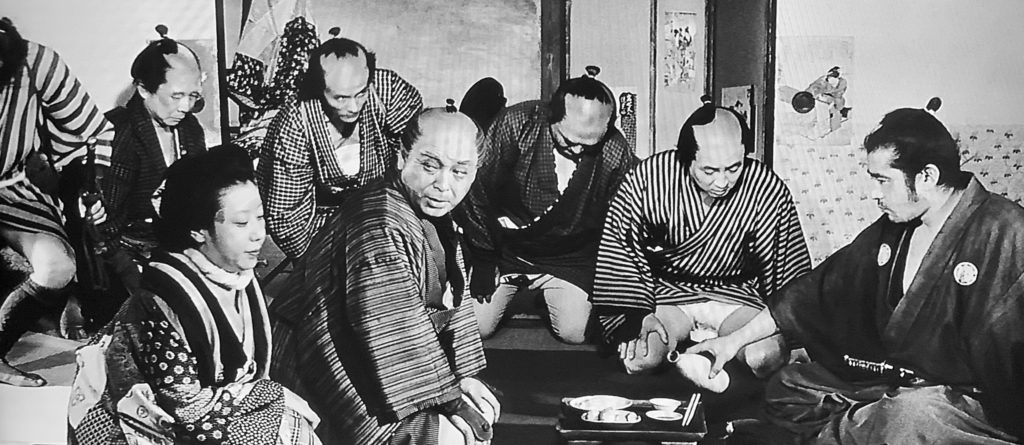
There are eight people in this shot, where one of the contenders for town boss is receiving Toshiro Mifune’s ronin and wheedling for his services. I didn’t do anything special to grab this frame—I just paused my player and took a photo of the TV with my phone, like a monster.
For the majority of people, color is a critical component of the way we separate shapes from each other, figure out what to pay attention to, and—like it or not—assess others. This image has no color dimension. But because its costume design is brilliant, my eyes immediately parse each person in the shot, and it’s even easy to grasp their ranks: the boss and his wife have the most ornate clothing, the ronin wears simple solids, and the background lieutenants each get a distinguishable but undistracting pattern. Because it’s blocked well, I know right away that Mifune is the center of the scene, with everyone else’s attitude cheated toward him. I happened to catch a frame where most of the lieutenants are looking down as they settle in, but the three principal characters always have their faces in full view or profile, so your brain can follow the conversation between them without the need to reverse between close-ups.
It’s fun to be able to break that out after the fact, and it’s even more fun to get picked up and carried along by it in motion. There’s all kinds of STUFF in Kurosawa movies: moving weather, moving fabric, bold expressions and exaggerated gestures and all kinds of people on the screen. Heck with minimalism! It’s great when the frame is busy, as long you can do it in a way that works for the viewer instead of against them. Anyway this movie is good and cool.
- The Old Man and the Gun (2018): I guess it could just be the Robert Redford fan in me speaking, but I certainly enjoyed this Robert Redford movie about movie star Robert Redford. It’s full of winks, but I was surprised to learn that casting Sissy Spacek opposite him was not one of them. They’d never been in a movie together before! They have wonderful chemistry, and I would have liked more of that instead of Casey Affleck’s dogged-mopey subplot, although his family was cute. When in doubt, always replace Casey Affleck with Sissy Spacek. Call that “the ek-eck rule.”
- Uncle Boonmee Who Can Recall His Past Lives (2010): This is a movie against which one critic’s epithet of “Uncle Bong Hit” can be… fairly applied. Also I really enjoyed it. The first shot in which the camera moves at all is fifty minutes in, and I’m not sure there was a single shot that lasted less than ten seconds in the whole thing; the median edit seemed somewhere around two minutes. It probably goes without saying that the only music is diegetic. Imagine those being your constraints. Imagine having that much confidence in your composition!
- Happy-Go-Lucky (2008): After talking a big game about my admiration for Sally Hawkins I decided I had to back it up by watching her breakout role, which is also my first Mike Leigh movie. Hawkins is extraordinary as expected. I knew that Leigh’s process of rehearse-improvise-rehearse-THEN write-THEN film was a whole unique thing; I did not know that the rehearsal process for this movie would have been happening while I lived in London in 2007. (I recognized zero locations aside from Hyde Park, but London is big and I lived south of the Thames.) This movie takes its time to get going, and anyone less charming than Hawkins in the lead could have grated a bit, but it’s lovely. Who else is going to make a movie that amounts to “a kind person politely and successfully asserts boundaries against hostile men, the end?”
- The Iron Monkey (1977): There are about forty movies called Iron Monkey and this is not the one directed by Yuen Woo-Ping, it’s one that was alternately titled Monkey Fist Vs. Eagle Claw and screened for the Hollywood’s monthly Kung Fu Theater night. Aside from the part where it shows a CHILD GETTING STRANGLED ON SCREEN in the first act, it’s pretty much what you’re there for.
-
Predator (1987): I love Alien (1979) and that franchise has long been a point of comparison against this one, so I decided to watch this. I didn’t like it. All right, John McTiernan, I hear your latter-day argument that this movie has some satirical intent behind it: the scene in which the bulging shout-men clear-cut an acre of rainforest using infinite bullets actually does trample right past power fantasy into grand display of impotence. It is goofy, but what does it end up saying by the end? That when the mechanized instruments of murder fail you, you must turn to… less mechanized instruments of murder? That beneath the ugly mask of sport hunting is… a face that is also ugly? I don’t buy it! This movie wants to stab its cake and shoot it too.
My favorite part was the special effects, which I think have now crossed a line from “dated” into “gloriously retro.” I spent most of the runtime thinking about the ways in which the Predator is shown to be a peerless hunter of men, to wit:
- outnumbered and outgunned at all times
- water-soluble camouflage
- glowing blood for convenient tracking
- slow-moving, light-up bullets for easy location in a firefight
- tall-ish?
- bound by strict rules of chivalry
- cannot chew food
- legally blind
- frequently sleepy
Damn, Arnold, you really skinned your teeth on that one.
-
Point Break (1991): See, with this one I can give credence to a certain archness of regard! Among Kathryn Bigelow’s other movies, I have only seen The Hurt Locker (2008), but that alone gave me reason to think she had a more nuanced understanding of masculinity than the other John McTiernan movie I have seen (Die Hard [1988]).
Contemporaneous reviews of this movie seem to have missed the homoerotic frisson that overlays the entire thing, not to mention the way the film keeps rolling its eyes at the incompetence of the FBI characters and the surfer gang’s bullshit philosophy. This is a movie shot by someone who had already watched many men’s eyes glaze over as they stopped listening because they believed they had something more important to say. The silent camera, in fact, plays with everyone here like a superior dance partner, and that’s one thing the reviews did notice—technically, the surfing and skydiving and chase sequences must have been fucking hard to shoot! There was no bullshitting with CGI in 1991, and no infinite digital storage either. For every perfect curl we get to see someone riding through in slow motion, someone else was doing the same thing, holding a camera, with a limited amount of celluloid film in a canister, backwards.
I loved this movie even though it had almost zero women in it. And having watched it, I’m now convinced that Bigelow invented the so-called Sorkin walk and talk!
- Perfect Blue (1997): It’s 1:30 in the morning and I really want to finish this roundup because it’s also almost September! This movie has sexual violence in it. It is really interesting to compare to Paprika (2006), not only for to see how far Satoshi Kon and Madhouse came as animators in ten years, but to see Kon developing what between them amounts to a career-length treatise on the Kuleshov Effect.
- High Flying Bird (2019): This movie was aaalmost ruined for me by an airbnb TV with motion smoothing turned on that I could not disable. It’s also one of two movies I watched this month that were shot on iPhones, and despite the fact that I love this cast (André Holland! Zazie Beats! Melvin Gregg from American Vandal!!) and this playwright (Tarell Alvin McCraney!!!) and of course this director, it was not the one I preferred. I enjoyed its subtle conceit about the long work of revolution, and its performances, but the decision to shoot everything in extreme wide angle with a single anamorphic lens is hard to handle. You can strap a telephoto onto an iPhone too, Steven! I really think at this point in his career that Soderbergh enjoys being able to execute what he wants very, very fast—they self-funded and shot a feature film on location in something like thirty days—and the result is not sloppy, but its spontaneity in form is a little at odds with its deliberate function.
- Tangerine (2015): See, now, this is how you shoot a movie on a phone. Grainy, artificially warm, hectic, rife with bad decisions, full of characters who see the world through this exact same lens, and fun as hell. There is homophobia in this movie and use of the n-word by white people, but it is not sexually violent, which was a relief to me. It’s on Hulu! Text me if you want my password.
Category: People
May Movie Moundup
- Blood of the Dragon (1971): Seen on 35mm at the Hollywood Theater, just before the reels were loaned to Quentin Tarantino. As promised, it had “some of the most interesting film damage” I had ever seen. Celluloid is a volatile material! Anyway the movie fit well within the bounds of the wuxia genre in a satisfying way, and I liked that it was directed by a woman.
- Bill & Ted’s Excellent Adventure (1989): Ian made me watch the sequel in 2002 or something, but I’d never actually seen this. What an earnest, sweet, stupid movie—so sweet, in fact, that the one random moment of requisite 20th-century homophobia jarred even more than usual. Nice to see them come correct on police violence, military recruitment and wealth inequality, though.
- Mad Max: Fury Road aka Black & Chrome (2015): Technically a rewatch, except not, as this was the monochrome version. It was also the big screen version, at the Hollywood as a Planned Parenthood benefit. Even without color, and with visible pixels, it loses no impact. I tried to take note of things like cuts and composition and depth of field, and I failed! It’s hard to observe at a remove that to which you are riveted.
-
The Red Turtle (2016): By contrast, I did a lot of observing composition (and color, and texture) in this movie, which is beautiful but I think holds itself a little apart from you. Part of that is its constraints: no dialogue, no narration, no explanations at all, like a wordless picture book. The characters don’t even have names. For me, that blunted its emotional impact as well, but it was very beautiful to watch.
They did pull out one particular and effective trick I haven’t really seen much in 2D animation. Usually, even when the 2D is all digital rather than cel painting, the “flatted” color areas are in fact flat, with maybe some highlights and shadows thrown in for depth; details are done with line work, and flatting is a separate process stage done quickly and by lower-level animators. If you see texture and detail within a colored space, it’s probably on something static like a background that only has to be drawn once. In this shot from Spirited Away (2001), Chihiro and the car were drawn by animators, where the idol and the trees were done by static painters. See the simple colors on her shirt compared to all the variation on the stone?
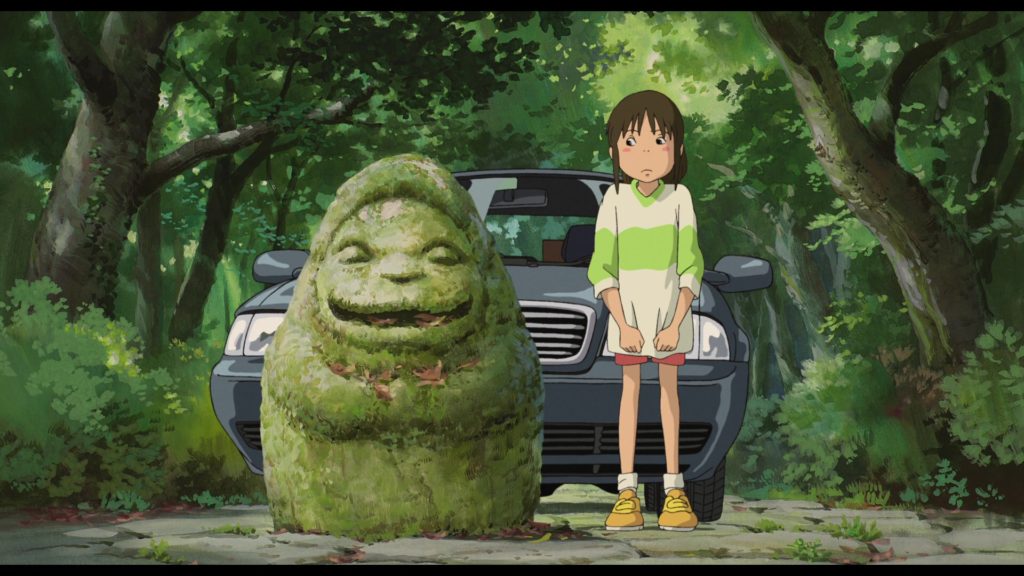
Instead, The Red Turtle takes advantage of its digital nature, attaching texture to everything and letting the computer do the work of keeping it consistent with movement. It’s like film grain, but you can see in this shot that it’s applied differently to various surfaces—the upper area of the turtle’s shell has less texture than the parts below the water.
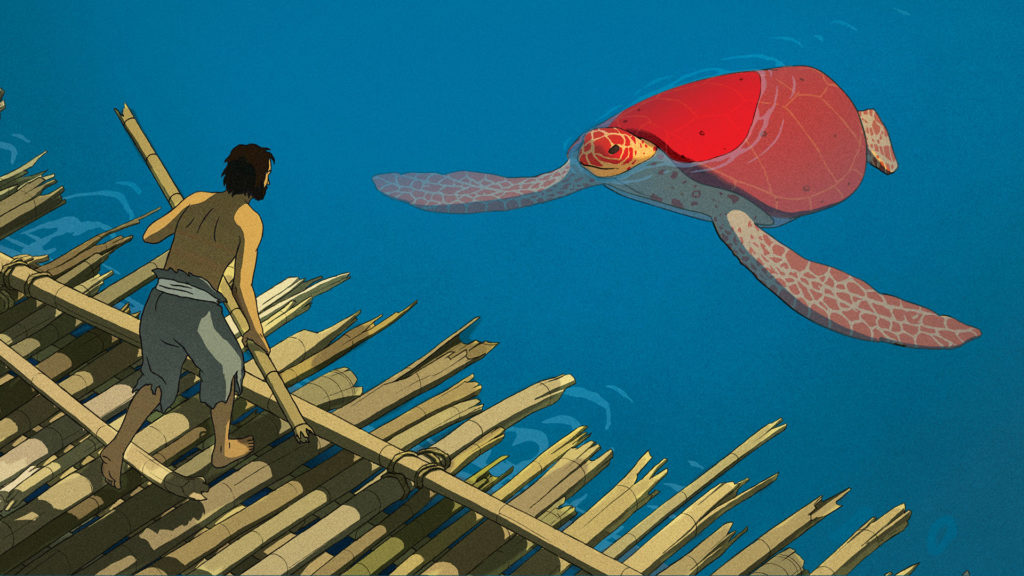
They do some other fun stuff too: using the surface simulation usually applied to fabric or water in 3D animation for foliage here, for instance. There’s some cool ligne claire influence going on, and Lucy even pointed out a couple of nods to Moebius. Simple story, visual feast.
- Ball of Fire (1941): Watched on Sumana’s recommendation. Man, this was great. That is to be expected from something cowritten by Billy Wilder and directed by Howard Hawks, but Sumana gave Barbara Stanwyck top billing, and she was correct. I’d never (remembered) seeing her in a movie before, and she carries the whole thing. Also, I’m going to start wearing a sweatshirt over a button-down in homage to the avuncular German professor. Easily my favorite pro-descriptivism jazzy screwball gangster comedy to feature Snow White and the seven dwarves.
-
You Were Never Really Here (2017): My second Lynne Ramsay movie, after a fifteen-year time jump in her career. I feel like if you have heard of this movie then you know it features a lot of violence, including violence against children, sexual and otherwise. It’s hard to put that in a genre story in the 21st century without seeming exploitative yourself, and I don’t know if this movie entirely avoids that.
All that said, holy fucking shit, I understand better why people are so reverent about Ramsay now. Fleet without skimming, enigmatic without distancing, clever but not ostentatious, observant but not voyeuristic—or at least not catering to the voyeur in all the expected ways. The crew’s stylistic watchphrase was apparently “heavy camera,” and the implications there are carried through.
Ramsay does this thing in common with Alexander Mackendrick that I might have mentioned before. This movie had sequences where a moving subject is obscured for most if not all of the shot, but I never felt confused or lost because my eye was guided along their path. I haven’t quite parsed it out yet, but I think it might be something like this: you catch the subject at the start of the shot at a rule-of-thirds line, as the point of focus, entering with movement; you keep the camera centered and focused on them as they move into obscurity, through a crowd of people or behind traffic; and you catch them out of it on the other side, at the opposite screen-third focal point, emerging into perfect focus and giving the audience a pleasing “aha” of facial recognition. You can convey depth of field, parallax, atmosphere, tension, and action all at once in a simple shot, but it only works if you have the technique really nailed down. Eventually I will find some clips that demonstrate what I’m talking about and then come back and compare them to see if this theory holds up.
Kat sent me an article that bothered me, so I wrote a post for my employer’s blog about some of my favorite hobbyhorses. (I like my job; let me know if you want to work here.)
January Movie Roundup
January Film Roundup is the intellectual property of Leonard Richardson and Nowhere Standard Inc. Any resemblance to actual film roundups living or dead is purely incidental.
A thing I did in 2017 that I’ve never actually recorded here was buy a house in Southeast Portland. More about that some other time. An important thing about this house, to me, is that it’s within walking distance of Movie Madness, the best place to rent movies in the world. Later in 2019 I’m going to leave Portland after eleven years and move to Chicago. More about that also some other time. Until then, I want to take great advantage of my proximity to the little cinder block building that just has… every… movie… in it. These are the ones I watched last month.
-
My Best Friend’s Wedding (1997): Kat’s favorite. I used to watch and basically believe in romantic comedies, a fact which may shed light on some of my permanent emotional scarring. I stopped watching in the early oughts, when the movies stopped being good, but I think I did see almost all of the nineties classics except this one. I liked it but I’m glad I didn’t see it at the time; I would not have appreciated it.
Having read nothing about its production, here’s my imaginary series of events: Ron Bass sees Mr. Wrong and The Truth About Cats And Dogs in 1996, then writes a combination of the two as a vehicle for Janeane Garofalo or someone Janeane Garofalesque. A studio buyer says “Ron, I love it, but why don’t we see if we can shoot for someone more… Julia Robertsesque.” Then the actual Julia Roberts, tired of being pitched on romantic comedies because it’s 1997, reads it and says “I would enjoy taking my own subversive turn at playing a sociopath,” and what you end up with is this strange world where Dermot Mulroney plays a human tree stump who’s marrying 20-year-old Cameron Diaz yet who has never in his life considered any attraction to Julia Roberts (who is in turn willing to ruin his life to have him).
I grant you that this is the same disbelief you are asked to suspend when The Truth About Cats And Dogs sets up its false dichotomy, but at least that is predictable Hollywood logic at work. Roberts gets her teeth into this anyway and has a great time, which is fun to watch, and so does Rupert Everett, who you already know is the best part of the movie even if you’ve never seen it.
-
Night of the Living Dead (1968): I think I saw this nineteen or twenty years ago and my recall of it was more accurate than I expected. I like it, but I would not have felt a specific need to rent it except for one thing: I seem to be among few Every Frame a Painting superfans to have discovered that last year’s Criterion reissue has a hidden Every Frame a Painting on the bonus disc.
To say that Every Frame a Painting meant a great deal to me is to understate. It turns out I am still grieving it, and—as is obvious to the point of pain—grieving the world I thought I was living in when its last video was posted to Youtube in September of 2016. Grief leads me to magical thinking, and so, of late, my brain has tried to conjure the past via whatever ancillary frames I can find. There are at least a couple more essays they produced for Filmstruck, a service which decided to shut down just as this bout of grief made itself known, that I haven’t found yet. But I have found three others (on The Breaking Point, His Girl Friday and Tampopo) in physical format at Movie Madness.
-
A Taxing Woman (1987): I enjoyed Tampopo so goddamn much that my friend Theron recommended I try to track this one down, the movie Juzo Itami made after it with the same leads. Even Theron had only ever seen this on VHS, but Movie Madness had it on DVD, because they have… every… movie. Tampopo is somehow a Western about cooking noodles, so of course this one is a gumshoe tax fraud noir in a world where everyone is constantly trying to cheat on their taxes. The genre twist I liked is that this time the detective character is on the offense: she’s the one who barges into other people’s offices, smelling like trouble. It’s fun just to see Nobuko Miyamoto and Tsutomu Yamazaki stretch their rapport into something wary and oppositional instead of bittersweetly pedagogical.
-
The Bad Sleep Well (1960): Three out of four of this month’s movies are directly derived from Every Frame a Painting, a trend which I expect will continue. This one got its own mini-episode about one scene—actually, about one shot—and I successfully used that to walk myself backwards into watching my first Kurosawa movie in decades. I enjoyed it.
I used to get bored very quickly by any movie I perceived as “old.” The only way I knew how to interpret film was through plots, which I tended to find either obvious or incomprehensible in the classics, their dialogue, which I found unrelatable, and their set pieces or action scenes, which I mostly found cheesy. Yes, this is callow, but I don’t think it’s uncommon! I could write at length about how standard liberal arts curricula can fail people, but fundamentally, putting complex art in front of someone and declaring that it’s valuable by fiat doesn’t work. I have seen so many movies without knowing how to see them. Modernist artistic complexity is a locked door with treasure behind it, but if the keys you have for the door don’t open it, the fault is not with you.
Every Frame a Painting showed me doors I didn’t know about, and nudged them open for me. I notice when my eyes are active in the frame now! I can identify different kinds of cuts between shots, and I notice when the camera directs my attention amid complex blocking. I can appreciate it when action and reaction are both in the same shot, or when one shot just set me up for its successor. I haven’t quite managed to catch compositional sectioning in action yet, but at least I know it’s out there to be recognized.
Each of the previous Kurosawa movies I’d seen (Ran, Throne of Blood, Rashomon, The Hidden Fortress and Seven Samurai) were things I found nebulously cool and even striking, but like Michael Bay, I couldn’t have articulated why. With The Bad Sleep Well, I can tell you this much: I like it because it doesn’t matter whether I speak Japanese or whether I speak cinematic shorthand (or whether I know Hamlet). I like it because it told me a harmonic story with its acting, its writing, its music, its composition, its costuming—in monochrome!—and its editing all at the same time. It uses its bandwidth well in concert, and a broader band means richer media.
I also liked it because Toshiro Mifune is nebulously cool.
It took me a while to hash that last point out with myself, so now it’s February 5th and I’ve already seen three more movies and rented a fourth. I guess we’ll see how long this keeps going, and also how many choices of movie I can tie back to Every Frame a Painting somehow. Maybe Leonard will forgive this format infringement if I tell him that I am about to finally get around to watching The Man Who Wasn’t There.
The past is a foreign country: I miss my friends who live there
In April my friend Russ Gilman-Hunt died. He was one of the first four people who worked at my job with me. He was funny, kind and clever. He was not very much older than me, but he had a deadpan world-weary affect and a quiet warmth that made him seem like everyone’s dad. I wish I had known him better, but most of his life was outside work, with his wife and two children and his community in the SCA. I wish they still had him.
In May I lost the job where I had worked with Russ, as did a number of my colleagues. I have a lot of support from people who care for me, and I am lucky in my socioeconomic class; that has allowed me to inform myself that this is an opportunity, more than a setback. (I have done so often and stridently.) I will probably have a new job soon. I like working, if not always working terribly hard. I hope I can make that work amount to something good.
It sometimes feels like the only things I write here are podcast show notes and epitaphs. I haven’t allowed myself much time to work on podcasts in the last month; hunting for what I perceive as a replacement means of survival has meant little available concentration for creative work. So this goes in the epitaph category. Sure wish there were fewer of those.
I didn’t always love my old job but I always liked it, and I took comfort in the idea that I was cultivating a good place to bring in new people and help them excel. I wanted to contribute patches to the leaky pipeline. I think Russ did too. I don’t know how much of that we managed. Some of the people I patched in got laid off with me. I’d say we did what good we could while seeing to our own survival, but. Well.
A job that you treat like just a job is, eventually, just a job. I want the work of my life to be more than that. Maybe in seven more years—if, God forbid, this WordPress install is still operating—I’ll tell you how that’s going.
In February I got an email from my old laptop, and then another, both suggesting that it was in Germany. I had not seen that laptop since it left the back of my car through a shattered window in 2010. The home page of its default browser, at the time, happened to be one I controlled and that was not linked anywhere else, so I told that page to blare alarms and notify me when and whence it was requested. It took seven years for that to (probably?) happen. I wonder if someone actually has that laptop, in more or less the same crumbling shape it was when it vanished. I wonder how well they read English, and what they can find out about me if they dig around on it. Surely nothing worse than the things I’ve written here myself.
I guess what I am doing here is reflecting, which is to say, looking for myself in a flawed surface. I started writing online in part because I wanted attention and in part because I already knew that my built-in memory could not be trusted to retain my life. My pipe is too leaky. All pipes are too leaky. Among my driving fears is the idea that anything I lose is lost forever, and that history unminded is a black hole, a /dev/null, a point of no return.
But to really believe that is to assert that I know the future, which is presumptive: the future and I have never met. Sometimes a setback is an opportunity. Sometimes the past writes you an email. Sometimes a kid whose dad dies grows up a whole person anyway. Even black holes leak back.
Dual Reflections on Cruel Intentions
It’s time once again for Reel 90s Kids, the podcast you have forgotten that we did one time! We have now done it again. Here is the audio click button thing that tells you the wrong file duration, and below it are the show notes.
0:00 – Thanks to Oliver Schories for this episode’s intro song, which I think has a 40% chance of deeply irritating my cohost.
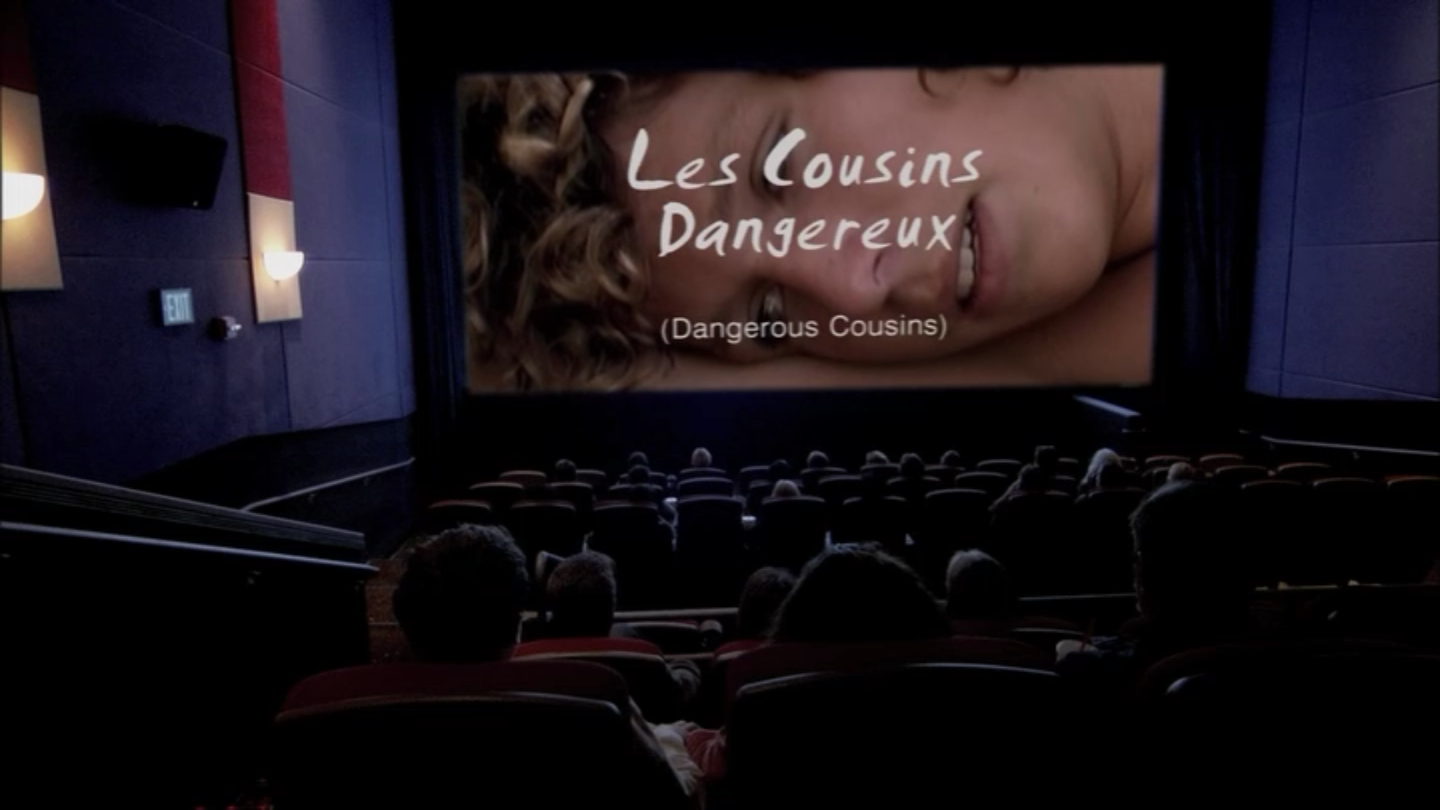
5:23 – I could put links to the Wikipedia articles for Les Liaisons Dangereuses and Dangerous Liaisons here, but you can type names into Wikipedia as well as I can.
8:37 – 
10:48 – Sorry, Mr. Lester.
12:41 – Shooter the 2007 movie; Shooter the 2016 TV series. Since we recorded this episode, USA has apparently decided we’ve had a long enough gap between mass shootings to actually premiere and air it! Yaaaay
19:03 – I cannot put anything about the confluence of Bittersweet Symphony and Shakespeare in Love in the show notes, because my brain completely manufactured it. Why did I think this was a thing?! If you have a clue, please call our toll-free line.
20:13 – Audio taken from this Fusion interview.
22:48 – Movie studios were forced to stop running their own theaters by United States v. Paramount Pictures, Inc, in 1948.
24:36 –
28:44 – The eclectic production history of Cruel Intentions 2, a “2000 American comedy-drama prequel.”
31:13 – I neglected to congratulate her, but Anne batted a thousand on these!
35:55 – The Deadline story in question. Alas, Cruel Intentions was not picked up to series after all.
37:35 – See you back here for the Drive Me Crazy episode in June 2019!
38:11 – And thanks to Jade Berlin and her terrifying accompanist for our outro music:
It is difficult to find sources of comfort right now
And indeed I think it is best not to be comfortable, no matter how much I want to. But there are still sources of strength.
A Timely Varsity Blues Podcast

Apparently the thing I do here now is, once a year, post a podcast I made with friends about a movie that already came out. This time I made one with my friend Anne! It’s about the non-classic 90s Teen Film Varsity Blues, for no clear reason that either of us could recall. Despite our claims at the beginning, we DID think of a belated title for it: Reel 90s Kids.
Because we remember.
I’m not going to link to the site we discuss for the latter half of the podcast because I don’t want to make anyone’s life sadder, including yours. I have faith in your ability to find it if you want to. Please don’t. Special thanks to small genius Aidan James for our outro music!
A Timely Captain America Podcast
I really love Captain America: The Winter Soldier, but my fondness is as nothing compared to that of my friend Rachel, even though she’s actually more a fan of a work derived from—well, we’ll get to that. Sometimes we exhort each other about it on twitter. Our mutual friend Sumana (star of many recent entries here) has found this charming, and a while back she urged us to record some kind of longer discussion and put it on the Internet; we did so, but not without making her complicit.
This is a podcast! It’s about 53 minutes long and covers a broad range of topics, which I have tried to annotate below. It is centered around the reasoning behind our affection for the movie, and especially the treatment of sexuality, gender and kyriarchy therein. I have been lax in my duty as its producer and am posting it months late, but fortunately it is now in time for Chris Evans and his portrayal of Steve Rogers to reënter our consciousness in Avengers: Age of Innocence. I found this conversation valuable and was grateful to be a part of it; I hope you like it too.
2:30 – The fanfic in question, the object of Rachel’s true fandom, is “Your Blue-Eyed Boy” by Feather.
3:40 – Steve has wood.
4:00 – Sumana’s reference to difficulty reading about torture “today” refers to when we recorded the podcast, in early December of 2014.
7:10 – Rachel and Sumana both knew the origin of the term “Winter Soldier” (it was news to me! I am a failed American).
10:30 – “Mothering versus Contract” by Virginia Held is an amazing piece of work, which came to me by way of my friend Monica; it first appeared in Beyond Self-Interest in 1990, and you can read some of it via Google Books.
17:30 – 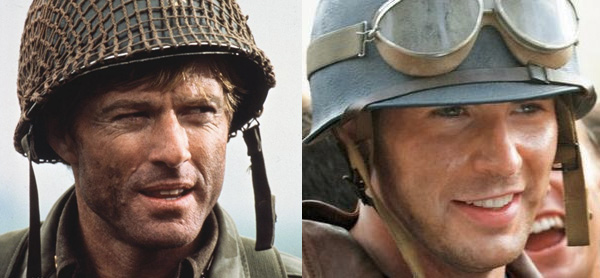
20:25 – Specifically, Captain America was created by Joe Simon and Jack Kirby in 1940. The joke about the title of this post is that they created him for a publisher known, at the time, as Timely Comics.
28:15 – The issue I am fumbling to recall was Captain America #292, from 1984, and the character was not a raven but Black Crow.
36:00 – 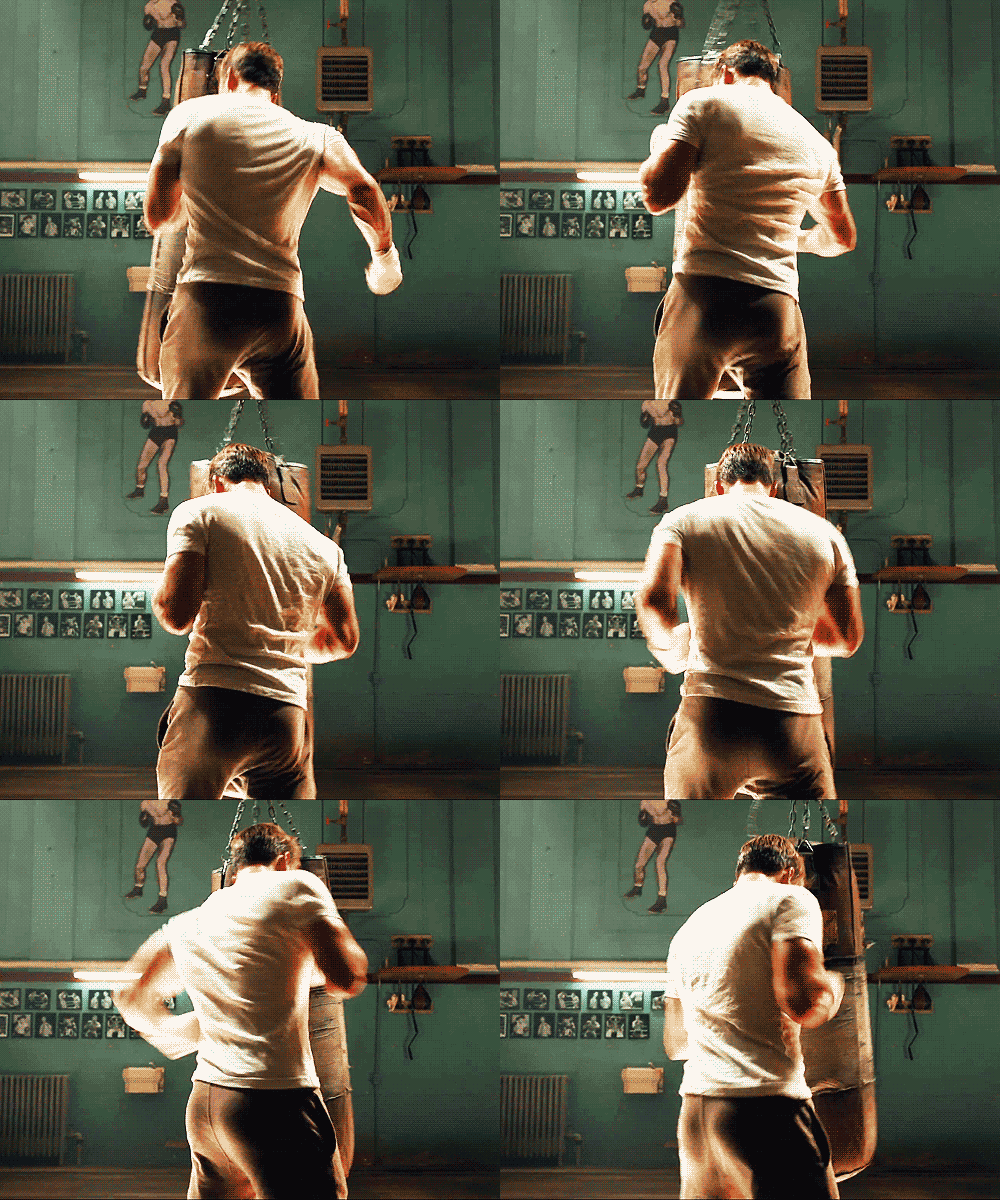
37:40 – Rachel here references Ursula K Le Guin’s classic short story (PDF): “Do you believe? Do you accept the festival, the city, the joy? No? Then let me describe
one more thing.“
39:00 – The Strong Female Characters are a joint creation of Kate Beaton, Meredith Gran and Carly Monardo.
40:15 – I couldn’t find an easily viewable version of the full pilot, but here’s a few minutes of footage from Global Frequency.
42:55 – Sumana is a graduate of Hacker School, now the Recurse Center, in Manhattan.
44:15 – I left this bit in because it has good comic timing.
46:05 – Sexy Murder Walk owes its name at least in part to Charlize Theron.
46:50 – The actress Rachel mentions, playing Bucky’s date and later starring in Doctor Who, is Jenna Coleman.
47:30 – Much of the inspiration for this podcast came from Sumana Meets Doctor Who!
52:35 – As requested. 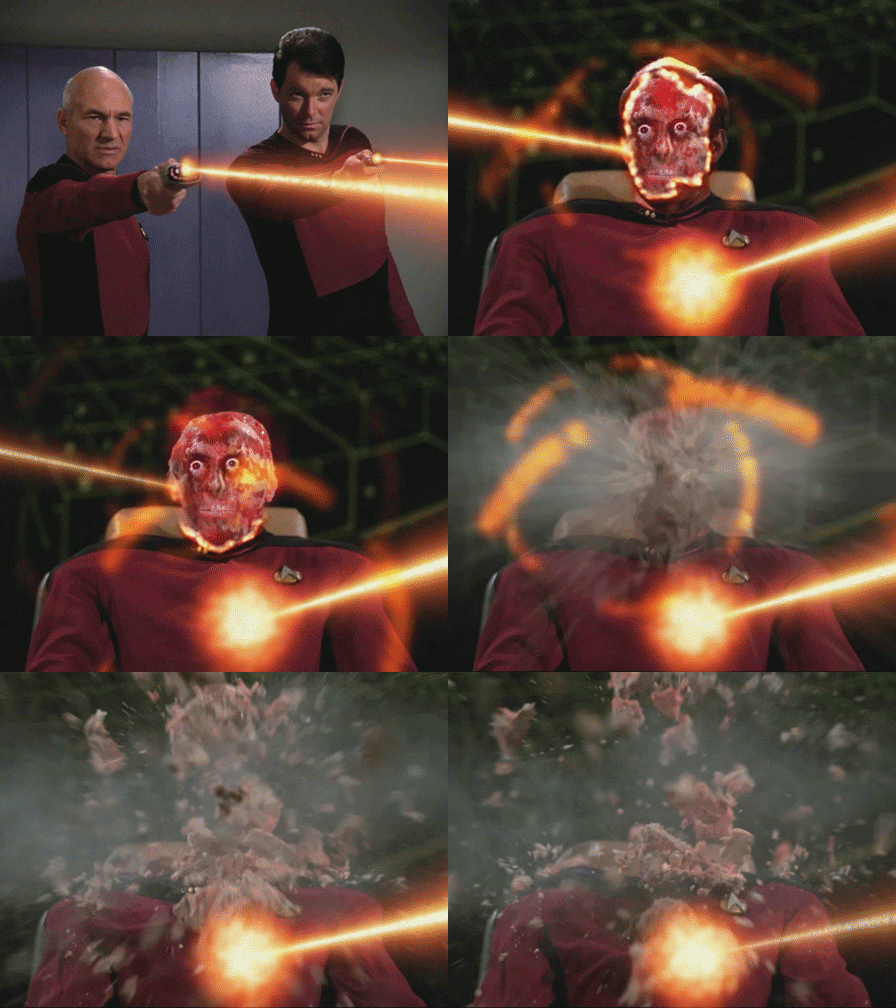
Sense Memory
In the spring of last year I was very ill. It got bad enough for long enough that I actually made and went to a doctor’s appointment, which found nothing wrong in any actionable way. Keep resting, drink fluids. As I lay wrung out on my couch, too sapped even to watch television, I stared at the tall ceiling above me and listened to the whining in my ears surge and fade, amplified by fever. For the first time, and at last, it occurred to me: I have had tinnitus my entire conscious life.
The next time I went to my doctor I asked about it, and she nodded. “Did you have a lot of ear infections as a kid?” she asked. I had. One of my earliest memories is of resting my head on the kitchen counter and feeling hot fluid drip out of my ear as my parents discussed what to do in low, worried tones. I ended up having surgery to implant temporary tubes in my eardrums. The infections stopped, but the damage lingered.
Tinnitus is usually called a “ringing” in one’s ears, but that makes me think of a bell or a telephone, which is why I never thought it described me. (Are you one of the people who can hear a persistent, faint eeeee when a CRT monitor or television turns on on? It’s like that, all the time.) The diagnosis explains a lot, actually—my preference for bass-heavy music, the way white noise helps me sleep, the staticky rush and roar I sometimes get in noisy crowds. My hearing is pretty good, considering, but the sound will be with me for the rest of my life, long after age takes that hearing from me. I’m listening to it right now, writing this. I will be as you read it. I will probably never experience silence. Yet I spent decades unaware, unable to distinguish this aspect of my life from that of everyone around me.
I am ashamed of much of what I’ve written here.
The consequence of publishing the things you think when you are twenty is that, later, people can read the things you thought when you were twenty. Most of these things were stupid. Some are toxic. Some are harmful. All were willfully deaf and blind to my own privilege. Several dear friends have turned up here in the last few years and started reading from the beginning, only to be embarrassed or repulsed by what they found. Despite the unbearable kindness of Sumana’s retrospective about this blog, I flinch to think of what it says about me.
All of this is a strong argument for the most obvious action, which is to delete nfd, or at least lock it: for the right to forget my previous self. I think I’m a better self than I used to be, and better at being human. But part of being better is honesty about everyone I’ve been. Ten years on, I still believe in transparency. To wipe this all away would be to brush out the trail marks I’ve left behind me, the stumbling footprint path from ignorance to… well, partial awareness of ignorance.
So I am letting the record stand. Maybe someone will read it and pick up a few of the things that cost me so much time and so much of others’ patience. Maybe you will read it, and grant me your own patience; or maybe you won’t. I wouldn’t blame you. I am flawed in every sense, but I will keep trying to learn to listen.