
Category: Stress

Won’t you be mine

Block parties are popular in Chicago’s summer; the city will loan you a free bounce house for yours if you ask. But the block where Kat and I live had not held such a party, not that anyone can remember, up until this past September. That was when our neighbors decided to change things for the better. The party we organized together was late in the season, and it drizzled a bit. But we put some garbage bags on the PA speakers and took shelter in the great fortune of our street’s tree canopy. The trees are our neighbors too. We took care of each other, and we went on.

That block party will be a good memory for a long time. It was a great success, and we met almost everyone who lives within a stone’s throw of us, and some new friends who don’t. I took photos on my little thermal-paper toy camera and handed the printouts out to kids who were playing together. We had an excess of good food and almost enough good dogs. And now when I walk our own good dog, and see someone from across the street, I can put a name to a face, and we can trade smiles that mean something more than politeness.
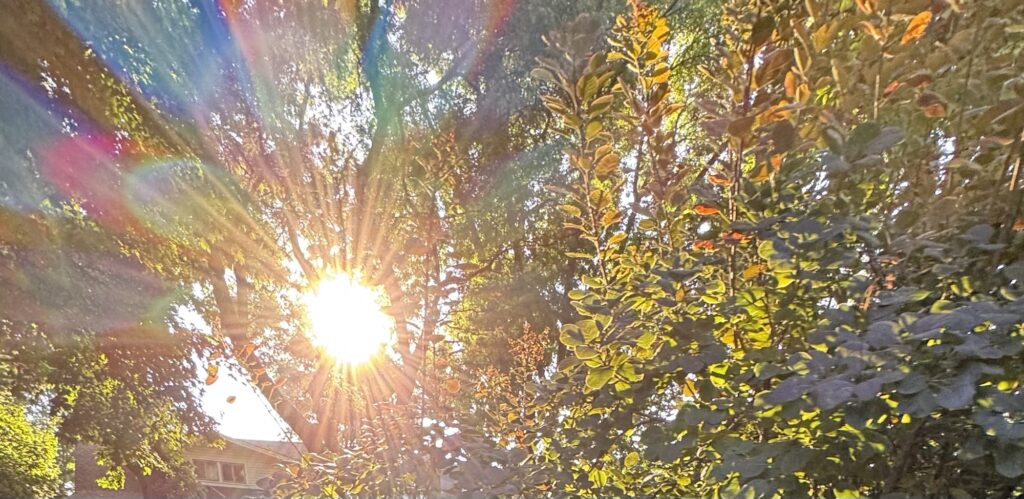
A sundog from my neighborhood, through trees, with identifying information cropped. I hope.

Less than three weeks later, masked federal agents abducted the first of their confirmed victims from the streets of Rogers Park. My mother was here visiting us. Some of my neighbors who were disappeared by the secret police were leaving the same church she attended. Some of them were trying to take their children to or from the nearby elementary school.

There has been excellent journalism showing that the kinds of people targeted in this way lacked arrest records, and had their documents, and were crucial parts of their communities. The fucking George W. Bush Center published an article this very year about how immigration benefits us all, but the truth is that people were targeted for their appearance, not their immigration status. And also: even if every one of the disappeared were an undocumented and solitary migrant with a history of arrests who took more from public resources than they returned, they would still be my neighbors. Evil committed against them is evil done to me and mine.

We wear plastic whistles when we go for walks these days. We got them from the bright warm queer coffee shop, or the physical therapist’s office, or the corner store, or the rally, or the evening crammed together in a restaurant. When we look across the street and see matching bright nylon strings looped around each other’s necks, we smile and nod, and it means much more than politeness. The smiles are tight, but they are sincere. Some say the moment of most acute terror here may have passed with the first touch of winter, at least for those of us not already detained or separated. I remain wary with pain in my heart. I have neighbors in Asheville, and Charlotte, and Baltimore, and Portland too.
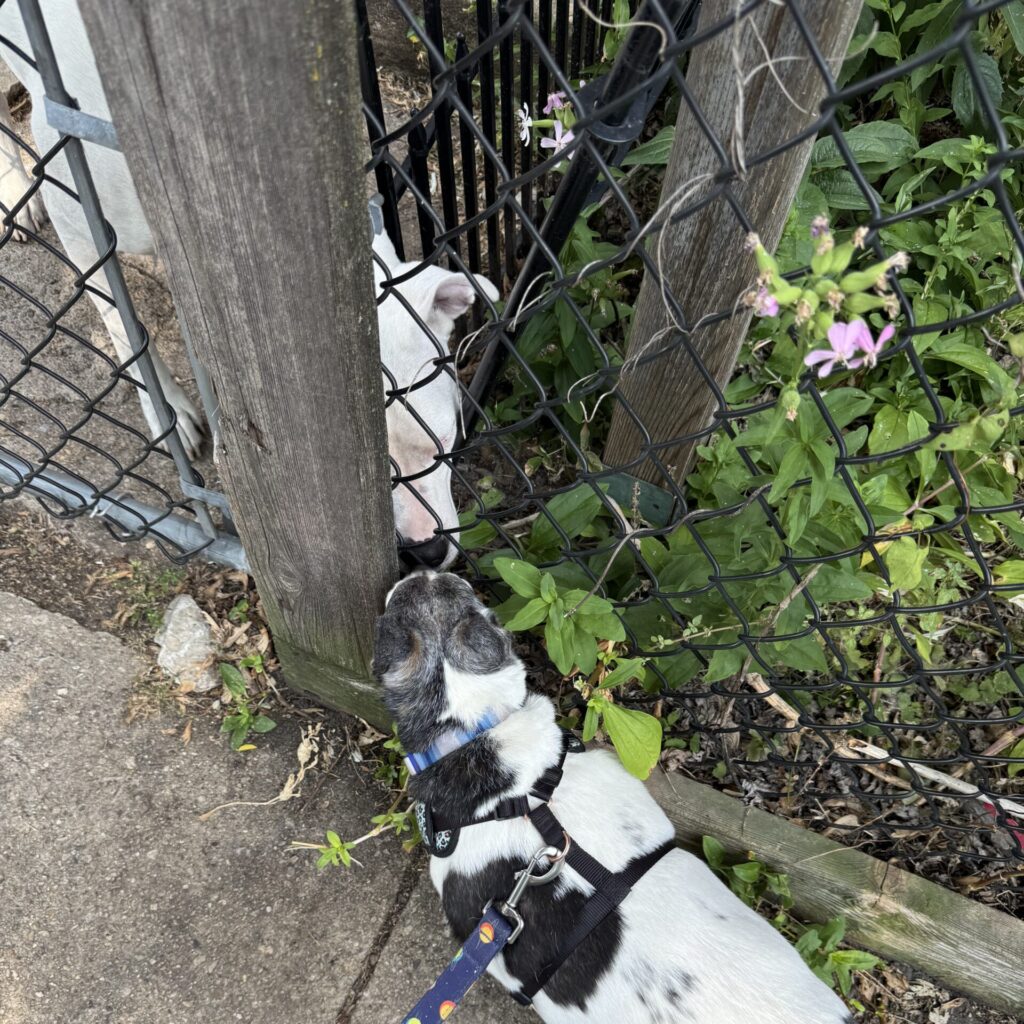
My dog and another dog touching noses through a chain-link fence

I moved a lot, when I lived in Portland: seven times in eleven years. I had the great fortune of many friends, but I didn’t get to know many of my neighbors. I often wanted to connect with them, but I was lacking in tools or time to do so, and then before long I’d be on to a different part of town. Now I live in the house I hope to keep until I can no longer climb its steps. I want the same roots the trees that line our street have grown. Yesterday I took care of an anxious dog from next door while his people were away, and when they came home they gave us a tub of beans and rice that I’m thinking of with hunger right now.

I lived decades with the terrible privilege of innocence to the way life proceeds under military enforcement. But proceed it does, for most of us. We trade favors and drink coffee. We hug each other tight at parties. We do the laundry and we watch the crosswalks. We keep our eyes up and our ears open. And when we hear the danger coming, we run toward it, not away.

A monarch butterfly perched on a sunflower in our neighborhood

The long, deep myth of the city as center and source of violence is so strange to me. Neighborhoods, even those where heat leads to suffering among missing trees, are places where people cooperate. Cities are nothing if not neighborhoods cooperating with each other. All the many benefits they offer are born of the choice to get along and share. I grew up in suburbs, a kind of place structured by a desire to be apart from other people. I mean no unkindness to my suburban loved ones when I make this generalization. But suburbs were built because people wanted to move away; cities like Chicago, for all their flaws and failures, are places people move to. The choice of a city is the choice to be close to people you don’t yet know.

On the weekend before Mom came to visit our home, Kat and I took the city light rail line to Chicago’s train station, and thereby went to Minneapolis to visit friends we have dearly missed. On the train back home I read through all of Sophie’s beautiful new book Kin. If you click on only one link from this blog post, it should be that one. I wish I could just read it aloud to all my loved ones, even the parts where Kat and I are mentioned. The book is so moving, and by that I mean I felt it move me to action. The subtitle of Kin is “the future of family.” It is a future I believe in, and one I am trying in my small way to make our present too.

When Mom saw an article about how her fellow parishioners here had been abducted, she sent the link to our relatives, and she wrote: “We took Communion together. They are my family.” It made my chest ache, and it made me so grateful that my family of origin has a mother who sees things clearly.
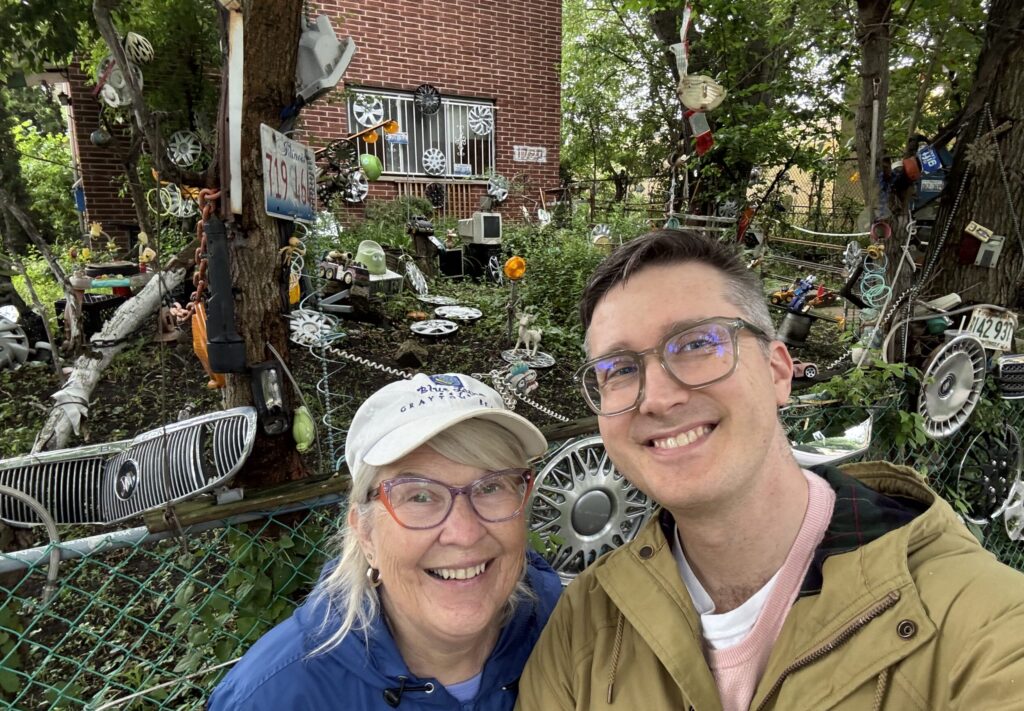
Mom and myself at a neighborhood landmark

I started writing this post because I wanted you, reading it, to take it as a sign to reach out to people where you live. It’s the only way to make strangers into neighbors and neighbors into friends. It is work I am still doing, and I have found it worth the effort many times over. I hope your neighbors don’t suck; I know some do. But even then there are more people in the next building down, and if you learn each other’s names, you can bring them cookies and trade numbers if you want to learn to like each other more.

We will only get through the worst together with those around us. Caring for each other is what makes us human, in a biological sense: prosocial behavior is the primary survival trait of our species. But it’s also the trait that brings us good dogs and pot luck and bounce houses on summer streets. I called them free bounce houses, but of course the reality is that everyone here pays for each other’s parties, just a little bit. I wish I could choose to pay for kids in bounce houses instead of in cages. I wish I could pay for my neighbors’ meals instead of tear gas. I wish that instead of paying people to set fire to our world, I could choose to keep the people around me warm.

It’s hard enough getting through a Chicago winter. It’s hard enough to feel one’s body aging, and to lose people by way of time and misfortune. It’s hard enough just doing the laundry and watching the crosswalks. It’s hard enough to care for the small and vulnerable in a family while budgeting time and money and effort to maintain oneself. It’s hard enough that work takes more and more from us, that trees and pets and people get sick, that the hours and the days slip from our grasp. It’s hard enough that things fall apart even with effort to keep them together.

Nobody needs cruelty and evil to make things harder on all of us, not even those who enact it. What we need is each other. We go on.

The Chicago skyline on a cloudy night, seen from the river

There are always more than enough takes to go around, on days like today

So I just want to talk about a Wikipedia article that I think about all the time.

There was this guy named Louis Slotin, who worked on the Manhattan Project and then continued atomic research at Los Alamos. This story doesn’t end well for him. He particularly liked to demonstrate an “experiment” in near-criticality that involved opening and closing the two hemispheres of a beryllium shell around a solid core of plutonium. There was a safety protocol for this experiment; Slotin decided not to use it. Instead of the standard shims that kept the shell from closing and thereby causing the core to go supercritical, he liked to wiggle it open and closed with a screwdriver. While wearing cowboy boots.

Smarter people said that this was a dangerous practice; Richard Feynman’s remark led to them calling Slotin’s demo “tickling the dragon’s tail.” But saying things was all they did. And when Slotin’s screwdriver slipped one day, the immediate burst of radiation killed him, and only his body partially shielding the others in the room from the blast saved their lives. Some of them died of leukemia or the complications of thyroid failure, too young.

Slotin was considered a hero by the US government for quickly flipping the shell back open and ending the reaction, and for dying, I guess. I differ on this matter. Slotin wasn’t learning anything or gathering data that day; he was showing off, angling for stature, flirting with death for the dozenth time and finally succeeding in his overtures. Tickle the dragon’s tail long enough and the dragon is going to do something about it.

I wonder if the men in that room wanted to make history. I wonder if this was how. And I wish this particular point in history were more widely understood.

After the Slotin incident, which followed an earlier near-disaster when physicist Harry Daghlian died by dropping a tungsten carbide brick on that same plug of plutonium, the scientists at Los Alamos redesigned their protocols and stopped doing hands-on experiments. But they also changed the nickname of the plutonium from “Rufus” to “the demon core.” These trained physicists—these men—reviewed the fatal interaction between one of their colleagues and an inanimate object, and they could not find it in themselves to put the blame on him.

To pinch the tip of today’s allegory, the core was allowed to cool off, then divided up and incorporated into other sources. Plutonium has a very long half-life. Its atoms are either still in use or polluting our atmosphere. This is the law of conservation of one’s demons: they can be summoned but not destroyed.

Notes from the New Normish

Hi, we’re alive and fine. My privilege is as evident as ever, as my daily routine of isolation with Kat resembles what Maria called “an extended snow day,” mostly but not entirely without snow. I hurt for the sick and grieving; I worry for the essential and vulnerable; I watch Bon Appetit and experiment with vegan baking; I do my internet job and I watch out my window and wait. Here are some things that have held my interest in the last little while.

  1. As mentioned in asides, I read too much about menswear online and off these days. My favorite habit is to bargain-hunt for clothes from Japan on eBay, prance around the living room in them to aggravate Kat, and then secret them away so I can buy more. But the emergent result is that I’ve learned a lot about things I might have disdained ten years ago. I don’t have any special interest in James Bond, for instance, but Matt Spaiser’s blog about the tailoring of the films has taught me a ton about men’s fashion in the last sixty years. His post on how Cary Grant’s suit in North by Northwest (1959) went on to influence Bond’s costuming is a great example of the dry clarity of his writing.
  2. It seems like I’ve never written about Porpentine Charity Heartscape here before, which is strange, as her work has loomed large in my view and admiration for… seven years? Eight? Her work in writing and game design blends the sweet, the filthy, the transgender and transhuman, the pure and the skin-crawlingly cute in a way I find singular in every sense. If that sentence doesn’t hint at some content warnings, then I hope this one does. But that boundary is very much worth braving if you are so emotionally equipped. Her recent story “Dirty Wi-Fi” on Strange Horizons is a good introduction to her prose and perspective.
  3. Despite my limited dabbling in microelectronics, I can’t follow many of the technical specifics in this review of process and call for aid on a final, perfect Super Nintendo emulator. But the SNES was a system that still informs my design and aesthetic sensibilities, twenty-seven years later, and I respect the author’s work very much. The most striking quote to me:

    “I can tell you why this is important to me: it’s my life’s work, and I don’t want to have to say I came this close to finishing without getting the last piece of it right. I’m getting older, and I won’t be around forever. I want this final piece solved.”

    What an extraordinary thing it seems, to me, to know what your life’s work is. I hope one day I do.

“What is the most amazing thing in the universe?”

On Thursday, amid rising feelings of unease, Kat and I traveled to San Francisco for a wedding; by Friday we knew it was a mistake, but there we were. It was good to see her family, not least because we finally got to talk wedding plans in person. But we’d planned to fly back Tuesday night after some time touring the Santa Cruz boardwalk and a movie premiere with friends in SF. Instead, we scrambled out on Monday at lunchtime, just ahead of a shelter-in-place recommendation. We both feel fine, though there’s no way to know what damage we have silently transmitted. We’re trying to limit it, going forward, by ceasing social contact for the next two weeks.

The weekend was, as Sumana says, an inflection point, at least in the perception of much of the country and the information we consume. Anyone at ease made me jumpy, and anyone jumpy made me… also jumpy. On Monday, as we tried to fill up our returning rental car, the pump behind us started gushing gasoline onto the concrete. As I ran inside to tell the clerk to shut it off, I expected the world to shrink its shutter angle and go full shakycam. It didn’t; some people yelled at each other and then they cleaned up the mess. We were all fine, but no one was easy. By April I don’t know how much the pace of change will continue to inflect, or how much this will have already settled as an uneasy new normal. Last Thursday my view of the world was different, and Lemon, it’s not even Wednesday.

The past is a foreign country: I miss my friends who live there

In April my friend Russ Gilman-Hunt died. He was one of the first four people who worked at my job with me. He was funny, kind and clever. He was not very much older than me, but he had a deadpan world-weary affect and a quiet warmth that made him seem like everyone’s dad. I wish I had known him better, but most of his life was outside work, with his wife and two children and his community in the SCA. I wish they still had him.

In May I lost the job where I had worked with Russ, as did a number of my colleagues. I have a lot of support from people who care for me, and I am lucky in my socioeconomic class; that has allowed me to inform myself that this is an opportunity, more than a setback. (I have done so often and stridently.) I will probably have a new job soon. I like working, if not always working terribly hard. I hope I can make that work amount to something good.

It sometimes feels like the only things I write here are podcast show notes and epitaphs. I haven’t allowed myself much time to work on podcasts in the last month; hunting for what I perceive as a replacement means of survival has meant little available concentration for creative work. So this goes in the epitaph category. Sure wish there were fewer of those.

I didn’t always love my old job but I always liked it, and I took comfort in the idea that I was cultivating a good place to bring in new people and help them excel. I wanted to contribute patches to the leaky pipeline. I think Russ did too. I don’t know how much of that we managed. Some of the people I patched in got laid off with me. I’d say we did what good we could while seeing to our own survival, but. Well.

A job that you treat like just a job is, eventually, just a job. I want the work of my life to be more than that. Maybe in seven more years—if, God forbid, this WordPress install is still operating—I’ll tell you how that’s going.

In February I got an email from my old laptop, and then another, both suggesting that it was in Germany. I had not seen that laptop since it left the back of my car through a shattered window in 2010. The home page of its default browser, at the time, happened to be one I controlled and that was not linked anywhere else, so I told that page to blare alarms and notify me when and whence it was requested. It took seven years for that to (probably?) happen. I wonder if someone actually has that laptop, in more or less the same crumbling shape it was when it vanished. I wonder how well they read English, and what they can find out about me if they dig around on it. Surely nothing worse than the things I’ve written here myself.

I guess what I am doing here is reflecting, which is to say, looking for myself in a flawed surface. I started writing online in part because I wanted attention and in part because I already knew that my built-in memory could not be trusted to retain my life. My pipe is too leaky. All pipes are too leaky. Among my driving fears is the idea that anything I lose is lost forever, and that history unminded is a black hole, a /dev/null, a point of no return.

But to really believe that is to assert that I know the future, which is presumptive: the future and I have never met. Sometimes a setback is an opportunity. Sometimes the past writes you an email. Sometimes a kid whose dad dies grows up a whole person anyway. Even black holes leak back.

I am a hacker’s anus, Bob.

I worked a phone bank last night, for the second time in my life and the first time for a political candidate. (If you know me you already know which candidate. If you don’t, see if you can guess by the side-street parked car count: two Priuses, two Fits and a Yaris.)

Cold-calling is hard for anybody, but for an introvert it’s pretty awful. My stomach ached on the way home, and stories like the one about the man who told me he wasn’t voting because of the apocalypse didn’t really make it better. And I was calling people in Oregon, man! A battleground state this ain’t.

So why did I do it, and why am I going to go back? Because of a stubborn faith in Leonard’s concept of vote multipliers and a corollary syllogism of my own devising: that memory is fluid, that people are self-centered, and that therefore vote multipliers affect both the future and the perceived past.

Voting for a winner confers a perceived, and perhaps even deserved, ownership in the winner’s subsequent successes. This is why incumbents get re-elected, and why politicians who abandon campaign promises can ride them out for a while before their approval ratings begin to drop. We take credit for what we’ve done right, but don’t like believing we chose wrong.

My candidate’s going to win the election, and I think he’s going to lead us toward better things; but the more people vote for him, even in long-decided states, the more lasting support he’ll have, and the more he’ll be able to accomplish over the next eight years. It’s not just that I want to be able to look back at a positive change and say that I was part of it. It’s that I want to nudge other people from apathy into agency, and let them see that it is good.

I don’t even LIKE jeans

Yesterday, for my job, I implemented some web-marketing stuff that included me actually typing out the following text, which... well, I don't want to reproduce it for fear of google, but I've rot13ed it below; click the button to read it.


Where was I entering this marketing text, you ask?

A MySpace page.

It's not like I was pretending I hadn't sold my soul long ago. I just hadn't realized it was going so cheap.

White pepper is awesome. Also, this is sort of about faith

I’ve reached the point, in my autoeducation as a cook, where I no longer really measure spices or indeed many liquids. This is great for saving time and for not having to rinse a measuring cup every time I need a quarter-unit of something. It is less great when something I make turns out well and I want to write down the recipe for the future. “A bunch of white pepper,” I find myself writing. “Like, as much as a good cook would put in but then also some more.”

If I could always trust myself to make the same judgments based on words like that I wouldn’t have any problems, but I have no faith in Locke and therefore I am not even sure I’m the same person who started this post, much less the one who cooked a pretty good spaghetti nonbolognese earlier tonight. Also it is probably going to be unhelpful in my inevitable cooking blog.

The (thoroughly hidden) point I wanted to record here is that I’m kind of a good cook now? I’m still working in a very small range, but I keep trying new things and they keep turning out pretty okay. I think cooking is, like kissing and biking, essentially a matter of confidence. The food will believe you’re in charge if you act like it.

I learned to cook spaghetti in ten-gallon vats, almost exactly ten years ago, when Jeremy Sissle got me a job at Fazoli’s. He was also the one who trained me on pasta-cooking rotation. We got to the end, and he hauled out the hose, sponges and soap. “Turn on the hot water,” he said, “and fill the bucket, add about this much soap, and… I mean, you know how to clean stuff.”

I still recite that sentence to myself in scary and uncertain places. It sounds stupid, but I did know how to clean stuff, and remembering that snapped me out of the standard lost-and-seasick feeling that everybody gets from new jobs. (At least, I assume everybody else gets it too.)

The other half of my cook-with-confidence mantra was posted by Kevan, years ago, in a comment on Leonard’s site: “I’ve only recently stopped… expecting food to be an inedible, inert, black lump of Syntax Error if I get something slightly wrong.” It’s so true, and such a perfect encapsulation of the way programmers approach other disciplines: raised by severe machines and math problems with one answer, we expect frustration as a punishment for the smallest mistakes (and indeed, with computers, that often remains the case). But once you realize that the notion of discrete measurement is a consensual hallucination, you find the world a more interesting place. Screw Locke. I’m glad I’m not the same person I used to be.

Selfism

Sumana has managed to combine almost all the reasons I read her blog–inspiration, clarity, critical appraisal of systems and examination of self–into one spectacular post. You should read it.

There’s a quote from Count Zero about being taken up from a low place, rotated through “invisible stresses,” and emerging changed. It’s actually kind of negative in context so I’m not going to reproduce it here. But at some point I have to write about how my interaction with propelled and propulsive people has changed me: how my internship at Dixon Design, followed by meeting Leonard and Sumana, followed by living with Kevan and Holly, reshaped me into someone who no longer fits anywhere outside the self-determined life.

I would have to actually achieve that life first, so I’m not writing it yet. But Sumana’s post brings up another connected point: work that matters for its own sake is superior to work that matters by fiat, which is to say that academic work is worthless in the short or long term, which is to say that I think the lecture-test educational system used in the United States (and, in my understanding, most of the rest of the world) is a sham, a wreck and a hindrance. I graduated with awards and honors from a large public high school and an elite private college, and I still say the system failed me. The intersection of what I learned in classes and my work, play and continuing interests is almost nonexistent; meanwhile, I’m still dealing with the fear and shame endemic to those institutions, and the ways they damaged me.

Under all that I continue to grow more absorbed with the idea of having children someday. I’m starting to consider my life choices in terms of where they’ll grow up, how I’ll support them and how they will learn. (How I’ll actually go about having them is almost secondary.) Could I in good conscience send them down the path less traveled, without having checked it for perils myself? Could I ever prepare them enough for the perils of the path I did take? Sumana again: isn’t it possible to sidestep the bad parts, with enough planning? Well, no, Brendan. Don’t deny the imaginary kids their own invisible stresses.

But if I start seriously working on my own propulsion, maybe my example can reshape someone else.