Category: Injustice

Won’t you be mine

Block parties are popular in Chicago’s summer; the city will loan you a free bounce house for yours if you ask. But the block where Kat and I live had not held such a party, not that anyone can remember, up until this past September. That was when our neighbors decided to change things for the better. The party we organized together was late in the season, and it drizzled a bit. But we put some garbage bags on the PA speakers and took shelter in the great fortune of our street’s tree canopy. The trees are our neighbors too. We took care of each other, and we went on.

That block party will be a good memory for a long time. It was a great success, and we met almost everyone who lives within a stone’s throw of us, and some new friends who don’t. I took photos on my little thermal-paper toy camera and handed the printouts out to kids who were playing together. We had an excess of good food and almost enough good dogs. And now when I walk our own good dog, and see someone from across the street, I can put a name to a face, and we can trade smiles that mean something more than politeness.
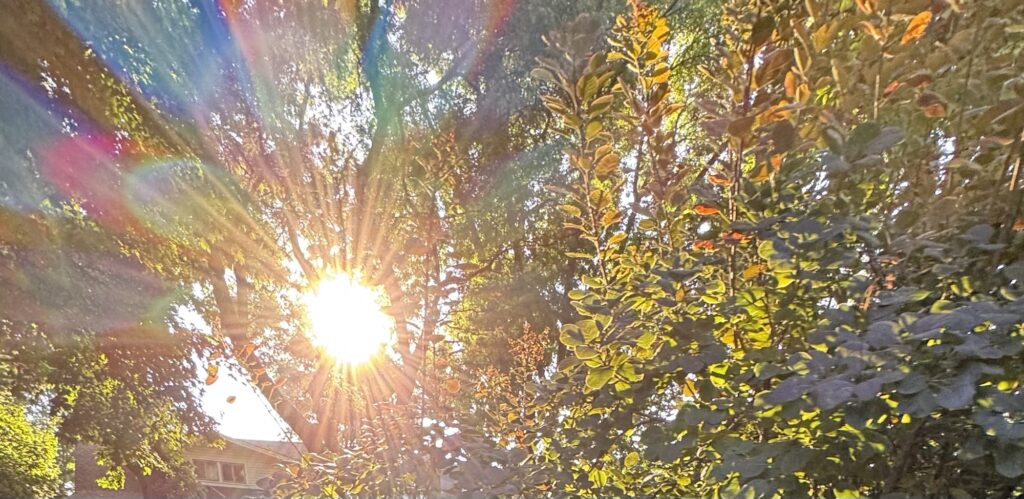
A sundog from my neighborhood, through trees, with identifying information cropped. I hope.

Less than three weeks later, masked federal agents abducted the first of their confirmed victims from the streets of Rogers Park. My mother was here visiting us. Some of my neighbors who were disappeared by the secret police were leaving the same church she attended. Some of them were trying to take their children to or from the nearby elementary school.

There has been excellent journalism showing that the kinds of people targeted in this way lacked arrest records, and had their documents, and were crucial parts of their communities. The fucking George W. Bush Center published an article this very year about how immigration benefits us all, but the truth is that people were targeted for their appearance, not their immigration status. And also: even if every one of the disappeared were an undocumented and solitary migrant with a history of arrests who took more from public resources than they returned, they would still be my neighbors. Evil committed against them is evil done to me and mine.

We wear plastic whistles when we go for walks these days. We got them from the bright warm queer coffee shop, or the physical therapist’s office, or the corner store, or the rally, or the evening crammed together in a restaurant. When we look across the street and see matching bright nylon strings looped around each other’s necks, we smile and nod, and it means much more than politeness. The smiles are tight, but they are sincere. Some say the moment of most acute terror here may have passed with the first touch of winter, at least for those of us not already detained or separated. I remain wary with pain in my heart. I have neighbors in Asheville, and Charlotte, and Baltimore, and Portland too.
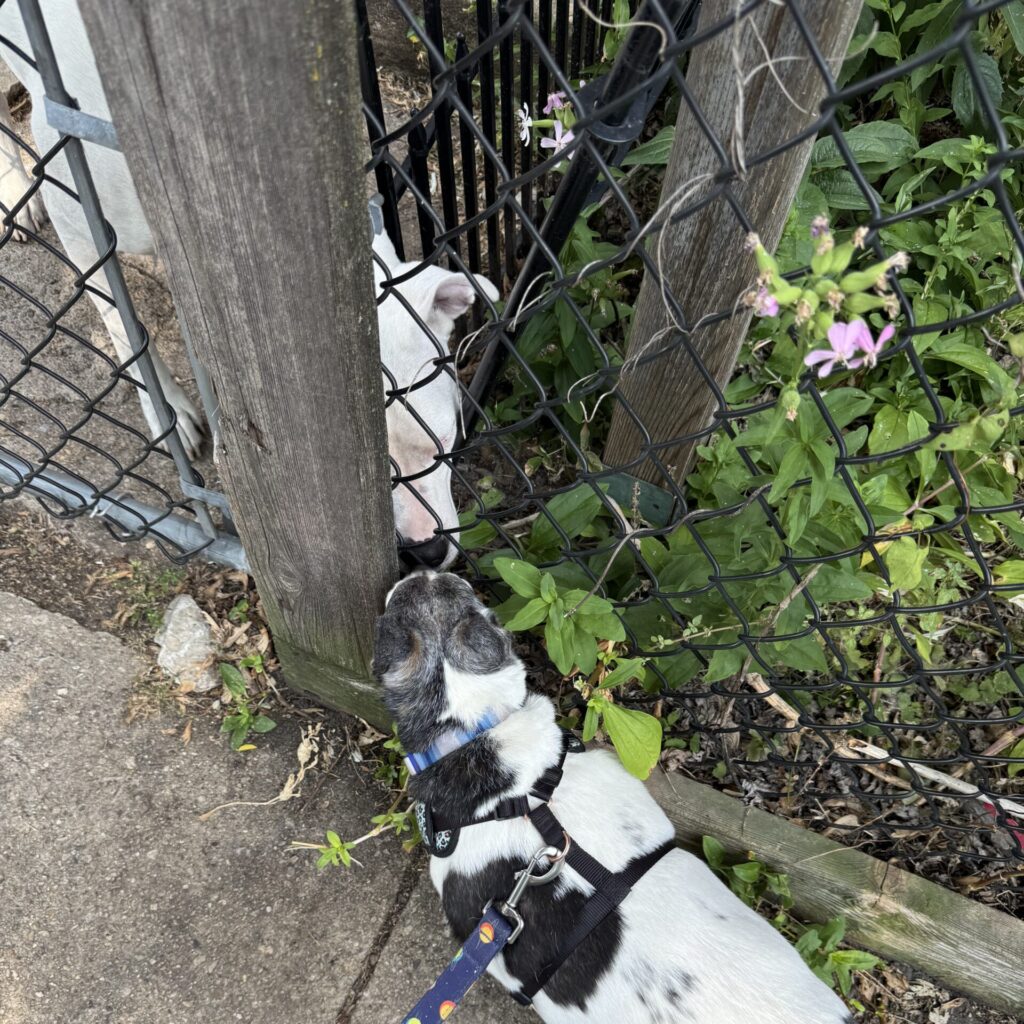
My dog and another dog touching noses through a chain-link fence

I moved a lot, when I lived in Portland: seven times in eleven years. I had the great fortune of many friends, but I didn’t get to know many of my neighbors. I often wanted to connect with them, but I was lacking in tools or time to do so, and then before long I’d be on to a different part of town. Now I live in the house I hope to keep until I can no longer climb its steps. I want the same roots the trees that line our street have grown. Yesterday I took care of an anxious dog from next door while his people were away, and when they came home they gave us a tub of beans and rice that I’m thinking of with hunger right now.

I lived decades with the terrible privilege of innocence to the way life proceeds under military enforcement. But proceed it does, for most of us. We trade favors and drink coffee. We hug each other tight at parties. We do the laundry and we watch the crosswalks. We keep our eyes up and our ears open. And when we hear the danger coming, we run toward it, not away.
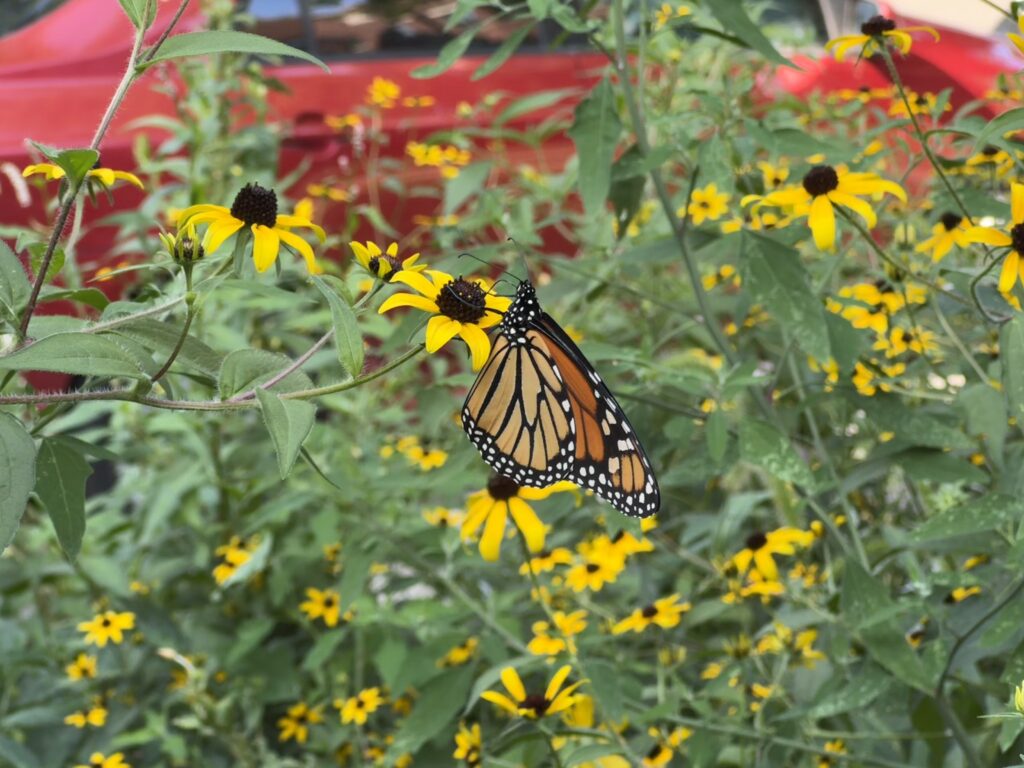
A monarch butterfly perched on a sunflower in our neighborhood

The long, deep myth of the city as center and source of violence is so strange to me. Neighborhoods, even those where heat leads to suffering among missing trees, are places where people cooperate. Cities are nothing if not neighborhoods cooperating with each other. All the many benefits they offer are born of the choice to get along and share. I grew up in suburbs, a kind of place structured by a desire to be apart from other people. I mean no unkindness to my suburban loved ones when I make this generalization. But suburbs were built because people wanted to move away; cities like Chicago, for all their flaws and failures, are places people move to. The choice of a city is the choice to be close to people you don’t yet know.

On the weekend before Mom came to visit our home, Kat and I took the city light rail line to Chicago’s train station, and thereby went to Minneapolis to visit friends we have dearly missed. On the train back home I read through all of Sophie’s beautiful new book Kin. If you click on only one link from this blog post, it should be that one. I wish I could just read it aloud to all my loved ones, even the parts where Kat and I are mentioned. The book is so moving, and by that I mean I felt it move me to action. The subtitle of Kin is “the future of family.” It is a future I believe in, and one I am trying in my small way to make our present too.

When Mom saw an article about how her fellow parishioners here had been abducted, she sent the link to our relatives, and she wrote: “We took Communion together. They are my family.” It made my chest ache, and it made me so grateful that my family of origin has a mother who sees things clearly.
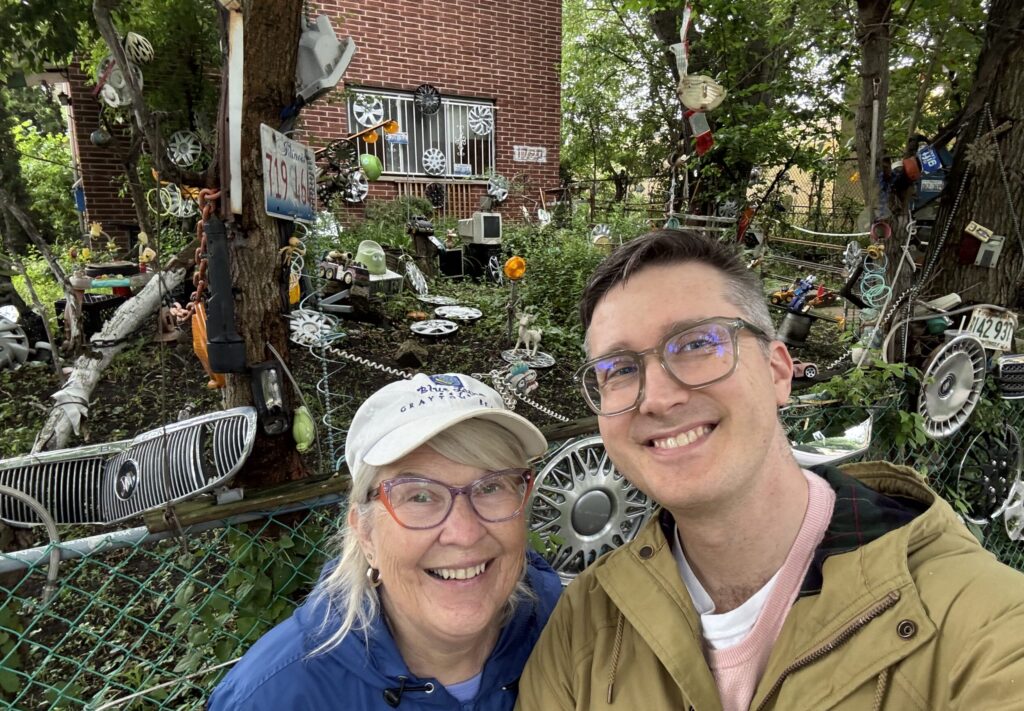
Mom and myself at a neighborhood landmark

I started writing this post because I wanted you, reading it, to take it as a sign to reach out to people where you live. It’s the only way to make strangers into neighbors and neighbors into friends. It is work I am still doing, and I have found it worth the effort many times over. I hope your neighbors don’t suck; I know some do. But even then there are more people in the next building down, and if you learn each other’s names, you can bring them cookies and trade numbers if you want to learn to like each other more.

We will only get through the worst together with those around us. Caring for each other is what makes us human, in a biological sense: prosocial behavior is the primary survival trait of our species. But it’s also the trait that brings us good dogs and pot luck and bounce houses on summer streets. I called them free bounce houses, but of course the reality is that everyone here pays for each other’s parties, just a little bit. I wish I could choose to pay for kids in bounce houses instead of in cages. I wish I could pay for my neighbors’ meals instead of tear gas. I wish that instead of paying people to set fire to our world, I could choose to keep the people around me warm.

It’s hard enough getting through a Chicago winter. It’s hard enough to feel one’s body aging, and to lose people by way of time and misfortune. It’s hard enough just doing the laundry and watching the crosswalks. It’s hard enough to care for the small and vulnerable in a family while budgeting time and money and effort to maintain oneself. It’s hard enough that work takes more and more from us, that trees and pets and people get sick, that the hours and the days slip from our grasp. It’s hard enough that things fall apart even with effort to keep them together.

Nobody needs cruelty and evil to make things harder on all of us, not even those who enact it. What we need is each other. We go on.
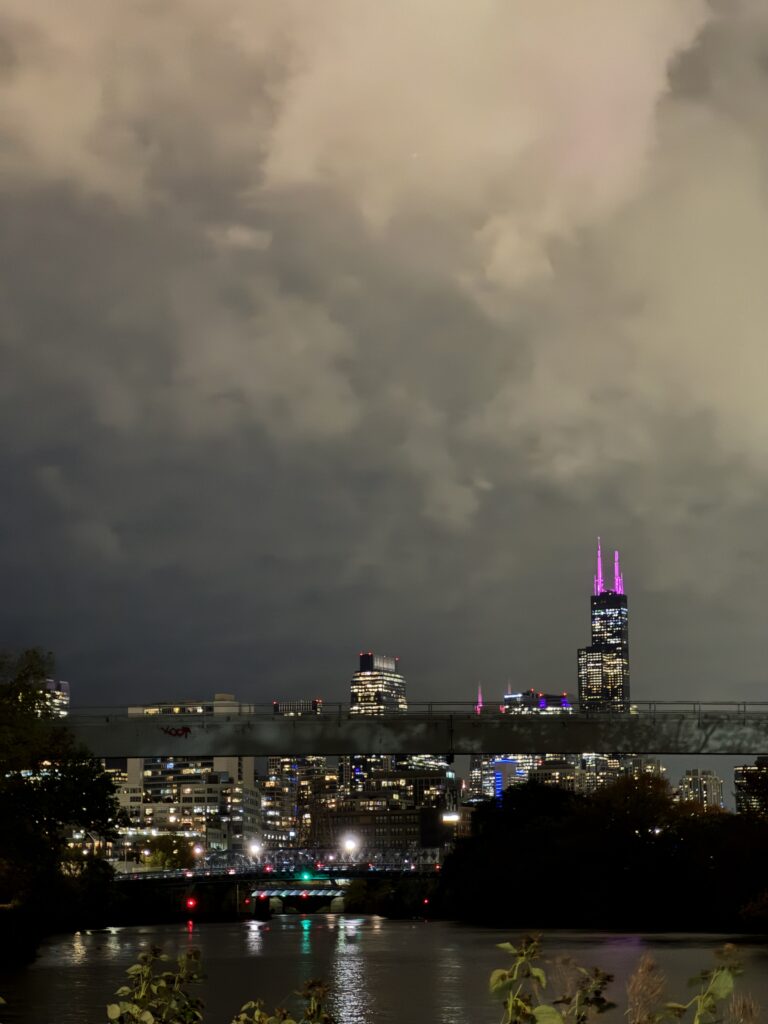
The Chicago skyline on a cloudy night, seen from the river

“I can’t help but wonder how rich our lives could be if we focused a little more on creating conditions that enable all humans to exercise their creativity as much as we would like robots to be able to.”

This is a content warning.

Last year I wrote about an Ars Technica article that appealed to technical experts for help perfecting every last possible system involved in emulating the Super Nintendo. I think it’s clear from that post that I felt a certain envy of the sense of purpose conveyed by its author, byuu, who also went by Near and by Dave. But I remember thinking, too, that their saying “I’m getting older, and I won’t be around forever” was a little surprising to read from someone deeply invested in a video game system from the 1990s. I’m getting older too, but not quite to the point of hurrying to put a capstone on my legacy yet.

Near was indeed not much older than me, but they meant what they said. This week, after years of organized and escalating cruelty directed at them and at their loved ones, they took their own life.

The purpose of a system is what it does. The purpose of the internet is in part to publish and distribute a unique and valuable life’s work. The purpose of the internet is also, in part, to torture people until they die. Sometimes it works.

Everybody I talked to in the course of reporting this story said some variation on “I hope Isabel is okay.” And she is. Sort of. In the months I’ve spent emailing Isabel Fall, she’s revealed herself to be witty and thoughtful and sardonic and wounded and angry and maybe a little paranoid. But who wouldn’t be all of those things? Yet I’m emailing with a ghost who exists only in this one email chain. The person who might have been Isabel has given up on actually building a life and career as Isabel Fall. And that is a kind of death.

Emily VanDerWerff, whose writing I have long enjoyed, has a piece of extraordinary nuance, precision and grace there. I’m grateful that Kat nudged me to read it. If you haven’t read it already, I would take it as a personal favor if you do.

Late last summer,

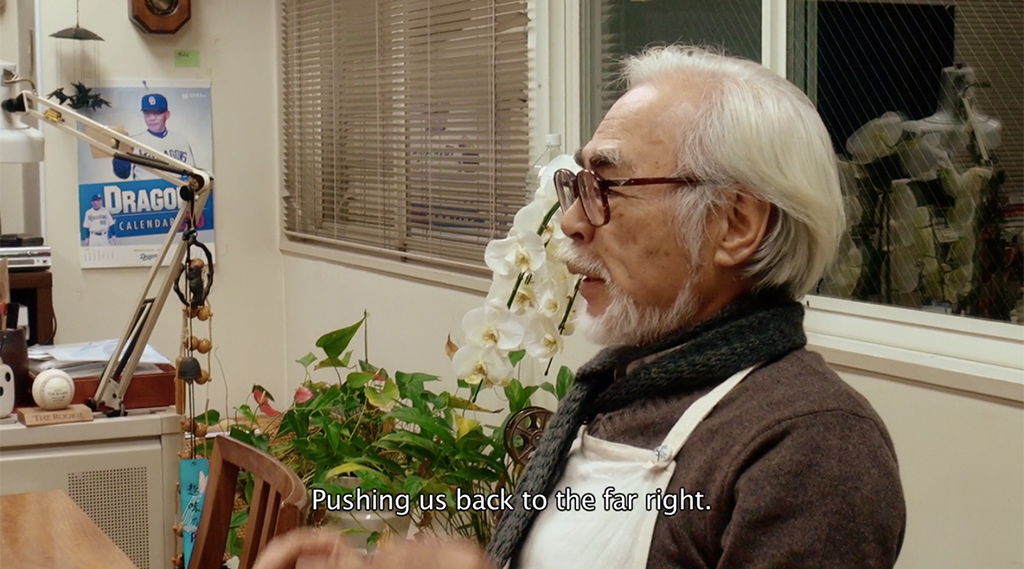
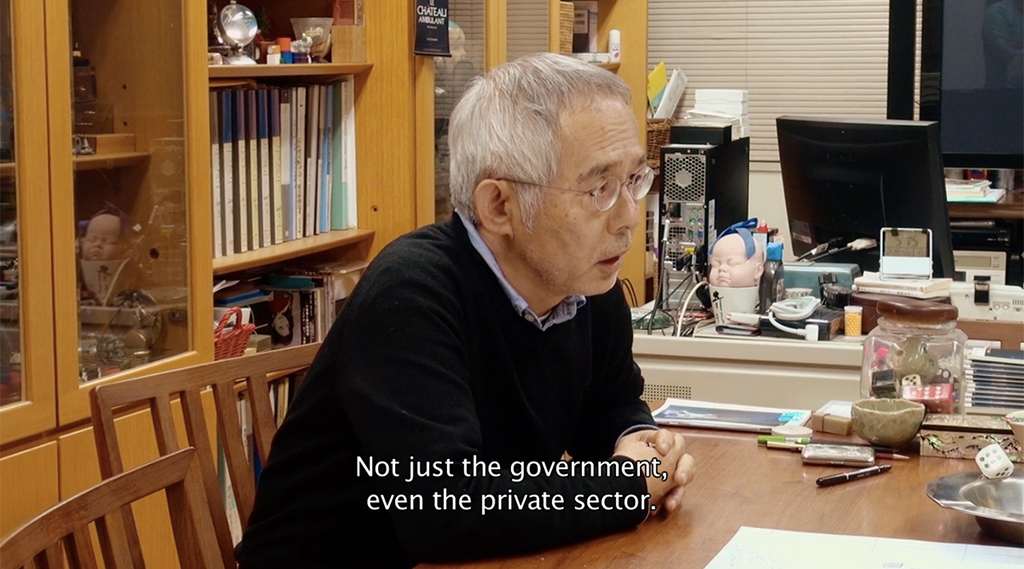
I watched Kingdom of Dreams and Madness, a documentary about Studio Ghibli. It was filmed there in 2012 and 2013 while Hayao Miyazaki made his final feature film, and it had an extraordinary impact on me.

"Not just the government, even the private sector."
"Pushing us back to the far right."
I haven’t stopped thinking about the documentary, or about that specific exchange, ever since. Tonight I finally watched the feature film itself.

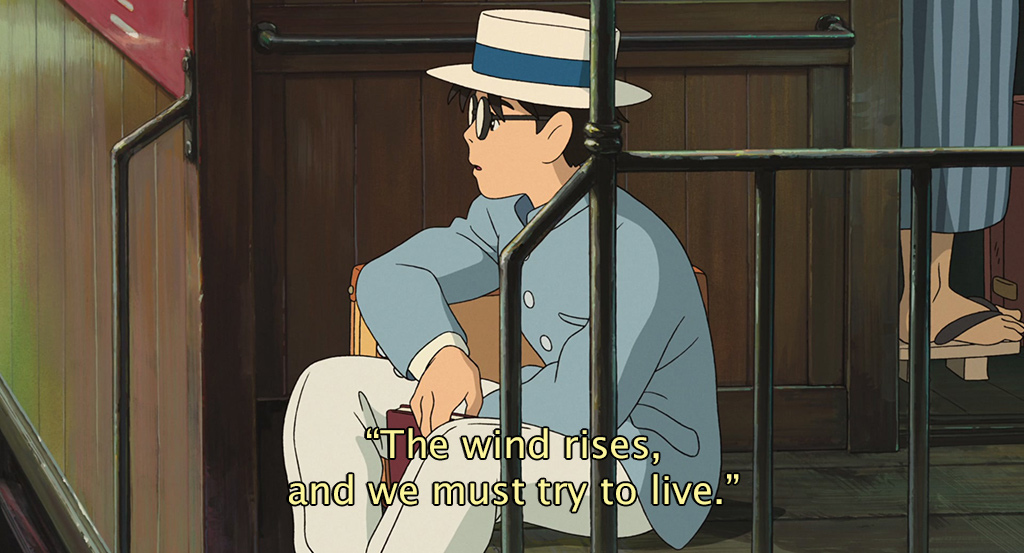
"The wind rises, and we must try to live."

By now all this is past the point of relevance

But it needs to get written down anyway. On Saturday morning, September 7th, I woke up feeling grumpy about the way nerds had treated my friend Elizabeth and made the following series of ill-advised tweets.

If you see the numbers under those widgets you can see that they became the most far-reaching things I have ever written. I did not plan for that. They were tossed off, poorly thought out, and not particularly intended to stand in the record. This took a while to dawn on me, and when it did, I considered deleting them. I chose not to mostly because it wouldn’t undo anything, and because I should be held to account for my words.

I failed as an ally and a writer in several ways by writing what I did. The most significant and glaring is that I didn’t ask Elizabeth before posting them. That’s enormous. She and I had talked privately about the abuse she was getting, so it was on my mind, and I am so used to violent misogyny being directed at women who point out flaws in popular culture that I failed to consider her public stance about it. But even if she had discussed the hate more openly, I still should have asked. At the very least I should have reconsidered using her twitter handle, which made it even easier for a new wave of garbage to find her.

Also, as several people have pointed out, those three tweets are not exactly an iron syllogism. Elizabeth wrote a strongly worded post taking a strong stance against PAX; all I did was briefly express disappointment. I still think someone with a feminine name and icon would have received more abuse than I did for that tweet, but I certainly am not doing the kind of work Elizabeth does, and should not have tried to accord myself her stature.

There are other things about my phrasing with which one might well take issue, but those two are the most basic and important: I didn’t show my friend the respect she deserves. I can’t undo that, but the least I can do is point out for other people who want to be allies where I went wrong. I hope this helps someone else avoid a similar mistake in the future, especially if that someone is me.

As for the original matter of the controversy, I’ve been wrestling with it, but the simplest way to put it is that I take a version of Elizabeth’s view. I’m not going to PAX in 2014, I’m definitely not volunteering there, and I won’t be back unless and until they demonstrate change from the top down. It won’t be enough for PAX to come up to the standard of games conventions; from here on they’ll have to be twice as good as everyone else to make me consider attending.

I have dear friends in and around the Penny Arcade organization, many of whom work tirelessly to create safe space, and I’m not going to spurn you or your work for being involved with PAX. But I will say that attending any conference without a clear, detailed, rigorously enforced harassment policy is a bad idea. PAX rose to that standard in 2012, but when internal pressure from the volunteer corps relented this year, they failed again. That alone is a valid reason to stay away.

Some people can’t do that. PAX is a big part of how money works in games, and if the choice is between taking a stance and making your rent this year, I don’t have the moral authority to stand in judgment. I hope you’ve got other avenues for promotion too, though. I won’t see you there.

Friendships With Women

Last September (oh dear) I said this on twitter:

The most rewarding and important thing you can do in this life is to seek out, cultivate, and invest yourself in friendships with women.

I phrased that as a prescription, because I wanted to see how people would take to it, and also I’m kind of a dick. It was actually a description that felt intuitively true. I tried to explain myself a few times, and failed, and then let it go quiet, but I haven’t stopped thinking about it. I still stand by my statement; here is the best I can do to unpack it.

The structural integrity of the system in which I live depends on men reducing women to their perceived sexual value and women being set against each other to diffuse their strength against inequity. This is awful.

If you are a man, the friendships you build with women will break parts of this structure, and put something new and better in their place. If you are a woman, I believe the friendships you build with other women will help restore the power that is yours by right and birth. If you occupy a place elsewhere in gender, I suspect you will find both of the above are true.

I am speaking from my lived experience, about the things I’ve seen through the women I know. Those are far from the only things friendship offers, and this isn’t really meant to be a generalization to the set of all people, not least because I have never been a woman. What I know about the power of female friendship is the way I grew up: watching my mother build a community of support and affection with the women in her church and school, who together accomplished remarkable things. I’ve tried to replicate that at every stage in my life.

Here’s the selfish part: the women I know are amazing, and have made my life amazing through their wit, kindness, generosity and patience. When I’ve invested in those friendships, they have yielded incredible and unexpected rewards in the real world, beyond the mere fact of my improvement as a person.

I owe myself to Monica Willett, Karie Miller, Leigh-Anna Donithan Roman, Maria Barnes, Amanda Brasfield, Lisa Brown, Emily Anderson, Leonor Linares, Sumana Harihareswara, Holly Gramazio, Erika Moen, Zoe Trope, Alison Hanold, Elizabeth Sampat, Anne Bradley, and more I know I am forgetting. Look for the women who will be to you what they have been and are to me. You cannot anticipate what your life will become.

Wrong on the Internet

A year ago I wrote about zero tolerance, intolerance and Antjuanece Brown, the Portland teenager who was thrown in jail and labeled a felon for texting with her girlfriend. Antjuanece is out now and things seem to be better for her and Jolene; I hope they are.

Not much has changed, though: the last week saw California and Washington come dramatically closer to marriage equality even as Oregon still lags behind. In the same week, Canadian Safety Minister Vic Toews announced that anyone opposing an Internet surveillance bill there was “siding with child pornographers.” Easy targets remain easy targets.

That’s why there’s so much value in the work my friend Ben is doing at his blog Wrong on the Internet, and particularly in his latest entry:

“This is hard to deal with. I want to have the luxury of dehumanizing pedophiles and other rapists. I would like to pretend that I would never be like that, never do something like that. But I can’t. That informs a lot of my writing here.”

It’s difficult to read, a fact that has nothing to do with Ben’s considerable writing skill. At a certain point the mind flops down and demands that some things must be absolute, that you must be able to point at some set of Others and declare those are the bad guys. We’re wired for that behavior, deep in our instincts. The cognitive battle to remember the contrary is exhausting, and it never ends.

I’m not arguing for total moral relativity here: I’m arguing for vigilance, because the kind of dehumanization in which we regularly engage is a dangerous exploit for our brains. It’s one thing to say that some people do evil. But to strip the humanity from evildoers is to remove the horrible weight and substance of their acts. What if you were a survivor? What choices would you make if your survival had damaged you? “The answers are out there,” the man said, “but they will not improve your self-esteem.”