Chapter 10 of Constellation Games is up. It features Curic informing Ariel that the alien whiteboard is for leaving messages to your other self, and then Ariel experiencing–and acting on–sudden sympathy for a phone app. Everything I said in my last CG post goes for it, but double.
Month: January 2012
Arizonans

I stole this juxtaposition from Racialicious.
Tennis for Two
This is a post about Constellation Games! If you don’t remember what Constellation Games is, it’s a very good book and you can read the first two chapters for free on that page. If you do remember but have not already subscribed to the book, you are wrong, and you should correct this situation immediately. Everyone else can keep reading.
Let’s talk about Gatekeeper.
One of the ways to slice up Constellation Games is as a book about partnership: Bai and his software girlfriend Dana, Agent Krakowski and Junior Agent Fowler, girl-Curic and boy-Curic, and Ariel + Jenny = Crispy Duck Games, among others. I don’t think it’s much of a spoiler to say that some of these pairings are less than functional—Fowler and Krakowski are arguing before they even get out of earshot in their first appearance, and Dana exists mostly as a strange loop in Bai’s head. When you observe the universe, to make sense of it, you need an origin from which to project your coordinates. Partnership is one way to set an origin. The obvious hitch is that when you do so, you’ve oriented yourself to an unfixed point.
You really should go back and click through to the link I posted in the last paragraph. Leonard’s mentioned that his reading on consciousness contributed to Constellation Games, and one of the most entertaining problems that comes up in the book is when people’s concepts of their partners—their internalized, emulated strange loops—fail to match that person’s actual behavior. Another is characters trying to apply their relationship to their own partner to someone else’s partner. You can see this disconnect at work when Ariel tries to wrangle everyone at his cookout into playing an impossibly foreign single-player video game, and ends up with what he considers a failure, even though everyone else has a great time. You can also see how seductive the projection is, though, in Ariel’s instant-message relationship with Curic. He treats Curic like he treats Jenny and Bai, sarcastically and demandingly, and they seem to hit it off right away. But if (as Leonard says) Curic’s account of her visit differs notably from Ariel’s, her interpretation of their chats must too. She doesn’t even realize he’s cursing when he says “fuck” all the time.
So: Gatekeeper. In Pong, a human game, two players manipulate reflective surfaces to keep a sphere moving back and forth. In Gatekeeper, the first Constellation Game Ariel plays, one player manipulates one reflective surface to keep certain spheres from crossing a forbidden line. The game loops forever until the player fails, and they will fail: you can’t keep a determined entity from crossing your arbitrary border (note that this book takes place in Texas), and you certainly can’t do it alone. Sometimes the partnership you earned will fail you. So what’s your recourse?
Curic: When one half of a person dies, the other half wants a refund. Otherwise the entire person will die in a few hours.
ABlum: who gives out the refunds?
Curic: There are no refunds. That’s the point of the game.
I had to finally write this up before the book got too much further because soon we’ll meet a new pair of characters who, quoth Leonard, “show up and run off with the whole damn book.” Look forward to that. Meanwhile, I don’t want to sound like I think all relationships are doomed or something, so consider that at the aforementioned cookout, Martin and Bizarro Kate “finally hook up” and drive off into the sunset. If there is hope for fratboys and catgirls, there is hope for you and me.
I knew I forgot something
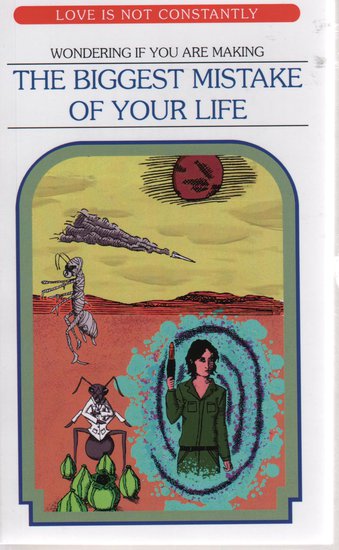
This is the other book I read in 2011 that pierced me like a lancet: Love Is Not Constantly Wondering If You Are Making The Biggest Mistake Of Your Life. It took me a couple months to get to the point where I could write about it, and I am still well aware that I am not doing so from an objective platform.
I noticed it on a shelf at my friend Harry’s house when I went over, a couple days after the breakup, still a bit reely. “Oh,” he said, “yeah. Yeah. You should borrow that.” I later learned he’d only received it from our mutual friend Jackson a few days before; this makes sense, as Jackson is part magical creature. I did borrow it, took it “home” to the couch at Matt and Erika’s, and read it again and again.
It’s structured and formatted like a Choose Your Own Adventure book, down to the ink-sketch art style and fonts. The conceit is this: the page numbers are ordered chronologically, so if you read it according to the instructions, you’ll skip back and forth in time. Sometimes you’ll get into loops. Sometimes, unexpectedly, you’ll reach the end. This gives you the sensation of making choices, but of course the story never changes. You are as wrapped up in the illusion of choice as the protagonist. None of your decisions make any difference in the final outcome, and neither do his.
It’s the best marriage of form and fiction in any book I think I’ve read, and I am a known weakling for narrative tricks with time, but of course that’s not what really got to me. The book is about the beginning and slow end of a relationship between a nerdy guy who doesn’t drink and his beautiful girlfriend who does. The second half even takes place in Portland. Reading it was personal and cathartic, though I don’t mean to say that our stories are parallel: his lasts eight years, for one thing; for another, Anne in the book is an alcoholic and Kara is not. But that’s how catharsis works, right? You read the bigger story to move through the pain of your own small one.
I haven’t talked much about breaking up with Kara here, a trend that will continue, but I suppose this is an opportunity to mark it in the record. It was a sad and probably good thing, and it took too long, the problem being that we were happy together until the end. You can see it in the pictures I posted from our trip to Ireland, just a month before I moved out. It was a good trip. I have few regrets.
For a somewhat more distanced (but still very positive) review of LINCWIYAMTBMOYL, see Alison Hallett at the Mercury.
My favorite book of 2011 was Constellation Games, which I am going to start writing about tomorrow, but I got more reading done this year than I have in a while and I’m glad. Much of it was crammed into fall and winter, during my Ireland trip and after my breakup, when I suddenly had a lot more time on my hands. I’m speaking specifically of Lois McMaster Bujold, whose work I’d never read before mid-September; I finished the fifteenth of her fifteen Miles Vorkosigan books at 9:00 on New Year’s Eve, because I really did get that obsessed. There’s plenty written about Bujold, you don’t need me to tell you she’s good, but: she’s good.
I already talked about Tinker Tailor. Listening to Tina Fey read Bossypants to me was a delight, and I finally backed up my assertion that I love Martin McDonagh by reading some more Martin McDonagh. Comicswise, I got on the Atomic Robo train, I snuck through Matthew G’s copy of Hark, A Vagrant because nobody can keep it in stock, and everybody is right about Anya’s Ghost.
I’ll read more in 2012. Goals: more le Carré, get back into Atwood, back up my assertions about Tiptree by reading more Tiptree, and finish at least three books I own but haven’t read (starting with Mindy Kaling, Jedediah Berry, and Iain M. Banks).