I want to kill you.
Month: January 2008
Okay, I thought I read once about an interactive fiction game that begins with a single paragraph of description, which just repeats over and over–but gradually expands and changes as you take actions. It’s a fascinating idea, but I never got around to downloading it, and now I can’t find the right google-juju to summon it again. Anyone else heard of this?
Update 1357 hrs: Kevan to the rescue, with Andrew Plotkin’s The Space Under the Window and Aisle. bloody_peasants also suggests Shade and the One Room Game Competition.
Because obviously I’ve never ripped them off
I did that gag THREE YEARS AGO, THE ONION.
Brendan painstakingly imitates a Photoshop filter, third in a series
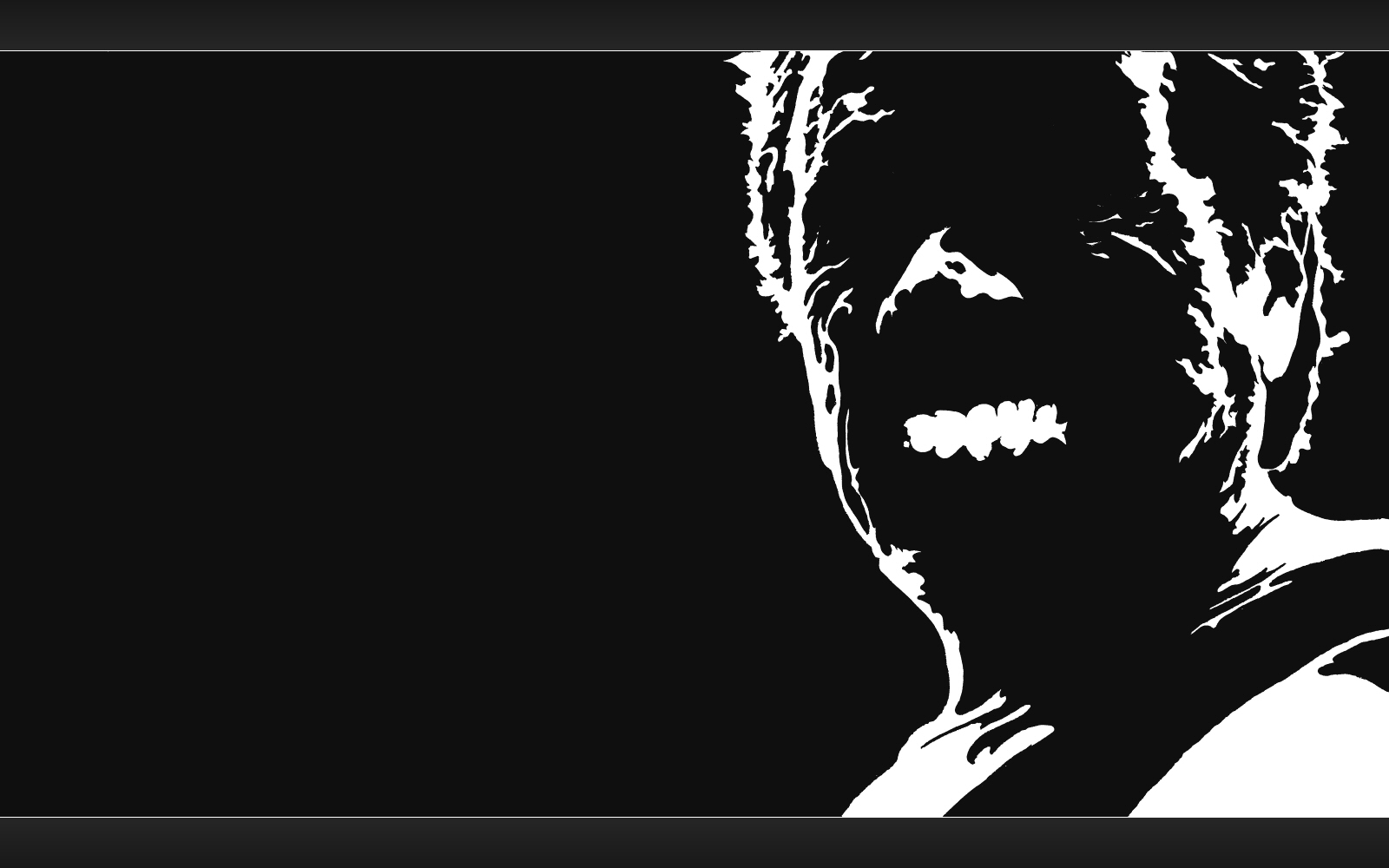
I will probably never love another episode of television as much as I love Battlestar Galactica, season 3, episode 9, “Unfinished Business.” And not just because it has images like this:
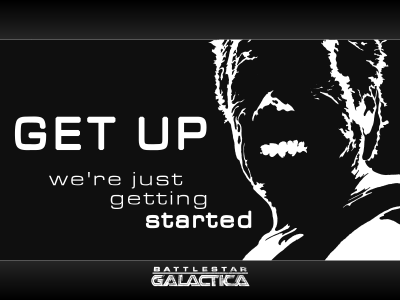
I’ve spent at least the last year and a half (actually, more like seven years, since my undergrad Drawing I class) being obsessed with this limited-tone art style. I called it “rotoscoping” once, and Lisa and Will jumped on me because there’s no animation involved, so I have to admit that it’s actually what people call “tracing.” But selective tracing.
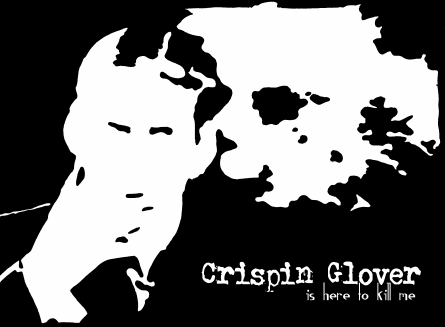
As was likely very obvious to anyone in my family, and as I only realized yesterday, my playing around with tone is blatantly derived from my uncle John’s painting and wood engraving work, especially his portraits of my grandfather (which he often combines with layered collage). Mr. Olmos there has some features similar to his, like the disappearing eyes which Ian and I inherited. I hope I get to look that craggy eventually. Right now people are still asking me what my major is, despite the obvious gray in my hair.
I almost forgot to mention that this is the first thing I’ve ever inked with the brushes I bought in 2003, and although it was a lot slower than my usual pens, I completely get why cartoonists get so excited about it now. There’s a feeling of dynamic control over the line weight that you just can’t get with pens, even the brush pen with which I inked a lot of later Xorph strips. (Not that there are actually any distinct lines in the finished images below. Good.)
So I made a picture and it’s a wallpaper if you want it: the images below link to 1600×1200 and 1600×1000 (widescreen) jpegs. There’s also a browser-sized version if you just want to zoom in a bit.
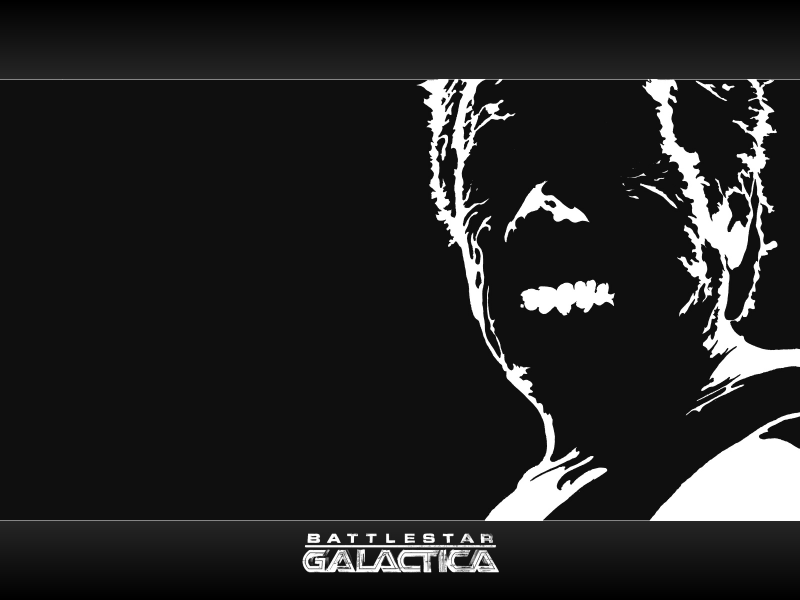
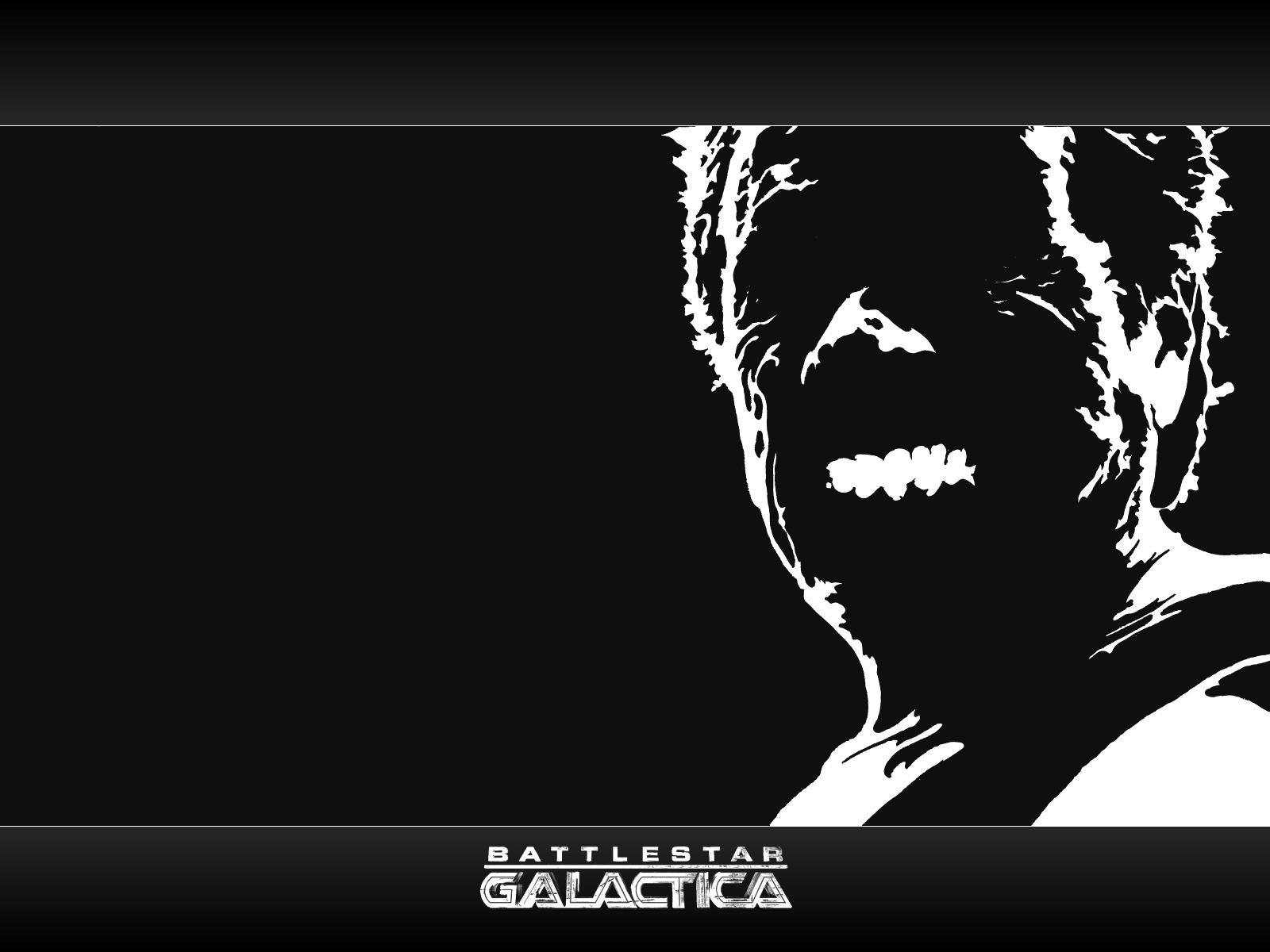
PS Can Battlestar Galactica be back on now plz
Update 2008.01.26 0001 hrs: Naturally, UJ has a much more cogent post on the subject (the art, not Battlestar), along with one of the portraits I was talking about.
You are hereby ordered to waste your afternoon
Everybody should be reading Starslip Crisis, and if you’re not, you need to start. With the Spine of the Cosmos. Once you’re done with that–if you just want to get the stuff that majorly advances the plot–you can read about the Ars Ad Astra gala, the Starslip Catastrophe, the Battle of Cirbozoid, the subsequent Glorysong, the Shark Time Jump, the Battle of Terra and… well, just read everything from that onward, it’s pretty recent. Then get kind of put out that you have to wait until tomorrow for the next one. Then go back to the beginning and read all the other stuff in between, because you’ll see the way all the story arcs tag into each other in startling and funny ways.
I’m not sure if I’ll ever love Starslip like I loved Checkerboard Nightmare, but come on, it’s still in the top five comic strips ever made. Reading back through to do this roundup, I noticed that some of the random-seeming asides are actually jokes that have just taken years to pay off. That’s Arrested Development-level, man.
Bing bong bing
I downloaded LCD Soundsystem’s 45:33 because it’s the first album I’d heard of that was specifically designed to be run to. Unfortunately it’s way too slow for that, but it’s still pretty good music. I had been rating everything on it three or four stars on iTunes, and suddenly–halfway through a song I’d already rated–I found my mouse hovering over the five-star button. Because somebody had started playing chimes.
This is a serious problem and I don’t know what to do about it. As soon as a song incorporates chimes, handbells or tone bars of any kind–especially, as they are often used, in counterpoint–I will unconsciously decide that it is the greatest song ever and listen to it ten times in a row. I can’t help it!
I would say that this is a flaw in my musical taste, but it is widely agreed that my musical taste already consists largely of flaws. This is a crack in the very foundations of my aesthetic sensibilities. It is a metaflaw. Chimes are a sloppy exploit for the kernel of my brain.
Someone recommend a song that will ruin chimes for me forever. I want to change.
Pirateball
It’s time to canonize the rules of Pirateball. I would put this on Wikipedia but we all know how that would go.
Pirateball was developed by myself, Jon Brasfield, Darren Hudson and McKinley Moore. Fellow contributors and playtesters included Tim Downing and Will Johnston, and possibly other people I don’t remember; this was developed at Centre College between 2001 and 2003.
There are no pirates involved.
Pirateball is like baseball in aspect, and ideally is played on a baseball diamond, but is an individual sport. The minimum number of players is three, comprising a batter, a pitcher and a first baseman. If you have more players, you can put them in the outfield or have a catcher, but too many fielders makes the game pretty much impossible, so if you have six or more players you should just start a batting queue. After each at-bat, players rotate through positions (with a minimal crew, it goes batter to first baseman to pitcher to batter and so on).
You will need two wiffle bats, a wiffle ball and a beach ball or one of those big latex balls you get at K-Mart. If you don’t have a second wiffle bat you can just use an umbrella or something.
Here is how an at-bat works:
- The pitcher throws the ball in the batter’s general direction. Don’t be a dick about this.
- The batter swings at the ball. There aren’t any balls, only strikes, so you might as well swing. Foul balls count as strikes.
- You get four tries to at hitting the ball to get it into play. It says something about our collective athletic ability that we had to allow four strikes with a wiffle ball.
- If you miss all four, the pitcher throws a fifth pitch, using the beach ball.
- If you miss the beach ball, not only are you out, you lose a point and don’t get to have sex for five years.
- I’m really glad it’s 2008.
- Once you hit the ball, you run to first base, HOLDING ONTO YOUR BAT. If you drop it out of habit you’ll have to go back for it.
- You will need your bat because when you get to first base you will have to fight the baseman, who has the second bat. Luckily for you, the rules specify that he is “kind of a wuss” at this.
- Having touched first base, you head directly to third, over the pitcher’s mound (literally over: you have to jump), and then head for home.
- The pitcher and fielders, if any, are spending this time getting the ball and trying to get you out with it. Catching the ball does not count as an out, nor does tagging: you have to be hit by a thrown ball. If one player throws and misses, a different player has to take the next throw. This is why the game gets a lot harder with more players.
- If you reach home untagged, you score a point for yourself, and you can be pretty proud of it because almost nobody ever scores.
The game continues to cycle through batters until it is dark and everybody is tired. The winner is the player with the most points, or, more specifically, not me.
You’ll note that I have used masculine forms in the description above, but of course pirateball is a coed sport. If you’re in the Winston-Salem or Triad areas of NC and would like to experience the majesty of pirateball, let us know! You will have to provide the diamond or equivalent playing field. You will also have to provide the balls, bats or batlike self-defense weapon.
We will be glad to provide the sexy.
Lawrence
He stumbles out of the house and falls to his knees, wiping his hands over and over on his bloody jeans. Smoke’s pouring out of the basement. It smells of hickory, myrrh and scorched wiring.
“Jesus, Lawrence,” says Marti, hollow around the eyes. “Tell me what happened, give me some reason I don’t have to arrest you…”
“You don’t understand!” says Lawrence. “The spell went all wrong–those aren’t them in there. Those aren’t my girls!”
“Not anymore,” says Marti sadly, and pulls out his cuffs.
From the house across the street, the doppelgang watches, hair in pigtails, eyes like wounds.
Yesterday a man was arrested for murdering his stepdaughters in some kind of ritual. It’s a horrible story. It also sounds way too much like a Clive Barker ripoff novel.
The Cryptid Epiphany
I know this is the kind of thing you’re supposed to smugly bury, when you’re writing, but I have this obsession with transparency? So here’s an example of how sometimes the world just drops stuff into your lap.
Almost a year ago I started writing stories about Proserpina, another name for Persephone, probably most well-known for the thing with Hades. In the very first one I threw in a remark about “her faded black tattoos.”
Later I decided to add an Australian of European descent, and only later did it occur to me that I’d set up her semi-suitor as an older man from “down there.” Right?
Then last week I decided to bring the tattoo thing back in, so I had to come up with a rationale for it. Poking around on Wikipedia led me to tā moko, traditional Maori tattooing; apparently New Zealand was becoming more economically entwined with Australia toward the end of the 19th century, so that’s a reasonable connection. Then I looked up the origin story of tā moko.
It’s about a man who descends into the underworld to find the wife he drove away. Persephone inverted.
I have traditionally viewed with skepticism the English-lit platform of divorcing the author from the work, but man, I could not have done this on purpose. The title of this entry comes from a discussion I had with Leonard a while back about his writing process; apparently this kind of thing happens to him all the damn time. I understood the sensation of epiphanic writing when he described it, but I couldn’t find any examples to hold up from my own corpus. This is about as close as I’ve come.
Mild ethical issues here: there’s a growing concern among Maori that moko is being appropriated by whites who have neither full grasp of nor entitlement to the art form, and, well, I’m kind of doing that. My defense is that I do plan to set it up with an explicit Maori connection, somehow, and to respect the source. I’m not sure whether recontextualization of a minority culture’s mythology is inherently evil or not, but I do think it’s inevitable. Origin stories are virulently memetic because they’re supposed to be. Eventually I’ll have to do a theme-post about how often I rip off and mash up mythology I don’t really understand.